A private Uffizi visit works particularly well for families when the guide concentrates on a handful of paintings, uses stories and visual games, and allows time for questions and breaks. Most families should aim for 90 minutes to two hours rather than an exhaustive museum tour. For a Uffizi tour with kids, the important booking decisions are the guide’s experience with your children’s ages, the actual time spent inside the galleries, and who arranges the entrance tickets. Children under 18 receive free museum admission, although private guiding remains a separate cost.
What Makes a Private Uffizi Tour Suitable for Children?
The Uffizi Gallery contains some of Florence’s most important Renaissance paintings, including works by Botticelli, Leonardo da Vinci, Michelangelo and Raphael. The collection is enormous, and the normal museum route involves considerable walking and standing. A conventional adult tour can become tiring for children long before the guide reaches the most interesting paintings.
A family-focused guide should select a manageable number of works and make them understandable without lengthy explanations. Botticelli’s Birth of Venus can become a conversation about Greek mythology. His Primavera offers opportunities to identify flowers, animals and figures. Michelangelo’s Doni Tondo can introduce the idea of how artists represent movement and family relationships.
Different guides approach this in different ways:
- Storytelling tours: Use mythology, historical characters and short narratives to explain the paintings. These often suit younger children who enjoy listening and asking questions.
- Art detective tours: Encourage children to find symbols, identify expressions, compare paintings or complete simple challenges. They work particularly well for primary-school children.
- Interactive art-history tours: Discuss techniques, Renaissance Florence and artists’ rivalries while encouraging conversation. These can suit teenagers and children already interested in art.
Ask what the guide actually does with children. A description such as “family-friendly” does not necessarily mean there will be games, activities or age-appropriate explanations. Some tours are ordinary highlights visits where children are simply welcome to attend.
It is also useful to mention subjects your children might find frightening. Certain paintings feature violence, religious suffering or unsettling mythological scenes. A private guide can usually adjust the selection, although popular rooms may still be busy and some displays may be temporarily unavailable.
Choosing the Right Tour Length for Your Children’s Ages
The advertised duration is one of the most useful clues about whether a tour will work for your family. Private Uffizi tours commonly last around two hours, with some extending to two and a half hours. A shorter customized visit may be more appropriate for younger children.
- Under 6: Consider a selective visit of approximately 60 to 90 minutes, particularly if the child is using a stroller. A private guide may still be unnecessary at this age unless older family members also want the experience.
- Ages 6 to 10: Around 90 minutes is a sensible starting point. A two-hour visit can work when the guide uses activities and allows breaks.
- Ages 11 to 14: Approximately two hours often provides enough time to introduce the major works without rushing.
- Teenagers: Two to two and a half hours may suit those with a genuine interest in history or art, provided the itinerary encourages discussion.
These are planning suggestions rather than museum age restrictions. Ask whether a shorter visit is possible and whether the guide can change the itinerary if your children lose interest.
Clarify what the advertised duration includes. A two-hour experience might begin when you meet outside the museum, meaning security checks, ticket arrangements and cloakroom stops use part of that time. Another provider may count two hours from the moment the guided museum visit begins.
For families, the distinction matters. Ask for the expected time inside the galleries and allow additional time before and after the tour.
When Should You Schedule the Visit?
The Uffizi’s currently published regular opening hours are Tuesday to Sunday, 8:15 a.m. to 6:30 p.m. The museum normally closes on Mondays, January 1 and December 25, although special openings can occur. Confirm the timetable through the official Uffizi visitor page, particularly for 2027 visits.
Morning tours are often practical for families with younger children. They can visit while everyone is relatively fresh, then have lunch afterward. An early entry also leaves the afternoon available for activities that involve less concentration.
Late-morning visits can suit families arriving by train or those who prefer a relaxed breakfast. However, entering shortly before lunch can become uncomfortable if children are hungry or the tour runs longer than expected.
Afternoon tours may work better with teenagers or children who are slow to get moving in the morning. Allow enough time before closing and avoid scheduling the museum immediately after another demanding activity.
Early and late entry times can sometimes help with crowd management, but a particular time slot does not guarantee quiet galleries. Popular paintings attract visitors throughout the day.
For a relaxed family schedule, leave approximately 15 to 30 minutes between the meeting time and any activity immediately afterward. Avoid arranging a train departure or another timed museum reservation too close to the expected finish.
Uffizi Tickets for Children: Free Entry Does Not Mean No Reservation
The official rules grant free admission to visitors under 18, regardless of nationality. Proof of age is required, so bring a passport or suitable identity document for each child. Children younger than 12 must be accompanied by an adult.
This free-entry entitlement is separate from the cost of a professional guide, any booking administration and other services included in a private tour.
Current Official Ticket Prices
As of November 2026, the Uffizi’s published standard admission prices are:
- Adults: €25 for a regular ticket purchased on the day of admission.
- Advance adult admission: €29 for a regular ticket purchased before the visit date.
- Children under 18: Free admission with proof of eligibility.
- Eligible young adults: €2 for qualifying visitors aged 18 to 25 under the museum’s nationality and identification rules.
Check the latest official Uffizi ticket prices before paying. These are the latest confirmed published fares, not guaranteed prices for 2027.
The museum’s official ticketing platform is tickets.uffizi.it. If you are arranging your own admission, use this platform rather than assuming that the first ticket seller appearing in a search is the museum’s official service.
Who Should Arrange the Children’s Tickets?
Some private tour providers include entrance arrangements in the quoted price. Others charge only for guiding and expect families to secure admission independently.
Before making any payment, ask:
- Are adult museum tickets included in the quoted amount?
- Will the provider arrange the children’s free admission for the same entry time?
- Will every family member receive the appropriate ticket or admission entitlement?
- Are advance booking charges already included?
- Will the provider send the admission tickets directly or manage entry on arrival?
Since October 2025, Uffizi admission tickets have been personalized with visitor identification details. The museum warns that a mismatch between a ticket holder’s name and identification can result in refusal of admission without a refund.
Check names carefully before tickets are issued. A child being admitted free does not remove the need to follow the museum’s identification and admission procedures.
Does a Private Tour Include Skip-the-Line Entry?
Many tour descriptions advertise skip-the-line or priority entrance. Usually, this means that admission has been arranged in advance so the family can avoid purchasing tickets at the museum on arrival.
It does not guarantee immediate entry. Security controls, admission checks and other museum procedures still apply.
Ask whether the provider has already secured a timed entry slot or merely intends to purchase tickets after your booking.
There is also an important exception on free-admission days. The Uffizi normally participates in the first-Sunday-of-the-month free museum initiative. Standard advance reservations and priority entry are unavailable on those days, apart from specified exceptions. This makes free Sundays a less predictable choice for families who want a tightly scheduled private visit.
Private Guide Fees and Extra Charges to Check
Private guiding prices vary with the duration, the number of participants, the service offered and the provider’s booking terms. A family of four should therefore compare the total amount payable rather than looking only at the advertised price per person.
Check whether the quote covers:
- The professional guide’s fee for the entire family.
- Adult museum admission and advance booking charges.
- Arrangements for children’s free admission.
- Any activity sheets, games or other educational materials.
- Headsets, if required.
- Any additional guiding time or requested pickup service.
For larger families, group regulations can affect the cost. The Uffizi requires groups of more than six people, including their guide, to use a headphone system during explanations, subject to the museum’s stated exceptions. Groups of at least 11 people also face a currently published €70 group surcharge, unless an exemption applies. The maximum group size is 16 people, including guides and accompanying adults.
These are museum rules, rather than optional policies set by individual tour operators. You can check them in the official ticket purchasing and group information.
A family of two adults and two children ordinarily does not need group headsets. A multigenerational family with several children and grandparents might.
The cheapest advertised tour can become less attractive once ticket charges, headsets and other exclusions are added. A clear total price is more useful than a low starting rate.
Meeting Points, Entrances and Hotel Pickup
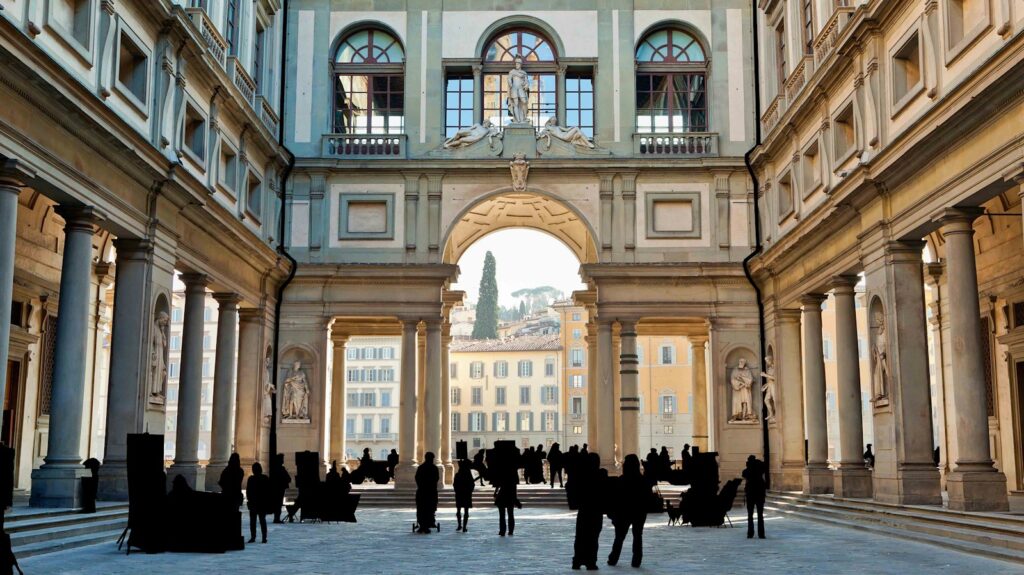
The Uffizi is in central Florence, in Piazzale degli Uffizi beside Piazza della Signoria. Most families staying in the historic center can reach it on foot.
Private guides do not all use the same meeting point. Depending on the provider, you might meet in Piazza della Signoria, somewhere in the Uffizi courtyard or at another clearly identified nearby landmark.
Check the exact meeting instructions rather than assuming that “Uffizi entrance” is sufficiently specific. The museum courtyard is long, and several doors and ticketing areas can be confusing for first-time visitors.
Ask the provider to confirm the meeting location, arrival time, guide identification and a working telephone or messaging contact.
Hotel pickup is not automatically included. Some private guides may offer to meet families at a centrally located hotel and walk to the museum together. Others begin their service at a fixed meeting point. A hotel meeting may consume part of the paid tour duration, so clarify that before agreeing.
The official museum entrance and ticketing arrangements are separate from a guide’s meeting place. Follow the instructions on your actual admission confirmation and any current directions from museum staff.
Strollers, Toilets, Snacks and Accessibility
Practical details can determine how comfortable a family tour feels, especially with toddlers or children who have mobility needs.
Strollers and Baby Carriers
Strollers and pushchairs are permitted inside the Uffizi Galleries. However, the museum states that they cannot be left in the cloakroom during the visit. You need to keep the stroller with you.
Front-worn baby carriers are permitted, while large baby backpacks are not allowed. If you are traveling with an infant, ask the guide to plan a route that accommodates the stroller and lift access where required.
Restrooms and Baby Facilities
The Uffizi provides toilets on different floors. There are also baby-changing facilities and a dedicated area for breastfeeding and infant care near the cafeteria.
Tell your guide if you want a planned toilet stop. With younger children, it is usually easier to arrange this before everyone becomes restless.
Food, Water and Snacks
Eating and drinking in the exhibition rooms is prohibited. The museum permits water containers of up to 500 ml and allows certain exceptions for medical requirements, baby food and children’s drinks.
Check the official food and drink rules before packing snacks. A large bottle, a bag of sandwiches or drinks intended for consumption during the tour may cause problems at entry.
For most families, the simpler arrangement is to have a proper snack before entering and plan lunch afterward. If a child has special dietary or medical requirements, inform the provider in advance.
Wheelchairs and Reduced Mobility
The museum has accessible routes, lifts and accessible toilets. The accessible entrance is reached from Via della Ninna, and wheelchairs and walkers may be available on loan, subject to availability.
If a child uses a wheelchair, has limited stamina or finds stairs difficult, explain this before the provider reserves tickets. Request an accessible route and sufficient time for lifts and rest stops.
The Uffizi has experienced changes to lift availability and gallery routes during building works. Check the museum’s official accessibility information rather than assuming that every route will be available on your visit date.
There is no need to provide detailed personal medical information in an initial booking enquiry. Explain the practical accommodations required, and discuss any supporting documentation privately with the provider or museum when necessary.
What to Send When Requesting a Private Family Tour
A useful first enquiry should give the guide enough information to design a realistic visit and quote accurately.
- Visit date and preferred time: Include one or two alternative time windows if you can.
- Number of adults and children: State each child’s age.
- Preferred language: Mention if your children are more comfortable listening in a particular language.
- Children’s interests: Mythology, animals, drawing, history, mysteries or famous paintings can all help shape the route.
- Preferred duration: State whether you want a short introduction or a fuller highlights visit.
- Accessibility: Mention strollers, wheelchairs, mobility limitations or sensory needs that affect the tour.
- Ticket status: Explain whether you already have admission tickets or need the provider to arrange them.
- Meeting preference: State whether you can meet at the museum or would like to ask about hotel pickup.
Once the guide responds, confirm that the visit is genuinely private and will not be combined with another family.
Ask whether the guide is professionally authorized to lead museum tours in Italy. The Uffizi permits professional guiding inside the museum only in accordance with the applicable legislation.
It is also reasonable to ask how frequently the guide works with children of similar ages. Experience with adult art-history groups does not automatically translate into engaging a seven-year-old.
Understanding the Booking Confirmation
The written confirmation should contain more than a payment receipt. Ideally, it will identify the date, the time you meet the guide, the reserved museum entry time, the meeting landmark, the number of participants and what is included in the price.
Check these details before the visit:
- The guide’s name or the process for identifying the guide.
- A local contact number for the day of the tour.
- Whether admission tickets have been issued and who holds them.
- Whether children’s free admission has been arranged correctly.
- The expected duration of guided commentary and when the service ends.
- Any payments still due and the accepted payment method.
- Cancellation, late-arrival and rescheduling terms.
For an explanation of the museum’s current entrance arrangements, see the Italy on Foot article on which Uffizi door to use. Older instructions telling every visitor to collect tickets at Door 3 may no longer match current ticketing arrangements.
Cancellation Policies and What Happens if Plans Change
Cancellation terms differ between tour providers. Some allow free cancellation until a specified deadline, while others require a deposit or apply stricter conditions once museum tickets have been purchased.
Check whether the guiding service and museum admission have separate refund rules. A provider may be willing to refund or reschedule the guiding portion while already-issued admission tickets remain subject to different restrictions.
Ask specifically what happens if a child becomes ill, your train is delayed, or the family cannot arrive for the agreed museum entry time.
Also establish what happens if the guide is unavailable. Does the provider offer another qualified guide, propose a different time or refund the guiding fee? If the alternative is not acceptable, will any unused museum admission be refunded?
A private guide cannot guarantee that every painting will be on display. Galleries may temporarily close for maintenance, security requirements or exhibition changes. A capable guide should have alternative works available and explain significant itinerary changes.
Rain is rarely a reason to cancel a museum tour because the visit takes place indoors. However, severe weather, transport disruption and strikes can affect access. If the museum itself closes unexpectedly, contact the provider promptly and ask for the options available under the booking conditions.
How to Fit the Uffizi Into a Family Day in Florence
The museum visit is easier when it is the main planned activity for that part of the day. Trying to combine a long Uffizi tour with several other timed attractions can leave children with little opportunity to eat, rest or enjoy the city.
For a family with younger children, a practical arrangement is an early museum visit, lunch nearby and a relaxed afternoon exploring Piazza della Signoria or walking toward the Arno.
If you want to visit the Accademia Gallery or another indoor attraction on the same day, leave a meaningful break between reservations. Both museums require attention and involve standing, so consider how much museum time your children genuinely enjoy.
You can organize your Italy itinerary around museum reservations, meals and the rest of your Florence plans without filling every available hour.
If your family wants to explore more paintings independently afterward, the Italy on Foot Uffizi Gallery visitor guide explains the main collections and practical visitor information.
Do You Actually Need a Private Guide?
A paid private guide is useful when children benefit from having someone turn paintings into stories, when family members have very different interests, or when you need an adaptable route with frequent breaks.
It can also be useful for parents who want to enjoy the art themselves without having to research every painting and keep children engaged at the same time.
However, a private guide is not necessary for every family.
The museum has its own Uffizi Kids initiative, which includes family-oriented activities and educational resources. Its dedicated family material includes themed approaches such as looking for flowers or fantastic creatures in paintings.
If your children enjoy independent discovery, consider planning a short self-guided visit around four or five artworks. Let each child choose a painting to investigate, give them a question to answer and avoid feeling obliged to see the entire museum.
This can be a sensible option for families on a limited budget or those unsure how long their children will tolerate an art gallery.
Families who already have a strong interest in Renaissance art may prefer a conventional private art-history guide. Older teenagers who want detailed explanations might find a heavily game-based children’s tour too simple.
The main consideration is the actual experience your family wants, rather than the presence of the word “kids” in the tour description.
Common Mistakes to Avoid Before Paying
- Booking an adult highlights tour for very young children: Check that the commentary and pace will actually be adapted.
- Paying for unnecessary children’s admission: Under-18s qualify for free museum entry, subject to the official identification and ticketing requirements.
- Buying separate tickets without coordinating the guide: The whole family needs compatible entry arrangements.
- Assuming priority entry means no waiting: Security checks and other museum procedures still apply.
- Choosing a long tour without breaks: Confirm that the itinerary can be shortened or adjusted if necessary.
- Arriving with unsuitable luggage: Bulky luggage and large backpacks can create entry problems. Leave travel bags at your accommodation or another suitable luggage facility.
- Assuming hotel pickup is included: Confirm the actual meeting location and whether walking time counts toward the tour.
- Ignoring ticket cancellation restrictions: Check the museum admission component separately from the guide’s fee.
Before finalizing the booking, ask the provider one last practical question: “If our children become tired after an hour, can you adapt the rest of the tour, and what happens to the agreed price?”
The answer reveals a great deal about how genuinely flexible the private service will be.
For most families, a well-paced visit of approximately 90 minutes to two hours, with a guide experienced in the children’s age group and correctly arranged admission, is a sensible starting point. Confirm the ticket names, meeting instructions, total cost and cancellation terms in writing, and keep the rest of the day flexible enough for the children to enjoy Florence after the museum.