Blue lines normally mean paid parking, white lines mean non-paid parking, and yellow lines mean the space is reserved for an authorized category. That is the national starting point, but the painted line never tells the whole story. Nearby signs can add payment hours, time limits, resident permits, temporary restrictions, or other conditions. The safest way to read parking colors in Italy is therefore simple: check the paint first, then read the vertical sign before leaving the car.
The basic Italian parking color rule
- Blue lines, strisce blu: paid parking.
- White lines, strisce bianche: parking that is not subject to a parking fee, although a time limit or other rule can still apply.
- Yellow lines, strisce gialle: reserved parking. You need the authorization indicated by the sign.
This color system comes from Italy’s road-sign regulations. The official terminology actually uses azzurro for paid bays, although almost everyone calls them strisce blu. The ACI guide for foreign drivers gives the same practical breakdown.
The important catch is that horizontal markings do not replace road signs. If a sign imposes a restriction, the fact that you can see a perfectly inviting painted rectangle on the ground does not make the space available to you.
Blue lines: you normally need to pay
A blue bay is the type most visitors will use on city streets. Look around for a parking meter, usually marked parcometro, and for a blue parking sign showing the charging hours and local rules.
You may see terms such as:
- Sosta a pagamento: paid parking.
- Tariffa: rate or fee.
- Orario: hours during which the rule applies.
- Feriali: non-holiday days. Saturday is normally included unless it is itself a public holiday.
- Festivi: Sundays and public holidays.
- Max 2 ore: maximum stay of two hours.
Do not assume blue parking is free because it is Sunday, lunchtime, nighttime, or August. Some municipalities charge only during certain hours; others have different schedules in tourist areas, near hospitals, around stadiums, or during events. The sign beside that particular group of spaces is what matters.
How payment works
Payment systems vary by city and parking operator. A meter may accept coins, cards, contactless payment, or direct you to an approved parking app. Some machines require you to enter the vehicle’s registration number, or targa.
If the machine prints a ticket, check whether the instructions tell you to display it behind the windscreen. Other systems record the payment against your number plate, so there may be nothing to display. Do not assume that the system works the same way as the last Italian city you parked in.
When paying through an app, compare the parking-zone number shown in the app with the code on the meter or street sign. Two adjacent streets can have different tariffs.
If your paid time expires
Changes to the Italian Road Code that took effect in December 2024 introduced a specific tolerance for motorists who have paid but stay slightly beyond the purchased time. An overrun of no more than 10% of the time paid does not trigger the administrative sanction; larger overruns are treated differently depending on their length. ACI explains the current system in its summary of the revised blue-line parking rules.
That small tolerance should not become your parking strategy. If you know you will be away longer, extend the session where the local system permits it.
White lines: free does not mean unrestricted
White bays are non-paid spaces under the national color system. You do not normally buy a parking ticket simply because the lines are white.
What catches visitors is the supplementary sign. A white space may have a time limit requiring a disco orario, the small parking disc used to show your arrival time. If the sign requires one, set the disc to your arrival time and leave it clearly visible inside the windscreen.
Common wording includes:
- Sosta gratuita: free parking.
- Disco orario: parking disc required.
- 1 ora: one-hour limit.
- Dalle 8 alle 20: from 8:00 to 20:00.
A free marked space also does not cancel the ordinary rules against parking somewhere dangerous or obstructive. A bay can become unusable because of temporary works or restrictions, and an unmarked stretch of curb is not automatically a free parking area just because there are no blue lines.
Yellow lines: check the permit before you park
Yellow bays are reserved. A rental car, foreign registration plate, hotel booking, or willingness to pay does not give you the right to use one.
The sign or road symbol tells you who the bay is reserved for. Depending on the municipality and location, yellow spaces can be assigned to people with disability permits, residents, authorized service vehicles, public bodies, taxis, or another defined category.
Do not use the color alone to decide what kind of reservation applies. In particular, do not assume every yellow space is a loading bay or that stopping for “just five minutes” is allowed. Loading and unloading areas have their own signs, often using the wording carico e scarico and specific operating hours.
If you cannot identify the permit required by a yellow bay, treat it as unavailable.
What about pink parking spaces?
You may also encounter stalli rosa. These are spaces intended for pregnant women and parents with children up to two years old who have the required special permit. Their introduction is provided for under the national Road Code, while municipalities handle the permits and local implementation.
A pink marking is therefore not simply another type of general family parking. Look for the dedicated symbol and permit requirements rather than assuming that anyone travelling with children can use the space.
The vertical sign is the part travelers miss
Before walking away from the car, find the nearest sign that applies to the row of spaces. Read it from top to bottom.
- Confirm that it is a parking sign, usually the blue square containing a white P.
- Check whether the space is paid, free, or reserved.
- Read the applicable days and hours.
- Look for a maximum stay or disco orario requirement.
- Check for permit wording such as residenti, autorizzati, or another reserved category.
- Look for temporary restrictions posted on poles, barriers, or portable signs.
Arrows beneath a sign can also show whether the rule begins, continues, or ends at that point. Do not automatically assume a sign facing the pavement applies equally to every space on both sides of it.
Temporary no-parking signs override your normal parking plan
Italian cities regularly suspend ordinary parking for street cleaning, markets, construction, festivals, removals, filming, or public events. A row of blue or white spaces can therefore become temporarily unavailable.
Watch for divieto di sosta, meaning no parking, and rimozione or rimozione forzata, indicating that vehicles may be removed. Temporary signs normally state the dates and hours of the restriction.
This matters especially if you leave a rental car parked overnight or for several days. Check the entire stretch of street rather than only the meter next to your vehicle. A temporary sign twenty metres away may govern the whole row.
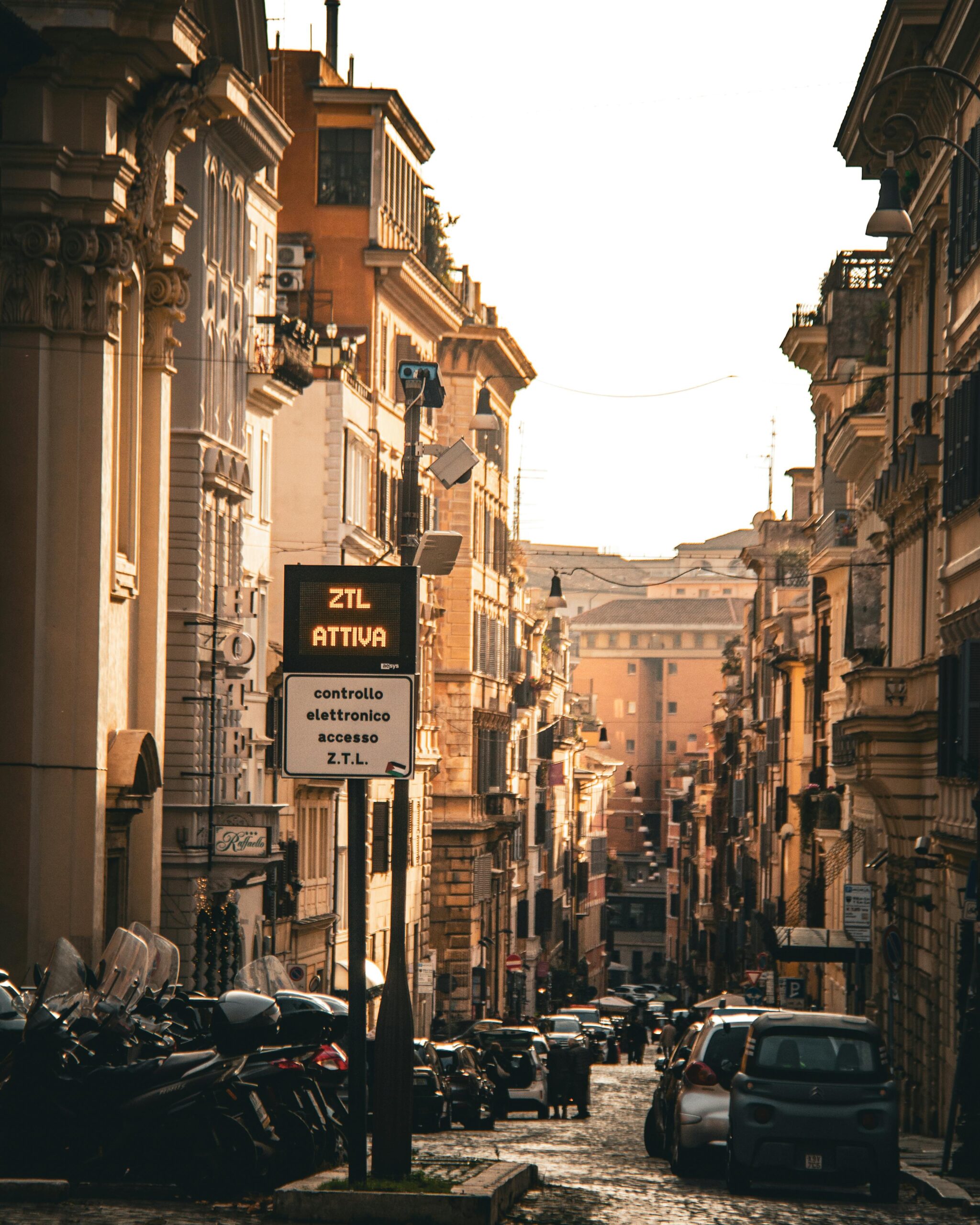
A parking space does not give you permission to enter a ZTL
One of the costliest mistakes is seeing available blue parking inside a historic centre and assuming that paying for it makes the drive legal. It does not.
A Zona a Traffico Limitato, or ZTL, controls access to the street or area. Parking regulations control where you may leave the vehicle once you are there. Those are separate rules.
You can therefore find perfectly legal paid parking in an area that your rental car was not authorized to enter. Camera enforcement at a ZTL entrance can record the vehicle before you ever reach the parking space.
Hotels and garages inside restricted zones sometimes have procedures for authorized customers, but these differ by city. Confirm the access procedure with the property before crossing a ZTL entrance rather than assuming the garage will fix it afterward.
City-specific rules become especially important in major destinations. See the practical parking details for Rome or Milan before driving into either city.
What to do if the parking meter is broken
A dead meter does not automatically turn blue parking into free parking. First check the machine for instructions directing you to another meter or payment method. Look along the same parking zone for another parcometro, and check whether the sign lists an authorized app.
If you cannot establish a valid way to pay, the lowest-risk choice for a visitor is another space or a staffed garage. Photographing the defective machine and applicable sign can document what you found, but it should not be treated as automatic permission to leave the car without paying.
A quick check before you leave the car
Use this sequence every time you street-park in Italy:
- Look at the line: blue, white, yellow, or another specially marked bay.
- Find the sign: confirm hours, days, permits, and time limits.
- Scan for temporary notices: especially divieto di sosta and towing warnings.
- Check the ZTL separately: parking permission and driving permission are not the same thing.
- Pay correctly: use the correct meter or zone code and enter the number plate accurately if requested.
- Display what is required: ticket, parking disc, or permit.
- Stay inside the bay: do not leave wheels or the rear of the car obstructing the pavement, traffic lane, driveway, or adjacent reserved space.
If a day involves several driving stops, it can help to organize the rest of your Italy route around garages or park-and-ride locations rather than repeatedly hunting for street spaces in historic centres.
Common parking mistakes that lead to trouble
- Assuming all white spaces have unlimited free parking. Check for a parking-disc requirement or time restriction.
- Assuming blue spaces are free on Sundays. Charging days are determined locally.
- Treating Saturday as a holiday. A restriction marked feriali normally includes Saturday.
- Parking in yellow because the bay is empty. Reserved spaces remain reserved even when nobody appears to be using them.
- Looking only at the road paint. Signs can add conditions or temporarily suspend the space.
- Paying at the wrong meter zone. Check the zone code and tariff beside your vehicle.
- Entering a ZTL to reach legal parking. The parking bay does not authorize the journey into the restricted area.
- Leaving the car for several days without checking temporary restrictions. A space that is legal today may be suspended tomorrow for a market, event, cleaning, or works.
When a sign is genuinely unclear, a nearby garage is usually cheaper than guessing. Italian parking becomes much simpler once you treat the painted color as the first clue rather than the entire rule.