The best Rome summer shade walk runs from Piazza del Popolo through Via Margutta, Via della Croce, Campo Marzio, the Pantheon area and Piazza Navona before finishing at Campo de’ Fiori. It is roughly 3 km and deliberately favors narrow streets where tall buildings create more shade than Rome’s broad avenues and open piazzas. Treat it as an early-morning or late-afternoon route, not a trick for making a very hot noon comfortable.
On serious heat-wave days, change the plan rather than trying to outsmart the temperature. Lazio’s 2026 heat guidance advises avoiding the hottest hours and doing physical activity during cooler parts of the day. Shade helps with direct sun, but stone streets, warm air and accumulated heat are still there.
The cooler route at a glance
- Start: Piazza del Popolo, close to Flaminio Metro A.
- Finish: Campo de’ Fiori.
- Walking distance: about 3 km, depending on small detours.
- Pure walking time: roughly 45 to 60 minutes. Allow much longer for water, photos and cooling stops.
- Best time: morning before the streets heat up, or late afternoon when building shadows lengthen.
- Most exposed places: Piazza del Popolo, the short stretch of Via del Corso, Piazza della Rotonda, Piazza Navona and Campo de’ Fiori.
- Best shaded stretches: Via Margutta, Via della Croce, the small Campo Marzio streets and the lanes between the Pantheon and Piazza Navona.
This route deliberately leaves Trevi Fountain out. Trevi is easy to add on a normal sightseeing day, but it pulls you east into another heavily visited area and adds more exposed walking. On a very hot day, see Trevi early in the morning or after the strongest afternoon heat instead.
1. Piazza del Popolo to Via Margutta
If you arrive by Metro A, leave Flaminio station for Piazzale Flaminio and enter the historic centre through Porta del Popolo. You emerge directly into Piazza del Popolo. Do not spend long crossing back and forth through the middle of the square in strong sun. Head toward the Via del Babuino side of the piazza.
Walk into Via del Babuino and watch the street plates on your left for the entrance toward Via Margutta. The important move is to leave Via del Babuino rather than following it all the way toward Piazza di Spagna.
Via Margutta runs roughly parallel to Via del Babuino beneath the Pincio. It is narrower, quieter and broken up by building shade, vegetation and recessed entrances. Shade still moves during the day, so expect occasional bright patches rather than a continuous green tunnel.
The pavement is the catch. This is old Rome, with sampietrini and uneven surfaces. Comfortable shoes matter, and small suitcase or stroller wheels can rattle badly here.
2. Via Margutta to Via della Croce
Continue south along Via Margutta until it feeds you back toward Via del Babuino near the Spanish Steps end of the street. Instead of walking into the open centre of Piazza di Spagna, continue only far enough along Via del Babuino to turn right into Via della Croce.
This is the useful summer shortcut. Piazza di Spagna is one of the places where people tend to stop in full sun because the view is famous. Via della Croce lets you keep moving west through a much narrower street toward Via del Corso.
If the Spanish Steps are essential, make the short detour, look, then come straight back. Sitting on the Spanish Steps is prohibited, so they are not a practical rest stop anyway.
3. Via della Croce to Piazza San Lorenzo in Lucina
Follow Via della Croce until it reaches Via del Corso. This next part cannot be made completely shady. Turn left onto Via del Corso and walk south only until you reach the entrance to Piazza San Lorenzo in Lucina on your right.
Use whichever side of Via del Corso is shaded at that moment rather than treating a suggested side of the street as permanent. In summer the useful shadow can switch as the sun moves.
Piazza San Lorenzo in Lucina is a good decision point. If everyone still feels comfortable, continue into the smaller streets toward the Pantheon. If someone is already overheated, this is a better moment to stop indoors than to push deeper into the centre, where the nearest metro station becomes less convenient.
4. Take the small streets through Campo Marzio
From Piazza San Lorenzo in Lucina, take Via di Campo Marzio. Your sequence of street names toward the Pantheon is:
- Via di Campo Marzio
- Via degli Uffici del Vicario
- Via della Maddalena and Piazza della Maddalena
- Via del Pantheon
- Piazza della Rotonda
This is the section where the route earns its keep. The streets are much tighter than Via del Corso, so building shadows cover larger parts of the pavement. Do not worry about taking the geometrically shortest line on your phone. In summer, an extra minute through a narrow lane can be preferable to several minutes on a broad sunny street.
For a broader look at handling the city during the hot season, the Italy on Foot article on summer in Rome covers the trade-offs between sightseeing, heat and daily timing.
5. Use the Pantheon as a waypoint, not necessarily an indoor stop
You emerge into Piazza della Rotonda in front of the Pantheon. The square itself can be very sunny, so move toward the building line rather than automatically stopping in the middle for ten minutes.
Do not build your heat strategy around getting inside the Pantheon immediately. Entry procedures, queues and visitor numbers can change, and waiting outside defeats the point of choosing a cooler route. If you already have a visit planned, fine. Otherwise, treat the square as a navigation point and continue when ready.
Refill your bottle before you need it
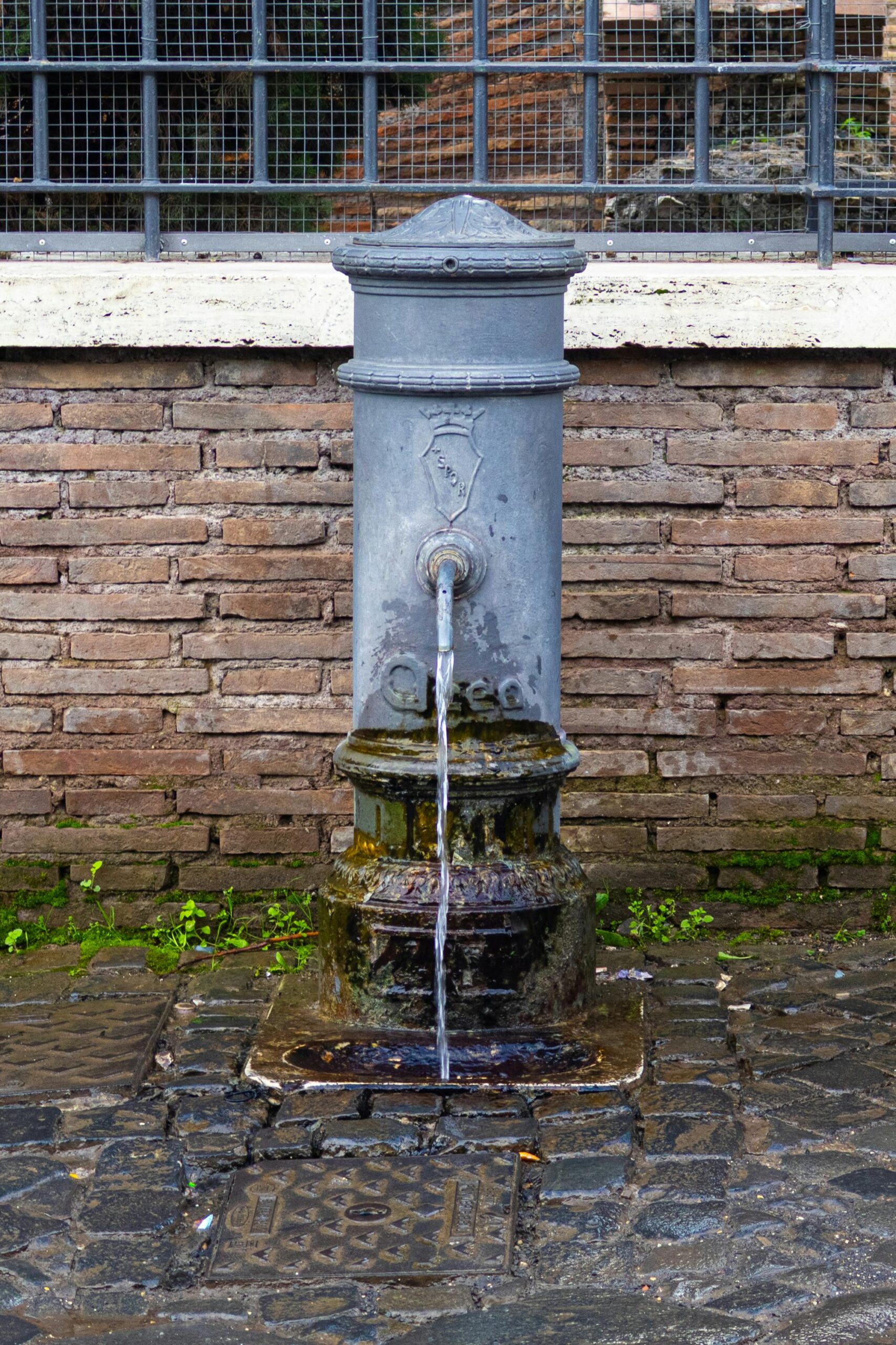
Rome’s small public drinking fountains are called fontanelle, usually nasoni. ACEA says the city has thousands of drinking fountains, including more than 200 nasoni in the historic centre, and the water supplied by them is drinking water from Rome’s public network. Its official drinking-fountain map is useful for locating the nearest working water point.
Look for acqua potabile, meaning drinking water. Acqua non potabile means do not drink it. Do not assume every decorative fountain is intended for filling bottles just because water is flowing.
6. Pantheon to Piazza Navona through the narrow lanes
With the Pantheon behind you, walk toward the back of Piazza della Rotonda and take Via Giustiniani. Continue into Via del Salvatore toward Corso del Rinascimento.
Corso del Rinascimento is the short exposed interruption. Use the pedestrian crossing rather than cutting diagonally through traffic. Once across, take Corsia Agonale into Piazza Navona.
The Pantheon and Piazza Navona are only a few minutes apart, but this small-street approach is noticeably preferable to wandering onto a broader road in search of a landmark you can already reach through the lanes.
If you are building several walking days in Rome, this is also a useful point to plan your Italy route and group nearby sights rather than repeatedly crossing the same hot parts of the centre.
7. Cross Piazza Navona without lingering in the centre
Piazza Navona is magnificent and almost completely open to the sky. During the hottest part of a summer day, the middle of the piazza is exactly what this route has otherwise tried to avoid.
Walk along the shaded building line when one side of the square offers it. The fountains are landmarks, not places to climb into, sit on or use for cooling your feet.
Make your way toward the southern end of the piazza. Leave via Via della Cuccagna, which brings you toward Piazza di San Pantaleo and Corso Vittorio Emanuele II.
8. Via dei Baullari to Campo de’ Fiori
At Corso Vittorio Emanuele II, use the pedestrian crossing and continue almost opposite into Via dei Baullari. After roughly a block, the street delivers you into Campo de’ Fiori.
Campo de’ Fiori is another open square, so on a hot afternoon the sensible finish is its shaded edge, not the centre beneath the Giordano Bruno statue. This is a convenient place to stop because cafés, shops and indoor spaces are close together, and Corso Vittorio Emanuele II is nearby if you want to leave the historic centre by bus or taxi rather than continuing on foot.
What to do if the shade disappears
Do not become loyal to the exact pavement line. Shade in Rome changes quickly. If the opposite side of a narrow street is cooler, cross when safe. If your navigation app suggests a sunny arterial road while a parallel lane goes in the same direction, use the lane.
The route also works in reverse, but the better direction depends on where the sun is falling at the time you start. The fixed waypoints matter more than walking the precise same curb throughout the day.
When you should abandon the walk
Shade is not enough if someone is becoming unwell. Head indoors if a traveler becomes increasingly dizzy, nauseated, unusually weak or confused. Do not make “reaching the next sight” the goal.
The easiest escape points are different along the route:
- Near Piazza del Popolo: Flaminio Metro A is close by.
- Near the Spanish Steps: Spagna Metro A gives you another early exit.
- After Campo Marzio: an indoor stop or licensed white taxi is usually more practical than walking farther just to reach a metro station.
- Near Piazza Navona and Campo de’ Fiori: move toward Corso Vittorio Emanuele II if you need buses or a straightforward taxi pickup area. Check live transport information because central routes can be diverted for events and street closures.
With children, strollers or reduced mobility
For families, the main advantage of this route is reduced exposure to direct sun. The disadvantage is old paving. Via Margutta and several central lanes have uneven sampietrini, which are awkward for small stroller wheels and can be tiring for anyone who needs a very smooth surface.
Wheelchair users and travelers with limited mobility should not assume the shadiest route will also be the easiest one. Staying on wider, smoother streets for part of the journey can be the better choice, even if that means a little more sun. Street-level routing avoids the need to use steps, but paving quality and kerb access vary from block to block.
With young children, shorten rather than slow the whole route through the hottest hours. Piazza del Popolo to the Spanish Steps area, or Pantheon to Campo de’ Fiori, each works as a separate short walk.
Do not bring rolling luggage on this route
A suitcase changes a pleasant 3 km walk into work. The combination of sampietrini, kerbs, crowds and heat is hard on small wheels and harder on the person pulling them. Leave bags at your accommodation or luggage storage and do the walk without them.
If you are changing hotels, use transport for the luggage first and sightsee afterward. A shaded cobbled lane is still a cobbled lane.
Three mistakes that make a Rome summer walk much hotter
- Starting at noon because the route is “shaded.” Narrow streets reduce direct sun, but they do not lower the air temperature enough to turn a severe heat day into comfortable sightseeing.
- Adding every famous sight. Trevi Fountain, Piazza Venezia and the Imperial Forums make sense on other routes. Adding them here creates long exposed detours and defeats the purpose.
- Waiting until your bottle is empty. Refill whenever a convenient nasone appears. Finding the next fountain is much less amusing once everyone is already thirsty.
On a normal warm day, take the small streets and let the shadows decide your side of the road. On an official high-risk heat day, the better adjustment is simpler: move the walk to the morning or evening and spend the hottest hours indoors.