Use marked crossings whenever they are available, obey the pedestrian signal, and do not step into the road simply because the white stripes give you legal priority. The safest technique for crossing streets in Rome is to make your intention clear at the curb, check every lane, and start only when approaching vehicles are visibly slowing or stopped. At signalized junctions, a green pedestrian light lets you cross, but turning vehicles may still enter your path and must yield to you.
What the zebra crossings actually mean
Italy’s legal position is clearer than Rome’s traffic can sometimes look. At an unsignalized attraversamento pedonale, drivers must give way to pedestrians who are crossing or are in the immediate vicinity of the crossing, slowing and stopping as necessary. This rule is set out in Article 191 of the Italian Highway Code. The national road code was most recently revised by legislation that entered into force in December 2024.
That legal priority should not be confused with a force field. Before stepping off the pavement, look at the approaching vehicle rather than assuming the driver has seen the stripes. A useful cue is the vehicle’s speed and wheels: you want to see an obvious reduction in speed, not merely hope that the driver will brake after you step out.
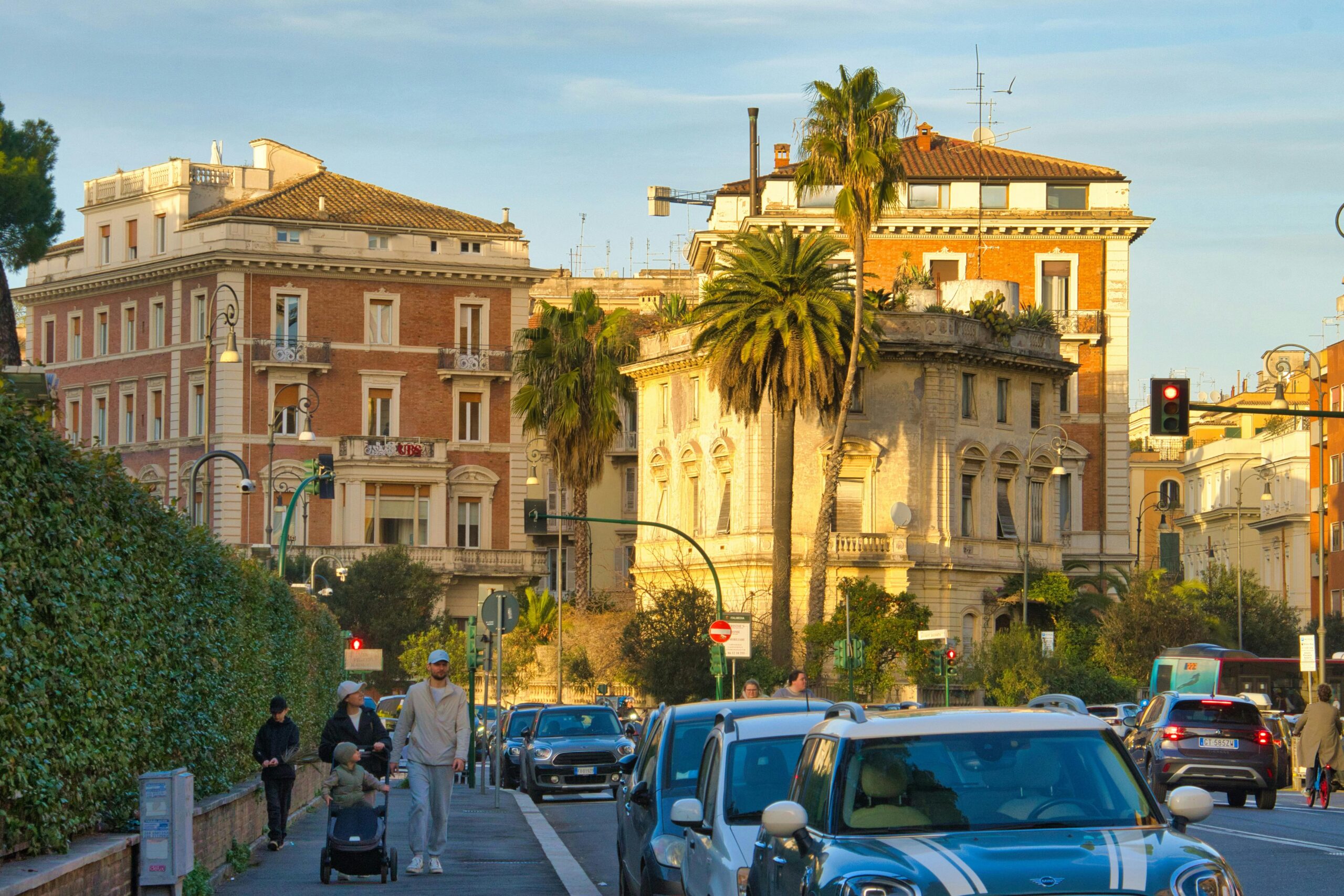
On a multi-lane road, the first stopped car creates another problem: it can hide a scooter, motorcycle, taxi or second car in the next lane. Check beyond the vehicle that has stopped before walking past its front bumper. Keep moving at a predictable pace once the crossing is clear rather than darting forward, stopping unexpectedly, or retreating.
How to read Rome’s pedestrian traffic lights
The Italian word for a traffic light is semaforo; a pedestrian signal is a semaforo pedonale. Watch the pedestrian figure intended for your crossing rather than copying nearby traffic or looking only at the vehicle signal.
- Green pedestrian: you may begin crossing.
- Yellow pedestrian: do not start. If you are already in the road, continue and clear the crossing promptly.
- Red pedestrian: remain on the pavement and do not enter the carriageway.
Those meanings come directly from Article 41 of the Highway Code. The same article also explains a detail that surprises some visitors: vehicles can sometimes have permission to move while pedestrians also have a green signal. A driver turning through the crossing must give priority to pedestrians who have been given the green light.
So a green pedestrian does not mean you can stop checking traffic. Look over the shoulder from which turning cars or scooters could approach, especially at large intersections. This is particularly important when you are walking with children and your attention is naturally focused on the far side of the road.
What if the light changes while you are halfway across?
Continue toward the far pavement at a steady pace. If there is a proper raised refuge island, you can stop there when necessary. Do not turn around suddenly because the signal has changed behind you. Under the road code, the yellow pedestrian phase exists specifically to let people already on the crossing clear it.
Some crossings have a pedestrian request button. Press it once and wait for the pedestrian signal. The button is a request for the crossing phase, not a command that immediately turns traffic red.
The three checks to make before stepping off the curb
- Find the actual crossing. On large junctions and piazzas, the legal pedestrian route may not follow the straight line shown by your map.
- Check every traffic stream. Look for cars, scooters, buses and bicycles, including vehicles turning from a side street.
- Wait for visible yielding. At an unsignalized crossing, begin when approaching traffic has clearly slowed enough for you to cross safely.
Do not let a group of other pedestrians make the decision for you. People sometimes follow the first person into the road without checking what is happening in the second lane. Use the crowd as extra visibility for drivers, not as evidence that the road is clear.
Where pedestrians are required to cross
Italian law requires pedestrians to use a pedestrian crossing, underpass or overpass when one is available. If none exists within 100 metres, pedestrians may cross elsewhere, but they must cross perpendicular to the road and take the necessary precautions. At an unmarked location, the pedestrian must give priority to vehicles. Squares and broad open junctions have an additional rule: where marked crossings exist, pedestrians are expected to use them rather than cutting diagonally across the traffic area. These rules are in Article 190.
For a visitor, the easy decision rule is simpler: if a proper crossing is visible nearby, use it. A walking app may suggest a straight line across a broad road while the safe pedestrian route requires walking to the corner first.
Italian words and signs worth recognizing
- Attraversamento pedonale: pedestrian crossing.
- Strisce pedonali: the painted zebra stripes. Italians may simply say le strisce.
- Semaforo: traffic light.
- Semaforo pedonale: pedestrian traffic signal.
- Isola salvapedoni: pedestrian refuge island in the middle of the road.
- Pedoni: pedestrians.
- Deviazione: diversion, useful when construction has altered the normal pavement or crossing.
A refuge island is worth using properly. Treat the second half of the road as a fresh crossing rather than assuming that because the first lanes stopped, traffic on the other side will do the same.
Cars turning across a green pedestrian signal
This is one of the situations that feels oddest to travelers accustomed to intersections where pedestrian and vehicle movements are completely separated. A vehicle can be permitted to turn while pedestrians have a green crossing phase. Legally, the turning driver must yield. Practically, you should still check the direction from which the turn is coming before you step in front of the vehicle.
Do not rely on eye contact alone. Helmet visors, reflections and windscreens make it unreliable. A visibly slowing or stopped vehicle is better evidence that you have been noticed.
Buses, trams and stopped public transport
Do not cross the road directly in front of a stopped bus, trolleybus or tram at a stop. Italian pedestrian rules expressly prohibit this. The vehicle can block your view of traffic approaching alongside it, and you are equally difficult for that traffic to see.
With trams, also remember that the tracks tell you exactly where the vehicle must travel. A tram cannot swerve around you. Use the designated pedestrian route across the tracks and obey any dedicated signals rather than following someone who cuts across.
Crossing with children, strollers or luggage
With a stroller, keep the front wheels on the pavement until you have confirmed that traffic is stopping. Do not roll the stroller into the road first to signal that you want to cross.
For young children, cross together rather than sending them ahead when the light changes. Wide Roman roads can have refuge islands and several separate signal phases, so reaching an island does not necessarily mean the entire crossing is clear.
Suitcases add another complication because wheels can catch on broken paving, drain covers and the transition between sampietrini and asphalt. Give yourself enough time to cross without rushing. For more general walking and transport preparation, the site’s practical Rome tips for first-time visitors cover the other small details that can slow a day on foot.
Reduced mobility and choosing the easier crossing
Not every Roman corner is equally convenient for a wheelchair, mobility aid or stroller. Renovated crossings may have lowered curbs, tactile paving and refuge islands, while an older crossing nearby may still involve awkward paving or a poorly aligned curb cut. Rome continues to modify higher-risk pedestrian intersections with measures including enlarged pavements, pedestrian islands, ramps and tactile routes.
Choose the signalized crossing with the clearest curb ramps even when it adds a short detour. If you are organizing a walking day across several neighborhoods, the Italy on Foot trip planner can help group stops so that you spend less time zigzagging across the city’s larger traffic arteries.
What to do when the normal crossing is blocked
Roadworks can move barriers, bus stops and pedestrian routes. If fencing closes the zebra crossing you expected to use, do not step around the barrier into the traffic lane just because your destination is visible opposite. Look for temporary pedestrian signs, a protected passage or the next open crossing.
If a vehicle is stopped on top of the stripes and blocks your view, resist squeezing around its front. Either wait until you can see the next lane clearly or use another crossing. The shortest route is not useful if a van turns it into a blind crossing.
If the pedestrian light is dark or obviously malfunctioning, the Highway Code specifically requires extra caution because other traffic streams may still have functioning signals that permit them to move. Do not interpret a blank pedestrian signal as an automatic green.
Crossing after dark
The rules do not change at night, but your margin for error does. A quieter road can tempt both pedestrians and drivers to treat an intersection casually, while darkness makes it harder to judge speed and whether a driver has seen you. Prefer a well-lit marked crossing, stay out from behind parked vans before looking, and wait for a clear reduction in vehicle speed.
If rain has started, allow an even larger margin. Headlights reflect from wet paving, umbrellas reduce peripheral vision, and drivers need more distance to stop. The green pedestrian figure is still your signal, but your own visual check remains part of the crossing.
A quick curb-side rule that works
Before every significant crossing, take a few seconds to ask: Is this the marked route? What can reach me from the left, right or behind? Has each relevant lane actually stopped or clearly slowed? If any answer is uncertain, stay on the pavement for another moment. Rome is a superb city to cover on foot, and there is rarely anything across the road worth winning an argument with a scooter over.