For most visitors arriving from Naples or Sorrento, get off at Pompei Scavi – Villa dei Misteri on EAV’s Naples-Sorrento line and use Porta Marina. Piazza Esedra uses the same station. For Piazza Anfiteatro, Pompei Santuario on the Naples-Poggiomarino line is closest, while the Trenitalia station called simply Pompei is nearly as convenient and often makes more sense from Salerno or the national rail network.
Of the Pompeii train stations that appear in journey planners, three are genuinely useful for the archaeological park, but they belong to different rail networks. The spelling is your first clue: the modern town and its stations use Pompei with one final “i”; the ancient Roman city is normally written Pompeii in English.
Which station should you choose?
| Park entrance | Best station | Rail operator | Best for |
|---|---|---|---|
| Porta Marina Superiore | Pompei Scavi – Villa dei Misteri | EAV, Naples-Sorrento line | Most visitors from Naples or Sorrento |
| Piazza Esedra / Porta Marina Inferiore | Pompei Scavi – Villa dei Misteri | EAV, Naples-Sorrento line | Antiquarium, western side of the site |
| Piazza Anfiteatro | Pompei Santuario | EAV, Naples-Poggiomarino line | Amphitheatre side and eastern Pompeii |
| Piazza Anfiteatro | Pompei | Trenitalia / RFI | Arrivals from Salerno or travelers already using Trenitalia |
The Archaeological Park itself recommends the Naples-Sorrento Circumvesuviana service for Porta Marina and Piazza Esedra, and the Naples-Poggiomarino service to Pompei Santuario for Piazza Anfiteatro. Trenitalia’s Pompei station is another official option for the eastern entrance. Check the park’s current transport information before traveling if engineering works or service changes are possible.
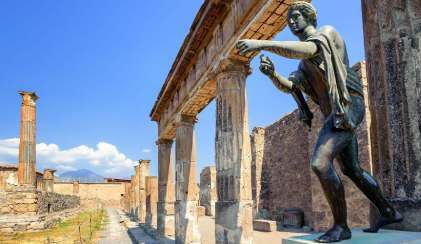
Pompei Scavi – Villa dei Misteri: best for Porta Marina
This is the station most first-time visitors are actually looking for. It is an EAV station on the Napoli-Sorrento route, commonly called the Circumvesuviana, and it sits immediately beside the western end of the archaeological area.
After leaving the station, follow signs for Scavi di Pompei and Porta Marina along Via Villa dei Misteri. The walk is only a few minutes. You do not need a local bus, taxi, or transfer.
Porta Marina is a particularly useful starting point if your priorities are the Forum, Basilica, Temple of Venus, and the western half of the ancient city. It is also the obvious choice when a guided tour voucher gives a meeting point on Via Villa dei Misteri.
If you are coming from Sorrento, this station is especially useful because the Naples-Sorrento line gives you a direct train. Pompei Santuario is on a different EAV branch and is not the direct Sorrento service.
Use the same station for Piazza Esedra
Piazza Esedra is also called Porta Marina Inferiore. Do not mistake it for Porta Marina Superiore simply because the two entrances are close together.
Get off at Pompei Scavi – Villa dei Misteri just as you would for Porta Marina, then follow signs specifically for Piazza Esedra or Porta Marina Inferiore. It is a little farther from the railway stop than Porta Marina but still on the same western side of the ruins.
This gate is useful if you want to start with the Antiquarium. The Archaeological Park specifically recommends Piazza Esedra for access to the museum. It can also be the right entrance when a pre-booked tour or group meeting point specifies Esedra rather than the better-known Porta Marina.
Do not assume you can simply join the first archaeological-site queue you see after leaving the station. Check the entrance printed on your ticket or tour confirmation first.
Pompei Santuario: best for Piazza Anfiteatro
Pompei Santuario belongs to EAV’s Napoli-Torre Annunziata-Poggiomarino route. It is a different line from the train to Sorrento.
From the station, head toward the modern town center and Piazza Bartolo Longo, where the large Sanctuary of the Blessed Virgin of the Rosary is an easy landmark. Continue toward Via Roma and the archaeological area. The Piazza Anfiteatro entrance is in Piazza Immacolata, at the point where Via Roma meets the eastern side of the ruins. The distance is roughly 650 meters, so allow around ten minutes at an ordinary walking pace.
This entrance places you beside Pompeii’s ancient amphitheatre and close to the Palestra Grande and the eastern end of Via dell’Abbondanza. Choose it if those sights are your priority or if you want to walk through the ancient city from east to west instead of beginning near the Forum.
Before setting out, check EAV’s current Vesuvian railway timetables. The Naples-Sorrento and Naples-Poggiomarino services have separate schedules, and temporary service alterations are not unusual.
Pompei station: the Trenitalia option
The station shown simply as Pompei is not the Circumvesuviana stop beside Porta Marina. It is an RFI station used by Trenitalia services on the Naples-Salerno corridor and sits in the modern town.
From here, Piazza Anfiteatro is roughly a ten-minute walk. This makes Pompei station a sensible choice if you are arriving from Salerno or if your journey planner already gives you a convenient Trenitalia connection. There is little benefit in making an extra transfer purely to reach the western EAV station when the eastern gate suits your visit.
Travelers coming from Rome may also find it simpler to stay within the Trenitalia network for part or all of the journey. If that is your route, our self-guided Rome to Pompeii day-trip guide covers the longer transfer in more detail.
The confusing “Pompei Scavi” result in the Trenitalia app
There is one naming trap worth knowing before you book. Trenitalia lets you search for Pompei Scavi as a destination for its Pompei Link product. That does not mean Trenitalia trains run to the EAV station called Pompei Scavi – Villa dei Misteri.
Pompei Link combines a Trenitalia journey to Pompei station with a connecting bus to the archaeological park. Trenitalia says the bus leaves from the square directly outside Pompei station. If you buy the combined journey, follow the bus instructions on that booking rather than looking for Circumvesuviana platforms.
This distinction matters when comparing journey planners: Pompei Scavi – Villa dei Misteri is an EAV railway station, while Pompei Scavi can appear inside Trenitalia’s system as a train-plus-bus destination.
Which station is best from Naples, Sorrento, Salerno, or Rome?
From Naples: choose according to your entrance. Use the Naples-Sorrento EAV line for Pompei Scavi – Villa dei Misteri and the western gates. Use the Naples-Poggiomarino EAV line for Pompei Santuario and Piazza Anfiteatro. Trenitalia to Pompei is another perfectly workable option, particularly if its departure time fits your day better.
From Sorrento: Pompei Scavi – Villa dei Misteri is normally the straightforward choice because it is on the same direct EAV line. Enter at Porta Marina or Piazza Esedra instead of creating an unnecessary transfer to reach the opposite side of the ruins.
From Salerno: Pompei on Trenitalia is usually the logical rail stop. Walk from there to Piazza Anfiteatro rather than traveling past the town and doubling back to the Circumvesuviana station.
From Rome: compare a Trenitalia itinerary through Naples or directly toward Pompei with a high-speed train to Naples followed by EAV. The best answer depends on that day’s connections rather than on a single station being universally superior. If Pompeii is one stop in a longer rail trip, you can also organize the rest of your Italy route around the station that keeps the fewest transfers.
Traveling with luggage changes the best entrance
The Archaeological Park does not allow bags, backpacks, suitcases, or cases larger than 30 x 30 x 15 cm inside the excavations. Paid luggage storage is available at Porta Marina and Piazza Anfiteatro. The park does not list Piazza Esedra as one of its luggage-storage locations.
That means a traveler arriving at Pompei Scavi – Villa dei Misteri with a suitcase should normally deal with the bag at Porta Marina rather than walking straight to Piazza Esedra. Likewise, arriving at Pompei or Pompei Santuario with luggage makes Piazza Anfiteatro useful because storage is available at that entrance.
Remember where you left the bag. Pompeii is large enough that accidentally finishing your visit at the opposite gate can turn luggage collection into an unwanted final walk around the perimeter.
Wheelchairs, reduced mobility, and strollers
The closest station is not automatically the easiest station for a wheelchair user. The Archaeological Park’s Pompeii for All accessible itinerary begins at Piazza Anfiteatro, making the eastern entrance particularly useful for visitors with mobility difficulties and for families who want a less awkward route with a stroller.
Pompei Scavi – Villa dei Misteri currently has an important EAV accessibility restriction. Arrival from Naples on a Sorrento-bound train is possible using the ramp-equipped platform, but EAV states that wheelchair users cannot directly board a Naples-bound train from that station. Arriving from the Sorrento direction also requires a special routing rather than simply getting off there. Check EAV’s current Pompei Villa dei Misteri accessibility instructions before relying on that stop.
The RFI station at Pompei has accessible routes to its passenger platforms, lifts for platforms 2 and 3, and passenger-assistance services. For some wheelchair users traveling from Naples or Salerno, Trenitalia to Pompei followed by Piazza Anfiteatro can therefore be simpler than choosing the physically closest station to Porta Marina. Check the accessibility of the specific train as well as the station.
Tickets for EAV and Trenitalia are not the same thing
Pay attention to the operator name when buying transport. EAV runs the Vesuvian railway lines through Pompei Scavi – Villa dei Misteri and Pompei Santuario. Trenitalia serves Pompei station. A journey shown in one company’s app should not be assumed to cover a completely separate service unless the ticket explicitly says it is an integrated connection.
EAV currently offers several ticketing methods, including station-issued QR tickets and its GoEav app. Contactless Tap&Go is also used on parts of the network. Where you use Tap&Go, follow the system’s instructions for both entry and exit rather than assuming a single tap completes the trip.
Common station mistakes that are easy to avoid
- Getting off at Pompei instead of Pompei Scavi: you are not stranded. You are in the modern town. Walk to Piazza Anfiteatro or use your planned Pompei Link connection.
- Assuming Pompei Santuario is on the Sorrento line: it is on the Poggiomarino branch. From Sorrento, the western station is normally much simpler.
- Following “Scavi” without checking the operator: EAV’s railway stop and Trenitalia’s Pompei Link destination can appear under very similar names.
- Choosing a gate before checking a tour voucher: tour meeting points may be at Porta Marina, Piazza Esedra, or Piazza Anfiteatro. Go to the entrance named on the booking.
- Leaving through the wrong side of Pompeii: if your return train is from Pompei Scavi – Villa dei Misteri, finishing at Piazza Anfiteatro leaves you on the opposite side of the archaeological site. The reverse is true if your train home leaves from Pompei or Pompei Santuario.
Plan your exit before you enter
Pompeii’s three visitor gates are spread along different sides of a very large archaeological area, so your return train should influence the final part of your walking route. If you arrived from Sorrento and need the Naples-Sorrento line again, work back toward Porta Marina rather than casually leaving through Piazza Anfiteatro. If you arrived by Trenitalia at Pompei and want to return on the same network, finishing near the amphitheatre saves a cross-town walk.
Entering one side and deliberately leaving another can be an excellent way to avoid backtracking, especially if you are continuing somewhere different afterward. Just decide that before you leave luggage, buy a return ticket tied to a particular operator, or agree to meet someone outside a specific station.
If your arrival is close to the park’s last admission time, check the official opening and last-entry times before boarding the train. A service that reaches Pompei in the late afternoon may still run perfectly on schedule while getting you there too late to enter the ruins.