The safest approach is simple: assume the historic center is not for visitor cars until the signs prove otherwise. For most travelers, driving into Tuscan hill towns means following signs for a public car park before reaching the medieval streets, then continuing on foot. A sign pointing to Centro tells you where the center is. It does not mean you are allowed to drive there.
The trouble usually starts in the final few hundred meters. Your navigation app says to continue straight, the street looks perfectly drivable, and a small sign beside an arch suddenly says Zona Traffico Limitato. That sign matters more than the route on your phone.
The parking-first rule that avoids most problems
Before reaching a town such as Siena, San Gimignano, Cortona, Pienza or Montepulciano, change your navigation destination from the town center to a specific public parking area.
- Choose the car park before you start the final approach.
- Follow signs marked P or Parcheggio rather than continuing toward Centro.
- As streets narrow, watch the roadside signs rather than relying only on GPS instructions.
- If you see a ZTL entrance and do not have confirmed authorization, do not cross it.
- Park, check the payment rules, and walk into the old center.
This also prevents another common mistake: setting the hotel itself as the navigation destination when the hotel is inside a restricted historic center. The app may happily route you through a camera-controlled gate.
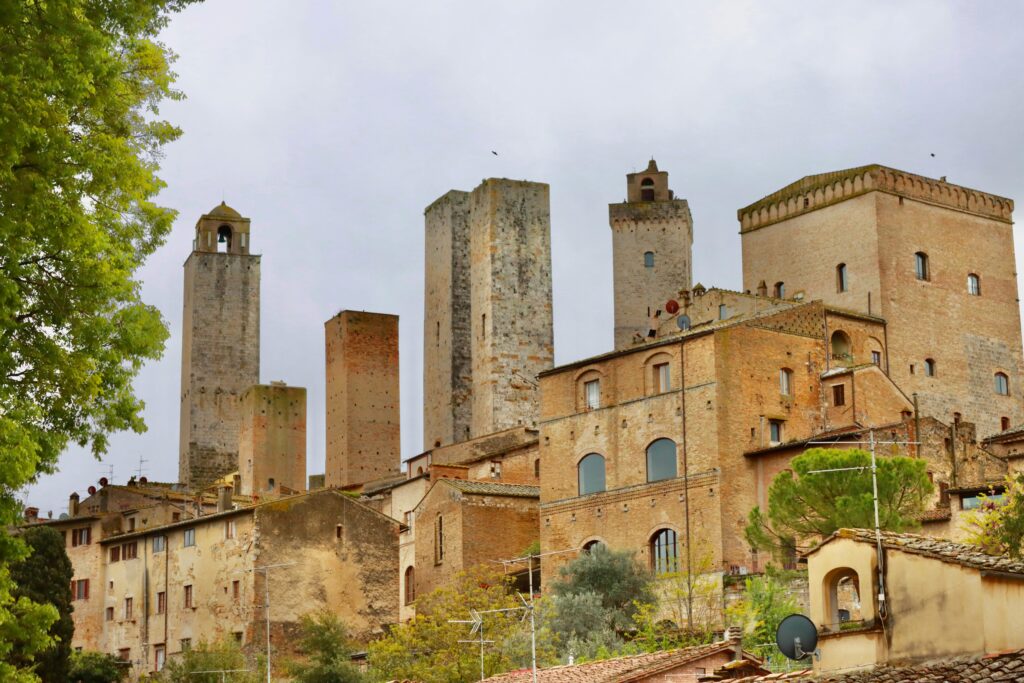
What “Centro” actually means
Centro simply means center. Centro storico means historic center.
Neither is a promise that private vehicles may continue all the way there. In many Tuscan towns, directional signs for the center eventually lead to a junction where ordinary traffic must peel away toward parking while authorized vehicles continue through a gate.
Watch for combinations such as:
- Centro: town center.
- Centro storico: historic center.
- Parcheggio: parking.
- P: the familiar blue parking sign.
- ZTL: Zona a Traffico Limitato, limited traffic zone.
- Varco: an access point or gate into a controlled area.
- Eccetto autorizzati: except authorized vehicles.
When Centro and Parcheggio split in different directions, visitors with no local permit should normally follow the parking sign.
How to recognize a ZTL entrance
The important sign normally contains the words zona traffico limitato and a white circular field surrounded by a red border. Below or beside it may be several smaller panels listing operating hours, permitted vehicles and exceptions.
Camera-controlled entrances may also have an electronic board. Italian transport ministry guidance provides for messages including:
- ZTL ATTIVA: the restriction is currently active.
- ZTL NON ATTIVA: the ZTL restriction is not currently active.
- ZTL CLOSED: an English-language version sometimes shown when access is restricted.
- ZTL OPENED: wording that may appear when the restriction is not in force.
You can see the national guidance on variable ZTL signage in the Italian Ministry of Transport’s ZTL guidance.
If the display says ZTL ATTIVA, do not enter unless your vehicle is specifically authorized. There may be no barrier, policeman or ticket machine. A camera reading the registration plate can be the entire enforcement system.
If it says ZTL NON ATTIVA, that particular time-based restriction is not in force at that moment. You must still obey any other no-entry, pedestrian-zone, vehicle-size, direction or parking signs.
Read the small panels, not just the big red circle
A ZTL sign can look intimidating because the lower half often contains several lines of Italian. Those lines are important. They can define the exact hours and vehicles allowed through.
Useful words include:
- dalle … alle …: from one stated time to another.
- residenti: residents.
- autorizzati: authorized vehicles.
- eccetto: except.
- carico e scarico: loading and unloading.
- merci: goods or commercial deliveries.
- festivi: Sundays and public holidays.
- feriali: non-holiday days, which normally includes Saturday unless another restriction says otherwise.
Do not memorize one town’s hours and apply them elsewhere. ZTLs are established and operated locally, and the schedules can vary even between different sectors of the same town.
Tuscan ZTL rules really do differ from town to town
San Gimignano is a good example of why old travel advice can become unreliable. The municipality put its updated video-controlled historic-center system fully into operation from 1 May 2026. Its current official ZTL information includes the access map and authorization rules.
Cortona uses multiple ZTL sectors with different summer and winter schedules. Under the municipality’s current published rules, some restrictions extend well into the night during the summer period. Check the official Cortona access rules rather than assuming that arriving after dinner automatically makes the center open to cars.
Siena has its own zones, gates and authorization categories. Even vehicles that are legitimately allowed into part of the center may be restricted from particular streets or sections.
The practical lesson is more useful than memorizing hours: check the municipality for the town you are visiting, then read the sign at the actual gate.
Blue, white and yellow parking lines
Once you reach a parking area, road markings give you the first clue about who may use the spaces. Under Italy’s parking-sign regulations:
- Blue lines indicate paid parking.
- White lines indicate non-paid parking.
- Yellow lines indicate spaces reserved for specified users or vehicle categories.
The vertical sign beside the spaces still matters. A white space can have a time limit. A blue space may be chargeable only during stated hours. A yellow space can be reserved for residents, disabled permit holders, service vehicles or another particular category.
What to do in a blue-line space
Look for a parking meter, parcometro, or instructions on the nearby parking sign. Confirm:
- the charging hours;
- the maximum stay, if any;
- whether payment is required on Sundays or holidays;
- whether the machine requires your registration number;
- whether a ticket must be displayed inside the windshield.
Do not assume a row of blue spaces is free because the meter appears switched off. Check the sign first.
White does not always mean unlimited
A white parking bay is not automatically an all-day space. The adjacent sign may require a disco orario, a parking disc showing your arrival time, and may impose a maximum stay.
If you see 1 ora, 2 ore or similar wording together with the parking-disc symbol, set the disc to your arrival time and leave it visible.
Yellow means check before stopping
Visitors should not treat an empty yellow bay as convenient overflow parking. Read the symbol or wording identifying who may use it.
Also watch for:
- riservato: reserved;
- residenti: residents;
- carico/scarico: loading and unloading;
- rimozione forzata: vehicles may be towed;
- passo carrabile: driveway or vehicle access that must remain clear.
What to do if your hotel is inside the restricted area
Do not assume that being a hotel guest automatically permits entry. Accommodation access procedures are municipal rules, not a single Italy-wide system.
Contact the property before arrival and ask five specific questions:
- Is the property inside a ZTL?
- May hotel guests enter by car?
- Does the hotel need my registration plate in advance?
- Which exact gate and route should I use?
- Where do I park after unloading the luggage?
Getting a clear written reply is useful because authorization may cover only a particular route, time period or loading stop.
For example, Siena currently allows qualifying accommodation businesses inside its ZTL to register guests’ plates for limited access connected with loading and unloading luggage. The municipality’s accommodation ZTL service specifies how those registrations work. That is a Siena rule, not permission to follow the same procedure in another Tuscan town.
San Gimignano has its own accommodation provisions and access windows. Again, follow the property’s instructions for that particular stay rather than assuming that “hotel guest” is a universal camera exemption.
Do not follow another car through a restricted gate
A local car driving through proves nothing about your car.
The vehicle ahead might belong to a resident, taxi, delivery company, disabled permit holder or hotel guest whose registration plate is already on the municipality’s authorized list. Cameras evaluate the plate, not whether you were following somebody who appeared to know where they were going.
The same applies to buses and taxis. Their access rights do not transfer to the rental car behind them.
GPS versus the road sign: the road sign wins
Navigation apps are excellent on Tuscan country roads but can become troublesome around old centers. Digital maps may know that a street physically exists without correctly handling temporary restrictions, seasonal rules, resident-only gates or changes introduced for an event.
If your phone tells you to turn into a street marked with an active ZTL, pedestrian-zone sign or no-entry sign, ignore the phone.
A better setup is to save the public car park itself as your destination. If you are stringing several towns together, you can also build your Italy itinerary around parking points rather than dropping pins in the middle of each historic center.
Late arrivals are when people make the expensive mistake
Dark streets, tired drivers and a hotel pin inside the walls are a bad combination. Do not assume that restricted zones switch off at 7 or 8 p.m. Some operate into the night, and others can run around the clock.
If you arrive late and do not already have clear hotel instructions, the low-risk option is to use a legitimate public parking area outside the restricted center and walk to the accommodation. Sort out luggage access with the property afterward.
This is especially important if reception is closed and nobody is available to confirm that your registration plate has been entered into an authorization system.

Sundays and public holidays are not automatically free
Two assumptions cause trouble: that ZTL restrictions disappear on Sundays and that blue parking is always free.
Neither is universal.
A municipality can operate a restricted zone on Sundays and public holidays, and paid parking hours are set locally. Look for festivi, feriali, days of the week and the stated times on the sign or meter.
Temporary traffic orders for markets, festivals, historic events and roadworks can also override the normal pattern. In hill towns with very limited road space, an event can close the very approach you intended to use.
Luggage, strollers and steep walks from the car park
Parking outside the walls can mean a climb. The nearest parking lot on a map is not always the easiest one with suitcases, a stroller or limited mobility.
Before choosing a lot, look at:
- the elevation difference to the historic center;
- whether there are steps;
- whether lifts or escalators connect the parking area with the upper town;
- whether a local shuttle operates;
- how far the accommodation is from the nearest pedestrian entrance.
If your hotel says you may enter briefly for luggage, get the permitted gate and unloading procedure first. “I am only dropping bags” does not by itself override a ZTL camera.
Disabled permits and electric cars still need local checks
Do not assume that a disability parking permit automatically makes a vehicle’s registration plate recognizable to every Italian ZTL camera. Municipalities may require advance registration or another notification procedure for occasional visitors.
The same caution applies to electric vehicles. Benefits for EVs vary by municipality, and exemption from parking charges or access restrictions in one city does not create an exemption elsewhere.
Check the town’s official ZTL instructions before reaching the gate, particularly if access is essential rather than merely convenient.
If you realize you have accidentally entered a ZTL
Do not panic, reverse dangerously or stop beneath the camera.
- Continue safely and obey the road layout.
- Take the first legal opportunity to leave the restricted area.
- Do not circle through another controlled entrance while trying to recover.
- Once parked, note the street, approximate time and gate you used.
- If you were genuinely entitled to hotel, disabled or other authorized access, contact the accommodation or local Polizia Municipale promptly and ask what registration procedure applies.
Some local systems allow legitimate authorized users or accommodation providers to submit registration information within a defined period. Others require authorization before access. There is no general tourist procedure for cancelling an accidental entry simply because it was a mistake.
With a rental car, any eventual infringement may be processed through the rental company, which can also have its own contractual administration charge.
A simple decision rule at the final junction
As you approach the walls, use this sequence:
- If you see P / Parcheggio, take it unless you already have confirmed permission to continue.
- If you see Centro, treat it only as a direction.
- If you see ZTL ATTIVA, stop before the gate unless your plate is authorized.
- If you see ZTL NON ATTIVA, check the remaining signs before proceeding.
- If the GPS disagrees with a road sign, obey the sign.
- If you cannot understand the access conditions in time, do not cross the gate. Find parking and check from there.
For travelers combining the countryside with Florence, the larger city’s restricted area requires the same parking-first mindset but on a bigger scale. The Italy on Foot guide to parking in Florence covers that situation separately.
The five signs worth remembering
- Centro: the center is that way, not necessarily open to your car.
- Zona Traffico Limitato / ZTL: check access conditions before crossing.
- P / Parcheggio: usually the sign visitors should follow as they reach the old town.
- Strisce blu: paid parking, subject to the posted hours and conditions.
- Strisce gialle: reserved parking, so check who is entitled to use it.
The most useful habit is to make your parking decision before the medieval streets begin. Once you are beneath an arch with a delivery van behind you and a camera above you, it is a very poor moment to start translating Italian traffic signs.