The easiest way to make eating out with children in Italy work is to plan around Italian meal times, reserve a high chair when you book, and order simply rather than hunting for a special kids’ menu. Children are usually welcome in ordinary trattorias, pizzerias and restaurants, but dinner often starts later than many young children are used to. A 7:00 pm table is possible in some places, especially in tourist areas, but 7:30 pm onward is a more reliable target.
Italian meal times are the first thing to plan around
Italy’s official tourism portal gives the usual restaurant lunch window as about 12:30 pm to 2:30 pm, with dinner normally served from about 7:30 pm to 11:00 pm. Those are customary hours, not a national rule, and individual restaurants can open earlier, later or continuously. You can check the current general guidance on Italia.it.
For families with toddlers, the awkward period is often 5:30 pm to 7:00 pm. A traditional restaurant may still be closed, while a child may already be hungry. If your usual dinner is early, build in a substantial afternoon snack and aim for the first available dinner seating rather than trying to stretch a hungry child to 8:30 pm.
Useful fallbacks during the gap include a bar with sandwiches, pizza al taglio sold by the slice, a rosticceria with prepared hot food, or a bakery selling focaccia and savory snacks. In larger city centers you will also find restaurants with orario continuato, meaning continuous opening, but do not assume every place serves full meals all afternoon.
Book the table with the child details, not just the headcount
A reservation for “four people” does not tell the restaurant that one guest needs a high chair, that you have a stroller, or that you would prefer space away from a narrow staircase. Mention those details when booking so staff can choose a workable table.
- High chair: Avete un seggiolone? means “Do you have a high chair?”
- Reservation: Siamo due adulti e due bambini. Ci serve un seggiolone. means “We are two adults and two children. We need a high chair.”
- Stroller: Abbiamo anche un passeggino. means “We also have a stroller.”
- Changing table: C’è un fasciatoio? means “Is there a changing table?”
Do not assume a seggiolone will be available. Small historic-center restaurants may have only one or two, and some tiny osterias or enoteche may have none. A restaurant can be genuinely welcoming to families and still have very limited baby equipment.
A stroller can be more difficult than the child
Older Italian restaurants can have tight aisles, tables packed closely together, steps at the entrance and toilets down a staircase. A full-size stroller may simply not fit beside the table. If the child will stay in the stroller, say so when reserving. Staff may place you at an outdoor table, near the entrance or somewhere with a little more floor space.
If the stroller folds easily, be prepared to collapse it and store it where staff direct you. Do not block a passage or emergency exit. For a sleeping baby, ask before assuming the stroller can remain open beside the table.
Kids’ menus exist, but you do not need one
Menù bambini means children’s menu. Family-focused restaurants sometimes have one, but many very good traditional places do not. That is rarely a problem because Italian menus usually contain dishes that can be ordered simply.
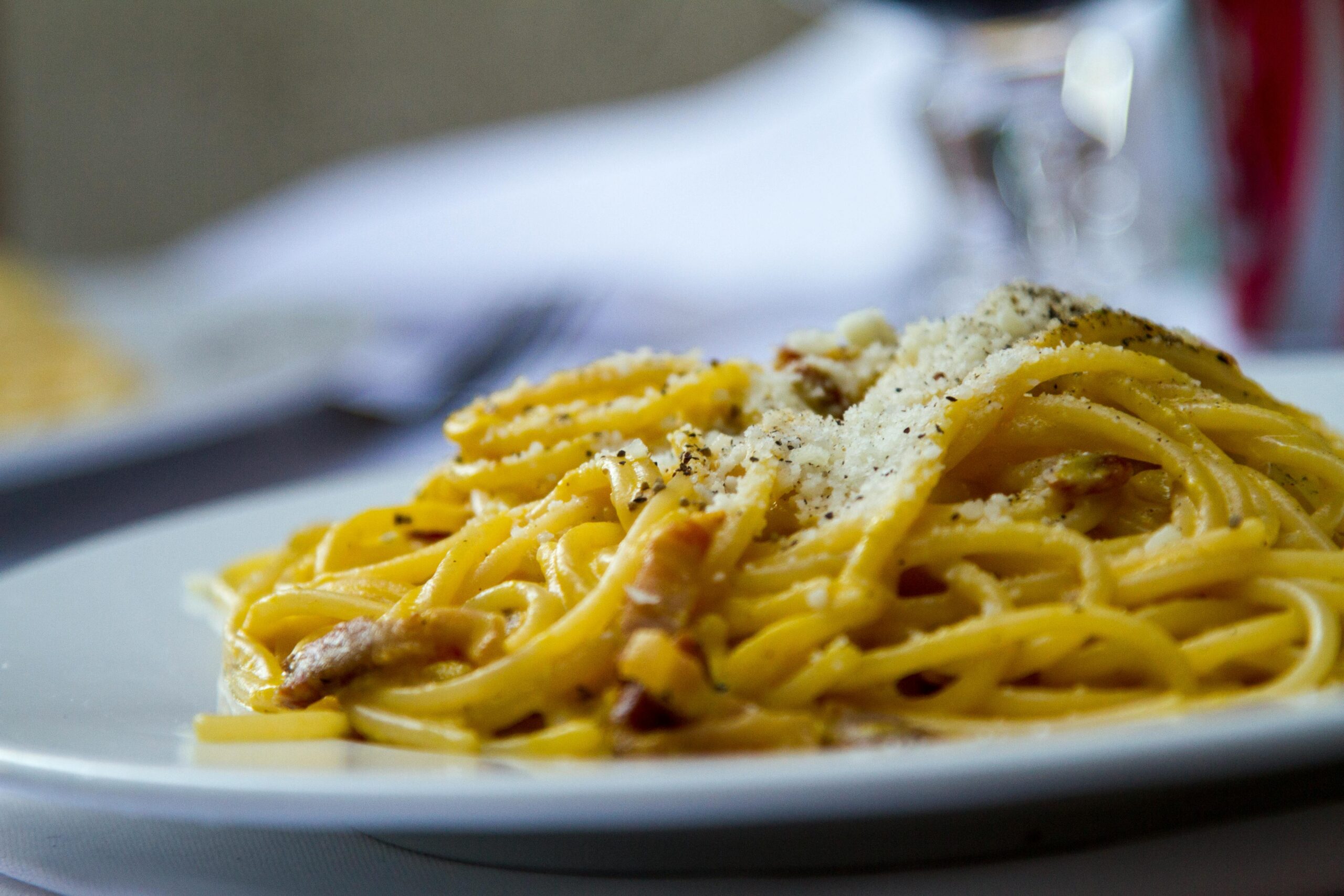
Good low-drama options include pasta al pomodoro for pasta with tomato sauce, plain grilled chicken or meat where available, simple vegetables, potatoes, or a portion of pasta with minimal seasoning. Pasta in bianco is often understood as plain pasta dressed lightly with butter or olive oil, sometimes with Parmesan, so specify what you do or do not want rather than relying on the phrase alone.
- Senza formaggio, per favore. No cheese, please.
- Senza burro. Without butter.
- Poco sale. A little salt.
- Senza sale. No salt.
- Non piccante. Not spicy.
- Solo pasta e pomodoro. Just pasta and tomato sauce.
Do not be embarrassed to ask for something uncomplicated, but ask rather than inventing a dish the kitchen does not make. A short request such as “Could you make a small portion of pasta with tomato sauce?” is usually clearer than trying to redesign a complex menu item.
Ask for a half portion, but do not assume it costs half
Una mezza porzione is a half portion. Some kitchens will happily make one for a child, especially for pasta, while others serve only the listed size. The price may also be more than exactly half of the adult portion because preparation and service costs do not shrink in the same proportion.
Useful phrases are È possibile fare una mezza porzione per un bambino? (“Is it possible to make a half portion for a child?”) and Possiamo dividere questo piatto? (“Can we split this dish?”). If you need an extra empty plate, ask for un piatto vuoto.
A child does not need to order an antipasto, primo and secondo. Italian menus are divided into courses, but ordering one suitable dish is completely normal. For more detail on reading menus, cover charges and ordinary restaurant cues, see our Italy first-timer practical guide.
If your child needs to eat first, say it clearly
Meals can be paced by course, and dishes ordered from different parts of the kitchen may not land at exactly the same moment. If a hungry child needs food as soon as it is ready, tell the server when you order:
Può portare il piatto del bambino appena è pronto? means “Could you bring the child’s dish as soon as it is ready?”
This is especially useful when adults are ordering a starter first. It prevents the kitchen from holding the child’s pasta until the adults’ next course.
Pizza is not always a lunchtime solution
A restaurant may be open at lunch without serving pizza then. Some pizzerias fire the pizza oven only for dinner, while others serve pizza all day. If pizza is the one food your child will reliably eat, check the menu or ask Fate la pizza anche a pranzo?, meaning “Do you make pizza at lunch too?”
This matters most outside the biggest tourist centers, where restaurant service can follow a more distinct lunch-and-dinner rhythm. If you are choosing between restaurants, a quick look at current opening hours and menus can save a difficult walk with a hungry child. Our guide to spotting Italian restaurant red flags is also useful when the easiest-looking family option is on a major tourist square.
What to order for drinks
For water, ask for acqua naturale if you want still water or acqua frizzante if you want sparkling. If you want room-temperature rather than chilled water, you can ask for acqua non fredda. Juice is succo di frutta.
Restaurants commonly bring drinks in bottles rather than automatically placing free tap water on the table. If the exact type of water matters to your child, order it explicitly rather than waiting to see what arrives.
Baby food, bottles and heating
For a baby jar, pouch or bottle, ask staff before expecting the kitchen to heat food you brought from outside. Some restaurants will help, while others may decline because of their own hygiene procedures.
- Potete scaldare questo biberon? Can you warm this bottle?
- Potete scaldare questa pappa? Can you warm this baby food?
- Posso dare questa pappa al bambino? Can I give this baby food to the child?
If a baby needs to eat at a very specific time, carry a backup that does not depend on restaurant heating. That is more reliable than discovering at 7:45 pm that the kitchen cannot warm the food you brought.
Food allergies need a separate conversation
Restaurants and cafés in Italy are subject to EU rules requiring information about specified allergens in non-prepacked foods. The Italian Ministry of Health explains the allergen-information requirements on its food allergy guidance page.
For a child with a serious allergy, do not stop at “Is there milk in this?” Explain that it is an allergy and ask about cross-contact if relevant. Mio figlio è allergico a… means “My child is allergic to…” and C’è rischio di contaminazione crociata? asks whether there is a risk of cross-contamination.
Written allergen information tells you which regulated allergens are associated with a dish, but it does not by itself guarantee that a kitchen can meet every cross-contact requirement. Speak with staff before ordering if the allergy is severe.
Check the menu for table charges and fixed-menu rules
Do not assume coperto, the cover charge you may see on Italian menus, is handled identically everywhere. Rules can be regional. In Lazio, which includes Rome, regional law prohibits restaurants from adding a separate coperto charge, while elsewhere you may see a clearly listed cover charge on the menu. Where a charge is permitted, treatment of babies and very small children can also depend on the restaurant, so ask if the cost matters to you.
If you see menù fisso, the restaurant is offering a fixed menu. At an agriturismo, holiday lunch or special event, the meal may be structured around a set sequence of dishes. Ask about the price and options for children before sitting down, especially if your child will eat only one small plate.
Build the day around the meal that is hardest for your child
For a toddler who needs lunch at noon, choose a museum or morning activity that finishes near an area with bars, bakeries or an early-opening restaurant. For a child who cannot manage a late dinner, avoid booking a timed attraction that ends at 7:30 pm and then requires a long transfer across town. You can build your Italy itinerary around meal stops so the practical break falls near the next sight rather than becoming a separate journey.
Sunday, holidays and popular family lunch days
Do not assume restaurants close on Sundays. Many open specifically for Sunday lunch, while their weekly closing day falls elsewhere. The important detail is the individual restaurant’s giorno di chiusura, or closing day.
On Sundays, national holidays and local feast days, family lunches can be popular and longer than a quick weekday meal. Reserve somewhere specific if timing matters. Around Christmas, Easter, Ferragosto on August 15, or a town’s patron-saint festival, check the restaurant’s own current opening hours and whether it is serving a special fixed menu.
What to do when dinner goes wrong
If the child has reached the end of their patience, ask for the bill immediately rather than waiting for the server to guess. Il conto, per favore means “The bill, please.” Depending on the restaurant, you may pay at the table or be directed to the cassa, the cashier.
If you arrive too late and the kitchen is closing, ask La cucina è ancora aperta? (“Is the kitchen still open?”). If the answer is no, switch quickly to a bar, takeaway pizza, bakery, rosticceria or supermarket instead of spending another half hour looking for a formal restaurant.
If there is no high chair after all, no room for the stroller, or the restaurant cannot make the one dish your child will eat, it is reasonable to leave before ordering. The best family meal is often the place that can seat you comfortably and feed the child at the right time, not the restaurant with the longest queue or most ambitious menu.