A private golf cart tour lets you see several parts of Rome in a few hours without walking the full distance between landmarks. Most routes combine short drives with stops for photographs and explanations, although the amount of walking varies considerably. A Rome golf cart tour can be particularly useful for older visitors, families and travelers with limited stamina, provided the vehicle, boarding arrangements and stopping points suit their needs.
Before booking, check the exact route, how many stops involve getting out, whether you can remain seated, and what happens when the cart cannot reach a pedestrian-only area. A tour advertised as covering the Colosseum, Trevi Fountain and Pantheon does not necessarily include entrance tickets or take you directly to each monument.
What happens on a private golf cart tour?
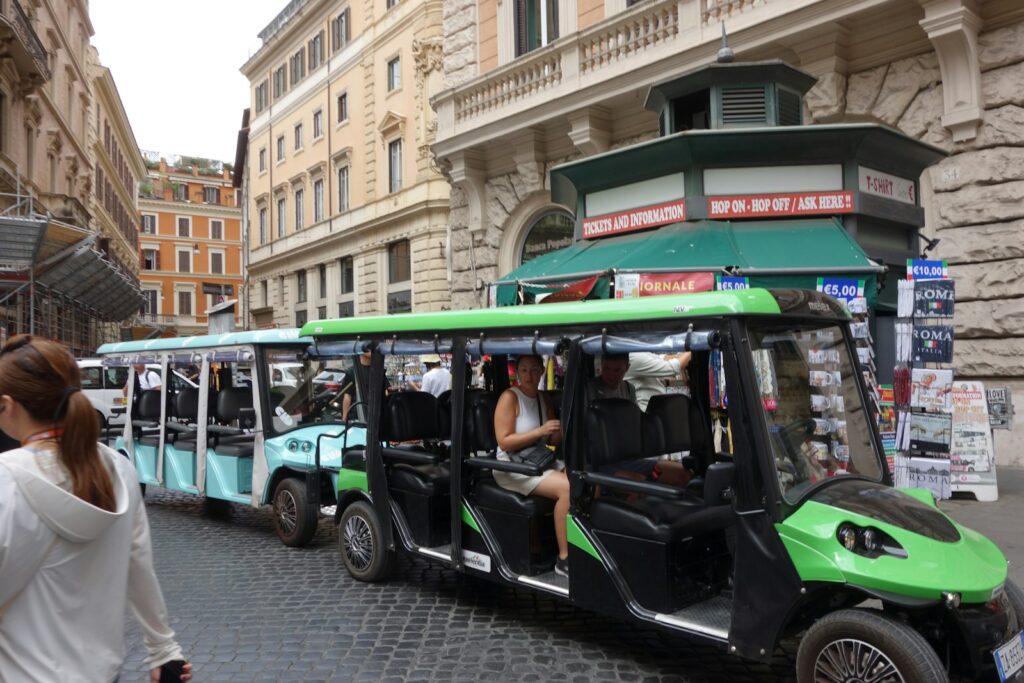
Most sightseeing golf carts in Rome are small electric vehicles driven by a local operator. Passengers sit while the driver travels between landmarks, stopping where vehicles are permitted to pull over safely. Some tours include a separate licensed guide, while others provide commentary from the driver. Those arrangements are worth checking because the description “driver-guide” does not always explain which services and professional qualifications are included.
Private tours normally reserve the vehicle for your group. This gives you more flexibility than a shared tour, particularly when someone needs extra time to board, wants fewer stops or needs a restroom break. The extent of that flexibility depends on the operator and the traffic restrictions affecting the route.
Golf carts are sightseeing vehicles rather than ordinary taxis. Their pickup areas, passenger capacity, luggage arrangements and permissions to use certain streets can differ from those of licensed taxis and chauffeur-driven cars.
Which parts of Rome can you see?
Most tours concentrate on the historic center, ancient Rome or a combination of the two. The following are common areas included in advertised itineraries, although no single route covers all of them.
Colosseum and Roman Forum viewpoints
Many tours include an exterior view of the Colosseum and nearby Roman ruins. You may also pass Piazza Venezia or stop at an accessible viewpoint overlooking part of the archaeological area.
Ask where the cart actually stops. The Colosseum’s surrounding streets include pedestrian areas and traffic restrictions, so you should not assume the vehicle can pull up beside the entrance. A photograph stop outside the monument is different from visiting the amphitheater or walking through the Roman Forum.
Entry to the Colosseum, Roman Forum and Palatine Hill generally requires separate ticketing arrangements. The official Colosseum Archaeological Park website explains visiting arrangements and accessibility services.
Trevi Fountain, Pantheon and Piazza Navona

These landmarks often appear together on historic-center routes, but their surroundings are busy with pedestrians. The golf cart may have to stop on a nearby street while passengers walk the remaining distance.
That difference matters if someone in your group can walk 50 metres comfortably but struggles with several hundred metres, uneven paving or long periods of standing. Ask for the approximate walking distance from the permitted stopping point to each landmark you particularly want to see.
A stop near the Pantheon also does not guarantee entry. If the tour includes an interior visit, check that admission, the booking time and the time needed inside are all accounted for.
Spanish Steps and Piazza del Popolo
Some routes pass through the northern part of central Rome, offering views of the Spanish Steps area, nearby streets and Piazza del Popolo. A cart can help with the distances between these places, although the Spanish Steps themselves are stairs and should never be described as an accessible walking route.
For someone avoiding steps, ask whether the operator offers a street-level viewpoint or another suitable location instead.
Aventine Hill, Circus Maximus and panoramic viewpoints
Longer tours may include Circus Maximus, the Aventine Hill or a viewpoint overlooking Rome. These additions can be valuable for visitors who would find the uphill walk tiring.
However, some viewpoints involve leaving the vehicle and walking along garden paths, sloping streets or uneven surfaces. If panoramic views are your priority, ask which ones can actually be enjoyed while seated.
Trastevere, Janiculum Hill and the Vatican area
Four-hour and customized tours sometimes travel beyond the compact historic-center circuit to Trastevere, the Janiculum viewpoint, Castel Sant’Angelo or the streets around Vatican City.
These extensions involve additional driving and may reduce the time available at other landmarks. Reaching the vicinity of St. Peter’s Square is also different from entering St. Peter’s Basilica or the Vatican Museums. If you are particularly interested in Vatican sightseeing, ask for a route focused on that area rather than assuming it can be added to a short central Rome tour.
Choosing between a two-hour, three-hour and four-hour tour
Tour length matters more than the number of landmarks printed in the description. A route with twelve locations may include several places seen only while driving, whereas a shorter list may allow more time for photography and explanations.
- Around two hours: Usually better for a focused introduction to central Rome, with a limited number of short stops. It can suit travelers who tire easily or children who would struggle with a longer outing.
- Around three hours: Often a useful compromise for combining the ancient city with some historic-center landmarks. Ask how many stops are included and whether a restroom break is possible.
- Around four hours or longer: Provides more scope for additional neighborhoods, viewpoints and customized stops, although spending longer seated in a small vehicle may not suit everyone.
These are typical tour formats rather than guaranteed itineraries. Before choosing a duration, ask for a realistic breakdown of driving time, stopping time and any walking involved. Hotel pickup, traffic and waiting for access to a suitable stopping area can all affect the time available for sightseeing.
Can golf carts drive through Rome’s pedestrian streets?
Do not assume that a small electric vehicle is allowed everywhere. Rome has pedestrian zones, restricted traffic areas known as ZTL (zona a traffico limitato) and streets where stopping or vehicle circulation may be limited.
Electric propulsion does not automatically give a sightseeing vehicle unlimited access to the historic center. Rome changed its ZTL rules for electric cars and other covered vehicles from July 1, 2026, requiring appropriate authorization where the new permit rules apply. Vehicle classification and the particular authorization held by an operator determine what is permitted. Details are available from Roma Servizi per la Mobilità.
Golf cart operations have also come under increased scrutiny in Rome, including enforcement against unauthorized services. Before paying, ask the company to confirm that the operator and the specific vehicle are legally authorized for the proposed passenger service and route, with appropriate insurance.
A responsible operator should explain restrictions clearly. Be cautious if someone promises to drive through every pedestrian square, stop directly outside every monument or ignore access limitations because the vehicle is electric.
Mobility questions to ask before booking
Golf cart tours are frequently marketed to older travelers and people who find long walks difficult. They can reduce the distance traveled on foot, but they do not all provide the same level of accessibility.
The most useful starting point is to describe exactly what the traveler can and cannot manage. “Limited mobility” could mean difficulty walking uphill, an inability to climb steps, a need for a folding wheelchair between stops or a requirement to remain seated in a wheelchair throughout the tour.
Can you board the cart without climbing a step?
Many golf carts require passengers to step up into the vehicle and turn to sit on a bench-style seat. Some have higher entrances, narrow footwells or less convenient handholds.
If boarding is difficult, ask for the step height, whether there is a firm handhold, and whether staff can offer appropriate assistance. Request photographs of the actual vehicle rather than relying on a generic listing image.
Someone who can walk with a cane may find the tour manageable once seated, yet still struggle with repeated boarding and disembarking. A route with fewer stops could be more suitable.
Can a wheelchair stay occupied during the tour?
A standard sightseeing golf cart should not be assumed to accommodate someone remaining in their wheelchair. Some specialist operators advertise wheelchair-accessible vehicles, but the arrangement must be verified for the particular vehicle being supplied.
If the passenger cannot transfer to a regular seat, ask whether the vehicle has a proper ramp or lift, an appropriate wheelchair space, wheelchair securement equipment and occupant restraints. Confirm the occupied wheelchair’s dimensions and weight against the vehicle’s stated capacity.
If the traveler can transfer independently or with assistance, ask whether a folded wheelchair can be carried securely. Some golf carts have very little space beyond the passenger seats.
How much walking is actually required?
The phrase “minimal walking” means different things to different operators. One tour may allow passengers to remain seated for nearly all commentary, while another may include repeated five- or ten-minute walks into pedestrian areas.
Ask the company to identify each planned stop as one of the following:
- A drive-by, with passengers remaining seated.
- A stationary viewpoint where passengers can stay in the cart.
- An optional photo stop requiring a short walk.
- A stop where walking is necessary to see the attraction.
Also ask about standing time, cobblestones, slopes and stairs. A short walk on level pavement can be considerably easier than the same distance across uneven historic paving.
What if someone needs frequent restroom breaks?
Not every stop has a nearby public toilet, and many cafés expect customers to make a purchase before using theirs. If restroom access is important, ask the operator to schedule a practical stop rather than relying on finding facilities at the next landmark.
For travelers with reduced mobility, ask specifically whether the proposed restroom is step-free and wheelchair accessible. A restroom being nearby does not establish that the facilities can be used comfortably.
Are golf cart tours suitable for wheelchair users?
They can be, but only when the equipment and route match the person’s needs. Some providers offer specially adapted vehicles, while others accept a folding wheelchair as luggage and expect passengers to transfer onto a regular seat.
There is also a separate accessibility service within the Colosseum Archaeological Park. Its official accessibility information describes a purpose-built golf cart for assisting visitors with mobility difficulties who use their own wheelchairs, subject to booking arrangements. This is distinct from a commercial sightseeing tour around Rome.
If the visitor’s main objective is to enter the Colosseum or Roman Forum, review the park’s official accessibility information rather than assuming an exterior golf cart tour will provide access to the archaeological site.
For someone who cannot transfer safely, an adapted vehicle with verified wheelchair securement may be preferable to a standard sightseeing cart, even if it changes the route or price.
Are golf cart tours suitable for children?
Families often choose golf cart tours to avoid several hours of walking, but age restrictions and child-seat arrangements differ between operators. Some accept young children with suitable restraints, while others set a minimum age. Do not assume that a toddler can sit on an adult’s lap or that a regular passenger seat is suitable for every child.
Before booking, provide the ages, heights and weights of the children, and ask whether appropriate restraints are available for the actual vehicle. Confirm whether a child seat reduces the advertised passenger capacity and whether the vehicle has suitable seat belts and seating positions.
Also ask about stroller storage. Some carts can carry a compact folding stroller, but a large travel system or double stroller may be difficult to accommodate.
For younger children, a shorter route with a restroom break and a few opportunities to stretch their legs is usually more practical than trying to cover every major landmark in one outing.
Hotel pickup and meeting points
Hotel pickup is a common feature of private tours, but it is not automatically available from every address. Operators often restrict pickup to particular central neighborhoods or locations their vehicles can legally reach.
If your accommodation is near Termini, in Trastevere, around the Vatican or outside the historic center, send the full address before paying. Ask whether the cart can meet you there, whether a separate transfer is necessary and whether that transfer costs extra.
Apartment guests should provide a precise meeting location rather than assuming the driver can find the correct building entrance from a property name. Rome’s historic streets can have several entrances, similar street names and pedestrian restrictions.
Confirm the end point as well. Some tours finish where they started, while others may offer drop-off at a different central location. If you want to finish near a restaurant, museum or your hotel, agree on that arrangement in advance.
What is included in the price?
Private tour quotes are commonly based on the vehicle, the duration, the number of passengers or a combination of these factors. Do not compare two prices until you know what each actually covers.
- Private vehicle: Confirm that only your party will travel in the cart.
- Driver and guiding: Ask whether commentary is provided by the driver or by a separate licensed tourist guide.
- Pickup: Check whether hotel collection and return are included for your exact address.
- Route: Confirm the planned landmarks, stopping arrangements and permitted changes.
- Admissions: Check whether any monument entrance tickets are included. Exterior-only tours generally do not need them.
- Additional equipment: Ask about child seats, folding wheelchair storage and any other requirements.
- Extra time: Establish whether an extension is possible and how it is charged.
- Cancellation: Obtain the refund deadline, late-arrival rules and weather policy in writing.
If the price is stated per person, check whether there is a minimum group charge. If it is stated per cart, confirm the total usable capacity, especially when children require dedicated seats. A larger group may require two vehicles, and splitting the group can affect how commentary and stops are coordinated.
What happens if it rains?
Many golf carts have a roof, and some have transparent side covers that can be lowered during rain. That does not make the experience equivalent to traveling inside a fully enclosed car. Wind-driven rain, cold temperatures and wet boarding areas can still make a tour uncomfortable.
Ask whether the actual vehicle has side covers, whether the tour operates in moderate rain and who decides when the conditions are unsafe. Some operators continue in rain and permit changes only under particular circumstances. Others offer greater flexibility.
For visitors with mobility difficulties, wet cobblestones can create a bigger problem than the rain itself. If the original itinerary includes several walking stops, ask whether these can be replaced with seated viewpoints.
A weather forecast alone does not establish a right to cancel without penalty. Check the booking terms before paying, including what happens if the operator cancels because conditions are unsafe.
When should you schedule the tour?
Morning and late-afternoon tours can be more comfortable during warmer months, particularly for older travelers and families with young children. Midday heat is a practical consideration because many stops offer limited shade, even if the vehicle has a roof.
Evening tours are another option, especially if you enjoy seeing illuminated monuments. However, nighttime sightseeing changes what you can see clearly, and some interiors and gardens may be closed. Ask whether the evening route differs from the daytime itinerary.
During cooler months, an exposed vehicle can feel surprisingly cold when moving, even on a dry day. Bring an extra layer and check whether wind protection is available.
Whatever time you choose, avoid scheduling the tour immediately after a long flight or directly before a timed train departure. Traffic restrictions, road closures and delayed starts can affect how the day unfolds.
Can you customize the route?
Private tours are often advertised as customizable, but flexibility has practical limits. A driver cannot simply enter every restricted street, park wherever passengers want or fit distant attractions into a short booking.
If you want to change the advertised route, mention your priorities before payment. For example, a traveler interested mainly in ancient Rome might prefer the Colosseum exterior, Circus Maximus, Aventine Hill and suitable Forum viewpoints instead of spending time near the Spanish Steps.
Someone who has already visited the Colosseum might prefer a route through parts of Trastevere, the Janiculum area and the historic center. A visitor who finds boarding difficult may benefit from fewer stops and more commentary delivered while seated.
Keep the request realistic. Select three or four priorities and allow the operator to explain which can be combined without spending most of the tour in traffic.
If you’re arranging several sightseeing days, you can use the Italy on Foot trip planner to organize the cart tour alongside museum visits, meals and other Rome activities. Keeping the day’s arrangements together makes it easier to avoid scheduling the same landmarks twice or leaving too little time between bookings.
How to recognize an operator worth considering
The most useful signs of a well-organized service are clear answers about the vehicle, route, operating authorization and passenger arrangements. A company should be able to explain what it provides without relying entirely on broad promises about convenience or accessibility.
Before paying, look for a clearly identified business, written booking conditions, contact information and a specific description of the service. Ask about the legal authorization and insurance covering its passenger operations, especially given the increased enforcement surrounding sightseeing golf carts in Rome.
Be cautious about the following:
- The operator cannot confirm the number of seats or the actual vehicle type.
- A listing promises full wheelchair accessibility but cannot explain boarding or wheelchair securement.
- Every major monument is advertised as accessible directly from the cart, with no explanation of pedestrian restrictions.
- The cancellation policy is missing or described only as flexible.
- The meeting point remains unclear after booking.
- The operator will not explain whether entrance tickets or guiding services are included.
- Payment is requested through an unclear process without a proper confirmation or identifiable business.
If a particular accessibility feature is essential, obtain confirmation from the operator rather than relying only on a marketplace accessibility label.
What if the tour route changes on the day?
Road closures, demonstrations, public events, heavy traffic and temporary restrictions can interfere with a sightseeing route. An operator may need to change the order of stops or omit a particular street.
Ask what happens if a headline attraction cannot be reached. Will an alternative viewpoint be offered? Can the route be adjusted to spend more time elsewhere? Does the booking offer any refund if a substantial part of the advertised experience becomes unavailable?
If the driver proposes changes, ask which stops are still included and whether they will require more walking than originally agreed. This is particularly important for anyone who booked specifically to avoid walking or climbing steps.
Keep the original itinerary and booking conditions accessible on your phone. If the actual service differs significantly from what was sold, communicate with the provider as soon as the problem becomes clear and keep a record of the response.
Questions to send before booking a private golf cart tour
For most travelers, one detailed message can resolve the important uncertainties before payment.
- Is the tour completely private, and how many passengers can the vehicle accommodate?
- Is the driver also a licensed tourist guide, or is commentary provided as part of the driving service?
- Which landmarks are drive-bys, seated viewpoints and walking stops?
- Approximately how far must we walk at the Colosseum, Trevi Fountain and Pantheon?
- Can passengers remain in the cart during explanations?
- Can you confirm that the vehicle and operator are legally authorized and appropriately insured for this tour?
- Can the tour start and finish at our exact hotel or apartment address?
- What happens if road restrictions prevent access to an advertised stop?
- Are entrance tickets, additional guides or other services included?
- Does the vehicle have a roof, rain covers, suitable seat belts and appropriate child seats if required?
- What are the cancellation, bad-weather and late-arrival policies?
For a traveler with reduced mobility, add the following details: whether they can stand and transfer, whether they use a wheelchair or walking aid, how far they can comfortably walk and whether they can manage a step into the vehicle. Request photographs and measurements where necessary.
The deciding factor is how the tour works for your actual group. A private golf cart can significantly reduce walking between Rome’s landmarks, but you still need to know where the vehicle can stop, what passengers must do on foot and how they will board. Confirm those arrangements, the legal operation of the service and the cancellation terms before making a non-refundable payment.