Beginners can learn to make a small glass object on Murano, but the experience depends on the type of workshop. A hands-on furnace class generally takes two to three hours and may let you blow and shape a glass ornament, bowl or tumbler with a master glassmaker’s assistance. Shorter classes often use a small torch to make glass beads or jewelry, while factory demonstrations allow visitors to watch the process without handling molten glass.
Before booking a Murano glass workshop, confirm exactly what you will do yourself, the finished object you can make, the minimum age and when the piece will be ready for collection. Furnace-made glass normally requires controlled cooling, so you may need to return the following day or arrange shipping. A workshop advertised as hands-on should clearly explain which stages involve the participant and which are completed by the glassmaker.
Glassblowing demonstration or hands-on workshop?
This is the first distinction to understand. Many activities advertised as Murano glassblowing experiences are demonstrations rather than practical lessons.
A demonstration usually involves sitting or standing in a designated viewing area while a skilled glassmaker shapes an object inside a working furnace. A host may explain the techniques and answer questions, followed by an opportunity to visit the showroom.
A hands-on workshop requires individual instruction, equipment and a safe working position. The glassmaker supervises the participant closely and may take over certain stages that require greater skill.
These experiences have very different prices, durations and participation requirements.
Factory glassblowing demonstrations
Factory demonstrations are usually the shortest and least physically demanding option. Some last approximately 15 to 30 minutes, although longer factory visits may include additional explanations or showroom time.
You might watch a glassmaker gather molten glass on a blowpipe, inflate it and shape an animal, vase or other decorative object.
Participants generally do not operate the equipment or make their own objects. Some factories may invite a visitor to try a simple activity under close supervision, but this should not be assumed from the description.
A demonstration is a useful choice if you mainly want to understand the craft, have young children or prefer to avoid working near intense heat.
Ask whether the demonstration takes place in a working furnace, how long it lasts and whether the advertised price covers anything beyond watching.
Furnace glassblowing classes
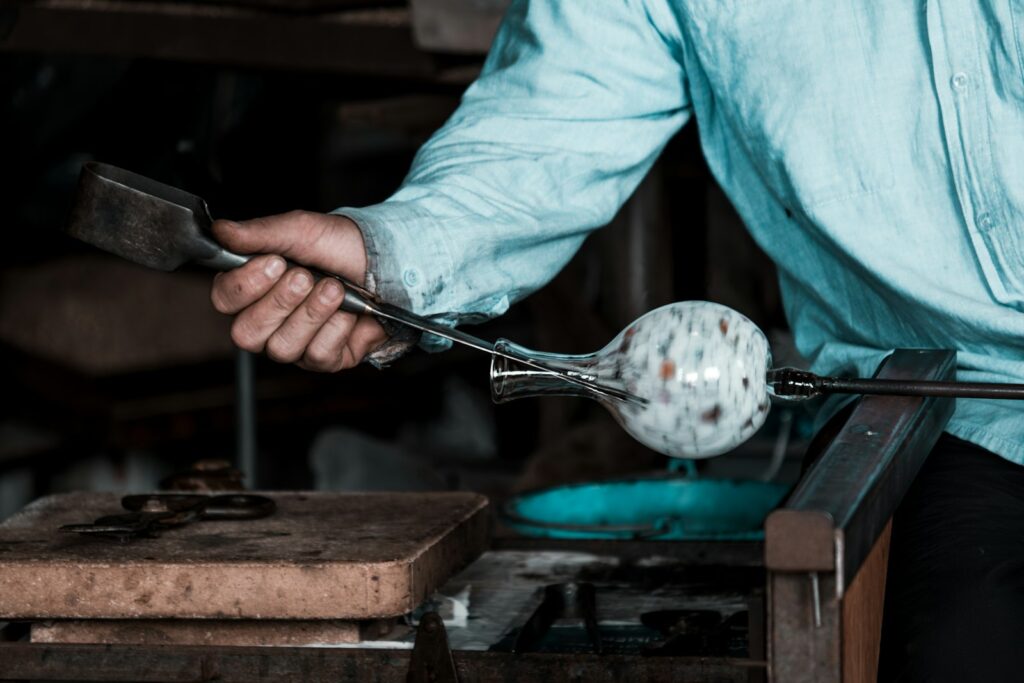
A furnace class uses molten glass gathered from a high-temperature furnace. The participant works with an instructor and may learn to rotate a blowpipe, blow air into the glass and use tools to help shape the object.
The glass can be worked at temperatures exceeding 1,000°C, so supervision and safety procedures are essential.
These sessions often begin with a demonstration and practice movements before participants approach the hot glass.
The master glassmaker may control the more difficult stages, particularly gathering the molten material, transferring it between tools, forming the opening and finishing the base.
A full beginner furnace lesson is generally more physically demanding and expensive than a short demonstration.
Lampworking classes
Lampworking, called lavorazione a lume in Italian, uses a concentrated flame from a torch to soften and shape glass rods.
It is commonly used to make beads, small ornaments and jewelry components.
Depending on the class, you may learn to rotate a glass rod, form a bead around a metal mandrel and add colors or simple decorative patterns.
A lampworking workshop can provide substantial hands-on experience without requiring the large furnace used to produce blown vessels.
However, the flame, tools and glass are still extremely hot. A bead-making class is not automatically suitable for young children merely because the finished object is small.
Glass jewelry assembly workshops
Some activities involve choosing previously made glass beads and assembling them into earrings, bracelets or necklaces.
These can be enjoyable creative sessions, particularly for younger children, but participants may not melt or shape glass themselves.
For example, a jewelry-making activity might provide a selection of colorful Murano beads and allow you to choose the arrangement and assemble a finished necklace.
If you want to experience working with molten glass, ask whether the session includes actual lampworking or only assembling prepared components.
What can beginners realistically make?
The finished object depends on the equipment, instructor and time available. Most introductory sessions offer a limited selection of projects rather than allowing participants to design anything they wish.
Small glass ornaments
A simple decorative ornament is a common beginner furnace project. The instructor helps the participant create a basic form, sometimes using colored glass.
Small ornaments can be easier to complete than functional drinking glasses because they may require fewer finishing operations.
However, even a small object must be formed, separated from the working tool and cooled appropriately.
Ask whether the ornament will include a hanging loop or another feature if you intend to display it at home.
Bowls and tumblers
Some furnace workshops allow beginners to attempt a small bowl or tumbler, often with considerable assistance from the glassmaker.
For example, during the September 2026 Venice Glass Week, a workshop organized with Franco Schiavon Glass Studio offered participants the choice of a traditional Murano tumbler, known as a goto, or a small bowl, alongside a simpler ornament option.
These projects require more control over the glass’s shape, thickness and temperature.
Do not assume that the finished vessel will be suitable for ordinary food or drink use. Ask whether the studio considers it food-safe and whether it can tolerate hot liquids or dishwasher cleaning.
A handmade drinking glass may be intended for cold drinks and handwashing only, depending on the materials and finishing process.
Small vases and glass flowers
Some studios offer a small vase or decorative flower as a beginner project.
These objects may involve working with molten glass, applying color and using tools to create the final shape.
A studio might describe the experience as making your own vase, but the instructor may perform much of the precision work.
Ask which parts you will complete independently and whether the finished piece will be substantially shaped by the master glassmaker.
Glass beads and pendants
In a lampworking class, a beginner may create one or more glass beads or small jewelry components.
Depending on the workshop, you might select colors, learn to create a round bead and add decorative dots or lines.
Some classes include the opportunity to assemble the finished bead into a pendant or bracelet.
For a short activity, a bead or pendant can be a more manageable project than a blown vessel. It may also be easier to pack and transport home.
Nevertheless, the completed glass must cool safely before it can be handled or assembled into jewelry.
How much work will you actually do yourself?
The term “make your own glass” can describe several levels of involvement.
In one workshop, the participant might blow briefly into a pipe while the master controls the shape. In another, the participant may gather glass, rotate the pipe, use shaping tools and work directly at the glassmaking bench with close instruction.
Both may be advertised as hands-on experiences, but they require different amounts of skill and provide different learning opportunities.
Before booking, ask the operator to identify which activities you will perform:
- Watch the master glassmaker demonstrate the process.
- Practice basic movements with tools before working with hot glass.
- Gather molten glass from the furnace.
- Rotate and control the blowpipe.
- Blow air into the glass to form a bubble.
- Apply colors or decorative materials.
- Use tools to shape the piece.
- Complete the final shaping and finishing with the instructor.
Not every step is appropriate for a beginner. It is reasonable for the master to handle operations that require specialist training.
The useful distinction is whether you actively learn and perform meaningful parts of the craft or simply watch someone else create the object.
Ask the studio how much individual time each participant receives at the furnace or torch. A two-hour group workshop with six participants may provide less working time per person than a shorter private class.
How long do Murano glassmaking classes take?
Duration depends mainly on the technique and whether the session includes a factory tour, practice exercises or several participants taking turns.
Short demonstrations: approximately 15 to 30 minutes
These generally involve watching a professional glassmaker work. Some include an explanation of the tools and the production process.
They are suitable when you have limited time or are mainly interested in seeing a furnace operating.
Short creative sessions: around 45 to 90 minutes
These may involve lampworking, choosing and assembling glass beads or participating in a simple assisted activity.
The actual time spent working with molten glass varies. A participant might only operate the torch briefly while the instructor completes the more demanding stages.
Beginner furnace workshops: around two to three hours
This is a common format for substantial hands-on glassblowing.
For example, Original Murano Glass advertises a beginner furnace workshop lasting approximately two to three hours, involving a demonstration, introduction to the equipment and the creation of a small object with a master glassmaker.
Wave Murano Glass also offered a dedicated beginner glassblowing class during the 2026 Venice Glass Week, introducing work at the bench and reheating furnace.
These are individual studio offerings, rather than a standard duration applying across Murano.
Multi-day courses
If you want more than an introductory experience, specialist schools offer longer training in furnace work or lampworking.
For example, MUVE Academy, associated with Venice’s Civic Museums Foundation, publishes a 20-hour basic lampworking course involving safety, glass rods, techniques and bead decoration.
These programs are intended for more systematic learning and are different from a short activity fitted into a sightseeing day.
For most visitors spending only a few days in Venice, a short or half-day workshop will be more practical.
Why the finished glass may not be ready the same day
Glass made in a furnace must cool under controlled conditions. Taking a newly formed object directly from the working area into ordinary room temperature could cause internal stress, cracking or breakage.
The process of controlled cooling is called annealing, or ricottura in Italian.
The finished object is placed in a special oven, called an annealing kiln or forno di ricottura, where its temperature is reduced gradually according to the type and thickness of the glass.
This process can take many hours. Some workshops require overnight cooling, while others advise collection 24 to 48 hours after the class.
The Franco Schiavon experience advertised during the 2026 Venice Glass Week, for example, specified collection after 24 to 48 hours, with shipping available at an additional cost.
Lampworked beads may cool more quickly, depending on their size and the process used. Some short workshops arrange same-day collection, but this is not universal.
Do not assume that finishing the practical activity means the glass is ready to carry away. Confirm the actual collection time before booking, especially if you are leaving Venice the same evening.
What if the finished object breaks during cooling?
Glass can break during forming, transferring, annealing or finishing, even when handled by an experienced professional.
A beginner’s object may also contain irregularities that make it more vulnerable to breakage.
Ask the studio what happens if the piece cracks during the lesson or cannot be successfully annealed.
Possible arrangements include allowing you to make another object if time permits, providing a replacement made by the artisan or offering another agreed remedy.
These policies differ between studios. For example, the Franco Schiavon workshop described during Venice Glass Week specified that an object broken during annealing would be replaced with a similar piece.
If you are paying specifically for an object you personally created, ask whether a replacement will be made by you or by the artisan.
Also check what happens if a shipped piece arrives damaged. The shipping and breakage policies should be included in the booking confirmation.
Can children participate in glassblowing workshops?
Children may be able to join some glassmaking activities, but minimum ages vary considerably according to the technique, equipment and studio safety policy.
There is no single minimum participation age covering every Murano experience.
Children under 8
For younger children, watching a furnace demonstration or assembling jewelry from prepared glass beads is generally more appropriate than handling molten glass.
Some studios welcome children as observers, while others limit access to working areas because of the heat, sharp materials and equipment.
Ask whether your child may enter the furnace viewing area and whether a parent must remain with them.
If you choose a jewelry activity, confirm whether the children will work only with cooled glass and suitable assembly tools.
Children aged 8 to 11
Some studios offer adapted lampworking experiences in which children select colors, help plan a bead and assist the artisan without independently controlling the flame.
For example, a workshop organized by The Glass Soul during the 2026 Venice Glass Week allowed children aged eight to eleven to participate in choosing and assembling jewelry while the artisan controlled the hot-glass process.
That is different from an adult course in which participants independently work glass rods over a torch.
Ask whether the child’s participation involves actual manipulation of hot glass or selecting materials and working with cooled components.
Children aged 12 to 15
Some studios allow older children and teenagers to try selected hot-glass techniques under close supervision.
Others impose a higher minimum age for furnace work. Original Murano Glass, for example, currently states on its detailed furnace-class page that children under fourteen may attend but cannot handle hot glass.
Because policies can differ even between experiences offered by the same business, obtain confirmation for the exact class and child’s age.
Teenagers aged 16 and older
Some furnace experiences accept teenagers aged sixteen and older when accompanied by a parent or responsible adult.
For example, the 2026 Franco Schiavon workshop recommended its beginner blown-glass ornament activity for participants aged sixteen and above, with parental accompaniment required for minors.
The studio still needs to assess whether the participant can follow safety instructions and safely handle the equipment.
A minimum age is an eligibility requirement, not a guarantee that the activity will suit every teenager.
What safety precautions should a working glass studio provide?
Furnace glassblowing is a specialist activity involving extreme heat, molten material, heavy tools and hot surfaces.
A professional beginner workshop should start with a safety briefing explaining the working area, tools and permitted activities.
Participants should not handle equipment until the instructor has demonstrated its use and given permission.
Important arrangements include:
- Protective equipment: Suitable eye protection and other equipment appropriate to the technique.
- Instructor supervision: Close guidance while participants work near the furnace or torch.
- Clear working areas: Safe separation between active glassmaking positions and observers.
- Appropriate clothing: Clothing that reduces exposure to heat and cannot easily become caught in equipment.
- Ventilation: Suitable ventilation for the furnace, torch and materials being used.
- Emergency procedures: Staff who know how to respond to burns, broken glass and other incidents.
- Suitable equipment: Tools and workstations appropriate for the participant’s age, height and ability.
Ask whether the instructor has experience teaching beginners rather than only producing glass professionally.
Someone who is skilled at making glass may still need additional teaching experience to introduce an unfamiliar visitor safely to hot equipment.
What should you wear to a furnace workshop?
Many furnace studios require closed-toe shoes and recommend comfortable clothing made from natural fibers.
For example, the Franco Schiavon workshop advertised during Venice Glass Week recommended non-synthetic clothing and closed-toe shoes. Its listing also confirmed that safety glasses and protective equipment were supplied.
Synthetic fabrics can behave differently from natural materials when exposed to heat. Follow the studio’s specific clothing requirements rather than assuming ordinary sightseeing clothes are suitable.
As a practical starting point:
- Wear closed-toe shoes rather than sandals or flip-flops.
- Choose long trousers when required.
- Avoid loose, dangling sleeves or scarves.
- Tie back long hair.
- Remove hanging jewelry that could interfere with equipment.
- Wear the protective glasses and other equipment supplied by the instructor.
Some workshops specify jeans or particular fabrics, while lampworking schools may recommend long sleeves and covered legs.
Ask for the complete clothing requirements when booking. Arriving in unsuitable clothes could prevent you from participating.
Heat, standing and accessibility considerations
A working furnace can be physically demanding even when the class is designed for beginners.
Participants may need to stand for extended periods, rotate a heavy blowpipe, move between workstations and remain close to a source of intense heat.
If you have limited mobility, difficulty maintaining balance, respiratory sensitivities or a condition affected by heat, discuss the environment and exercises before booking.
Ask whether the session can be adapted for seated participation or whether a companion may assist.
The workshop’s physical access also matters. Some studios occupy old industrial buildings with steps, uneven floors and limited restroom facilities.
For example, Venice Glass Week identified accessible facilities at some participating furnace workshops while explicitly marking other artisan studios as inaccessible.
Those descriptions belong to the individual premises and should not be generalized across Murano.
If you use a wheelchair or walking aid, confirm step-free access to the actual classroom, not only the showroom. Also ask about suitable workbench height, passage width and an accessible restroom.
A short demonstration viewed from a designated seating area may be more appropriate when active furnace work is not physically suitable.
How many participants share the instructor?
Group size affects how much time you spend actively making glass.
Some beginner furnace experiences are limited to small groups, while others reserve a complete session for a private party.
For example, Original Murano Glass currently limits its advertised furnace workshop to six participants. Other studios operate with smaller groups or individual instruction.
Ask whether the price includes exclusive teaching or whether unrelated visitors may join.
Also clarify whether everyone works at the same time or takes turns at one workstation.
In a group of six, a substantial part of the class may involve watching other participants. That can still be educational, but the individual hands-on time should be explained.
For someone who particularly wants to learn the technique, a private or very small group may be worth considering.
For a couple mainly interested in trying glassblowing once, a shared class may provide sufficient instruction at a lower total price.
How much do beginner glassmaking workshops cost?
Prices vary substantially because the term glass workshop covers very different techniques and levels of participation.
A short demonstration may cost only a few euros, while an intensive private furnace session can cost several hundred euros per person.
Current published 2026 examples include:
- Glass bead and jewelry activities: The Glass Soul advertised lampworking-related experiences during the 2026 Venice Glass Week at €70 for adults, €60 for participants aged twelve to sixteen and €50 for children aged eight to eleven, with different levels of practical participation.
- Beginner furnace instruction: Wave Murano Glass listed a hands-on beginner class at €245 per person during the September 2026 festival.
- Fuller furnace workshops: Original Murano Glass currently advertises a two- to three-hour beginner class starting at €360 per person.
- Individual blown-glass projects: The 2026 Franco Schiavon experience listed an ornament at €80, a bowl at €120 and a traditional tumbler at €150.
These are prices for particular experiences, and some relate to a completed September 2026 festival. They are useful examples of the differences between activities but should not be treated as standard rates or guaranteed future availability.
Before comparing two workshops, confirm the technique, individual working time, group size and what is included in the fee.
A €70 jewelry activity in which a child chooses colors while the artist controls the flame is a different service from a €245 furnace lesson involving direct supervised work with molten glass.
What should be included in the price?
A clear workshop quotation should identify the materials, teaching arrangements and the finished object you will receive.
Before paying, establish whether the price includes:
- Use of the furnace or lampworking equipment.
- A professional instructor for the booked duration.
- All glass and colors needed for the agreed project.
- Safety equipment.
- Any required protective clothing or apron.
- One finished object per participant.
- Controlled cooling and finishing work.
- Collection or packaging.
- Shipping, if required.
- A certificate or other documentation, if advertised.
- Transport to and from the workshop, if specifically included.
- Taxes and booking fees.
Ask what happens if you select a larger object or additional colors. Some workshops have a fixed project price, while others charge more for particular forms or finishes.
Also check whether a non-participating companion may watch without paying. Some studios permit observers, while others limit access to the working area or charge for additional visitors.
Shipping your finished glass home
Shipping can solve the collection problem when your stay in Venice is short, but it should be arranged before you pay for the workshop.
Ask whether the studio regularly ships glass internationally and how it packages fragile objects.
Important questions include:
- How much does shipping cost to your country?
- Is the price based on the object’s size or weight?
- Does the shipment include tracking?
- Is the glass insured against loss or damage?
- Who is responsible for customs documentation?
- Could you have to pay import taxes or handling charges?
- What happens if the object arrives broken?
- When will the workshop dispatch the finished piece?
Do not assume that a small object costs very little to ship. Proper protection may require a box substantially larger than the glass itself.
If you are staying in Venice for several more days, collecting the piece personally may be simpler and less expensive.
If you plan to carry the object home, ask for protective packaging and check whether the size is suitable for your airline’s cabin baggage allowance.
Where are the workshops located on Murano?
Murano is a collection of connected islands north of Venice’s historic center. Glass furnaces, small artisan studios and showrooms are spread across several neighborhoods.
A workshop may be near Murano Faro, along Fondamenta dei Vetrai, around the Da Mula area or elsewhere on the island.
The exact address determines which vaporetto stop is most convenient.
For example, Original Murano Glass operates on Fondamenta San Giovanni dei Battuti near Murano Faro, while Wave Murano Glass is on Fondamenta da Mula.
Do not assume that all Murano glassmaking activities take place within a few minutes of the same public transport stop.
Also check the location carefully when booking through a marketplace. Some glassworking studios operate in Venice’s historic center rather than on Murano itself.
A workshop in Castello can still teach Venetian glass techniques, but it will not provide a visit to a working Murano island furnace unless that visit is separately included.
Ask for the full address and a map pin before reserving.
Getting to Murano from Venice
Murano is accessible by ACTV public water buses, known as vaporetti.
Common connections include Line 3 from the Piazzale Roma and railway-station area, Lines 4.1 and 4.2, and Line 12 from Fondamente Nove toward Murano Faro.
The best service depends on your starting point and the workshop’s location.
ACTV restored services through Murano’s internal Grand Canal and reopened the Murano Da Mula stop on September 1, 2026, following work around Ponte Longo. This affected the routes and schedules of Lines 3, 4.1 and 4.2.
Check the official ACTV service update and current timetable before traveling.
Allow time for the boat journey, waiting at the stop and walking to the studio. From many central Venice locations, the full journey can take 30 to 60 minutes, depending on the connection and departure point.
Arriving at the island is only part of the journey. A glass workshop may require a further walk through Murano’s streets and across its bridges.
Should you book a private water taxi?
Some glass factories can arrange a private water taxi to collect visitors from Venice.
This may be convenient for larger groups or families who prefer a direct transfer, but it can add substantially to the cost.
Original Murano Glass, for example, currently advertises an optional water taxi transfer costing approximately €100 for a group of up to ten people, paid directly to the driver. That is an example from one company, not a general Venice water-taxi tariff.
Ask whether the quotation covers a one-way or return journey and whether the boat can collect you directly from your accommodation.
A hotel pickup may involve walking to an authorized pier rather than boarding immediately outside the property.
For most independent travelers, the public vaporetto provides a practical and less expensive way to reach Murano.
Can you combine a glass workshop with the Murano Glass Museum?
Yes. The Museo del Vetro explains the history of Murano glass, from earlier production techniques to modern design.
It is located at Fondamenta Marco Giustinian 8 and contains historical glass objects, decorative works and examples of specialist techniques.
The museum is separate from the working furnaces. An ordinary museum ticket does not include a hands-on glassblowing class.
Under the current published schedule, the museum is open daily:
- April 1 to October 31: 10 a.m. to 6 p.m., with last admission at 5 p.m.
- November 1 to March 31: 10 a.m. to 5 p.m., with last admission at 4 p.m.
Check the official Glass Museum opening information before planning your day.
If your workshop lasts two or three hours, a museum visit afterward can provide more historical context, but allow enough time for lunch and travel between the locations.
For a broader itinerary, the Italy on Foot guide to visiting Murano from Venice explains how to organize a day on the island.
How to tell whether the glass is genuinely made on Murano
Many visitors assume that an item purchased from a Murano shop must have been manufactured on the island. This is not always the case.
If authenticity matters, ask where the object was made and who produced it.
The Vetro Artistico Murano trademark is a regional designation managed by Consorzio Promovetro. It identifies eligible artistic glass produced on Murano under the trademark’s requirements.
The consortium explains the system and how to verify its labels through its official authenticity information.
Not every genuine artisan object necessarily carries this particular trademark, so the absence of the label alone does not prove that an item was made elsewhere.
For a workshop, ask whether the piece you create is made in the studio on Murano and whether any certificate supplied refers specifically to its production or simply confirms your participation.
A certificate of attendance and a certificate describing the origin of a glass object are different documents.
Will you have to visit a showroom or buy something?
Some furnace demonstrations end in a showroom where visitors can browse glass objects available for purchase.
That is a common part of Murano’s visitor economy, but it should not be confused with the practical workshop itself.
Ask whether a showroom visit is included and whether purchases are entirely optional.
For an activity focused on learning, the workshop fee should clearly describe the instruction and object you are paying for.
Be cautious if a listing emphasizes a free factory visit and private boat transfer but provides little information about how much time you will actually spend learning or making glass.
If you are interested in buying finished glass, the Italy on Foot Venetian shopping guide covers practical ways to assess artisan souvenirs and ask about their origin.
Planning the workshop around your Venice itinerary
A two-hour furnace class can easily occupy half a day once you include travel to Murano, check-in and the return boat journey.
For example, a morning appointment may leave time for lunch and the Glass Museum afterward. An afternoon appointment may work better if you plan to explore Murano before the class.
However, avoid scheduling a timed museum visit immediately after a hands-on furnace session. The workshop may take longer than expected when several participants need individual instruction.
Some furnaces do not offer the same workshop schedule every day, especially on Sundays, public holidays or during seasonal production closures.
Ask whether the studio will definitely operate on your date. For travel in 2027, confirm the new calendar and prices when booking rather than relying on activities advertised for the 2026 Venice Glass Week.
You can use the Italy on Foot trip planner to organize the workshop alongside transport, museums, meals and other Venice activities. Record the workshop address and return collection arrangements separately if the glass will not be ready on the same day.
Booking and cancellation policies
Glassmaking workshops often require reservations because the studio must allocate equipment, working time and an instructor.
Some collect full payment when booking, while others request a deposit or allow payment on arrival.
Cancellation policies can be stricter for private furnace sessions than for ordinary factory demonstrations.
Ask what happens if:
- You cancel before the scheduled session.
- Your train or vaporetto is delayed.
- You reach the workshop after the class has started.
- The furnace develops a technical problem.
- The instructor becomes unavailable.
- You cannot participate because you do not meet the clothing or safety requirements.
- You become uncomfortable with the heat and decide to stop.
- The object breaks during production or cooling.
- You must leave Venice before the piece is ready.
Also check whether the studio may substitute a different instructor, technique or finished object if the original arrangement becomes unavailable.
A short torch-based session should not automatically replace a full furnace-blowing lesson without your agreement if the furnace activity was the reason for booking.
Ask whether you would receive a refund, a rescheduled class or an alternative activity, and obtain those terms in writing.
Questions to ask before booking a Murano glassblowing workshop
Send the studio your preferred date, the number and ages of participants, and the type of glassmaking you want to try. Then confirm the details that determine what you will actually experience.
- Is this a demonstration, furnace glassblowing class, lampworking lesson or jewelry assembly activity?
- Will I personally work with molten glass, or mainly watch the artisan?
- Which stages will I perform myself?
- What parts will the master glassmaker complete for me?
- What objects can beginners make during this session?
- Can I choose the shape and colors?
- Is one finished object included in the price?
- How long does the workshop last, including the demonstration and safety briefing?
- How much individual hands-on time will I receive?
- How many participants share the instructor and equipment?
- Is the session private or shared with other visitors?
- What is the minimum participation age?
- Can younger children attend as observers?
- What safety equipment is provided?
- What clothing and footwear are mandatory?
- Does the instructor have experience teaching complete beginners?
- Can the activity accommodate any relevant mobility or health requirements?
- Will the class be taught in English?
- Does the object need overnight annealing or additional finishing?
- When exactly can I collect my finished glass?
- Can the studio ship it if I cannot return?
- What are the shipping cost, insurance and breakage arrangements?
- What happens if the piece breaks during production or cooling?
- Is the finished object suitable for food, drinks or dishwasher use if it is a vessel?
- Is any authenticity documentation or participation certificate included?
- Where exactly is the workshop located, and which vaporetto stop is closest?
- Is transport from Venice included or arranged separately?
- Are showroom visits and purchases entirely optional?
- What is the total cost, including materials, finishing, taxes and booking fees?
- What are the cancellation, late-arrival and rescheduling conditions?
For beginners who mainly want to see traditional techniques, a short furnace demonstration is sufficient and avoids the cost and physical demands of making glass. A lampworking class is more suitable when you want to create a small bead or jewelry component. If your goal is to blow and shape a vessel at a working furnace, choose a longer session that explicitly confirms hands-on participation with a master glassmaker.
The last detail to settle is collection. Before paying, get written confirmation of the project, how much of it you will make yourself and when it can safely leave the studio. If you are departing Venice the next day, an object requiring 24 to 48 hours of cooling may need to be shipped rather than collected personally.