Glass-bead jewellery workshops in Venice let you make a bracelet, pendant, necklace or earrings using traditional Venetian glass. Most beginner experiences last between one and two hours, although the activities vary considerably. Some teach you to create a glass bead using a torch, while others provide finished handmade beads that you select and assemble into jewellery. The second option is usually easier when you want something ready to wear immediately.
Before booking a Venice glass bead workshop, confirm whether you will actually shape molten glass or work with prepared beads, how many pieces you can make and whether the finished jewellery is included in the price. Beads made over a flame may need controlled cooling before they can be worn. If you are leaving Venice the same day, collection and shipping arrangements are as important as the workshop itself.
What can you make during a glass-bead jewellery workshop?
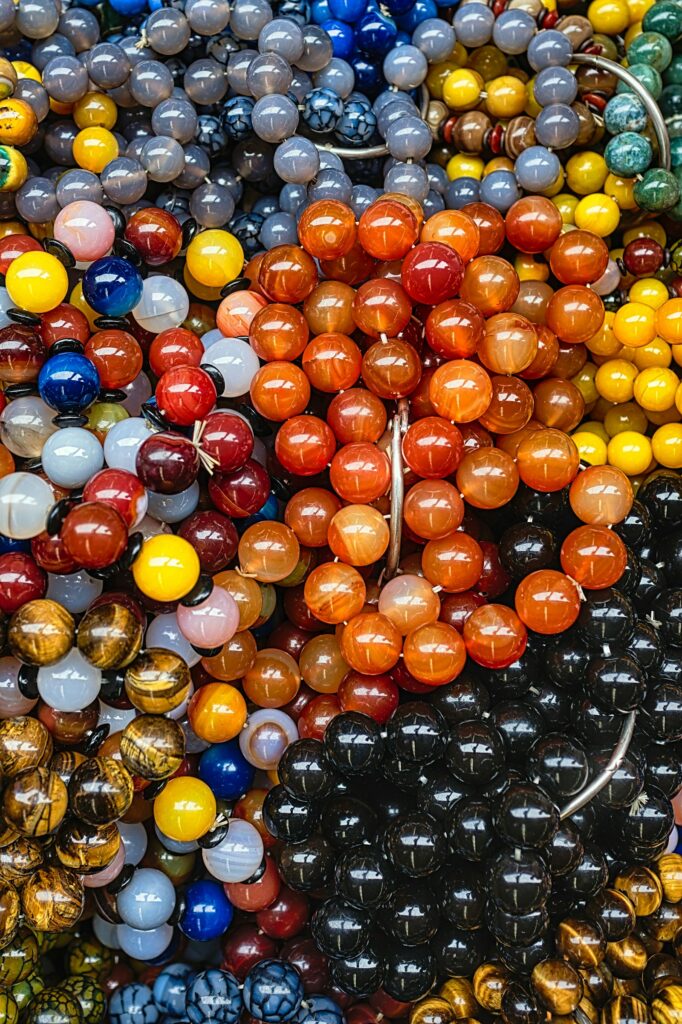
Most introductory workshops concentrate on one small wearable object. The available choices depend on whether you are making the glass components yourself or selecting beads already prepared by the artisan.
A glass-bead bracelet
Bracelets are a practical beginner project because they can be made from a small selection of finished beads and relatively simple jewellery components.
You might choose several colors, arrange the beads into a pattern, add smaller spacer beads and finish the bracelet with an elastic cord or metal clasp.
Some studios offer large individual beads as the main feature of the bracelet. Others allow participants to choose a wider selection of smaller glass beads.
A bracelet also makes sense for travelers who want to wear their creation during the rest of the holiday. If the workshop uses prepared beads, the finished piece can often be taken away immediately.
Ask whether the bracelet is made to your wrist measurement. A bracelet that is too loose can slip off, while one that is too tight may be uncomfortable or put unnecessary strain on the stringing material.
A pendant or necklace
A pendant is another manageable project for beginners. You might create one decorative glass bead and then have it attached to a cord or chain.
Some lampworking workshops offer pendants as a project alongside ordinary beads. The artisan may help shape the glass and prepare a suitable attachment once the piece has cooled.
A necklace made from several prepared beads involves a different process. You select the arrangement, decide how the beads should hang and assemble the necklace using suitable stringing materials and a clasp.
Before booking, ask whether the chain, cord and fastening are included. A class described as making a glass pendant may provide only the glass component, with the jewellery attachment charged separately.
A pair of earrings
Earring workshops can be suitable for participants who enjoy choosing colors and working with small components.
A typical beginner project might involve matching two glass beads, adding metal findings and attaching them to hooks or studs.
Creating two nearly identical beads directly over a flame is more difficult than selecting a matching pair from an artisan’s collection. This is particularly relevant when the session is short.
If you specifically want to make the glass yourself, ask whether you will create both beads and whether the instructor will help achieve a reasonably matched pair.
Also confirm what type of earring findings are supplied. If you do not have pierced ears, ask whether clip-on fittings are available.
A decorative glass ring
Some contemporary glass jewellery workshops offer rings, although the technique may differ from ordinary bead-making.
The glass artist may shape a solid glass form using a torch or create a decorative component that is later attached to a separate ring fitting.
Ask whether the ring will be made entirely from glass, whether it includes a metal setting and how the studio determines the correct size.
Glass rings can be more vulnerable to knocks than conventional metal rings. If you want something suitable for everyday wear, discuss durability and care with the instructor before choosing this project.
Three types of glass-bead workshops to understand
The biggest booking mistake is assuming every jewellery-making activity involves melting glass. Venetian studios offer several different formats, and each provides a different level of practical involvement.
1. Lampworking: making your own bead with a flame
Traditional lampworking is known in Italian as lavorazione a lume. The glass artist heats colored glass rods over a torch, then shapes the softened material into a bead or other small object.
In a hands-on beginner class, you may learn to rotate a metal rod, control the softened glass and add simple decorative colors.
The instructor demonstrates the technique, explains the safety precautions and guides you as you try the movements.
Some classes allow participants to work directly at the torch. Others restrict particular operations to the artisan, depending on the participant’s age and experience.
This is the format to choose if your main interest is learning how Venetian glass beads are made.
However, the finished bead may need to cool slowly before it can be handled, removed from the metal rod and assembled into jewellery. Ask whether you will receive a wearable object during the same appointment or only the glass component later.
2. Bead selection and jewellery assembly
In an assembly workshop, the glass beads have already been made and cooled. Your task is to design a piece of jewellery using them.
The instructor may introduce different bead shapes and techniques, then help you select colors, arrange the components and attach suitable fastenings.
This format is usually less physically demanding because participants do not work near molten glass or operate a torch.
It is also easier to arrange for families, visitors with limited time and people who want to take their finished jewellery away immediately.
The main thing to clarify is how much creative work you will do. Some sessions teach participants to string and fasten the jewellery themselves, while others involve selecting a design that the artisan then assembles.
Both can produce personalized pieces, but they offer different levels of hands-on learning.
3. Glassmaking demonstration followed by jewellery assembly
Some workshops combine the two experiences. You first watch a glass bead being made over a flame, then choose finished beads and create a bracelet or another small piece.
For example, Alchimia Vitrum currently describes a one-hour experience divided into a 30-minute lampworking demonstration and a 30-minute bracelet-making session.
Participants observe the glassmaking process, then use beads already produced by the studio to create jewellery they can take home immediately.
This can work particularly well for visitors who want to understand the craft without handling hot glass themselves.
However, watching a new bead being made and assembling a bracelet from prepared beads is different from making that same bead and immediately wearing it.
Ask which beads you will use in the finished jewellery and whether you personally create any of them during the demonstration.
How are traditional Venetian glass beads made?
Venetian glass-bead making is a long-established craft. In 2020, UNESCO recognized the art of glass beads as intangible cultural heritage through a joint nomination by Italy and France.
The recognition covers traditional knowledge and techniques rather than a particular commercial product or workshop.
In Venice, two important production methods are perle a lume and perle da canna.
Perle a lume: beads made over a torch
For perle a lume, the artisan heats a glass rod until it becomes soft enough to work.
The softened glass is wound around a metal mandrel, called a mandrino, which creates the central hole of the bead.
By rotating the mandrel and controlling the heat, the artisan shapes the glass. Additional colors can be applied as dots, lines or other decorations.
Some techniques use thin glass rods, metallic effects or more complicated layers to create detailed patterns.
The finished bead must cool appropriately before being removed from the mandrel and prepared for use in jewellery.
A traditional bead-maker may be described as a perlera or perlero.
Perle da canna: beads made from glass cane
Another traditional technique begins with a hollow glass cane, known as a canna.
The cane is cut into sections that are then finished to create beads. More elaborate canes can contain layers of colored glass arranged into decorative patterns.
You may encounter murrine, small patterned glass sections often featuring flowers, stars or geometric designs.
The methods used to create cane-based beads are different from ordinary torch-based bead making.
A workshop where you string murrine beads into a bracelet does not necessarily teach you how to produce the patterned glass cane itself.
Conterie and smaller Venetian beads
Another term you may see is conterie, associated with small Venetian glass beads historically used in embroidery, decoration and jewellery.
Very small beads allow detailed color arrangements, but they can be challenging for participants with limited fine-motor coordination.
If a workshop advertises traditional Venetian beading, ask whether it involves threading small beads, creating larger lampworked pieces or combining several techniques.
What happens during a hands-on lampworking lesson?
A beginner lampworking session usually begins with an introduction to the tools and working environment.
The instructor explains how the torch works and demonstrates how the glass changes as it heats.
You may then practice holding and rotating a mandrel before working with molten glass. The instructor helps you control the movement and maintain an appropriate position relative to the flame.
Once the glass is ready, you may choose one or more colors and try forming a basic round bead.
More advanced effects, such as flowers, delicate lines or complex patterns, require additional skill. They may be demonstrated rather than taught in a short introductory class.
After shaping, the bead is cooled using the studio’s appropriate procedure. It may then need finishing work before being threaded or attached to a jewellery component.
Ask whether the session includes just one bead or several attempts. Some workshops offer enough time to practice with multiple pieces, while others concentrate on making one finished object.
How much of the glassmaking will you do yourself?
A listing that says “create your own bead” does not always mean you independently control every stage of production.
In some classes, participants use the torch directly while the artisan provides close instruction. In others, the artisan manages the flame and glass while visitors select colors, assist with limited movements and help design the finished object.
For example, during the September 2026 Venice Glass Week, The Glass Soul offered a workshop in which adults and teenagers aged twelve to sixteen participated actively in making glass objects. Children aged eight to eleven selected colors and shapes, helped the artisan and assembled the finished components into jewellery.
These arrangements reflected that particular event’s age groups and safety procedures, not a universal rule for Venetian workshops.
Before booking, ask the studio to identify which activities you will perform yourself and which will be completed by the instructor.
If using the torch is your main priority, obtain explicit confirmation that your chosen age group and workshop format permit it.
What if the glass bead needs to cool?
Hot glass is vulnerable to thermal stress when cooled too quickly. Beads made over a torch may need controlled cooling, known as annealing or ricottura in Italian.
Depending on the materials, bead size and technique, the studio may use a kiln to cool the glass gradually.
After cooling, the artisan may need to remove the bead from its mandrel, clean the hole and check the finished surface before it can be strung into jewellery.
This process matters when you have another activity or a train departure later that day.
Some workshops arrange shipping rather than immediate collection. For example, the Perlamadre lampworking lesson in Venice’s Dorsoduro district, listed through Homo Faber, provides a hands-on bead-making experience and specifies that the finished piece will be sent to the participant’s home.
Other studios may offer same-day collection when their methods and timetable allow it.
Before booking, establish:
- Will the bead be ready before the session ends?
- Does it require annealing or additional finishing?
- Can the bead be made into jewellery immediately?
- Must we return later or the following day?
- Can the studio ship the finished object?
- Is shipping included in the workshop price?
- What happens if the bead cracks during cooling?
If you want a bracelet ready to wear the same afternoon, a workshop using finished beads is generally the more straightforward option.
How to make sure the finished jewellery fits
Jewellery-making involves more than selecting attractive colors. The beads need to work together in a piece that fits securely and feels comfortable to wear.
For bracelets
Ask whether the instructor measures your wrist and allows you to choose between elastic, cord or a clasp.
The total length matters because large glass beads take up more space than thin metal or fabric components.
For a bracelet made with elastic, check that the material is strong enough for the weight of the beads and that the finishing knot is properly secured.
If the design uses a metal clasp, practice fastening it before leaving the workshop.
For necklaces
Choose the length according to how you want the necklace to sit. A short necklace close to the neck requires a different arrangement from a long pendant.
Ask whether the studio provides an adjustable chain or cord and whether alternative lengths are available.
Heavy glass beads may need stronger stringing materials than smaller decorative components.
For earrings
Glass beads can vary considerably in weight. A large pair may be attractive but uncomfortable for someone who normally wears lightweight earrings.
Ask to check the weight and choose suitable hooks, studs or clip-on fittings.
Also ask whether the pair is intended for regular use or occasional wear.
What if you have a metal allergy?
The glass itself may not be the main concern. Jewellery can include metal clasps, chains, hooks, spacer beads and other fittings that come into prolonged contact with the skin.
If you have a nickel allergy or sensitivity to certain metals, tell the instructor before selecting the design.
Ask which materials are used for the findings and whether suitable alternatives are available. Terms such as “silver-colored,” “hypoallergenic” or “nickel-free” should be clarified when a particular metal causes reactions.
For example, a silver-colored clasp may be made from plated base metal rather than solid sterling silver.
Similarly, some gold-colored components have a thin coating that can wear away over time.
If you require a specific material, such as titanium or a known grade of stainless steel, ask whether the studio can supply it and confirm the composition.
Do not assume that an expensive bead automatically comes with premium metal fittings.
Are glass-bead jewellery workshops suitable for children?
Many jewellery assembly activities can accommodate children, but the minimum age depends on the tools, materials and whether the session includes hot glassworking.
For young children, selecting finished beads and threading them with appropriate supervision is generally more suitable than using a torch.
Bead size matters too. Small loose components can present a choking risk, particularly for toddlers and children who put objects in their mouths.
Ages and participation rules vary:
- Children under 6: May need continuous parental help with a simple bead-selection or threading activity. Check whether the studio accepts children this young and whether all components are age-appropriate.
- Children aged 6 to 10: May enjoy designing a bracelet with prepared glass beads. Look for larger components and suitable stringing tools.
- Children aged 11 to 15: May be eligible for more detailed jewellery-making activities or supervised glassworking, depending on the studio.
- Older teenagers: Some workshops permit direct work with a torch under an instructor’s supervision, subject to minimum-age and safety requirements.
As one confirmed future example, the Peggy Guggenheim Collection has announced a family activity called The Joy of Glass for March 20, 2027. It is designed for children aged six to ten and involves a lampworking demonstration followed by making jewellery with existing Venetian glass beads. Participation is restricted to Family Card members, with a €3 contribution per child and advance registration required.
That event illustrates the distinction between watching hot glassworking and assembling a wearable item. It is a scheduled family activity rather than an ordinary workshop available every day.
For a commercial workshop, always ask whether parents must remain present and whether accompanying adults pay if they are not making jewellery themselves.
What safety precautions matter in a lampworking class?
Glassworking over a flame requires proper equipment, ventilation and close instruction. The glass rods, metal tools and finished objects can remain hot after they stop glowing.
Ask whether the studio provides suitable eye protection for the particular glass and torch, explains safe distances from hot equipment and supervises participants throughout the practical work.
Typical precautions include closed-toe shoes, secured long hair, clothing without loose hanging sleeves and appropriate protective equipment.
The exact requirements depend on the technique. Some instructors recommend long sleeves and clothing made from natural fibers.
Do not touch an apparently finished bead until the instructor confirms that it is safe. Glass can retain heat after its surface looks solid.
If children will be present, ask where they must stand during the demonstration and whether they are permitted near the torch workstation.
For an assembly-only class, the main concerns are different: small components, sharp wire ends, jewellery tools and safe use of fastenings.
How long should you book?
A short jewellery assembly workshop is usually easier to fit into a sightseeing day than a substantial lampworking lesson.
- 30 to 60 minutes: Suitable for a demonstration followed by making a simple bracelet from prepared beads, or a focused jewellery assembly session.
- 60 to 90 minutes: Often enough for more personalized jewellery design or an introductory hands-on bead-making activity.
- Around two hours: Better for learning basic torch techniques, practicing movements and creating a small glass component under supervision.
- Longer courses: Appropriate for visitors who want to develop lampworking skills, make several beads or study more involved decorative techniques.
Some workshops include time for selecting materials and discussing design ideas. Others reserve most of the session for technical instruction.
Ask whether the duration includes preparation, safety briefing, actual making time and final jewellery assembly.
For couples attending together, confirm whether you will each have a workstation or take turns using one torch.
How much do glass-bead jewellery workshops cost?
Prices differ substantially according to whether you are stringing prepared beads, making glass over a torch or receiving individual instruction from an artisan.
Current published examples from October 2026 include:
- Alchimia Vitrum: €60 per person for its one-hour demonstration and bracelet-making experience. Materials and the finished bracelet are included.
- Perlamadre: A 90-minute lampworking workshop listed by Homo Faber at €100 for one participant or €160 for two, with the finished glass sent to participants afterward.
- Huang Xiaozhe: A two-hour introductory lampworking workshop priced at €120 per person, with a published 20% per-person discount when two guests attend together.
- Muriel Balensi: A jewellery design and assembly experience advertised for the September 2026 Venice Glass Week at €65. This was an event-specific offering, and future availability requires confirmation.
These prices illustrate different types of activities. They are not a standard rate across Venice, and a past festival workshop should not be treated as a confirmed year-round booking option.
Some studios also price personalized jewellery according to the beads selected. For example, Alchimia Vitrum currently lists a bespoke jewellery service with a €35 consultation and assembly fee, plus the variable cost of the chosen beads.
That means the advertised starting amount may not be the total cost of the necklace or bracelet you design.
What should the workshop price include?
Before paying, request confirmation of the actual materials and finished object.
- The agreed duration and type of workshop.
- Instructor guidance in English, if required.
- All glass beads or glass rods needed for the project.
- Use of torch equipment and safety materials, where relevant.
- Jewellery findings, including chains, clasps, earring hooks or cords.
- One finished piece per paying participant.
- Any necessary cooling and finishing work.
- Protective packaging.
- Collection or shipping arrangements.
- Taxes, booking charges and any required additional fees.
Ask whether choosing premium beads, additional decorative elements or precious-metal findings will increase the total.
If you want a necklace rather than the standard bracelet, check whether the studio can accommodate that request within the same time and price.
Where are glass-bead workshops located in Venice?
Venetian bead-making is not restricted to Murano. Working bead-makers and jewellery artists also have studios in Venice’s historic center.
This matters because booking a workshop in Venice does not necessarily require a waterbus journey to Murano.
Studios in the historic center
Small artisan workshops can be found in neighborhoods such as Dorsoduro, Castello and San Polo.
For example, Perlamadre operates in Dorsoduro, while the contemporary glass jewellery artist Huang Xiaozhe has a studio in Castello, within walking distance of the San Marco area.
Alchimia Vitrum’s published studio address is Calle del Campaniel 1758, in San Polo.
These are separate locations, and the available activities differ. Check the specific lesson and address rather than choosing solely by neighborhood.
If you are staying near Rialto or San Marco, a workshop in the historic center may fit into your day without the additional travel involved in visiting Murano.
Workshops on Murano
Murano is closely associated with glass production and has studios specializing in lampworking, jewellery and larger furnace-made objects.
Some bead-making workshops operate near Murano Faro or other island stops, while additional studios are located along the island’s canals and quieter streets.
Murano can be a useful choice if you want to combine a jewellery workshop with a glass museum visit, a furnace demonstration or time browsing local galleries.
However, glass-bead jewellery classes and large-furnace glassblowing lessons use different equipment. Do not assume that every Murano furnace offers a small bead-making workshop.
Confirm the full address before arranging your transport.
Getting to Murano for a jewellery workshop
Murano is reached by ACTV public water buses, known as vaporetti. Connections include Lines 3, 4.1 and 4.2, depending on where you start in Venice and the service operating that day.
Fondamente Nove is a useful departure area for several Murano connections. Other services link the island with the railway station and Piazzale Roma.
Check the current stop and timetable using ACTV’s official transport information.
When choosing a workshop time, allow for waiting at the vaporetto stop, the boat journey and walking through Murano.
The exact stop matters. A studio near Murano Faro may be more conveniently reached from a different landing than one near the Glass Museum.
For a more detailed day-trip plan, see the Italy on Foot guide to visiting Murano from Venice.
If your session involves working with a torch, arrive at the agreed time so you do not miss the safety introduction. Some studios cannot extend the appointment when other bookings follow yours.
How to check whether the beads are genuinely Venetian
Venice has a long history of glass-bead production, but not every colorful bead sold in a Venetian tourist shop is necessarily made locally.
If origin matters, ask where the beads were produced and whether they were made by the studio itself.
The distinction is especially important when a workshop uses prepared materials. You may be assembling Venetian-made beads, Murano-made beads or components sourced from elsewhere.
The Vetro Artistico Murano trademark, managed by Consorzio Promovetro, is a protected designation identifying eligible artistic glass produced on Murano under its requirements.
You can learn about the trademark and its traceability features through the official Promovetro information.
Not every genuine handmade Venetian bead necessarily carries that particular trademark. The system concerns eligible products made on Murano, while traditional Venetian bead-making also takes place elsewhere in the lagoon and historic city.
UNESCO’s recognition of the art of glass beads is a recognition of cultural knowledge. It does not certify that an individual bracelet or necklace was handmade in Venice.
If a workshop advertises authentic Murano glass, ask whether the beads were actually made on Murano, whether the studio knows the producer and whether any relevant documentation is available.
How to look after the finished jewellery
Glass beads are relatively durable when properly made, but they can chip or break if dropped onto a hard surface.
Jewellery with many glass beads can also be heavier than a similar design made with plastic or lightweight materials.
Before leaving, ask the artisan how to clean and store the piece.
For most glass-bead jewellery, a soft cloth is a sensible starting point. Avoid exposing the metal fittings, cords or adhesives to harsh cleaning products.
Do not assume the finished bracelet or necklace can be worn while swimming, showering or using a sauna. Water, salt, chlorine and heat can affect stringing materials and metal components even when the glass itself remains unaffected.
Store delicate necklaces where they cannot become tangled, and avoid packing glass jewellery beneath heavy objects.
If the finished piece has a particularly large or irregular bead, ask how it should be protected during travel.
Can you carry the jewellery home on a plane?
Small glass bracelets, earrings and pendants are generally easy to pack in cabin luggage, subject to the relevant airline and airport security rules.
Place the jewellery in a rigid box or padded pouch so the beads cannot strike one another repeatedly.
If the object has a protruding glass decoration or unusually delicate shape, ask the studio for additional protection.
Do not carry torch equipment, sharp cutters or other workshop tools in hand luggage unless the applicable security rules expressly permit them.
If your bead is still cooling at the end of the class, do not try to persuade the studio to release it early. Arrange collection or shipping instead.
For other locally made items and practical purchasing advice, see the Italy on Foot Venetian shopping guide.
Planning the workshop around your Venice itinerary
A one-hour jewellery assembly experience can fit between sightseeing activities, particularly when the studio is in the historic center.
A two-hour lampworking lesson needs more time, especially if you must arrive early for safety instructions or return later to collect your bead.
If the appointment is on Murano, allow for the vaporetto journey in both directions. You may also want time for lunch or a visit to the Glass Museum.
You can use the Italy on Foot trip planner to organize the workshop alongside other Venice activities, transport and meal plans. If the glass will be collected later, record the pickup appointment separately from the class.
For a one-day visit to Venice, a workshop that includes an immediately wearable bracelet may be easier to manage than a hot-glass class requiring next-day collection.
Booking for 2027: what is confirmed?
The Peggy Guggenheim Collection has already published its March 20, 2027 family jewellery activity, but this is a specific event restricted to eligible Family Card members rather than a regular commercial workshop.
For most artisan studios, 2027 prices and schedules should be checked directly when booking.
The Venice Glass Week program from September 2026 provides examples of the different techniques and workshops offered by local artisans, but it does not establish which festival events will return in 2027.
Do not assume that a workshop advertised for a festival will be available throughout the year or that the same instructor will offer it on your travel dates.
If you want a particular artisan, request confirmation of the date, technique and finished object rather than relying on an older event listing.
Cancellation policies and missed appointments
Small artisan studios often reserve teaching time and equipment specifically for each booking. Cancellation conditions can therefore be stricter than those for ordinary attractions.
For example, Alchimia Vitrum’s published policy requests at least 48 hours’ notice for cancellation or rescheduling and states that cancellations inside that period are non-refundable. The studio also warns that arriving more than ten minutes late may shorten the session.
Other workshops use their own deposit, rescheduling and refund conditions.
Before paying, confirm what happens if:
- You need to cancel because your travel plans change.
- Your train or vaporetto is delayed.
- You reach the studio after the lesson begins.
- The instructor becomes unavailable.
- Equipment problems prevent the planned glassworking activity.
- You cannot participate because of an age or safety requirement.
- The finished bead cracks during cooling.
- You leave Venice before the object is ready.
- Shipping is delayed or the finished jewellery arrives damaged.
If the studio offers an alternative activity because the torch cannot be used, ask whether you may accept or decline it. A bracelet assembly session may be enjoyable, but it is a materially different experience from a hands-on lampworking lesson.
Questions to ask before booking a glass-bead jewellery workshop
Send the studio your preferred date, participant count, ages and the type of finished jewellery you want to make. Then confirm the details that determine what you will actually receive.
- Is this a lampworking class, a jewellery assembly workshop or a demonstration followed by assembly?
- Will I personally work with molten glass, or will the artisan make the bead?
- Which stages of the glassmaking process will I perform?
- Will I make a bracelet, pendant, necklace, earrings or another object?
- Can I choose my own design and colors?
- How many beads or finished pieces are included?
- Are the beads handmade in Venice or Murano, and can you identify their producer?
- How long is the session, including instruction and finishing?
- How much individual time will I spend making or assembling jewellery?
- Is the workshop private or shared with other participants?
- How many people will use the same workstation?
- What is the minimum participation age?
- Can younger children join with parental help?
- Must a parent remain present throughout the activity?
- Do accompanying observers need to pay?
- What protective equipment and clothing are required?
- Can you accommodate reduced mobility or difficulty with fine hand movements?
- Can the workshop accommodate specific metal allergies or material sensitivities?
- Are all chains, cords, clasps and other jewellery findings included?
- Can the jewellery be sized to fit the person making it?
- Will the completed item be ready to wear immediately?
- Does the glass need annealing or additional finishing?
- When can the finished jewellery be collected?
- Can you arrange shipping if collection is not possible?
- What happens if the bead breaks during cooling or shipment?
- Where exactly is the studio, and which vaporetto stop is closest if it is on Murano?
- Is the lesson conducted in English?
- What is the total price, including beads, metal findings, cooling, packaging and any other charges?
- What are the payment, cancellation and rescheduling conditions?
For visitors who want a wearable souvenir on the same day, a one-hour bracelet or jewellery assembly workshop using finished Venetian glass beads is usually the simplest arrangement. Choose a lampworking lesson if you particularly want to understand how the beads are made and are comfortable working under close supervision around a flame.
Before paying, establish whether the finished jewellery will contain a bead you personally created or one selected from the artisan’s existing collection. Then confirm the fittings, final price and collection time. Those details will tell you whether you are booking a hands-on glassmaking lesson, a personalized jewellery-design experience or a combination of the two.