A short leather-making workshop in Florence can leave you with a finished keyring, card holder, wallet, notebook cover, or belt, depending on the class and how much construction is involved. Simple accessories may take less than two hours, while more detailed projects can require three to six hours. A fully handmade handbag usually takes longer, especially when participants cut, stitch, and finish the leather themselves. Before booking, check what you will actually make, which steps you perform, and whether you can take the finished item home that day.
A Florence leather workshop is a practical way to learn some of the techniques behind the city’s leatherworking tradition. Beginner sessions generally provide tools, materials, and guidance, so previous sewing or craft experience is rarely necessary. The main difference between classes is how much of the item has already been prepared before you arrive.
What Can You Realistically Make in a Few Hours?
The size of the finished item does not always determine how long it takes. A small wallet with several compartments may involve more careful cutting and stitching than a simple leather belt.
These are useful planning ranges based on the types of short workshops currently offered in Florence. They are examples rather than standard course lengths, and a class using pre-cut components can be considerably shorter than one teaching every construction step.
Keyrings, luggage tags, and small accessories: 45 minutes to 1.5 hours
These are among the easiest projects for complete beginners. A participant may select a piece of leather, shape or trim it, make holes, attach metal hardware, and add initials or another personal detail.
Some short classes focus mainly on assembling prepared components. Others include more cutting, edge finishing, or hand stitching.
A keyring or luggage tag is a sensible choice if you have limited time, are traveling with children, or want to try leatherworking without committing to a lengthy session.
Ask whether the leather pieces arrive pre-cut. This makes a considerable difference to how much you learn about the actual construction process.
Card holders, coin purses, and simple wallets: 1 to 3 hours
Small wallets are popular beginner projects because they introduce several techniques while still being manageable within a short visit.
Depending on the design, you may choose the leather, trace a pattern, cut sections, punch stitching holes, sew the components together, and finish the edges.
Some Florence workshops advertise wallet-making sessions lasting around 45 minutes, while others offer two-hour or longer classes. The shorter format normally involves a more simplified construction process.
Before choosing, establish whether you are making a flat card sleeve, a coin purse, or a folding wallet with several compartments. These are quite different projects.
If learning to hand stitch leather is important to you, choose a class that explicitly includes cucitura a mano, meaning hand stitching, rather than one described only as wallet personalization.
Leather notebook covers: approximately 2 to 3 hours
A notebook or journal cover can be another practical single-session project. The work may involve measuring, cutting, folding, assembling, and finishing a piece of leather around a notebook.
For example, Florence’s Scuola del Cuoio currently describes a three-hour introductory course in which participants make a leather book cover with a blank journal inside.
The appeal of this format is that it offers more substantial leatherworking than a simple keyring without requiring the many separate pieces found in a structured handbag.
Confirm whether the notebook itself is included and whether you will be able to replace the paper insert later.
Leather belts: approximately 2 to 6 hours
Belt-making classes vary considerably. Some Florence artisans advertise a two-hour session in which beginners choose leather and hardware, prepare the strap, punch holes, and attach the buckle.
Other courses take considerably longer, particularly when participants do more hand stitching, detailed edge finishing, and personalization.
A belt can be a useful project if you want to learn how leather is measured and finished while making something you will actually wear.
Ask whether the finished belt is fitted to your waist or made to a standard size. You should also confirm whether buckle choices, leather colors, and monogramming are included.
Small handbags and totes: half a day to several days
This is where expectations need particular care. Some workshops advertise a small bag that can be assembled during one session, especially when the leather has already been cut and the design is simplified.
Making a more complicated bag from scratch involves additional steps such as pattern preparation, lining, pocket construction, handles, hardware fitting, and multiple stitching operations.
For comparison, one Florence workshop advertises a small leather bag project starting at 12 hours, while Scuola del Cuoio offers a two-day course for making a shopper tote by hand.
A short class promising a finished handbag may still be enjoyable and genuinely hands-on. However, ask how much of the bag is already prepared and which construction stages you will perform yourself.
If you have only two or three hours available, a wallet, belt, or notebook cover is usually a more realistic project for learning the fundamentals.
What Happens During a Leather-Making Class?
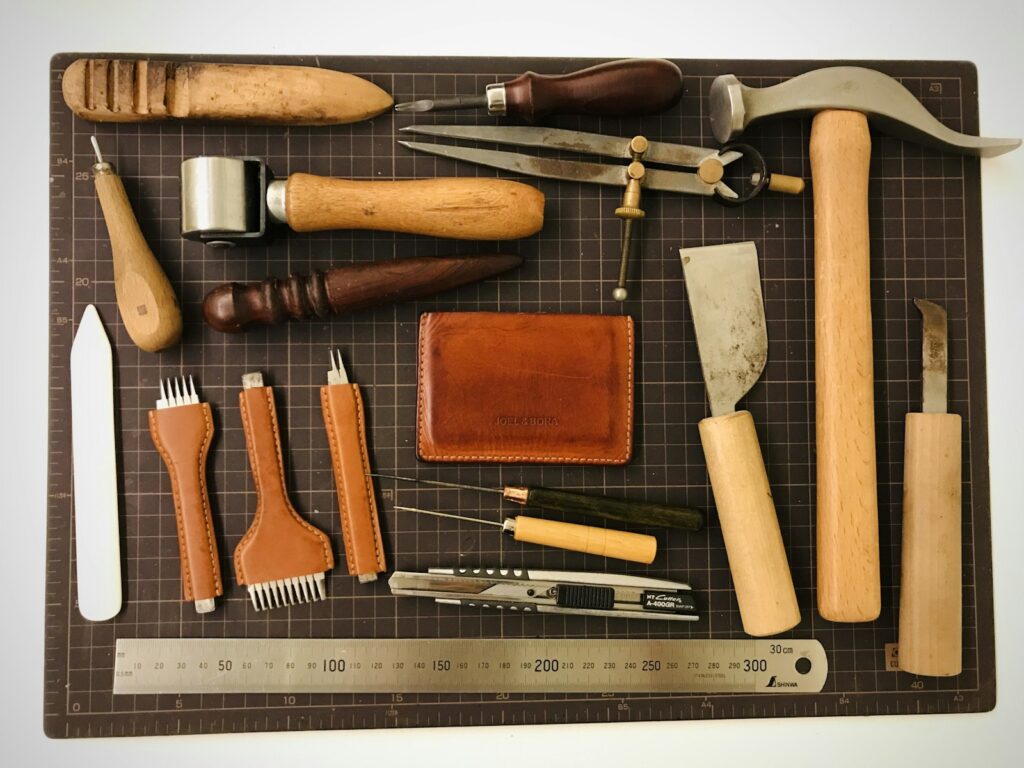
Most beginner workshops follow a relatively straightforward sequence, although the exact techniques depend on the chosen item.
- Introduction to the materials. The artisan explains the types of leather available, their thickness, texture, and suitability for different products.
- Choose a design. You select from the patterns, colors, or styles available for the session.
- Prepare the pieces. Depending on the course, you may trace a pattern, cut leather, or work with components already prepared by the artisan.
- Assemble the item. You may punch holes, stitch sections together, attach hardware, or apply appropriate leather adhesive.
- Finish the details. The instructor helps with edge treatment, trimming, polishing, and personalization.
- Check the finished piece. The artisan examines the construction and explains any care instructions before you take it away.
Do not expect every class to teach tanning, which is the process of converting animal hides into usable leather. That industrial or specialist process happens before the material arrives at most visitor workshops.
A short class concentrates on leather goods construction, known in Italian as pelletteria, rather than the entire production process from raw hide to finished accessory.
How Much of the Work Will You Actually Do?
This is arguably the most revealing question you can ask an organizer.
Different experiences use the word workshop to describe activities ranging from choosing colors and adding initials to constructing an item with hand tools.
Three common formats are worth distinguishing:
- Personalization session: You choose an existing product or prepared accessory and add initials, colors, decorative elements, or hardware. This is usually the shortest format.
- Guided assembly workshop: You use prepared leather components but carry out important steps such as stitching, fastening, and finishing.
- Construction-focused class: You learn to prepare patterns, measure, cut, punch, assemble, and finish an item. These sessions generally take longer.
None of these formats is inherently unsuitable. A family with an hour available may prefer a simple assembly session, while someone interested in craftsmanship may want to spend half a day practicing cutting and hand stitching.
Problems arise when the advertised description makes an assembly experience sound like a complete leather-making course.
Ask the organizer directly: “Will I cut and stitch the leather myself, or will the pieces already be prepared?”
Where Are Leather-Making Workshops Located in Florence?
Florence has a long association with leatherworking, especially around Santa Croce and in the artisan districts south of the Arno.
Leatherworking developed as an important local trade during the medieval period, with the historic guilds involved in tanning and processing hides. Visit Tuscany’s information on Florentine artisan traditions explains this history and the continuing presence of workshops in the city.
Santa Croce
The area around the Basilica di Santa Croce remains closely associated with leather goods, including workshops, specialist retailers, and the historic Scuola del Cuoio.
Some classes take place inside traditional working studios, while others are held in separate teaching spaces.
Check the precise class address rather than assuming that the retail entrance and workshop entrance are the same.
Oltrarno, Santo Spirito, and San Frediano
Oltrarno, on the south side of the Arno, contains artisan workshops involved in leatherworking, bookbinding, metalwork, jewelry, and other traditional crafts.
The districts around Santo Spirito and San Frediano can be particularly interesting if you want to combine a class with a walk through Florence’s artisan neighborhoods.
The official FeelFlorence artisan guide provides further information about the city’s traditional craft areas.
However, a shop displaying handmade leather products does not necessarily offer classes. Many artisans work on customer orders and can receive visitors only by appointment.
Studios outside the historic center
Some leather experiences take place in workshops, factories, or teaching facilities beyond central Florence, including nearby municipalities.
These may offer more space for demonstrations and group activities, but you need to check how to reach them.
A class advertised as being “in Florence” may actually require a taxi or a pre-arranged transfer. If transportation is offered, confirm whether the return journey is included.
How to Choose the Right Class Length
The most useful approach is to choose the project first, then check whether the course provides enough time to complete it properly.
- Less than 90 minutes: Choose a simple keyring, tag, or prepared wallet project. Expect limited time for detailed instruction.
- Two to three hours: Consider a card holder, wallet, notebook cover, or straightforward belt-making session.
- Four to six hours: Look for more detailed construction, additional stitching, or a substantial accessory that requires several operations.
- More than one day: Consider a structured handbag, tote, or another project involving pattern making and more complicated assembly.
These ranges are guides to the complexity of the work. The same item can take very different amounts of time depending on whether its components are pre-cut, stitched by hand, or assembled using specialist machinery.
One additional question is whether the published duration includes an introduction, a tour of the studio, or refreshments. A three-hour experience containing an hour-long walking tour leaves considerably less time at the workbench.
Group Size and How Much Instruction You Receive
Leatherworking involves tools and procedures that beginners may need help using correctly. Group size therefore matters, particularly for classes involving cutting, punching, and stitching.
A class with four participants and one instructor can offer a different level of individual attention from a larger group assembling prepared accessories.
Before booking, ask for the maximum number of participants and whether the class has one artisan or several assistants.
If you want to learn a specific technique, ask whether every participant will practice it independently. In some demonstration-focused sessions, the instructor performs the more complicated operations while guests complete the easier stages.
For a couple or family, a private class may allow the project and pace to be adjusted. However, private instruction does not automatically mean you can choose any item to make. The artisan may still work from a limited selection of patterns.
What Materials and Tools Are Included?
Most beginner classes provide the basic materials and tools needed for the advertised project. Nonetheless, the wording of the inclusions deserves attention.
Check whether the fee covers:
- The leather needed to complete your chosen item.
- All required metal hardware, such as buckles, rings, clasps, or fasteners.
- Thread, adhesive, edge finishes, and other consumables.
- Use of cutting, punching, and stitching tools.
- Personalization, such as stamped initials.
- The finished product that you will take home.
Some experiences include instruction and a demonstration but treat the finished accessory as a separate purchase. Others include the completed item in the workshop fee.
That distinction is particularly important when comparing experiences at different prices.
What type of leather will you use?
Florentine workshops may use vegetable-tanned leather, chrome-tanned leather, suede, or other finished materials depending on the project.
Cuoio conciato al vegetale means vegetable-tanned leather, produced using tannins derived from plant materials. It is commonly used in belts and other structured accessories, although its suitability depends on thickness and finish.
Softer leather may be used for wallets, bags, and more flexible products.
If you care about the origin or environmental characteristics of the material, ask about the tannery, type of leather, and any specific claims the organizer makes. Words such as “sustainable,” “Italian,” and “premium” do not describe the same characteristic.
Some workshops use deadstock leather, meaning leftover material from previous production. This can allow participants to work with unusual colors or textures, although availability may change.
Will You Take the Finished Item Home Immediately?
For most short visitor classes, taking home the finished project is a central part of the experience. However, you should confirm this before booking, particularly for leather bags or items requiring adhesive and additional finishing.
Some products can be used immediately. Others may need a period for adhesives or surface finishes to cure fully.
Ask whether you can put the item straight into your bag, wear it, or use it that evening. If special handling is necessary, the instructor should explain how long to wait.
For larger projects, establish whether the piece will be completed during the scheduled class or finished later by the artisan.
If an item must be collected on another day, check the collection hours. For travelers leaving Florence immediately after the workshop, ask whether shipping is available, who pays for it, and what happens if the finished item is delayed.
Are Leather Workshops Suitable for Children?
Some Florence leather-making sessions accept children from around six years old, while other courses are restricted to adults. There is no single minimum age across all providers.
The difference usually depends on the activity, tools, supervision, and structure of the class.
A child may enjoy choosing colors, assembling a prepared leather piece, or stamping initials. More demanding projects involving sharp cutting tools, heavy punching equipment, or long periods of careful stitching may be less suitable.
For families, ask:
- What is the minimum participant age?
- Must an adult accompany each child?
- Which tools will children be allowed to use?
- Can children complete the same project as adults?
- Is a shorter or simpler project available?
- Is the finished item included in the child ticket?
If the whole family wants to participate, confirm that enough workstations and materials are available. Some small studios have only a few seats, even when the booking page allows several people to enquire.
Accessibility, Hand Strength, and Workshop Comfort
Leatherworking often involves repetitive hand movements. Cutting, gripping tools, threading needles, and pulling stitches tight can be tiring for people with reduced hand strength or certain mobility conditions.
A short session may still be possible with assistance, but the organizer needs to understand the requirement in advance.
Ask whether the instructor can prepare particularly difficult components, offer suitable tools, or provide a simpler design.
Physical access should also be verified. Some traditional Florence workshops occupy old buildings with steps, narrow entrances, or limited space between workbenches.
For wheelchair access, check the entrance, workspace height, circulation space, and toilet facilities. Do not rely only on a general description of the workshop as accessible.
Leather dust, adhesives, dyes, and finishing products may also matter for participants with respiratory sensitivities or allergies. If you have a relevant sensitivity, request information about the products used and whether the workspace is adequately ventilated.
How Much Does a Short Leather Workshop Cost?
Prices depend on the project, instructor’s time, class size, and materials. Two classes of similar length can have very different costs.
For an indication of the range among individual providers, current advertised examples include a one-hour keyring workshop at €80 per person, a two-hour coin purse workshop at €100 per person, and a two-hour belt-making experience at €200 per participant.
These are individual provider prices, not an industry-wide average. They may change and should be checked against the actual booking dates.
Longer instruction can be substantially more expensive. For example, the published Scuola del Cuoio course information currently lists a three-hour book-cover workshop starting at €185 per person for groups of four to ten, with higher per-person fees for smaller groups. Its six-hour courses are priced separately.
When comparing prices, pay attention to how many participants share an instructor, whether the materials are included, and how much of the product you actually construct.
A lower-cost session may be sufficient for a simple keepsake. Paying more can make sense if you specifically want extended individual tuition or experience with more complicated tools and techniques.
Booking a Class: What to Confirm Before Payment
Most small workshops require advance arrangements, particularly for private instruction or projects needing preparation.
Some offer direct online reservations, while others ask visitors to send an enquiry specifying the preferred date, number of participants, and project.
Before paying, request confirmation of the following:
- Exact finished item: Wallet, card holder, belt, notebook cover, or another specified project.
- Hands-on activities: Which operations you will perform yourself and which are prepared in advance.
- Session length: Total duration and actual time at the workbench.
- Materials: What is included and whether certain leathers or hardware cost extra.
- Group size: Maximum participants and number of instructors.
- Collection: Whether the finished item is ready to take home the same day.
- Location: Full address, entrance instructions, and any transport arrangements.
- Payment: Total price, deposit, balance due, and accepted payment methods.
- Changes: Cancellation deadline, rescheduling conditions, and what happens if the instructor cancels.
If your class is scheduled for 2027, ask the organizer to confirm availability and prices specifically for that year. A current course description may explain the format without guaranteeing that the same dates, instructors, or fees will apply in 2027.
How to Fit a Workshop Into a Day in Florence
Most central workshops can be reached on foot from other parts of the historic city, although the exact walking time depends on your accommodation and the studio’s location.
For a two-hour class, allow additional time to find the entrance, check in, and collect your finished item afterward.
Do not schedule a timed museum entry immediately after the advertised finishing time. A project may require a few additional minutes for final adjustments, and the instructor may need to check each participant’s work individually.
If you have a morning workshop near Santa Croce, you could arrange your remaining sightseeing in that part of the city. For a class in Oltrarno, the surrounding streets offer opportunities to explore Florence’s artisan shops afterward.
The Italy on Foot trip planner can help organize your Florence itinerary around the class and other activities that require fixed entry times.
If you are visiting Florence specifically to shop for leather goods, the Italy on Foot guide to shopping in Florence also covers the main markets and artisan shopping areas.
Should You Choose a Workshop or an Artisan Demonstration?
Some visitors are primarily interested in seeing how leather products are made. For them, a guided workshop visit or demonstration may be sufficient.
A demonstration can involve watching an artisan cut material, operate specialist machinery, prepare a product, or explain how different leathers are selected.
A hands-on class requires more time and generally costs more because the instructor must supervise participants and provide materials.
Choose a workshop if you want to practice a skill and make something yourself. Choose a demonstration if you mainly want to understand the production process without spending several hours working at a bench.
There is also a middle ground: some experiences combine a short introduction to the craft with a simple personalization activity. This may be suitable if you want a small handmade souvenir but have limited interest in learning detailed construction techniques.
What If You Arrive Late or Cannot Finish Your Project?
Small workshops usually operate on a fixed schedule, particularly when another class follows yours.
If you are delayed, contact the organizer immediately. A private instructor may have more flexibility, while a shared class may need to begin without you.
Check the late-arrival policy beforehand, especially if you are traveling from outside Florence or joining directly after a train journey.
If you struggle to finish the project within the allotted time, ask whether the instructor will help complete the remaining work, whether you can stay slightly longer, or whether collection at a later time is possible.
Some classes deliberately use prepared components to ensure beginners can finish on schedule. More construction-focused sessions may allow the instructor to complete a particularly difficult operation when necessary.
Do not assume that extra tuition time is included. If you want to work entirely independently, discuss the likely duration before choosing your project.
If a machine breaks down, materials become unavailable, or the instructor cannot deliver the advertised activity, ask about a replacement project, rescheduling, or a refund under the applicable booking terms.
Common Mistakes When Choosing a Leather Workshop
- Assuming every workshop teaches full construction. Some involve only decorating or assembling prepared items.
- Choosing a complicated project for a short session. A handbag requires more work than a simple card holder.
- Comparing prices without checking materials. The finished accessory may carry an additional charge.
- Confusing the showroom with the teaching location. The actual class may be held in another building.
- Booking without confirming the age policy. A workshop that welcomes adults may not accept young children.
- Assuming finished items are immediately usable. Some adhesives and finishes need additional curing time.
- Ignoring physical access. Traditional studios may have steps or unsuitable workbench arrangements.
- Expecting complete freedom of design. Beginner sessions usually offer a limited selection of patterns and materials.
- Leaving no time afterward. Final stitching, fitting, or personalization may take longer than anticipated.
What to Ask When Enquiring About a Workshop
A short message can establish whether the experience matches your interests before you commit to a booking.
“We are interested in a leather-making workshop in Florence for two adults. We have no previous experience and would like to make a wallet or another small leather accessory in approximately two to three hours. Could you confirm which projects are available, whether we will cut and hand-stitch the leather ourselves, and whether all materials and the finished item are included? We would also appreciate the exact workshop address, total price, and cancellation policy.”
If you are traveling with children, add their ages. If accessibility or hand strength is a concern, describe the specific adjustments you require.
For a class that includes personalization, ask whether you can select the leather color and have initials embossed. Some workshops have limited letter sets, hardware options, or equipment for stamping.
Is a Short Workshop Enough to Learn Leatherworking?
A single session can teach the basics of working with prepared leather, handling tools, making straight stitches, and finishing small accessories.
However, learning to design and construct more advanced leather goods takes considerably more practice.
Someone who wants to pursue leathercraft as a hobby may benefit from a longer course covering pattern making, leather thickness, cutting accuracy, seam construction, and different finishing methods.
Short visitor workshops are particularly useful for discovering which parts of the craft you enjoy. You may discover that careful hand stitching is relaxing, that working with leather tools requires more physical effort than expected, or that you prefer designing products to assembling them.
If the workshop is primarily a souvenir activity, there is no need to choose the most technically demanding project. A well-made card holder or notebook cover can be completed during a short visit and still introduce several useful skills.
Before reserving, settle the exact item you will make, the amount of work you will perform yourself, and whether you can leave with the completed piece. For most first-time visitors with two or three hours available, a wallet, card holder, or notebook cover offers a manageable introduction. If your main goal is to construct a handbag from the initial pattern through the final stitching, allow considerably more time and choose a course designed for that level of work.