Start with a photo or sketch, the type of jewellery you want, your preferred colours, approximate dimensions, metal preferences and the date you need it. Ask whether the artisan will make new glass beads or assemble a design from existing ones. These are different jobs, with different costs and production times. For anyone searching for custom glass bead jewellery Venice offers both specialist bead-makers and jewellery designers, and understanding the difference will help you commission something you actually want to wear.
Decide what kind of custom jewellery you want
Venetian glass jewellery ranges from simple bracelets made with individually selected beads to elaborate necklaces featuring glass elements created specifically for one customer. The word custom can describe several levels of work.
- Personalising an existing piece: Changing the necklace length, replacing a clasp, selecting different earrings or adjusting the arrangement of beads already available in the studio.
- Designing with existing beads: Choosing colours, shapes and decorative elements from the artisan’s collection, then having them assembled into a necklace, bracelet or matching set.
- Commissioning new beads: Asking a glassworker to create individual beads in particular colours, patterns, sizes or shapes before assembling the finished jewellery.
- Creating a fully bespoke piece: Developing a design that involves new glasswork, specialist fittings and possibly several rounds of discussion or approval.
If you mainly want a bracelet in your preferred colours, selecting existing handmade beads may be enough. Commissioning entirely new glasswork makes more sense when you have a distinctive design, need matching pieces for a special occasion or cannot find the right combination among finished items.
Bead-making and jewellery assembly can also involve different artisans. A glassworker may produce the beads on Murano, while a jewellery designer strings and finishes the piece in Venice’s historic centre. Ask who performs each stage if the origin of the work matters to you.
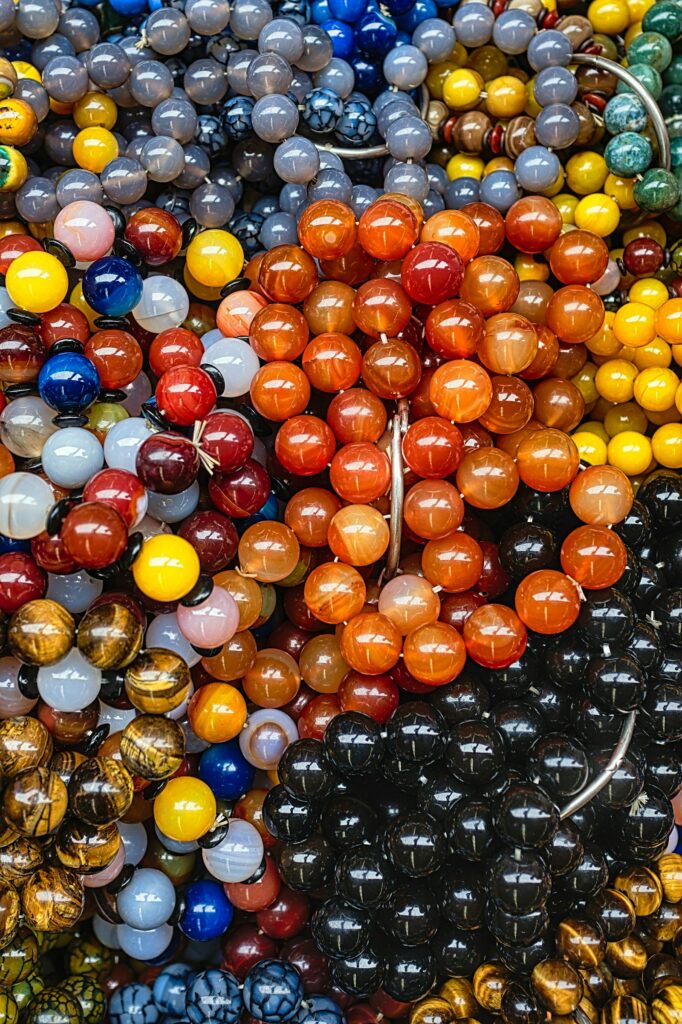
Understand the glass techniques before choosing a design
Venetian glass beads are produced using several traditional methods. Knowing a few terms makes it easier to discuss your design without needing to become a glassmaking expert.
- Perle a lume: Lampworked beads formed by heating glass rods with a torch and shaping the softened glass. They can feature raised dots, stripes, floral patterns and other decorative details.
- Murrine: Small sections of patterned glass cane, often showing colourful geometric or flower-like designs. These can be incorporated into larger beads.
- Conterie: Small glass beads traditionally used for threading, embroidery and decorative jewellery.
- Avventurina: Glass containing sparkling metallic inclusions that give it a distinctive shimmering appearance.
- Foglia d’oro or foglia d’argento: Gold or silver leaf incorporated into glass decoration. These terms describe decorative metal leaf, not necessarily the material used for the jewellery’s clasp or chain.
The Italian term perlera refers to a glass-bead maker, while impiraressa traditionally describes an artisan who threads and arranges beads. Both skills form part of Venice’s glass-bead heritage.
The art of glass beads was added to UNESCO’s Intangible Cultural Heritage list in 2020. The Italian Ministry of Culture’s explanation of the tradition provides useful background on its techniques and history.
For a commission, photographs of actual finished beads are more useful than technical vocabulary alone. They show the artisan the surface finish, transparency and decorative detail you prefer.
How to write a useful brief for the maker
A good brief should explain how the jewellery needs to look, fit and function. A maker can advise on the artistic details, but cannot reliably guess whether you want a lightweight necklace for everyday wear or a statement piece for a wedding.
1. Specify the finished piece
Say whether you want earrings, a necklace, a bracelet, a pendant, a ring or a coordinated set. Include the number of items and whether they need to match closely.
For earrings, specify whether your ears are pierced and whether you need hooks, studs, lever-back fittings or clips. If you want matching earrings and a necklace, explain whether the same bead design should appear in every piece.
2. Give measurements instead of descriptions
Terms such as “medium length” or “quite small” are open to interpretation. Measurements make the result more predictable.
- Necklaces: Provide the intended overall length in centimetres and explain where you want the piece to sit. Mention any preferred extension chain.
- Bracelets: Supply the wearer’s wrist circumference and say whether the fit should be close or loose. Let the maker allow for bead thickness and clasp construction.
- Earrings: Specify the maximum drop length and ask about the finished weight, especially if you find heavy earrings uncomfortable.
- Pendants: Give an approximate bead diameter or pendant height and explain whether you prefer a cord or metal chain.
Glass beads can be surprisingly substantial, particularly when large or layered. A necklace that looks delicate in a photograph may feel heavy when worn. Ask for the approximate finished weight if comfort matters.
3. Describe the colour and finish
Send two or three reference photographs, preferably with a short explanation of what you like about each one. A photograph may communicate the right shape but the wrong colour, or the right colour with a finish you dislike.
Be specific about opaque versus transparent glass, glossy versus matte surfaces and whether you want gold or silver decorative details.
If you need to match clothing, send a photograph taken in natural daylight. Screens reproduce colours differently, and handmade glass may vary slightly between batches. Ask the artisan which colours can be matched closely and which should be treated as approximate.
4. Explain your preferred bead arrangement
For necklaces and bracelets, describe whether you prefer identical beads in a repeating pattern, graduated sizes, a single prominent centre bead or an irregular arrangement.
Also explain whether the jewellery should feel symmetrical. A deliberately uneven composition can be attractive, but it should be an agreed design choice.
5. Specify the metal components
Glass may be the main attraction, but clasps, chains, earring hooks and other fittings affect comfort, durability and price.
Ask whether the maker can provide sterling silver (argento 925), stainless steel (acciaio inox), gold-plated fittings or another specified material. If you have a nickel allergy, describe it directly and request the exact material composition rather than relying on a general “hypoallergenic” description.
For necklaces and bracelets, ask how the beads will be threaded and whether the stringing material can be replaced if repairs are needed later.
6. Give a realistic budget and deadline
Tell the artisan your approximate maximum budget, the date you arrive in Venice and the latest date on which you could collect the finished item.
If you can accept home delivery, mention your destination country. That may make a more complicated design practical without forcing an unrealistic production deadline.
A sample enquiry to send before your visit
You do not need a professional design drawing. A concise message with photographs and practical requirements is usually a better starting point.
Example brief:
Hello, I would like to commission a necklace using handmade Venetian glass beads. I prefer deep blue and clear glass, with a simple arrangement and one larger decorative bead in the centre. I would like the necklace to be approximately 45 cm long, with sterling silver fittings. I have attached two photographs showing the colours and style I like. My budget is approximately €200, including the finished fittings. I will be in Venice from 12 to 16 May. Could you tell me whether this is possible, whether you would use existing beads or make new ones, the expected total price and whether collection during those dates would be realistic? If not, could you provide a shipping quote?
Adapt the measurements, budget and dates to your needs. If the commission is a gift, include the recipient’s preferences and any sizing information you have. When the exact size is unknown, ask whether an adjustable design is feasible.
How the commissioning process usually works
The process depends on the complexity of the piece and the studio’s working arrangements. Some artisans can adapt stock jewellery during an appointment, while others require an advance discussion and a separate production period.
- Initial enquiry: Send your brief and reference photographs. Ask whether the studio accepts individual commissions and whether a visit is necessary.
- Design discussion: Agree on the bead type, colours, dimensions, arrangement and fittings. The maker may suggest alternatives where your original idea is technically difficult.
- Written quotation: Request the price, estimated completion date, payment schedule and any delivery charges.
- Design approval: Confirm the final specifications before production begins. If the artisan offers a sketch or layout photograph, check it carefully.
- Production and finishing: The maker creates or selects the beads, completes the jewellery and checks its fittings.
- Collection or delivery: Inspect the finished piece in person or arrange shipping using the agreed service.
Ask how many design changes are included before approval and whether changes made after production begins will cost extra.
For valuable or complex commissions, agree on what handmade variation is acceptable. The precise position of decorative details, colour distribution and bead dimensions may differ slightly from a photograph. Those differences should be distinguished from a genuinely incorrect size, material or design.
How long does custom Venetian glass jewellery take?
There is no standard turnaround time for every Venetian jewellery studio. The availability of finished beads, the complexity of the design, the maker’s workload and the need for specialist fittings all affect delivery.
Simple alterations to an existing piece may be possible during a visit, subject to the artisan’s availability. A necklace assembled from existing beads may require a separate appointment. Newly made lampworked beads need production, controlled cooling and finishing before they can be incorporated safely into jewellery.
Some specialist producers publish jewellery lead times of around one to two weeks, while more involved commissions can take longer. Treat any published estimate as that individual maker’s policy, and request a completion date for your specific design.
If you are visiting Venice for only two or three days, it is sensible to contact the maker before travelling. An appointment during your stay may be useful for selecting colours and checking proportions, but it does not guarantee that new glasswork can be finished before you depart.
Ask for two dates: the estimated date the jewellery will be completed and the date it can actually be collected or dispatched. They may differ.
What should be included in the quotation?
An accurate quote should describe the finished item and the materials involved. Avoid agreeing to a price that covers only the consultation or jewellery assembly if you assume it also includes handmade glass beads.
Check the following details:
- The number and type of glass beads included.
- Whether the beads are newly made or selected from existing stock.
- The cost of design work and assembly.
- The precise materials used for chains, clasps and earring fittings.
- Any additional charge for gold leaf, specialist glass or complex decoration.
- Whether requested adjustments and design revisions are included.
- Whether VAT and other applicable charges are included in the stated total.
- Packaging, delivery, insurance and any shipping charges.
- The deposit amount, final payment date and accepted payment methods.
Some studios charge for consultation and assembly separately from the beads selected. This makes it particularly important to ask for the estimated total cost of the finished jewellery before paying anything.
If the maker cannot provide a fixed total because the bead selection has not yet been agreed, request a price range and a maximum budget that cannot be exceeded without your approval.
For custom orders, deposits may become non-refundable once materials have been purchased or production has started. Ask exactly when that happens and what you would owe if you change your mind.
Visiting a jewellery studio in Venice or Murano
Venetian glass-bead artisans work in both the historic city and on Murano. You do not automatically need to travel to Murano to meet someone who works with traditional Venetian beads.
A central Venice appointment can be convenient if you are staying near San Marco, Rialto or Dorsoduro. Murano may suit you if you want to combine your design consultation with a wider look at glassmaking workshops and galleries.
For Murano visits, use the public vaporetto network. ACTV operates connections from Venice to different Murano stops, including services associated with routes 3, 4.1 and 4.2. Check the official ACTV navigation timetables shortly before your appointment, as routes, stops and service arrangements can change.
Confirm the full workshop address and nearest landing stage rather than assuming that every Murano studio is within a short walk of Murano Faro. Leave enough time for the boat journey, waiting and walking.
A jewellery consultation normally does not include hotel pickup or private transport unless the studio has specifically agreed to provide it.
Accessibility, children and luggage
Some small workshops are in historic buildings with steps, narrow entrances or limited space around the workbench. Ask whether the consultation area has step-free access and whether seating is available. Venice’s official accessible travel information can help you assess routes, bridges and transport connections.
Children can often accompany an ordinary shopping appointment, but a working glass studio may have restrictions around hot equipment, tools or fragile displays. If you want children present during a demonstration, confirm the studio’s rules and any age restrictions beforehand.
Large suitcases can be awkward in small ateliers and on bridge-heavy walking routes. Ask whether the studio has space for luggage or arrange to leave bags at your accommodation.
Weather rarely prevents an indoor design consultation, but high water, strong winds or waterbus disruption can affect access. Keep the studio’s telephone or messaging contact available and agree on what happens if transport problems make you late.
How to check whether the glass is genuinely Venetian
For a substantial purchase, origin deserves the same attention as colour and design. “Murano style”, “made with Murano glass” and “made on Murano” are not necessarily equivalent descriptions.
Ask the maker:
- Where were the finished glass beads produced?
- Who made them?
- Are the beads handmade or commercially manufactured?
- Does the jewellery contain glass made outside Venice?
- Can the studio provide a written description of the materials and their origin?
- Does any applicable authenticity label or documentation accompany the piece?
The Veneto Region protects the Vetro Artistico Murano trademark, which can be used by authorised producers for qualifying artistic glass made on Murano. Its coverage includes beads and murrine. The Veneto Region’s official explanation of the trademark describes who may use it.
The mark includes traceability features and identifies authorised production. However, not every genuine Venetian artisan or piece of handmade bead jewellery necessarily carries this particular trademark. Glass-bead production also takes place outside Murano, including in Venice’s historic centre.
UNESCO recognition concerns the traditional craft itself. It is not an authenticity certificate for an individual necklace or pair of earrings.
Be cautious if a seller cannot identify where the beads were made, describes imported components as locally produced or provides only a generic certificate without explaining what it certifies.
Collecting or shipping your finished jewellery
If possible, arrange a final fitting before leaving Venice. Check the necklace or bracelet length, test the clasp and make sure the jewellery sits comfortably. For earrings, examine the balance and weight of each piece.
If you will receive the commission by post, ask the maker to send photographs of the completed jewellery before dispatch. Agree in advance whether these photographs are for information or form a final approval stage.
For shipping, confirm:
- The complete delivery address and recipient details.
- The shipping company and whether tracking is provided.
- The declared value and whether the shipment is insured.
- How the beads will be protected from impact and movement.
- Who pays import taxes, customs duties or handling fees, if applicable.
- What happens if the parcel is delayed, lost or delivered damaged.
- Whether the maker will replace a damaged bead, repair the piece or arrange another remedy.
International deliveries may involve customs charges depending on the destination and the circumstances of the shipment. Ask for the price of delivery separately from the jewellery itself.
For collection in Venice, request a protective box or padded case. Store the jewellery where the beads cannot repeatedly strike each other, especially inside a suitcase. Small glass items are generally easy to carry, but a rigid case is safer than placing a loose bracelet among toiletries and other belongings.
What if the finished piece is wrong or your plans change?
Before paying a deposit, distinguish between cancelling a commission, requesting a design change and reporting a faulty finished product. Different rules may apply.
Under EU consumer rules, the usual 14-day withdrawal period for distance purchases has exceptions for goods made to a customer’s specifications or clearly personalised. There is also no general EU right to return an ordinary in-store purchase simply because you change your mind.
These rules do not remove the consumer’s statutory remedies for faulty goods or goods that do not match the agreed description. The European Union explains the distinction in its guidance on shopping rights and returns.
Ask the maker to put the cancellation terms in writing. For a particularly expensive piece, you should also know whether a deposit is refundable if the artisan cannot fulfil the commission by the agreed date.
If the studio needs to postpone your appointment, first ask whether the design can be discussed remotely or the finished piece shipped. If you will be leaving Venice before a revised completion date, agree on the replacement delivery arrangement and any additional cost before proceeding.
If the item arrives damaged or differs materially from the approved specifications, photograph the packaging and jewellery promptly, retain the receipt and contact the seller with the original written agreement. Keep the packaging until the claim is resolved.
When a bespoke commission may be unnecessary
Custom glasswork is useful when the design, colour, fit or symbolism matters enough to justify additional production. For simpler pieces, you may get the result you want by selecting handmade beads and requesting a small adjustment to an existing design.
If you would rather take part in making the jewellery, that is a different kind of activity. A studio may offer a bead-making lesson, a jewellery assembly session or both. The Italy on Foot article on glass-bead jewellery workshops in Venice explains what participants actually do and what to check before booking.
A workshop can suit someone who values the process as much as the finished object. A private commission is more appropriate when you need a particular result, professional finishing or a design that would be difficult to complete during an introductory session.
If you are combining a Murano appointment with sightseeing elsewhere in Venice or another Italian city, you can organize your Italy itinerary around the consultation and any later collection appointment. Leave some flexibility in your schedule until the maker has confirmed the actual completion date.
What to check before accepting the finished jewellery
Whether the piece is handed to you in a Venetian atelier or delivered after your trip, compare it with the agreed brief before considering the order complete.
- Design: Are the bead colours, shapes and arrangement consistent with the approved design?
- Dimensions: Is the length correct, and does the jewellery fit as intended?
- Materials: Are the clasps, chains and fittings made from the agreed metals?
- Comfort: Is the piece an appropriate weight, with no sharp edges or uncomfortable fittings?
- Construction: Do the beads sit securely, and do the clasps open and close properly?
- Documentation: Do you have the receipt, maker’s details and any promised authenticity information?
- Care: Has the maker explained how to clean, store and, if necessary, repair the piece?
Ask for written care instructions if your jewellery combines glass with plated metal, leather, textile cord or other materials that may require different treatment.
Before leaving the studio, find out whether the artisan can restring a necklace, replace an individual bead or supply a matching earring if one is lost. A one-of-a-kind glass bead may be difficult to reproduce exactly, so the availability of repairs and replacements is useful information to have from the start.
The most useful final question is simple: Can the maker confirm in writing exactly what will be made, what it will cost and when you will receive it? Once those three details are settled, you can give the artisan room to exercise their craft without leaving the practical parts of the commission to chance.