The railway station is not in the hilltop historic center. It sits below the old town in Santa Maria degli Angeli, about 4 km from central Assisi. For most travelers, the easiest way from Assisi station to Assisi is Busitalia’s Assisi Link, Line C, which climbs from the station to the Basilica di San Francesco area and Piazza Matteotti. Take a taxi if you have heavy luggage, limited mobility, or a late arrival. Walking is possible, but it is a genuine uphill walk.
First, understand where the station actually is
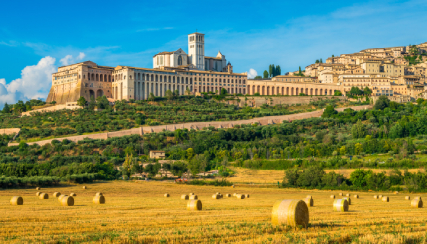
The stop shown on rail tickets as Assisi is in Santa Maria degli Angeli, on the plain below the medieval town. The station address is Piazza Dante Alighieri. When you step outside, you can see the hill town above, but you are not yet within practical walking distance of Piazza del Comune or the main historic streets.
There is another easy source of confusion here. Basilica di Santa Maria degli Angeli is the large church in the valley near the station. Basilica di San Francesco is the famous Franciscan basilica up in historic Assisi. If your hotel is in Santa Maria degli Angeli, you may not need to go uphill at all. If your booking says Assisi historic center, Piazza del Comune, Via San Francesco, San Rufino, Santa Chiara, or Piazza Matteotti, you do.
The bus is the best default choice
Use Assisi Link, Linea C, operated by Busitalia. Exit the station into Piazza Dante Alighieri and look for the local bus stop in the station area. The wording to watch for is Assisi Link, Linea C, S. Francesco Assisi, or P. Matteotti Assisi.
Line C passes the railway station in both directions, so do not board purely because you see a C on the vehicle. For the hill town, check that the bus is heading toward S. Francesco Assisi / Piazza Matteotti. If the display is unclear, ask the driver, “Per Assisi centro?” A yes saves a surprisingly annoying loop around Santa Maria degli Angeli.
The current official timetable shows the station-to-Piazza Matteotti run taking roughly 12 minutes on many departures. Busitalia announced an enhanced 15-minute frequency between 08:00 and 20:00 from 1 August 2026, with some earlier and later journeys as well. Because seasonal and event timetables can change, check the official Assisi Link page for the dated schedule you need.
Which stop should you use?
- S. Francesco Assisi: get off here for the Basilica di San Francesco, the lower/western side of the old town, Via San Francesco, and accommodation around the basilica and Via Fontebella. If the basilica is your first stop, this is usually the sensible choice. Our Basilica di San Francesco practical page covers the visitor side once you arrive.
- Piazza Matteotti: stay on to the terminus for the upper/eastern side of the historic center, including easier access toward San Rufino, Piazza del Comune, Rocca Maggiore, and much of the accommodation higher on the hill.
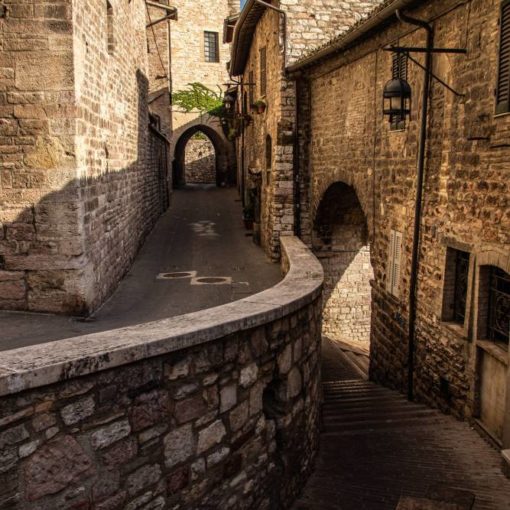
Do not expect Line C to drop you directly in Piazza del Comune. The bus works around the edge of the historic center, then you finish on foot. That last section can still involve slopes, stone paving, and steps, which matters much more with a suitcase than it does with a day bag.
Bus tickets: the small details that prevent fines
The standard Assisi urban ticket currently costs €1.30 and is valid for 90 minutes from first validation. A ticket bought from the driver in cash costs €2.00. Busitalia also supports contactless payment on Assisi urban buses without the onboard surcharge, so you can tap a supported bank card or payment device on the validator. One payment card covers one passenger.
If you buy a paper ticket in advance, validate it as soon as you board. If you use the SALGO or Trenitalia app, the digital ticket must be activated before boarding according to Busitalia’s rules. If you pay contactless, tap the card or device on the onboard reader and keep using that same payment method if you make a transfer. Current fares and ticket rules are on Busitalia’s Assisi fare page.
Taxi: best with luggage, children, or a hotel high in town
A taxi removes the steepest and most awkward part of the transfer. It is especially useful if you have a full-size suitcase, a stroller plus bags, reduced walking tolerance, or accommodation on a small street well beyond the bus stops.
Give the driver your hotel name and full address, not simply “centro.” Access inside Assisi is affected by the historic center’s traffic restrictions and street layout, so the most practical drop-off depends on the property. If no taxi is waiting at the station, the official Assisi tourism site lists Radio Taxi Assisi at +39 075 813100 and itTaxi at +39 075 9930007. You can verify current contacts on Visit Assisi’s transport page.
Do not rely on an old blog post quoting a fixed station fare. Confirm the current price when you call, particularly at night or when carrying extra luggage. For a late train arrival, pre-booking is much safer than assuming a car will be sitting outside.
Walking uphill: possible, but choose it on purpose
The official city map places the railway station about 4 km from historic Assisi. The traditional walking route is linked to the Strada Mattonata, the historic path between Santa Maria degli Angeli and Assisi. The municipality describes the Mattonata itself as roughly 3 km long.
From the station, first orient yourself toward the center of Santa Maria degli Angeli and the Basilica di Santa Maria degli Angeli, then follow the signed route toward Assisi and the Mattonata. The climb ends around the lower historic-town side near Porta San Pietro before you continue into the center.
This is a good walk with a light daypack and suitable shoes. It is a poor substitute for a missed bus if you have a rolling suitcase, it is very hot, or you are already tired from a long rail journey. The issue is not just distance. The route gains the hillside steadily, and the final streets inside Assisi add more gradients and uneven paving.
If you actually want the walk as part of the day, take the bus uphill and walk down later. That gives you the views and the historic route without beginning your visit by hauling luggage uphill. You can also use the Italy on Foot trip planner to fit the transfer around the rest of your Assisi day rather than treating the station arrival as dead time.
Luggage and reduced mobility
Busitalia’s transport conditions set limits on the size and weight of baggage carried free on local buses, and larger or additional luggage can require an extra ticket or supplement. In practical terms, do not assume every large airline-style suitcase is automatically covered by the basic passenger fare. Check the current Busitalia conditions of carriage if you are traveling with bulky bags.
Busitalia states that its urban buses are equipped with ramps for passengers with reduced mobility. The rail station itself deserves a little more planning: RFI lists no lift at Assisi station and identifies step-free access to platform 1, while the station is also covered by assistance services for passengers with reduced mobility. If you need help boarding or changing platforms, check the RFI station accessibility information before travel.
Even after an accessible bus ride, the medieval center can involve steep streets and stone surfaces. For wheelchair users, travelers with walkers, or anyone for whom slopes are a serious issue, a taxi directly to the closest permitted point to the hotel is usually the most predictable option.
Late arrivals, Sundays, and public holidays
Line C runs on Sundays and public holidays as well as ordinary weekdays. On Italian timetables, festivo means Sunday/public-holiday service. Feriale means non-holiday service, but do not assume every “feriale” column is identical from Monday through Saturday because operator footnotes can split Saturday from Monday-Friday.
The current summer 2026 timetable includes Line C trips from the railway station after 20:00 and shows a late departure at 23:05 toward S. Francesco and Piazza Matteotti. That is useful, but it is seasonal information, not a promise for every month. If your train arrives late, check the timetable for that exact date before leaving your origin station. If your train is delayed beyond the last bus, call a taxi rather than starting the uphill walk in the dark with luggage.
For the return trip, leave more margin than the bus ride suggests
Going back to the station, board Line C toward Stazione FS from Piazza Matteotti or the S. Francesco stop. Stazione FS is the wording to recognize for the railway station. The ride itself is short, but traffic, boarding, and a possible wait for the next bus make a tight connection unnecessary.
For a train you cannot afford to miss, choose a bus scheduled to reach the station with a sensible buffer rather than aiming for the last possible connection. This matters even more if you need to cross to another platform or use passenger assistance, since the station has no lift.
Common mistakes to avoid
- Assuming the train arrives in the old town. It does not. The railway station is down in Santa Maria degli Angeli.
- Confusing the two basilicas. Santa Maria degli Angeli is near the station; San Francesco is up in historic Assisi.
- Boarding Line C in the wrong direction. Check for S. Francesco Assisi or Piazza Matteotti when going uphill.
- Forgetting to validate. Paper and digital tickets have specific validation rules, and a paid-for ticket that has not been correctly activated can still be invalid.
- Dragging a suitcase up the Mattonata because the map says “walkable.” Four kilometers on a hillside is not the same thing as four flat city blocks.
- Using Piazza del Comune as the bus destination. Line C serves the edge of the historic center; choose S. Francesco or Piazza Matteotti according to where you are actually going.