There is no single opening or closing time for the Quadrilatero. It is a network of streets filled with independent delis, bakeries, fishmongers, butchers, bars and restaurants, not one gated market. For the strongest shopping atmosphere, go roughly from 9:00 to 11:30, Tuesday to Saturday. From about noon, lunch service takes over more of the lanes; by early evening, the area feels much more like a food-and-wine district than a grocery market. Bologna Quadrilatero market hours therefore depend on what you actually want to do there.
The key point: the Quadrilatero does not “close” as one market
The old market sits immediately east of Piazza Maggiore, around Via Pescherie Vecchie, Via Drapperie, Via Clavature, Via Caprarie and Vicolo Ranocchi. There are no gates to wait for and no bell that ends trading. Bologna’s official tourism site describes the Old Market in the Quadrilatero as a historic commercial district and gives it only the “usual opening times of shops,” because each business keeps its own schedule.
That distinction matters. A fishmonger may trade in the morning, close for several hours after lunch and reopen briefly in late afternoon. A bakery may run straight through until early evening. A salumeria may sell mortadella and Parmigiano at the counter while also serving boards and wine. A restaurant next door may only be getting busy when the traditional shop is locking up.
What the area feels like at each time of day
7:00 to 9:00: the working-market window
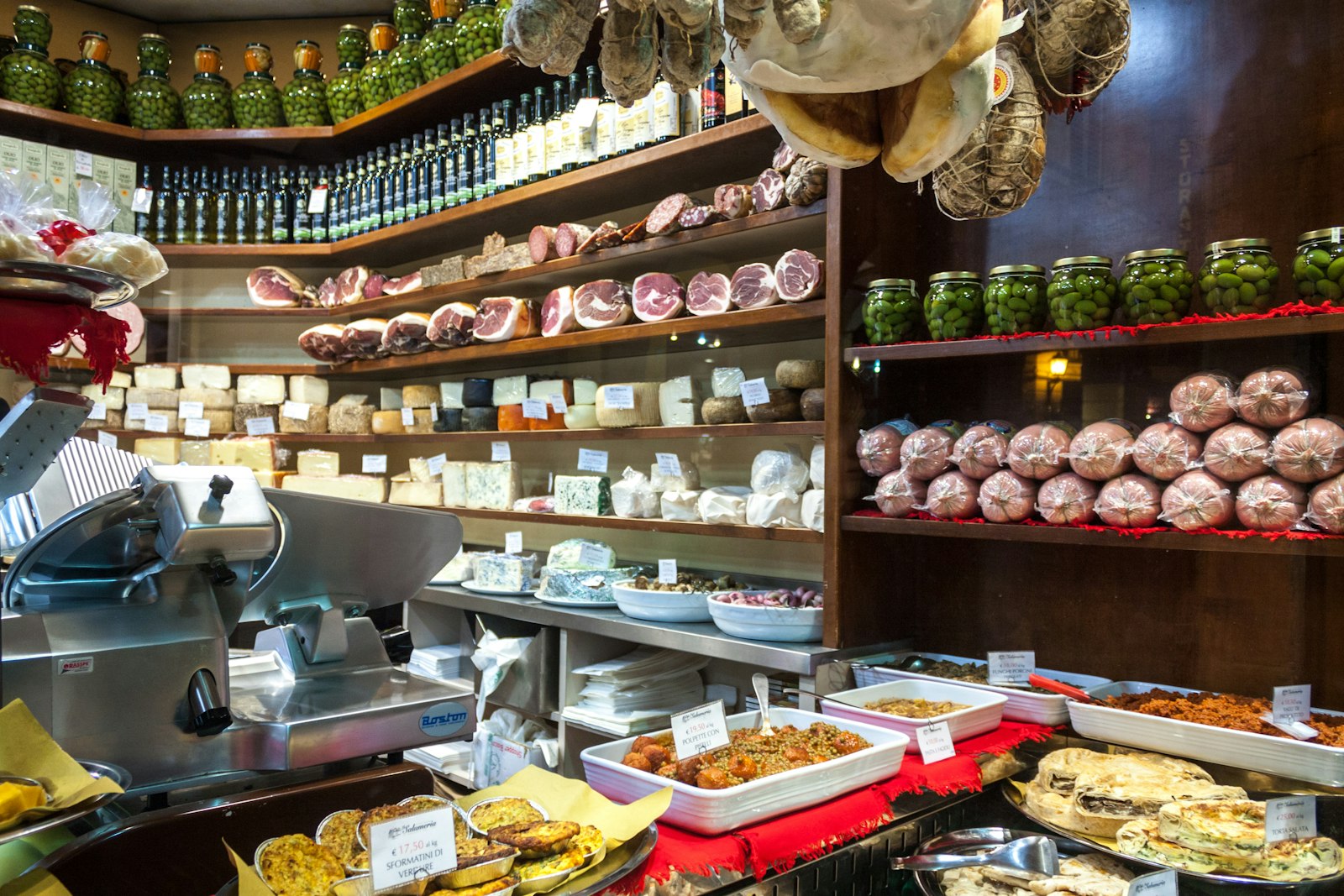
This is when the Quadrilatero is closest to an ordinary food-shopping district. Some traditional businesses start very early. Bologna Welcome currently lists Macelleria Equina on Via Pescherie Vecchie from 7:00 on its operating days and Pescheria Brunelli on Via Drapperie from 7:30 on most of its operating days. Other well-known shops begin later, so arriving at 7:15 does not mean the whole district will be open.
Choose this window if you want to see fresh-food counters and local shopping without the lunch crowd. It is less useful if your priority is sitting down for a tasting, because many dining operations have not started yet.
9:00 to 11:30: best for actual food shopping
This is the most reliable period for browsing fresh pasta, bread, cured meats, cheese, meat, fish and pantry goods. More doors are open, counters are fully active, and the narrow streets have not yet filled with lunch tables and standing drinkers.
If your aim is to buy food to take away, make this your target. It is also the easiest part of the day with a stroller or a suitcase, although the lanes can still be tight and individual historic shops may have small entrances or steps.
11:30 to 14:30: the switch to lunch
This is the period that creates the impression that the market “turns into restaurants.” It does not happen all at once. Instead, hybrid businesses begin serving food, restaurants fill their outdoor tables, and retail-only shops start reaching their midday break.
Tamburini is a useful example. Its own current schedule separates the shop from the wine bar and restaurant: the retail shop opens earlier, while the wine bar and restaurant starts at 11:30. La Baita on Via Pescherie Vecchie is another hybrid, selling gastronomic products while also serving lunch, aperitivo and dinner. Its current published hours run into the evening.
If you want both shopping and lunch, arrive around 10:30 or 11:00. Browse first, then eat. Arriving at 13:30 can put you in an awkward middle ground where restaurant tables are busy but some traditional counters are about to close for the afternoon.
14:30 to 16:30: the easiest time to misunderstand
This is the classic split-hours gap. Some traditional shops close after the morning session and reopen around 16:00 or 16:30; others stay open continuously; some do not reopen on particular weekdays. Signs may show two time ranges on the same day, for example 8:00-13:30; 16:30-19:00.
The area itself is not closed. Bars, restaurants and all-day food businesses can remain active. But if your main goal is buying from traditional retail counters, this is the least dependable part of the day.
17:00 to 19:30: retail overlaps with aperitivo
Late afternoon is the second useful shopping window for businesses that reopen after lunch, but the mood has changed. Wine glasses, taglieri and outdoor tables become more prominent, especially around Via Pescherie Vecchie and Via Clavature. This is a good compromise if you want to buy a few packaged specialties and then stop for a drink.
Do not leave fresh-food shopping until 19:15 and assume you still have time. Many traditional shops finish around 19:00 or 19:30, and a posted closing time is not a promise that every counter will still have the full morning selection.
After about 20:00: dinner district, not traditional market shopping
The lanes remain lively, but most of the old-style shopping function has finished. Come at this time for dinner, wine or a late plate, not because you expect fishmongers, butchers and bakeries to be trading as they were in the morning.
If you reach Bologna late and want fresh pasta, salumi or another specific item to take away, enjoy dinner and return the next morning. Trying to “do the market” after dinner hours have started usually means seeing the setting without the part that made it a market in the first place.
Why Sunday and Monday need separate planning
Sunday is the weakest day for traditional food shopping because many independent shops close or reduce their hours, while restaurants and hybrid food businesses are much more likely to keep serving. The pattern is not universal. Tamburini, for example, currently lists Sunday shop hours, while Bologna Welcome lists Dante Zanetti bakery and Pescheria Brunelli as closed on Sunday. La Baita currently opens on Sunday as well.
Monday is not a blanket closing day either. Some food shops trade normally, while others take Monday as their weekly rest day. This is why a generic “the market is open every day” statement is not useful enough for a traveler trying to buy from a specific counter.
For the broadest choice of traditional retail, Tuesday through Saturday morning remains the safer bet. On public holidays and during seasonal closures, look for the words orario festivo (holiday hours), riposo settimanale (weekly closing day), chiuso (closed) or chiuso per ferie (closed for holidays/vacation).
Mercato di Mezzo has its own hours
Do not confuse the whole Quadrilatero with Mercato di Mezzo. The latter is the indoor food hall at Via Clavature 12, inside the district. It has its own operating schedule, separate from the surrounding streets and independent shops. Bologna Welcome currently lists Mercato di Mezzo from 10:00 to midnight Monday through Saturday; Sunday is not shown in that current timetable, so check the same official page for your date rather than guessing.
This makes it a useful fallback when traditional retail counters are on an afternoon break or have already closed, but it is a different experience. If you came specifically for old delis, fish counters and bakeries, an open food hall does not mean the rest of the historic market is still trading.
The simplest timing plan
- For market shopping: arrive 9:00 to 11:30, preferably Tuesday through Saturday.
- For shopping plus lunch: arrive about 10:30, browse first, then sit down from 11:30 or noon.
- For aperitivo: come from roughly 17:30 onward and expect less traditional retail activity.
- For dinner: come in the evening, but treat the area as a dining district rather than a working grocery market.
- For Sunday: choose a specific venue first, then check that venue’s own hours instead of relying on a district-wide schedule.
If the Quadrilatero is one stop in a larger Bologna day, the Italy on Foot trip planner is useful for putting the shopping window before lunch rather than accidentally scheduling the market during the afternoon lull.
How to enter the market streets without walking past them
From Piazza Maggiore, the food-market lanes are only a few minutes away on the eastern side of the square. The streets to look for on signs and maps are Via Pescherie Vecchie, Via Drapperie and Via Clavature. These form the core of the food area. Via Caprarie and Vicolo Ranocchi are also useful once you are inside the grid.
Do not search for a building labelled “Quadrilatero Market.” There is no single front entrance. Mercato di Mezzo does have a specific doorway on Via Clavature, but the old market itself is the surrounding street network.
If you are coming straight from Bologna Centrale, get the station part right first. Bologna’s platform names can include Est, Ovest and underground high-speed tracks, so the Italy on Foot guide to Bologna Centrale platform labels is useful if this market stop is squeezed into a short train connection or day trip.
Useful Italian words on doors and menus
- Orario / orari: opening hours.
- Orario continuato: open continuously, without a midday closure.
- Chiuso: closed.
- Riposo settimanale: weekly closing day.
- Aperto: open.
- Asporto: takeaway.
- Dehors: outdoor seating area.
- Servizio al tavolo: table service.
- Prenotazione: reservation.
- Consumazione obbligatoria: purchase or consumption required.
Two useful questions are “Si mangia qui?” for “Can we eat here?” and “La cucina è aperta?” for “Is the kitchen open?” An open shop does not automatically mean its kitchen or table service is operating.
One very Bologna way to combine shopping and eating
Osteria del Sole in Vicolo Ranocchi is the clearest example of the district’s shop-to-table logic. The osteria serves drinks but allows customers to bring in food bought elsewhere. Its current house rules say that beverages must be purchased from the osteria and outside alcoholic drinks are not allowed. That means you can buy mortadella, cheese, bread or other food in the surrounding market and carry it in with you, subject to the osteria’s rules and opening hours.
Do not assume every bar or restaurant in the Quadrilatero works this way. It is a specific policy of Osteria del Sole, not a neighborhood rule.
With luggage, children or limited mobility
The old market is a set of public streets, so there is no turnstile or baggage check. The problem is space. Via Pescherie Vecchie can become crowded once lunch tables and standing customers fill the narrow lane. A large suitcase is far easier to manage before the lunch rush than around aperitivo.
With a stroller, the same timing rule helps: morning is calmer, while lunch and evening seating can narrow the walking line. Individual historic shops vary in entrance width, thresholds and internal space, so do not assume every doorway is step-free just because the surrounding streets are flat.
For a family that needs a guaranteed seated meal, choose the restaurant first rather than wandering until someone gets hungry. Counter service, standing aperitivo and tiny outdoor tables are common enough here that “food everywhere” does not always mean “easy table right now.”
If you arrive at the wrong time
If most retail shutters are down at 15:00, do not conclude that you missed the district for the day. Check the posted afternoon reopening time, walk through Via Clavature and Via Pescherie Vecchie, and use the gap for coffee or a seated lunch. Some shops will reopen later.
If it is already evening, switch objectives. Eat and drink now, then return the next morning for traditional shopping. If it is Sunday, check individual businesses rather than waiting for the whole area to “open.” That one adjustment prevents the most common disappointment: arriving during restaurant hours and wondering where the market went.