The practical route is simple: start at Porta Saragozza, enter the covered portico through Arco Bonaccorsi, follow Via Saragozza to Arco del Meloncello, then take the steeper covered section uphill to the Santuario della Madonna di San Luca. The Portico di San Luca walk is about 3.5 to 3.8 km from the gate to the sanctuary. To avoid walking the same route back, take TPER bus 58 from the sanctuary to Villa Spada, then change to bus 20 toward central Bologna.
The one detail worth sorting out before you leave is the return timetable. Line 58 reaches the sanctuary itself, but it is not a frequent, continuous city service throughout the whole day. Check your likely return departures before starting uphill.
Where the San Luca portico actually starts
For the full walk, set your map for Porta Saragozza, on the southwestern edge of Bologna’s historic centre. From Piazza Maggiore, allow roughly 15 to 20 minutes on foot to reach it.
Once you arrive, do not simply walk through the medieval gate and continue along whichever arcade looks promising. The useful landmark is Arco Bonaccorsi, directly outside the old city walls near Porta Saragozza. This marks the beginning of the long portico leading toward San Luca.
The official Bologna Welcome route also uses Porta Saragozza as the starting point. From here, the covered walkway continues almost all the way to the sanctuary.
There are three sensible starting choices:
- Porta Saragozza: choose this for the full traditional route.
- Arco del Meloncello: choose this if you mainly want the scenic hill climb and want to skip the flatter first section.
- The historic centre: starting at Piazza Maggiore adds the walk across central Bologna, but the San Luca portico itself does not begin there.
Step by step from Porta Saragozza to the sanctuary
- Find Arco Bonaccorsi. Once underneath it, you are on the correct portico. The first stretch follows Via Saragozza away from the centre.
- Stay under the arcade along Via Saragozza. This section is mostly level and passes through a normal residential and commercial neighbourhood. There is little route-finding to do.
- Watch for Arco del Meloncello. You cannot easily miss it: the portico forms a large curved structure above the road. This is the important junction between the flat and hill sections.
- Turn uphill at Meloncello. Do not continue straight along Via Saragozza toward Casalecchio. Follow the covered walkway as it bends onto the San Luca climb.
- Follow the portico all the way up. The hill section contains the chapels of the Mysteries of the Rosary, repeated flights of steps and increasingly steep stretches. There are no confusing junctions once you are climbing.
- Exit onto the sanctuary piazzale. The church is directly ahead, with the road and public transport stop beside the summit area.
The flatter section from Porta Saragozza to Meloncello is about 1.5 km. The hill section is roughly another 2.3 km. This is why descriptions that call the outing an easy covered stroll can be misleading: most of the physical effort is concentrated after Meloncello.
How difficult is the climb?
Allow roughly 60 to 90 minutes from Porta Saragozza to the sanctuary if you are walking rather than exercising. Faster walkers can do it more quickly, but photographs, traffic crossings and pauses on the upper section add time.
The portico gives excellent shade and useful rain cover, but it does not make the climb cool. Its sides are open, and Bologna can be hot and humid in summer. Bring water before reaching Meloncello rather than assuming you will find a shop halfway up the hill.
Footwear matters more on the descent than many visitors expect. Smooth paving and steps can be slippery after rain, and walking downhill for more than two kilometres is harder on knees than the gradient looks from photographs.
How to return from San Luca by public bus
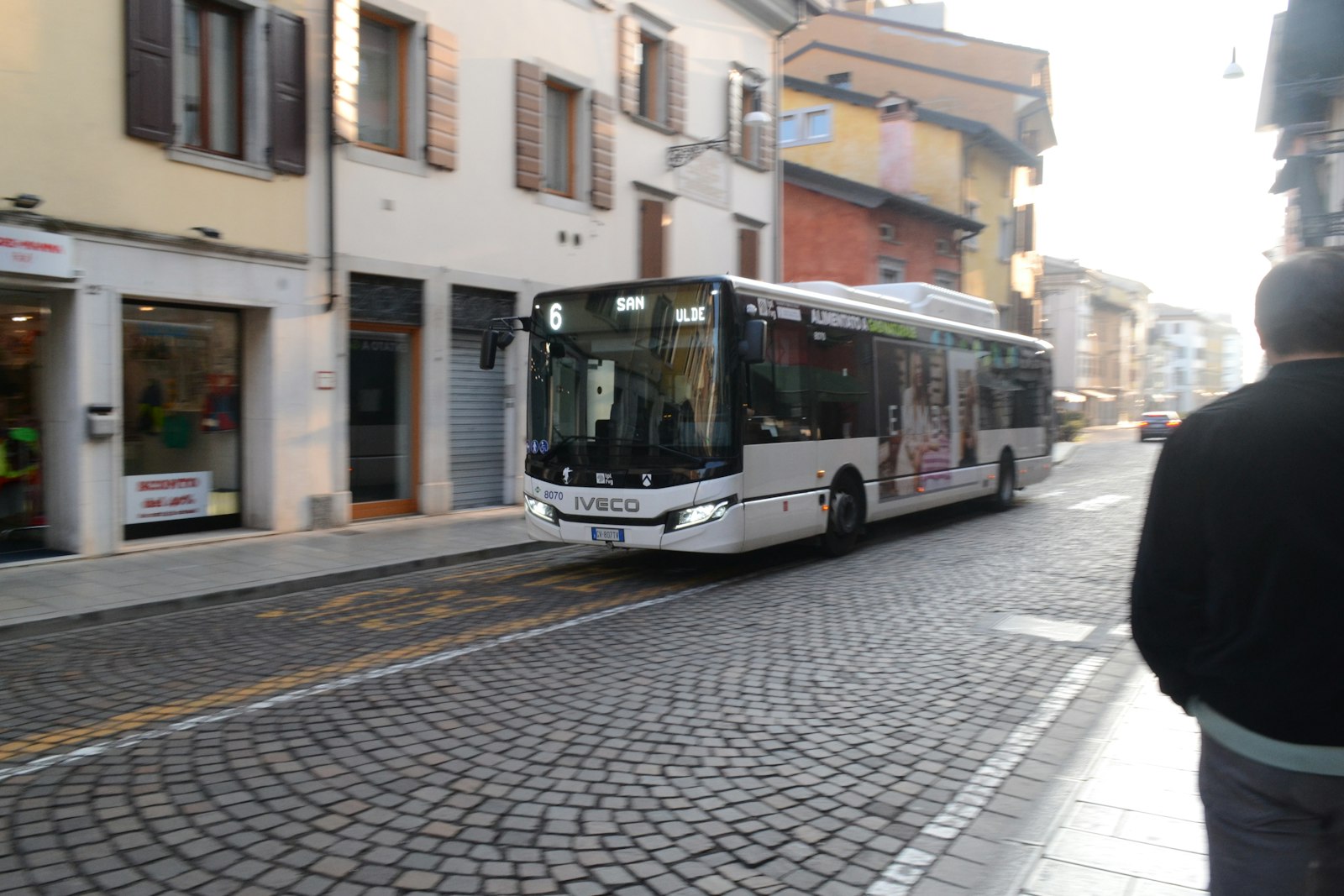
The ordinary public-transport return requires one change. The sequence is 58 to Villa Spada, then 20 into Bologna.
1. Find the Basilica di San Luca stop
At the top, look for the TPER stop marked Basilica di San Luca in the road area beside the sanctuary piazzale. On the downhill journey, line 58 runs from the basilica to Villa Spada.
Check the current TPER line 58 timetable before relying on it. The service can have substantial gaps between groups of departures, and the pattern changes with seasonal timetables, Sundays and holidays.
2. Stay on the 58 to Villa Spada
Villa Spada is the lower terminus for this journey, so there is no difficult stop to identify along the way. The bus descends from the sanctuary and brings you back to the Via Saragozza area.
3. Change to bus 20 toward central Bologna
At Villa Spada, find the line 20 stop for buses travelling toward Bologna centre, not farther outward toward Casalecchio. Central destinations displayed on individual runs can vary, so the most useful check is the stop list: you want a bus serving Porta Saragozza and Piazza Malpighi.
- Get off at Porta Saragozza if you want to finish where you began.
- Stay aboard to Piazza Malpighi if you are returning toward Piazza Maggiore and the heart of the old town.
At an ordinary street stop, make your intention to board obvious when the bus approaches. TPER asks passengers to signal drivers at request stops. This is one of those small Italian bus habits that becomes obvious only after a bus has sailed past you; our guide to why Italian buses do not always stop automatically explains how request stops work.
Tickets for the 58 and 20 transfer
TPER currently lists the Bologna ordinary urban ticket at €2.30, valid for 75 minutes from validation. That allows transfers within the validity period. Check the current TPER fares before travelling, since prices can change.
The important rule is to validate again when changing vehicles. If you have a normal ticket, validate it when boarding each bus as required. If you pay by contactless bank card, tap the same card or the same phone/watch on each bus. TPER’s system recognises the transfer and avoids charging another journey when the first ticket is still valid.
Do not tap your physical credit card on the 58 and then the same card stored in Apple Pay or another phone wallet on the 20. TPER treats the physical card and its digital version as different payment devices.
Useful Italian words at the stops
- fermata: bus stop
- capolinea: terminus
- direzione: direction
- fermata a richiesta: request stop
- feriale: working-day service, whose exact definition depends on the timetable
- festivo: Sunday or public-holiday service
- orario estivo / invernale: summer / winter timetable
Line 58 is exactly the sort of route where checking these labels matters. If they are unfamiliar, see our explanation of feriale, festivo and seasonal Italian bus timetables.
How much time to allow
A comfortable plan is roughly:
- 15 to 20 minutes: Piazza Maggiore to Porta Saragozza.
- 60 to 90 minutes: Porta Saragozza to the sanctuary.
- 20 to 40 minutes: rest and a look inside the sanctuary.
- About 30 to 50 minutes: buses back toward the historic centre, plus whatever wait you have for line 58.
The timetable, rather than the walking speed, is usually the variable. Check the 58 before leaving the centre and note at least two usable departures from the summit. If San Luca needs to fit around a train, restaurant booking or another city stop, you can also organize the rest of your Italy route before committing to a particular return bus.
Strollers, reduced mobility and luggage
The upper pedestrian section is not a practical step-free route. It combines a sustained gradient with steps, so a wheelchair user should use road transport to reach the sanctuary rather than attempting the covered climb. The sanctuary itself is accessible by lift, although the dome and crypt are not.
A lightweight stroller is possible only if you are comfortable dealing with steps and carrying it when necessary. With a baby or toddler, taking the bus uphill and walking only the flatter section is often the less exhausting choice.
Do not bring a rolling suitcase on the climb. Even a small cabin bag becomes tiresome on the steps, and transferring between two local buses with bulky luggage adds another unnecessary problem. Leave larger bags at your accommodation or in central Bologna.
If you want a shorter version
Take bus 20 from Bologna toward the Saragozza area and get off at Meloncello. From there, join the covered walkway at Arco del Meloncello and climb only the hill section to San Luca.
This removes the long, flat approach but keeps the part most people picture when they think of the route: the rising succession of arches, the chapels and the final ascent to the sanctuary.
If you miss the 58 at the top
First check the next departure rather than assuming another bus will arrive in ten or fifteen minutes. Line 58 can have long timetable gaps.
If the wait is unreasonable, the most useful recovery is to walk downhill only as far as Arco del Meloncello. From there, line 20 provides a much more useful connection toward the centre. You do not have to retrace the entire route to Porta Saragozza.
If you reach San Luca after the final useful 58, or someone in your group cannot manage the descent, use a taxi from the sanctuary rather than building your plan around a bus that has finished for the day. Checking that last summit departure before you start walking is the one bit of preparation that prevents most transport headaches.