Choose a morning session between Monday and Saturday if you want to shop at a working food market before cooking. Most combined experiences take around four to five hours, including the market visit, practical lesson and meal. Afternoon, Sunday and public-holiday classes may leave out the market entirely.
A Florence market tour and cooking class usually combines a guided introduction to local ingredients with a hands-on lesson in preparing Italian dishes. Before reserving, check which market you will visit, whether you actually help select ingredients, what you will cook and how much time is spent in the kitchen.
What Happens on a Florence Market and Cooking Tour?
Most combined experiences follow a similar pattern. You meet your chef or guide, visit a food market, learn about seasonal products, return to a teaching kitchen and prepare a meal that you eat together afterward.
The main stages generally include:
- Meeting and introduction: Meet the chef at a cooking school, market entrance or designated nearby location. The chef explains the menu and how the morning will work.
- Market visit: Walk through food stalls, learn about Tuscan produce and ingredients, and possibly sample cheeses, cured meats, bread or other specialties.
- Ingredient selection: Depending on the class, the chef buys ingredients, demonstrates how to choose them or involves participants in shopping.
- Cooking lesson: Move to a kitchen to prepare fresh pasta, sauces, vegetables, desserts or other dishes.
- Shared meal: Eat what the group has prepared, often accompanied by water and sometimes wine.
The important distinction is how closely the market visit connects to the cooking. Some experiences genuinely use ingredients selected that morning. Others provide a guided market introduction before returning to a kitchen where the ingredients have already been prepared.
Both formats can be enjoyable, but someone specifically interested in learning how Florentines shop should look for a meaningful ingredient-selection component.
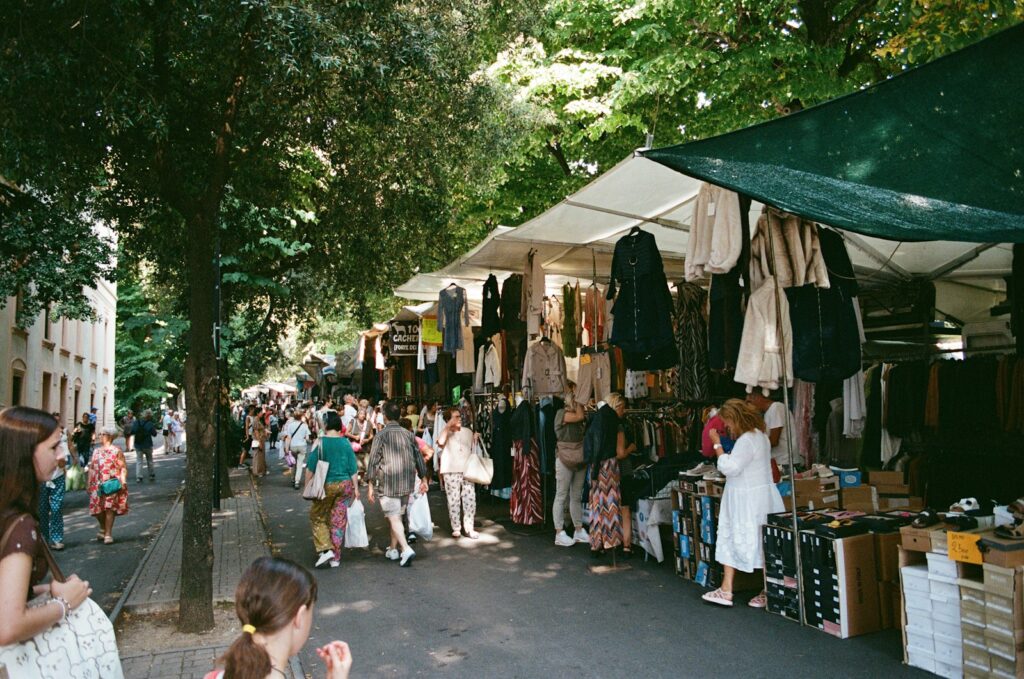
Which Florence Market Will You Visit?
Two food markets appear most frequently in cooking-class itineraries: Mercato Centrale in San Lorenzo and Mercato di Sant’Ambrogio near Santa Croce.
Mercato Centrale: Convenient for the Historic Center
Mercato Centrale is in the San Lorenzo district, close to the Basilica of San Lorenzo and within walking distance of Santa Maria Novella railway station.
The building has two distinct food areas:
- Ground floor: A traditional food market with produce sellers, butchers, cheese counters, bakeries and other grocery businesses.
- First floor: A food hall with prepared dishes, restaurant counters and places to sit and eat.
For a traditional market-shopping experience, the ground floor is generally the relevant area.
According to the Comune di Firenze’s published market information, the ground-floor market operates from 7:00 am to 3:00 pm Monday through Friday and from 7:00 am to 5:00 pm on Saturdays and days preceding public holidays, subject to holiday closures and exceptional arrangements.
The upstairs food hall follows a different schedule. Its official website currently lists daily opening from 9:00 am to 11:00 pm.
That difference matters. An experience advertised as visiting Mercato Centrale on a Sunday could involve the upstairs food hall rather than the traditional grocery stalls, or it might replace the visit with tastings at the cooking school.
Ask which floor the market portion covers before assuming you will meet vendors selling ingredients.
Mercato di Sant’Ambrogio: A Neighborhood Food Market
Sant’Ambrogio Market is in Piazza Lorenzo Ghiberti, east of the Santa Croce area.
Inside the covered market are traditional food counters selling meat, cheese, bread, produce and other groceries. The surrounding outdoor stalls add fruit, vegetables, flowers, clothing and household goods.
Florence’s visitor-facing municipal information lists the market from 7:00 am to 2:00 pm, Monday through Saturday. Some municipal trading schedules allow the covered section to operate until 3:00 pm, but earlier is the more useful time for visitors.
For cooking classes, Sant’Ambrogio works well when the goal is to understand everyday food shopping, seasonal vegetables and the relationship between vendors and their customers.
Remember that an early closing time affects the whole itinerary. A class beginning at 3:00 pm cannot realistically provide the same traditional market experience as one starting at 9:00 am.
Do Not Confuse the Food Market With San Lorenzo’s Outdoor Shopping Stalls
The streets outside Mercato Centrale also contain the San Lorenzo outdoor market, known mainly for leather goods, clothing and souvenirs.
This is separate from the indoor food market.
If an itinerary simply advertises a “San Lorenzo market visit,” confirm that the guide takes you into the food market rather than focusing on the surrounding shopping streets.
What Is the Right Starting Time?
For a combined market visit and cooking lesson, a departure around 9:00 am is a practical arrangement. It allows time to explore the stalls while food vendors are trading and still leaves several hours for cooking and lunch.
Published Florence cooking-class itineraries commonly run for approximately four to five hours, although shorter sessions exist when the market component is omitted.
A five-hour morning activity might look like this:
- 9:00 am: Meet the instructor and receive an introduction.
- 9:15 to 10:15 am: Visit market stalls, discuss ingredients and make any planned purchases.
- 10:15 to 10:30 am: Walk to the cooking school and get ready.
- 10:30 am to 12:45 pm: Prepare the dishes with the chef.
- 12:45 to 2:00 pm: Finish cooking, sit down for lunch and complete the experience.
This is an illustrative schedule rather than a timetable followed by every school. Some operators spend less time at the market, while more elaborate menus require longer kitchen sessions.
Do not schedule another activity according to the advertised cooking start time alone. Check the expected finishing time, including lunch, and allow some flexibility if you have museum tickets or a train afterward.
How Much Shopping Do You Actually Do?
One of the most useful questions to ask concerns the word “shopping.”
A market tour may include several different levels of participation.
Guided Browsing
The chef walks through the market, identifies ingredients, explains local traditions and introduces participants to particular stalls. You may not purchase anything.
This works well if you primarily want to understand Tuscan ingredients and how locals use them.
Ingredient Selection With the Chef
The chef chooses vegetables, cheeses, herbs or other products while explaining what makes them suitable for the planned recipes.
Participants may help make decisions, ask vendors questions and see ingredients purchased for the lesson.
This provides a stronger connection between shopping and cooking.
Market Tastings
Some tours include samples of cheese, cured meat, bread, olive oil or other products.
Check whether tastings are included in the price. A description mentioning “local specialties” does not necessarily mean every sample or snack is provided without an additional charge.
Personal Shopping
A few experiences leave time for participants to buy products to take home. Others keep the market segment tightly scheduled, with no separate shopping time.
Ask whether personal purchases are possible and whether the instructor can help with labels, quantities or choosing products that travel well.
If you want to buy fresh food for yourself, keep in mind that the cooking class may continue for several hours. Perishable purchases should not be left unrefrigerated throughout the lesson.
What Will You Cook?
Menus vary considerably. The fact that a class includes a market visit does not guarantee that participants choose the dishes or create a menu entirely from seasonal purchases.
Common cooking activities include:
- Fresh pasta: Mixing and kneading dough, rolling pasta sheets and making shapes such as tagliatelle or ravioli.
- Pasta sauces: Preparing tomato-based sauces, meat ragù or vegetable sauces.
- Tuscan starters: Bruschetta, crostini or simple dishes using seasonal vegetables.
- Main courses: Depending on the school, meat dishes, vegetable preparations or layered pasta such as lasagna.
- Desserts: Tiramisù and other Italian sweets.
Some lessons concentrate on two or three recipes, while others cover a more extensive menu. A four-course description may include dishes that the instructor prepares partly in advance.
Fixed Menus Versus Seasonal Cooking
Many cooking schools follow a standardized menu because the class has limited time and must accommodate groups with different experience levels.
Other experiences change the recipes according to ingredients available in the market.
Seasonal dishes might involve tomatoes and basil in warmer months, mushrooms or pumpkin in autumn, and leafy vegetables or hearty soups during colder weather.
However, seasonal ingredients do not automatically mean a flexible menu. A school might use fresh local produce while keeping the same pasta-making format throughout the year.
If learning to cook with seasonal Tuscan produce is your priority, ask the instructor to describe the actual menu for your date.
A particularly useful question is: “Which ingredients will we buy during the market visit, and which dishes will we make using those ingredients?”
The answer quickly reveals how closely the shopping and cooking portions are connected.
Choosing Between a Small-Group and Private Experience
Group size influences how much cooking you personally do, how freely you can ask questions and whether the menu can be adapted.
Small-Group Classes
Shared classes are generally more economical because the cost of the instructor, kitchen and ingredients is divided among participants.
They suit solo travelers, couples and people happy to prepare a predetermined menu alongside others.
However, “small group” can mean different numbers. Some classes accommodate approximately six participants, while others advertise groups of fifteen or twenty.
Look beyond the overall number and ask how many people share each workstation. A class of twelve participants with several active workstations can provide more practical cooking time than a smaller group watching most of the preparation.
Private Cooking Classes
A private experience may be useful for families, groups celebrating an occasion, travelers who want instruction at a slower pace or people with specific menu interests.
Private arrangements can sometimes offer greater flexibility over the starting time, recipes and market activities.
However, private does not automatically mean fully customizable. Some cooking schools run private versions of their regular classes with essentially the same menu.
Before paying a higher private rate, establish exactly what can change.
What Should the Price Include?
A combined market and cooking experience will generally cost more than a basic pasta lesson because it requires additional guided time outside the kitchen.
The total depends on the duration, number of participants, menu, included tastings and whether the booking is private.
Common inclusions are:
- Chef or instructor and guided market visit.
- Ingredients used during the lesson.
- Cooking equipment and an apron for use during the class.
- The meal prepared by participants.
- Water and, in some experiences, wine or other beverages.
- Recipes supplied digitally or in printed form.
Items that may be excluded include personal market purchases, additional drinks, transportation, hotel pickup, gratuities and special menu requests.
Pay particular attention to wine. Some classes include a fixed tasting, some serve wine with lunch and others advertise unlimited house wine. If you do not drink alcohol, ask whether a non-alcoholic alternative is provided.
When comparing prices, check that both options include an actual market visit. A cheaper afternoon class may be perfectly reasonable, but the lower price may reflect a shorter experience without shopping.
Food Allergies, Vegetarian Menus and Gluten-Free Requirements
Dietary restrictions should be discussed before reserving, particularly when the experience combines market tastings with cooking in a shared kitchen.
Vegetarian adaptations are available at some schools, but a standard menu may contain meat ragù, cured meats, cheese or other animal products.
Vegan travelers should ask specifically about eggs, butter and dairy ingredients, especially if pasta or tiramisù is involved.
For gluten-free diets, the distinction between an ingredient substitution and a kitchen that can safely manage cross-contact is critical.
Traditional fresh pasta lessons use wheat flour, sometimes handled across shared work surfaces and equipment. Several Florence operators explicitly state that their standard classes are unsuitable for guests with celiac disease.
Ask whether the school can provide appropriate ingredients, separate utensils, a suitable preparation area and safe handling during the entire experience, including market tastings. An operator’s willingness to substitute gluten-free pasta does not by itself establish that the class is safe for someone with celiac disease.
For any serious allergy, obtain a clear written response explaining what the provider can and cannot accommodate. Do not rely on a general statement that dietary requirements are accepted.
Meeting Points, Walking and Practical Arrangements
Most city-center experiences involve walking between the meeting point, market and teaching kitchen. Hotel pickup should not be assumed.
Your confirmation should provide the exact starting address and explain where the class finishes. The cooking school is often the meeting point even when the first activity takes place at a nearby market.
Florence addresses can also contain an r, meaning rosso, the red numbering system used for many commercial premises. A business address such as 43r is distinct from an ordinary street number 43. Use the complete address when checking your route.
What to Bring
- Comfortable shoes suitable for standing and walking.
- A small bag for personal essentials.
- Any necessary dietary or medical information already discussed with the school.
- Weather-appropriate clothing for the outdoor walking portion.
- Your booking confirmation and the provider’s contact details.
Wear clothing that can tolerate occasional flour, oil or sauce splashes. Aprons are often provided, but they will not protect everything.
Luggage and Arrival-Day Bookings
Market stalls can be busy, and teaching kitchens may have limited room for bags.
Do not assume that a cooking school can store suitcases. Confirm luggage arrangements before making a reservation on a hotel checkout day or immediately after arriving by train.
If the school cannot store bags, arrange luggage storage before the class and allow enough time to reach the meeting point.
Accessibility and Reduced Mobility
The level of accessibility varies between premises. A market route may involve uneven paving, busy aisles and extended standing, while the teaching kitchen may have steps or workstations designed for standing cooks.
Ask about step-free access, lifts, accessible toilets, seating during food preparation and the walking distance between the market and kitchen.
For someone who cannot stand for an extended period, a private class or a cooking-only session with suitable facilities may be more practical.
Children and Families
Age rules are set by individual providers. Some cooking schools welcome younger children, while others discourage or restrict participation by children under approximately six years old because of knives, hot surfaces and kitchen activities.
For families, confirm the minimum age, whether children must be accompanied, available child pricing and whether young participants actually prepare dishes.
A pasta-focused menu with rolling and shaping dough may provide more practical participation for children than a menu involving several long cooking stages.
What Happens on Sundays, Public Holidays or Rainy Days?
The most consequential scheduling issue is the closure of traditional food markets.
Mercato Centrale’s ground-floor market and Sant’Ambrogio generally operate Monday through Saturday, excluding public holidays unless exceptional openings are arranged.
Some cooking schools continue offering classes on Sundays and holidays. Instead of shopping at the market, they may provide extra product tastings, an introduction to Tuscan food or a longer cooking session.
That replacement may be worthwhile for someone primarily interested in cooking. It is a meaningful change for someone who specifically wants to meet market vendors and learn how to shop.
If the market visit is central to your plans, ask whether the operator offers a different date or a cancellation option when the market cannot be visited.
Rain usually does not prevent an indoor cooking lesson from taking place, and many market tours operate in normal wet weather. However, heavy rain can affect outdoor stalls and the walking portion of the itinerary.
Ask what happens if the market section must be shortened, altered or cancelled. The provider’s written terms should explain whether the class continues with a substitute activity and whether any refund or rescheduling is available.
For a separate breakdown of opening times, see Florence markets by time of day.
Booking and Cancellation Details to Check
For standard group lessons, online booking is common. Private experiences may involve an enquiry and a tailored quote.
Before confirming payment, check the following:
- Cancellation deadline: How many hours or days before the start can you cancel, and what portion of the payment is refundable?
- Deposit: Is the total collected immediately, or is a deposit followed by a remaining balance?
- Minimum participants: Could the operator cancel or move the class if too few people register?
- Late arrival: Can someone join after the group has entered the market, or is a missed departure treated as a no-show?
- Menu changes: Can substitutions be made because of availability or dietary restrictions?
- Market closure: What replaces the market visit, and what options do participants have if that replacement is unsuitable?
Some businesses offer free cancellation until a stated deadline, while others have stricter terms, particularly for private bookings. Policies can also differ between a cooking school’s direct website and a third-party reservation platform.
Read the conditions attached to the particular ticket or booking channel you use.
If your plans change, contact the operator as early as possible in writing. A request to change dates does not automatically preserve your original cancellation rights.
Questions to Send Before Reserving
A short message can resolve most uncertainties without a lengthy exchange. Include your intended date, number of adults and children, preferred language, dietary restrictions and any mobility requirements.
Then ask:
- Does the selected departure include an actual visit to the working food market?
- Which market will we visit, and approximately how long will we spend there?
- Will we select or purchase ingredients that we later use in the cooking lesson?
- What exact dishes are planned, and which steps will participants complete themselves?
- What is the maximum group size, and how many people share each workstation?
- Are market tastings, ingredients, lunch, drinks and recipes included in the quoted price?
- Where exactly do we meet and finish, and what is the expected end time?
- What happens if the market is closed, the instructor is unavailable or the class is cancelled?
For private bookings, also ask which parts of the itinerary can be customized and whether changing the menu affects the final price.
The confirmation should clearly identify the date, starting time, location, participants, inclusions, amount paid and applicable cancellation policy.
How to Fit a Market Cooking Class Into a Florence Itinerary
A morning market tour generally occupies most of the first half of the day and extends into lunchtime. Treat it as your main morning activity rather than trying to squeeze it between major attractions.
If you want to visit the Uffizi or Accademia on the same day, an afternoon admission with a comfortable buffer after the class is more practical than a tightly timed reservation.
Avoid scheduling the class immediately before a train departure. Even when the cooking finishes on time, you may still need to collect luggage and travel to the station.
For a longer trip involving several cities, you can organize your Italy itinerary around fixed activity times, museum reservations and onward transport.
When a Market Tour Without Cooking Makes More Sense
A combined experience is useful if you want to learn both how to choose Italian ingredients and how to cook with them.
However, you may not need the full package.
If you mainly want to understand local food shopping, a shorter guided market walk can leave more of the day available for sightseeing. You may also enjoy exploring the markets independently, especially if you are comfortable asking vendors questions and reading Italian food labels.
Both Mercato Centrale and Sant’Ambrogio can be visited without purchasing a cooking class.
For travelers interested in food shopping and other purchases, the Italy on Foot guide to shopping in Florence explains the different market areas.
On the other hand, if making fresh pasta or learning kitchen techniques is your main goal, a shorter cooking-only lesson could provide more focused instruction for less money.
Paying extra for a combined experience makes sense when the market component offers information and participation that you would not otherwise receive.
What to Do If the Market Visit Does Not Go as Planned
Occasionally, a market visit may be shortened because of a closure, weather, delays or a problem affecting the instructor.
If the guide is late, contact the provider using the number in your confirmation before leaving the meeting point. Keep your booking details accessible and record the time of any attempted contact.
If the market is unexpectedly unavailable, ask what alternative the operator proposes and whether the cooking lesson will proceed as advertised.
When a substantial part of the booked experience is missing, compare the proposed replacement with the original description and cancellation terms. If the alternative does not meet your needs, request the available refund or rescheduling options in writing.
For bookings made through another platform, follow that platform’s procedure for reporting a missing or materially changed activity, and retain the operator’s messages.
The Most Useful Detail to Confirm Before Paying
The strongest distinction between Florence’s combined food experiences is the connection between the market and the menu.
For a traveler mainly interested in pasta-making, a well-organized kitchen lesson may be enough. For someone who wants to understand Tuscan ingredients and how local cooks select them, a meaningful morning market visit is the part to prioritize.
Before committing, obtain a clear answer about which market is included, what you will select or taste there, which ingredients reach the kitchen and which dishes you will personally prepare. Those details tell you much more about the experience than its advertised duration or the number of courses.