Italy has no single national system. Every comune sets its own recycling rules through its waste company, so the basics are the same everywhere (separate paper and cardboard, packaging, bottles and jars, food scraps and the non-recyclable rest) but the way materials are grouped, the container colors and the collection times change between municipalities. As a visitor, the rule that matters is simple: read the word printed on the lid, not just its color, and follow your host’s instructions for that address.
Separate collection, the raccolta differenziata, is taken seriously. According to ISPRA, the national environment agency, 67.7% of Italy’s household waste was collected separately in 2024, and councils can fine people who get it wrong or leave trash in the street.
In this guide:
- Bin colors
- Words on the bins
- What goes where
- How the big cities differ
- Collection calendars
- Fines
- FAQ
Why sorting matters so much here
Households pay for waste collection through a local tax, the TARI, and Italian municipalities that send more to landfill pay more for disposal, so councils and building managers push hard for good sorting. Many Italian councils moved to door-to-door collection precisely to raise their recycling rate, and some now charge households by the amount of unsorted garbage they produce. For visitors, that explains the occasional note from a host asking you to recycle carefully: a mis-sorted bag can be refused by the collectors, left in the building and traced back to the apartment.
The good news is that once you have learned the system in a single Italian city, the logic carries over. Only the grouping, the colors and the timetable change.
What color are the bins in Italy?
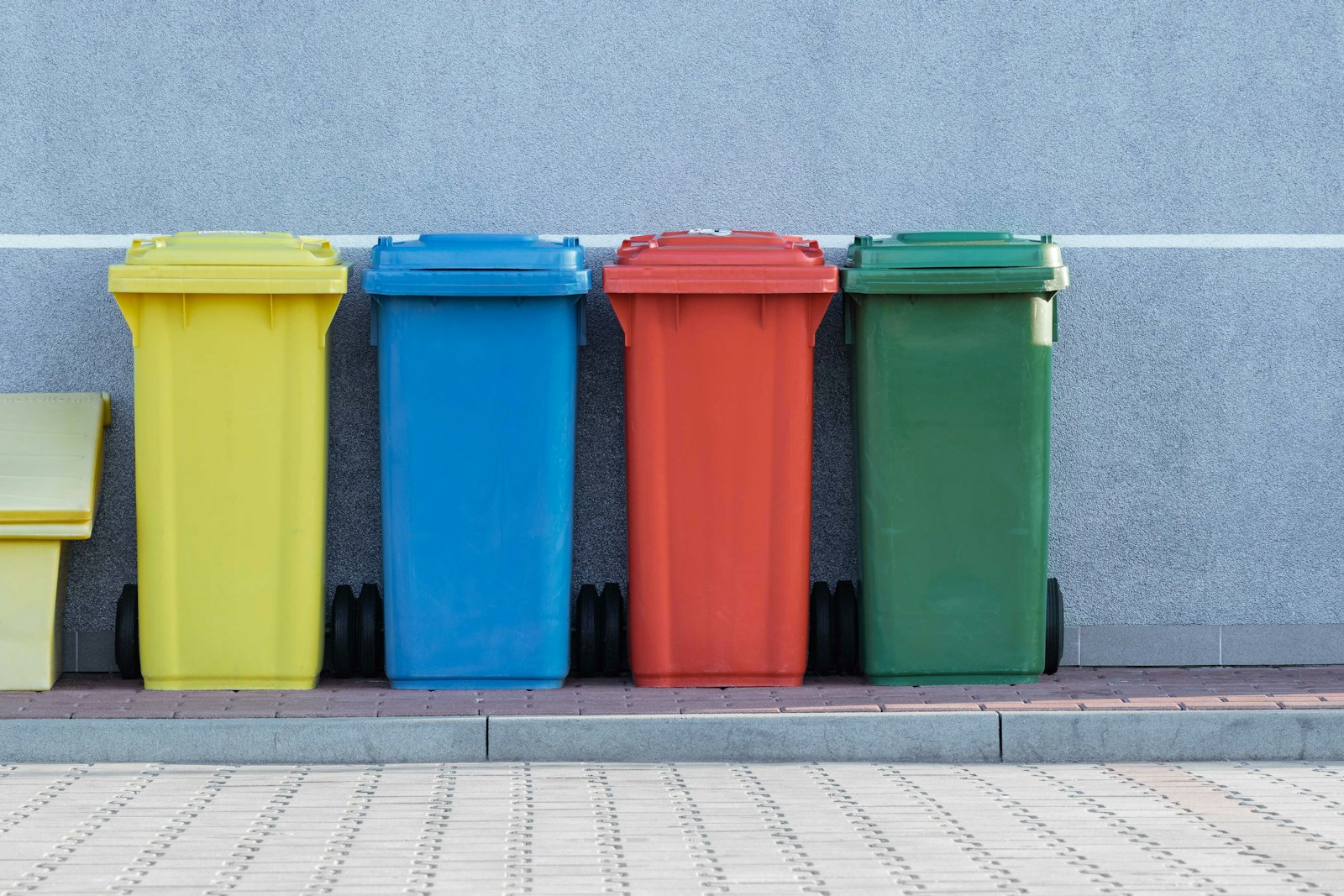
Many waste companies are moving to the UNI 11686 color standard, which looks like this:
| Color | Italian label | What goes in |
|---|---|---|
| Blue | Carta e cartone | Paper and cardboard |
| Yellow | Plastica (often with metalli) | Packaging such as bottles and tubs, often with cans |
| Green | Vetro | Bottles and jars |
| Brown | Organico / umido | Food scraps and other organic waste |
| Gray | Indifferenziato / secco residuo | Non-recyclable waste |
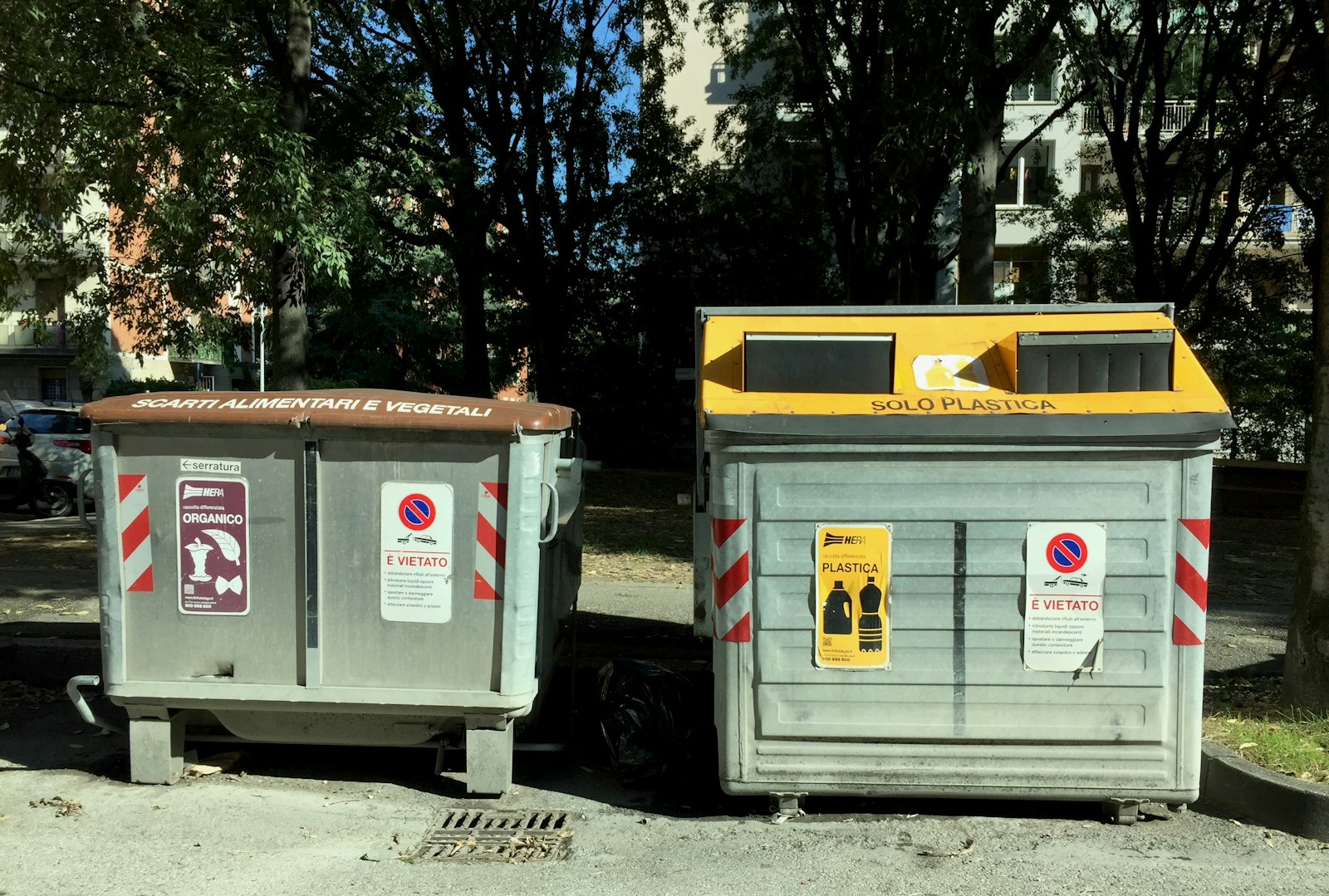
Treat that as a starting point. Older bins stay in use for years, so you will still see white paper containers in Milan, and some towns combine materials in ways the chart does not show. The printed word beats the color: if a lid says CARTA, it is for paper, whatever shade it is.
The Italian words printed on the bins
A short vocabulary covers almost every label you will meet:
| Italian | Meaning |
|---|---|
| Raccolta differenziata | Separate collection, recycling |
| Carta e cartone | Paper and cardboard |
| Plastica e metalli | Plastic and metal packaging |
| Vetro | Glass bottles and jars |
| VPL (vetro, plastica, lattine) | Bottles, packaging and cans together |
| Organico / umido | Food and compostable scraps |
| Indifferenziato / secco residuo | Everything that cannot be recycled |
| Porta a porta | Door-to-door collection |
| Esposizione | Putting waste out |
| Ecocalendario | Collection calendar |
| Isola ecologica / ecocentro | Municipal drop-off center |
What goes where in Italian vacation rentals
Paper and cardboard
Newspapers, clean paper and flattened boxes go in carta e cartone. Shop receipts printed on thermal paper do not: they go with general trash. A greasy pizza box usually goes in organic waste in Rome and Naples, while a clean box goes with paper; tear off the clean lid if in doubt. Drink cartons are collected with paper in Rome and Venice but with packaging in Tuscany’s capital, which shows why each place’s system matters.
Plastic and metal packaging
In most big cities, plastic packaging and metal cans share a container marked plastica e metalli. Bottles, yogurt pots, food trays, cans and foil all belong there once roughly empty. Durable objects such as toys, toothbrushes or a broken colander are not packaging, so they usually go in the residual bin.
Bottles and jars
The green vetro bell takes bottles and jars, loose rather than bagged. Drinking glasses, mirrors, ceramics, oven dishes and light bulbs do not belong there. In Venice, bottles go in together with packaging and cans.
Food scraps and organic waste
The brown organic container is for food leftovers, fruit peel, coffee grounds and tea bags. Cities usually require a certified compostable bag (marked EN 13432); an ordinary plastic shopping bag, even if sold as “biodegradable”, can get your waste left behind.
Coffee capsules
Since 12 August 2026, under new EU packaging law, coffee capsules count as packaging. Milan’s waste company now asks residents to put compostable capsules in organic waste and plastica or aluminium ones with packaging. Other councils are adapting, so check your area’s guide.
Everything else
The gray residual waste container is for what genuinely cannot be sorted: diapers, thermal receipts, dirty tissues, broken dishes in small amounts, and sweeping dust. It is not a catch-all for anything confusing.
Sorting in the big cities
| Place | How it works |
|---|---|
| Rome (AMA) | Five streams: paper with drink cartons, packaging with metal, bottles and jars, organic, and non-recyclable. Street containers in most areas, collection from the building in some districts. |
| Milan (AMSA) | Collected from each building. Packaging goes in a yellow transparent sack, unsorted waste in a clear neutral sack, paper in a white or blue-lidded bidone, bottles in a green bidone and food in a brown bidone. |
| Florence (Alia) | Street stations with five bins; packaging and drink cartons share a slot. Most are digital and open with a resident’s key or the Aliapp, so guests need the host’s key. |
| Venice historic center (Veritas) | Paper on Monday, Wednesday and Friday; bottles, packaging and cans together on Tuesday, Thursday and Saturday; residual every day except Sunday. No separate food collection in the center. |
| Naples (ASIA) | Street cassonetti for paper, bottles and jars, packaging with metal, organic and residual. Residual goes out in the evening only. |
In Venice, residents take bags to the Veritas boat or collection point between 6:30 and 8:30, or wait for the collector to ring the bell later in the morning, and leaving garbage in the street is banned. The council’s collection page has the details, and our Venice dos and don’ts cover the other local rules.
Your rental may not use street containers at all
Before you head outside with four sacks of trash, check the building. A rental may have shared bins in a courtyard, basement or storeroom, private tubs kept inside until collection day, or locked street containers that open with a card. Ask the host where everything goes, which streams to separate, whether trash goes straight into shared bins or out on collection day, whether a key is needed, and what to do if you leave before the next pickup.
That last question matters on short stays. A Friday departure does not give you permission to leave Monday’s waste by the front entrance, and many hosts would rather you leave sorted trash in a set place inside.
How to read a collection calendar
With door-to-door pickup, each stream has its own days, and the orario di esposizione (the window when garbage may go out) matters as much as the day. A typical sheet reads LUN organico, MAR carta, MER organico and residuo, GIO plastica e metalli.
Times vary widely. Milan’s 2026 ordinance asks residents in the central area to put waste out between 5:00 and 5:40 on collection mornings (later on Saturdays), and between 7:00 and 8:00 in outer areas, while Naples wants residual trash out in the evening. Calendars can change by street and even house number, so use the calendar for your address on the operator’s website, such as AMSA’s address search in Milan, rather than a generic result.
Holidays can move or cancel pickups, so look for notes like festivi esclusi. If you are moving between several rentals, save each host’s trash instructions with your check-in details when you organize the rest of your Italy trip.
Batteries, medicines and bulky items
Used batteries go in collection tubes in shops and supermarkets, out-of-date medicines in pharmacy boxes, and electronics (RAEE) back to an electronics shop or the municipal drop-off center. Drop-off centers often admit residents only, so a visitor should ask the host rather than carry a broken appliance across town. For anything unusual, search the operator’s “Dove lo butto?” (“where do I throw it?”) tool, or use the free Junker app, which reads a barcode and gives the waste rule for the Italian comune you are in, handy if you move between places during your trip to Italy.
Packaging labels help too. Since 2023, the law in Italy requires packaging to show its material code (such as PAP, PET or ALU) and a sorting hint like Raccolta carta. The CONAI packaging consortium explains the codes, but once you know the material, your municipality decides where it goes.
Fines for getting it wrong
Fines are set locally. In Milan, breaking the sorting ordinance costs €50, rising to €500 for repeat offenses, and abandoning waste costs €1,000 to €3,000. Naples charges between €51.65 and €500 for wrong sorting, and Venice penalizes trash left in the street. Guests are rarely chased directly, but penalties on a building can be passed on, so sorting properly protects your host as well as your deposit.
A quick setup that prevents most mistakes
When you arrive, find the household bins before you start making trash, and photograph any sorting notice or calendar. Then match words before colors: carta, vetro, organico, plastica e metalli and residuo. If the property has collection from the building, note both the day and the time window. If anything conflicts with what you saw elsewhere, follow the label in front of you. One quick photo of the notice saves guesswork for the rest of your stay in Italy, and leaves the apartment’s trash sorted for the next guests.
FAQ
What are the new recycling rules in 2026?
Coffee capsules now count as packaging under EU law from 12 August 2026, and Milan issued a new sorting ordinance in April 2026 with transparent sacks and set exposure times. Other changes are set by individual municipalities, so check your waste company.
What are five things that cannot be recycled?
Thermal till receipts, diapers, used tissues, drinking glasses or mirrors, and ceramic or oven dishes. Most go in the residual container; larger amounts of ceramics may need the drop-off center.
Do tourists have to sort their trash?
Yes. Recycling rules in each Italian comune apply to everyone staying there, including short-term guests, and hosts expect you to follow the building’s system.
Is the bin color the same everywhere?
No. Blue for paper, yellow for packaging, green for bottles, brown for food and gray for the rest is becoming standard, but older bins and regional combinations remain, so read the label.
What if I miss the collection?
Bring the bag back inside, check the next date on the local recycling calendar and ask your host. Never leave trash beside a closed container or in a doorway.