Tutor speed cameras in Italy do not normally judge you by the speed at one camera. On a monitored autostrada section, an entry gantry records your vehicle and time, a later gantry does the same, and the system calculates your average speed between them. If that average exceeds the applicable limit, the record can be checked by the Polizia Stradale and a penalty issued. Slowing only as you pass the second gantry does not erase faster driving earlier in the section.
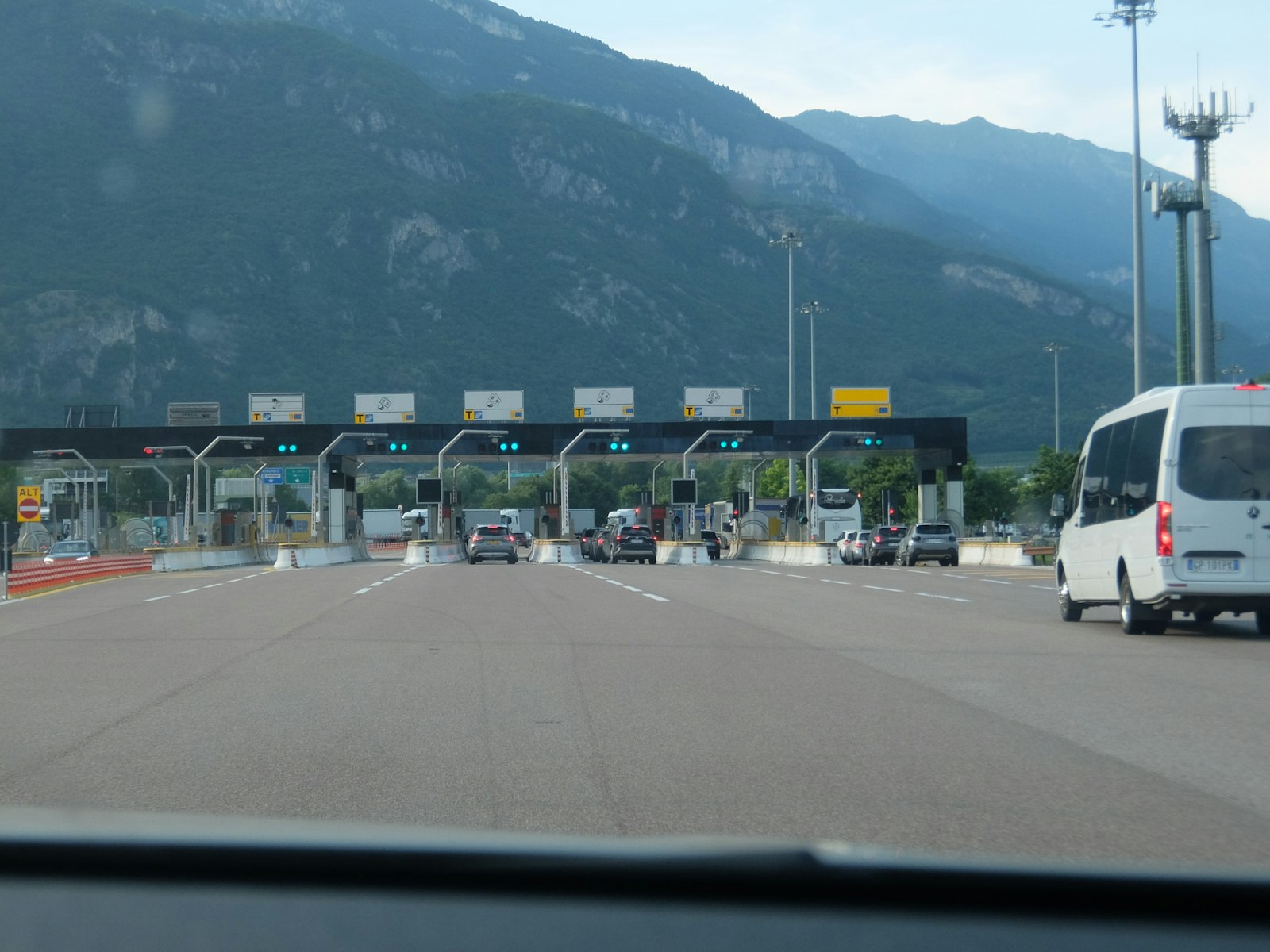
There is one increasingly important wrinkle. The newer Tutor 3.0 system has been approved by Italy’s Ministry of Infrastructure and Transport for both average and instantaneous speed enforcement. That does not mean every Tutor gantry is simultaneously issuing both types of violation, but it does mean treating the camera itself as a place where you can safely speed up or slow down is a poor strategy. The posted limit applies throughout the road.
What the Tutor system actually measures
The traditional system uses pairs of motorway gantries, called portali. According to Autostrade per l’Italia’s official Tutor information, the process works like this:
- At the first portal, sensors identify the vehicle category and cameras record the vehicle, licence plate, date and exact time.
- At a later portal, the system records the vehicle and time again.
- The central system matches the two records and calculates how long the vehicle took to cover the known distance.
- If the travel time corresponds to a permitted average speed, the data are deleted. Potential violations are passed through the enforcement process and checked by the Polizia Stradale.
For a simple example, imagine that two portals are 20 km apart. Covering those 20 km in 12 minutes gives an average of 100 km/h. It does not matter whether you drove at exactly 100 the entire time. The calculation is based on total distance and elapsed time between the measuring points.
This is why a burst at 150 km/h followed by braking to 100 km/h just before the next gantry may still produce an average above the limit.
How to recognize a Tutor-controlled stretch
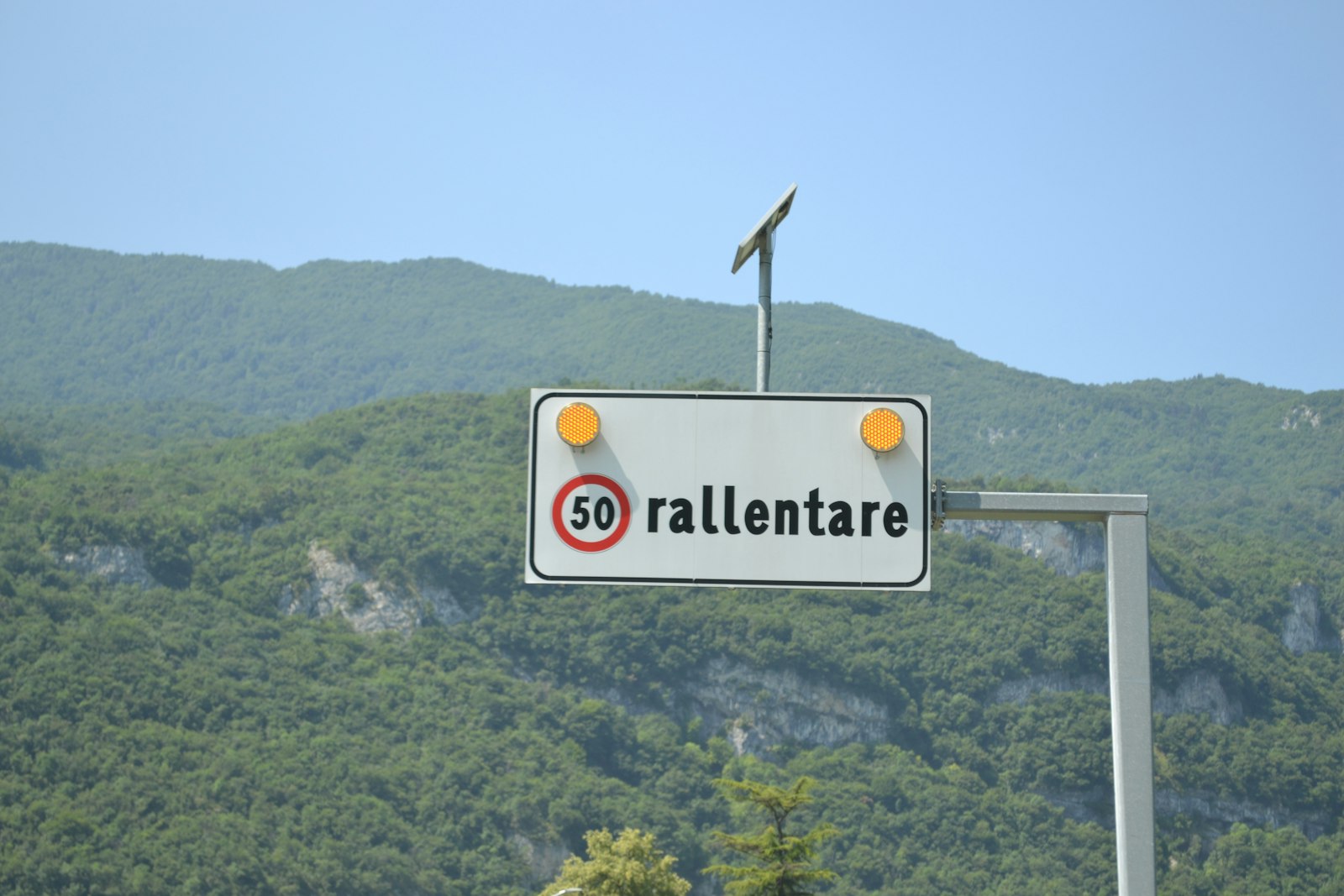
On the autostrada, look for green warning signs associated with electronic speed control. Wording can include controllo elettronico della velocità con sistema Tutor or references to controllo velocità media.
Autostrade per l’Italia states that Tutor-controlled sections are signposted with green signs both approaching the system and beneath the portals. Do not expect the overhead electronic message board to say that enforcement is active. The system can operate regardless of whether a variable-message sign happens to display a Tutor warning.
The physical portal usually spans the carriageway and carries cameras or sensors above the lanes. Changing lanes underneath it is not a loophole. The system is designed to identify vehicles even when they cross lanes or pass underneath at an angle.
The limit used is not automatically 130 km/h
For an ordinary passenger car, 130 km/h is the normal maximum on an Italian autostrada unless signs impose a lower limit. The number on the road signs in front of you is what matters.
Several situations change the applicable speed:
- Rain: the motorway maximum for ordinary cars drops to 110 km/h during precipitation. Autostrade per l’Italia states that the Tutor threshold can also be adjusted accordingly by the Polizia Stradale.
- Roadworks: temporary limits of 110, 100, 80 km/h or another posted speed may apply through a cantiere. Follow the temporary signs, not the limit you remember from several kilometres earlier.
- Tunnels and difficult sections: permanent or variable lower limits can apply.
- Trailers: a car towing a trailer has a lower motorway limit. The Tutor system can distinguish vehicle categories and detect trailers.
- Heavy vehicles and buses: these have their own statutory limits, which the system can take into account.
If several circular speed-limit signs appear as you travel through a monitored section, obey each new limit from the point where it takes effect. Do not assume the number displayed near the first Tutor portal remains the relevant limit for the entire motorway journey.
Does slowing down at the second camera work?
Not in the way many drivers imagine. The second portal provides the finishing timestamp. By the time you reach it, the time spent covering the entire measured stretch has already determined your average.
If you have been travelling too quickly for most of the section, braking hard immediately before the camera is both ineffective and potentially dangerous. The sensible response after realizing you have been speeding is simply to return smoothly to the legal limit and stay there.
Likewise, driving across lane markings, changing lanes below a gantry or moving into another normal traffic lane does not prevent the system from matching the vehicle.
What happens if you stop at an area di servizio?
A motorway service area is an area di servizio. A parking-only rest area may be signed area di sosta.
If a genuine stop occurs between two average-speed measuring points, that stop forms part of the elapsed time between the two recordings. But treating a service-area stop as a way to compensate for deliberately speeding beforehand is a bad plan. Speeding remains an offence, other enforcement may be present, and newer equipment can support instantaneous as well as average-speed measurement.
Stop because you need fuel, food, a toilet or a rest, not because you are trying to manipulate the calculation.
Tutor works at night and in bad weather
Darkness does not switch the system off. Autostrade per l’Italia says Tutor operates at night and can function in rain and reduced visibility caused by fog.
That matters because an empty autostrada late in the evening can make 130 km/h feel surprisingly slow, particularly in a quiet rental car. The absence of traffic or a police patrol does not mean the monitored section is inactive.
The same applies when the overhead motorway signs are blank. Fixed roadside warnings, the current posted speed and the road conditions are what you should use.
Telepass has nothing to do with the speed calculation
Tutor identifies vehicles through its own sensors and cameras. You do not need a Telepass or another electronic toll device to be monitored.
Conversely, having Telepass does not somehow make the system more or less likely to record you. Toll collection and speed enforcement are separate processes.
If you are still sorting out the practical side of driving a rental, including tolls, city restrictions and pickup procedures, the Italy on Foot guide to renting a car in Italy covers the surrounding issues that tend to cause problems for visitors.
What happens with a rental car
A rental plate is not invisible to the system. Autostrade per l’Italia specifically states that the enforcement process can query rental-company records when identifying the relevant renter or driver.
This means you may hear nothing during the trip itself. A notice can arrive after the rental has ended, and the rental company may separately charge an administrative fee for processing a police request if its contract allows one. That company fee is not the same thing as the traffic penalty.
If correspondence arrives later, check the motorway number, direction of travel, date, time, vehicle registration and recorded section against your rental documents before deciding what action to take.
How to check where Tutor is installed
Do not rely on an old blog map or a saved screenshot. Controlled sections are added, removed or changed as equipment and motorway works evolve.
The Polizia di Stato Tutor page publishes the official list of controlled motorway stretches, while Autostrade per l’Italia also lists sections on its own network. The police listing was updated again in 2026, which is a good reason not to assume a map from a previous trip is still complete.
For trip planning, you can build your Italy itinerary around the routes and stops you actually want, but once you are driving, the motorway’s live signs take priority over any route-planning app.
Tutor 3.0 changes the “it only measures averages” assumption
The original Tutor concept is strongly associated with average-speed enforcement, and that remains its best-known function. However, Italy’s Ministry of Infrastructure and Transport approved Tutor 3.0 for detecting both instantaneous and average-speed violations.
Autostrade per l’Italia’s newer road-safety technology also combines higher-definition cameras, radar and central processing. The practical consequence for a traveler is simple: do not build your driving around supposed camera loopholes. Keep to the displayed limit throughout the section.
Common mistakes that cause trouble
- Seeing 130 once and treating it as permanent. Rain, roadworks and local restrictions can lower the limit later.
- Braking sharply underneath a portal. Average-speed enforcement is based on the whole measured section.
- Following the fastest local driver. The car overtaking you may be speeding, may have misunderstood the limit or may simply receive a notice later.
- Assuming a blank electronic sign means Tutor is off. Autostrade per l’Italia explicitly says operation does not depend on a Tutor message appearing on the variable-message board.
- Thinking lane changes defeat the cameras. They do not.
- Ignoring the rain limit. On the autostrada, precipitation changes the legal maximum for an ordinary car from 130 to 110 km/h unless an even lower posted limit applies.
- Assuming rental cars cannot be traced. The enforcement system has a procedure for obtaining rental information.
The easiest way to drive through a monitored section
Once you see the green Tutor warning, check the current speed-limit signs, settle at or below the applicable limit and hold a consistent speed. Cruise control can help on an open motorway, although it should be adjusted immediately when limits, traffic or weather conditions change.
If roadworks reduce the limit, slow before entering the restricted section rather than waiting for the next gantry. If rain starts, remember that the statutory motorway maximum for an ordinary car drops even if you have not yet seen another large speed sign.
Most importantly, treat the entire controlled stretch as the enforcement zone, not the camera gantries as two isolated traps. That is exactly what average-speed control was designed to encourage.