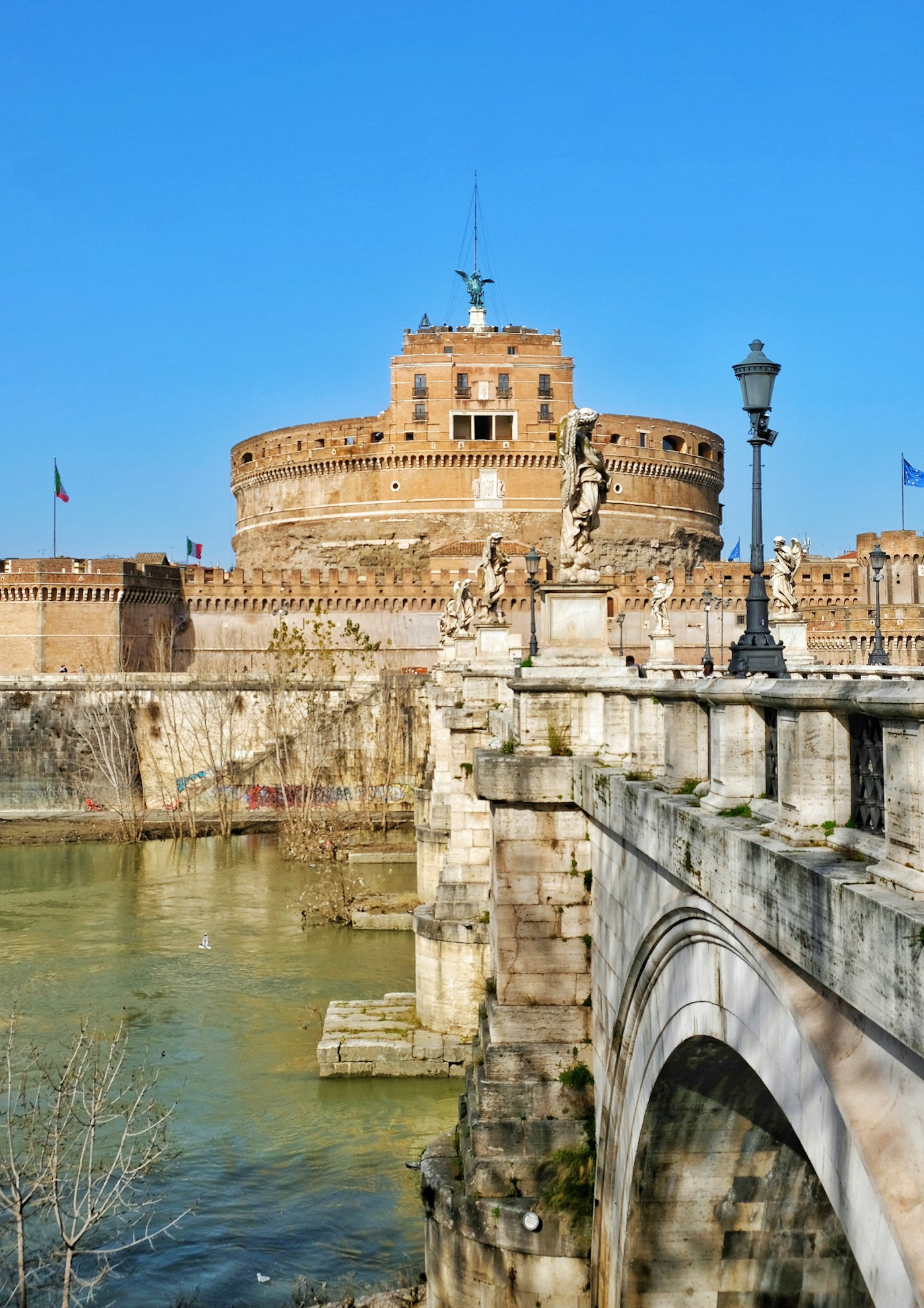
The Castel Sant’Angelo exit route does not put you on the street as soon as you leave the Terrazza dell’Angelo. The terrace is the last major sight, but you still have a signed descent through the fortress before reaching ground level. Follow Uscita signs and staff directions rather than trying to retrace your climb. You finish back at the Castel Sant’Angelo complex on Lungotevere Castello, not through the Passetto into Vatican City.
What Happens After the Terrazza dell’Angelo
Think of the terrace as the top of the visit, not the physical exit. After taking in the view, look for the doorway and stairs marked Uscita. The route begins descending again through the building.
- Leave the terrace by the signed visitor descent. Do not assume the staircase you remember from the climb is necessarily the route staff want you to use on the way down.
- Keep following Uscita. The descent passes through connecting rooms, stairs and lower defensive areas before returning toward ground level. Castel Sant’Angelo is a layered fortress rather than a museum arranged along one neat corridor, so the way out feels longer than many visitors expect.
- Ignore Passetto signs unless you have the specific visit that includes it. The Passetto di Borgo is not the ordinary museum exit to St Peter’s.
- Continue until you are outside the ticketed monument. Depending on the route operating that day, you may be led through lower fortifications or garden areas before reaching the final gate.
Older maps and visitor descriptions often mention the Portone del Peruzzi, on the eastern side of the fortress. It has been used as a visitor access and exit point, but it is better treated as a landmark than a guaranteed final door. The museum currently warns that parts of the visitor route can be modified, so the arrows and staff you see inside take precedence over an old floor plan or video.
Where You Are When You Finally Get Outside
You emerge beside Castel Sant’Angelo itself, whose official address is Lungotevere Castello 50. The internal route does not transport you to the Vatican end of the Passetto, nor does it automatically leave you on Ponte Sant’Angelo.
If your final gate brings you out on the side of the gardens rather than directly opposite the river, simply follow the outside perimeter of the fortress toward the side you need. The huge cylindrical castle makes a much better landmark than trying to remember which gate you entered earlier.
For Ponte Sant’Angelo, Piazza Navona and the historic center
Head for the river-facing side of the castle. Ponte Sant’Angelo is the bridge lined with angel statues directly on the main axis in front of the fortress. Cross it if your next destination is Piazza Navona, Campo de’ Fiori, the Pantheon or the historic center south of the Tiber.
For St Peter’s Square and the Vatican
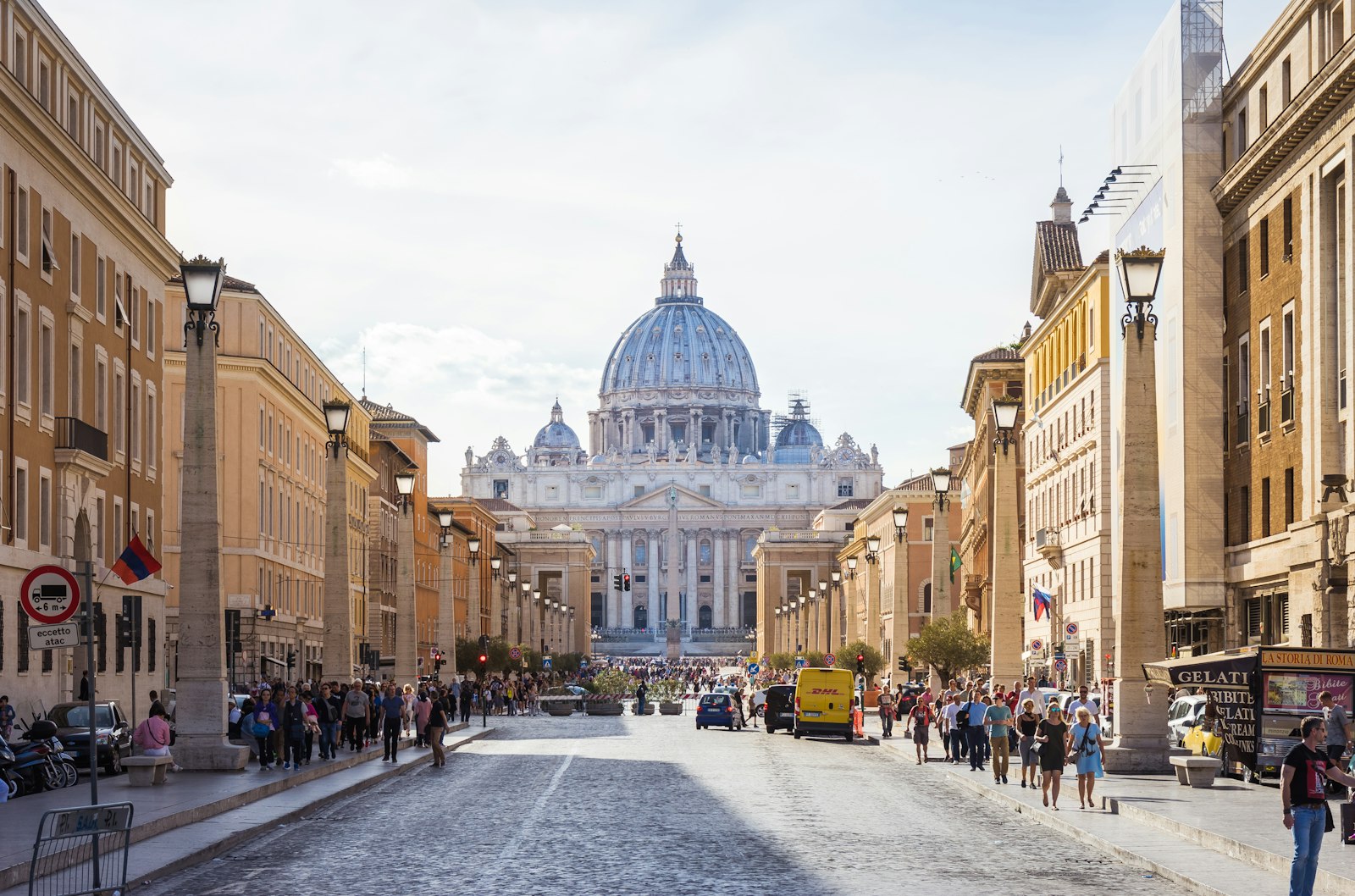
Do not cross Ponte Sant’Angelo. Stay on the Castel Sant’Angelo side of the Tiber and walk around the fortress toward Piazza Pia and Via della Conciliazione. Once you reach Via della Conciliazione, the street points straight toward St Peter’s Basilica.
This distinction saves an annoying bit of backtracking. Crossing the angel bridge is perfect for the centro storico, but it puts you on the wrong bank if St Peter’s is next.
For Piazza Cavour and Prati
Head away from the river toward the Palace of Justice and Piazza Cavour. From there you are in the Prati side of central Rome, useful for restaurants, shopping and onward travel toward Via Cola di Rienzo. See our guide to Rome’s Prati neighborhood if you plan to stay on this side of the river after the museum.
If Castel Sant’Angelo is the handoff between your Vatican sightseeing and the historic center, you can organize the rest of your trip around which bank of the Tiber you actually need next. That is more useful than automatically following the crowd toward the bridge.
The Passetto di Borgo Is Not a Shortcut Out
The elevated Passetto connecting the castle with the Vatican is easy to mistake for a clever alternative exit, especially after seeing it from the terraces. Ordinary museum admission does not allow you to wander through it and emerge beside St Peter’s.
Passetto access is handled through specific guided visits. The museum’s current information states that its regular daytime and evening Passetto visits begin and end at Castel Sant’Angelo. A separate facilitated Passetto itinerary uses the Torre del Mascherino in Piazza della Città Leonina, but that is a special route rather than the normal museum visit.
Check the official Castel Sant’Angelo visitor information if the Passetto is part of your plans, since access arrangements and visitor flows can change.
Why the Last Part of the Route May Look Different From Photos and Videos
The museum currently has an important routing notice in effect. Since December 2024, the circular ground-floor ambulatory has been subject to diversions and alterations during work intended to improve accessibility. The official site still displays that notice in 2026.
The museum also states that the normal visit can be reorganized on free-admission days when crowds require different visitor flows, while evening openings can involve route changes or restrictions.
That matters particularly on the way out. A video showing someone descending through a particular courtyard and leaving by a specific doorway is not proof that the same door will be operating when you visit. If temporary barriers block what appears to be the obvious route, do not squeeze past them or start retracing the museum. Look for the next Uscita sign or ask a member of staff.
For a broader overview of what comes before the terrace, including the Roman ramp and papal apartments, see our Castel Sant’Angelo National Museum guide.
Italian Signs That Matter on the Way Down
- Uscita: exit. This is the word to follow.
- Ingresso: entrance. Do not follow it assuming it will take you back to the door you used earlier.
- Percorso di visita: visitor route.
- Scala or Scale: staircase or stairs.
- Ascensore: lift or elevator.
- Passetto di Borgo: the fortified Vatican corridor, not a general exit sign.
If the route becomes unclear, the simplest question is Dov’è l’uscita?, meaning “Where is the exit?” If you are already outside and need directions, Per San Pietro? asks which way to St Peter’s, while Per Ponte Sant’Angelo? points you toward the bridge.
Luggage and Reduced-Mobility Visitors
Castel Sant’Angelo’s official visitor information states that there is no cloakroom. That means there is normally no end-of-visit detour to collect a bag from a storage desk near the entrance. Anything you were permitted to carry inside remains with you throughout the route.
The building itself has significant accessibility limitations, and the standard upper route contains stairs. If museum staff have arranged an assisted or modified path for you, do not assume the descent from the upper levels will follow the ordinary pedestrian flow. Follow the return instructions given by staff, particularly while accessibility works are affecting parts of the monument.
Mistakes That Cause Most of the Confusion
- Treating the terrace as the end of the physical route. Allow extra time to descend and reach the street.
- Trying to retrace the entire climb. Follow Uscita instead. Parts of the museum operate with directed visitor flow.
- Following the Passetto because it appears to lead toward St Peter’s. It requires the appropriate guided visit and is not the standard way out.
- Crossing Ponte Sant’Angelo when heading to the Vatican. St Peter’s is on the same side of the river as the castle.
- Using an old map as if the final gate cannot change. Current works and crowd-control measures can alter the last section of the route.
If you have a timed reservation immediately after the museum, budget for the descent rather than scheduling from the moment you expect to finish taking photographs on the terrace. Reaching the top means the sightseeing portion is nearly finished, but you are still several levels above Rome’s pavement.