Most beginner mosaic workshops in Rome last around two to three hours and give you enough time to make a small decorative piece using marble, stone or glass tiles. You do not need drawing experience, and the instructor usually provides a design, materials and tools. What you take home depends on the workshop: some pieces are ready to carry away immediately, while others need several hours to set or must be collected the following day.
A mosaic workshop Rome visitors can fit into a sightseeing day is usually focused on one manageable project, such as a patterned tile, small picture or decorative panel. The most useful question to ask before booking is whether you will actually take your finished piece away that day, particularly if you are leaving Rome soon afterwards.
What can beginners realistically make in one session?
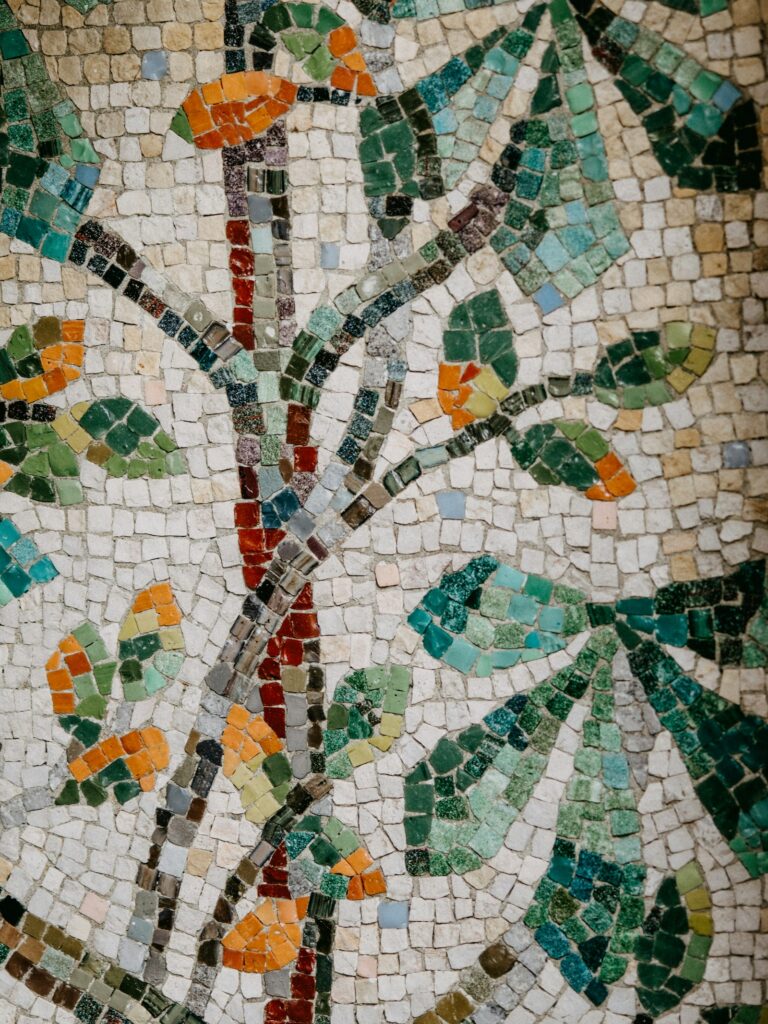
A short workshop is enough to learn the basic process of arranging small pieces, known as tesserae, into a decorative surface. You will usually work on a prepared base rather than create a large mosaic from scratch.
The size and complexity of the finished object depend on the materials, technique and time available. Beginners typically have a better experience with a small, clearly defined project than with an ambitious design containing dozens of tiny details.
A geometric Roman-style mosaic
Geometric patterns are particularly suitable for beginners because they can be assembled using repeated shapes and a limited selection of colors. Common designs include borders, squares, diamonds, circles and arrangements inspired by ancient Roman floor mosaics.
A two-hour artisan workshop listed by Homo Faber, for example, teaches participants to decorate a 20 cm by 20 cm tile with a geometric pattern using small marble pieces. No previous mosaic experience is required, although the finished tile is collected the following day.
For someone interested in learning how traditional Roman mosaics were assembled, this type of project offers a useful introduction without demanding advanced artistic skills.
A small mosaic picture
Some workshops allow participants to create a small framed picture or decorative panel. The design might include a flower, animal, heart, sun, initials or a simple image inspired by Roman art.
The instructor may supply a template or help simplify your chosen design. A picture with large areas of color and a clear outline is usually easier to finish than one containing detailed shading or very small lettering.
One Rome studio workshop currently advertises a finished piece measuring approximately 7 by 5 inches, or about 18 by 13 cm, completed during a session lasting around two and a half hours. This gives a useful indication of the scale you can expect from a short class, although other studios use different dimensions and techniques.
A decorative tile or small panel
A flat decorative tile is another practical option. You can display it on a shelf, place it in a frame or use it as a decorative object after the materials have fully cured.
Do not assume the completed piece is suitable for use as a coaster, trivet or outdoor tile. Its heat resistance, water resistance and durability depend on the backing, adhesive, grout and finish. If you want a functional object rather than a decorative souvenir, ask whether the workshop materials are designed for that purpose.
A personalized design
Private workshops sometimes provide more flexibility to choose colors, initials or a particular motif. Personalization is easiest when the design remains relatively simple.
If you want to reproduce a family crest, detailed photograph or complicated Roman scene, send the image to the instructor before booking. They can tell you whether it is achievable within the session or whether you would need a longer class.
What actually happens during a mosaic-making class?
Although individual studios use different methods, most beginner sessions follow a similar sequence. The instructor introduces the materials and demonstrates how to arrange the tesserae, then helps participants complete their own pieces.
- Choose a design. You may select from prepared patterns or draw a simplified design on a backing board or tile.
- Select the materials. Depending on the workshop, you might use natural marble, other stone, glass tiles or a mixture of materials.
- Learn the cutting technique. Some traditional classes demonstrate how to cut and shape marble pieces using specialist tools. Other beginner workshops provide precut tiles.
- Arrange the tesserae. You position the pieces, leaving appropriate spaces and following the pattern.
- Fix the design. The tiles are secured using the technique chosen by the instructor.
- Finish and pack the piece. The studio explains any setting time, finishing work and precautions for transporting your mosaic.
The exact finishing process matters. Some techniques involve adhesive that needs time to cure, while others require grouting or additional studio work. Ask how the piece is finished and whether you will participate in every stage.
Roman marble mosaics versus modern craft mosaics
Not all mosaic workshops teach the same craft. The distinction matters if you are booking specifically because you want to learn about ancient Roman techniques.
Traditional marble mosaic workshops
Traditional-style classes often use natural stone or marble tesserae, introducing the arrangement of individual pieces and sometimes teaching participants to cut marble themselves.
You may encounter the term mosaico romano or mosaico tagliato, referring to a mosaic technique using cut pieces of material. Workshops focused on these methods can be particularly interesting if you have already seen ancient mosaics in Rome’s archaeological sites or museums.
Cutting stone takes time and requires careful tool handling. The instructor may prepare some materials beforehand so beginners can complete their work within the allotted session.
Glass and mixed-material workshops
Other classes use colored glass, stone, ceramic or prepared mosaic pieces. These can offer a wider range of colors and may be easier for beginners, especially when the tiles are already cut.
A workshop using precut glass pieces can still teach composition, spacing and basic mosaic assembly. However, it may provide less hands-on experience with traditional marble cutting.
Micromosaic workshops
Roman micromosaics are a more specialized art form involving extremely small elements, often made from glass-based materials. Traditional micromosaico filato uses finely worked glass elements to create detailed images.
A two-hour introductory workshop may demonstrate the technique or allow you to make a simplified project, but traditional detailed micromosaic work requires much more time and precision. If a listing uses the word “micromosaic,” ask exactly which materials and techniques participants will use and what they can realistically finish.
How long should you book?
Workshop duration should influence your choice of project. A longer class does not necessarily mean a larger finished mosaic because some methods require more preparation, cutting or finishing.
- About 90 minutes: Better suited to a small, simple craft project using prepared materials, particularly for children or travelers with limited time.
- About two hours: Usually enough for an introductory lesson and one small decorative tile or panel, with instructor assistance.
- Two and a half to three hours: Allows more time for learning techniques, cutting materials and completing a slightly more involved design.
- Half-day or multi-day courses: Better suited to larger pieces, more intricate compositions or travelers specifically interested in developing mosaic-making skills.
These are general planning guidelines rather than fixed standards. Compare the actual project and teaching method, since a focused two-hour artisan class may involve more traditional technique than a longer session using prepared materials.
Can you take your mosaic home immediately?
This is one of the biggest differences between workshops and an especially important consideration for travelers.
Some studios prepare the backing and finishing method so that participants can leave with their mosaics immediately after class. Others box the artwork while it continues to set, and some require next-day collection.
For example, the mosaic workshop advertised through Romeing in Trastevere explains that the completed piece is placed in a box and can take up to six hours to set. The Homo Faber artisan experience described earlier specifies collection the following day. These are different arrangements, and neither should be assumed to apply to every Rome studio.
Before booking, ask:
- Will the mosaic be finished during the workshop?
- Can I take it away immediately afterwards?
- If it needs to set, can I safely carry the box while walking around Rome?
- Does the piece need to remain flat?
- Is next-day collection required?
- Can the studio ship the finished piece if I cannot return?
- Is protective packaging included?
If your flight leaves the same evening, prioritize a class that explicitly confirms same-day collection and travel-safe packaging. Completing the design during class does not always mean the adhesive or finishing material has fully cured.
Can you carry a finished mosaic on a plane?
Small mosaics are generally easier to transport in cabin luggage, provided they meet the airline’s baggage limits and airport security requirements. However, a finished piece may be relatively heavy, especially if it has a stone backing or substantial marble tiles.
Ask for the approximate dimensions and weight, including the protective box. A small mosaic can be compact enough for a backpack yet too fragile to carry loose among other belongings.
Keep the finished piece flat if instructed, protect its corners and avoid putting pressure on the tile surface while the adhesive is still curing. If the mosaic has sharp edges or incorporates glass, use the packaging supplied by the studio rather than wrapping it only in clothing.
Do not take cutting tools, blades or other workshop equipment into cabin baggage. If you intend to bring any tools home, check the relevant airline and airport security rules separately.
Are mosaic workshops suitable for children?
Many Rome workshops welcome families, but minimum ages vary. Some classes are designed for young children using prepared materials, while workshops involving sharp stone-cutting tools may impose higher age limits.
For example, one traditional marble workshop in Rome sets a minimum age of 12, while family-focused workshops advertise simpler projects for younger participants. A class described as suitable for beginners does not automatically mean it is suitable for a six-year-old.
For younger children, look for shorter sessions with precut pieces, simple templates and direct instructor supervision. Confirm whether an adult must participate and whether the accompanying adult pays the full workshop fee.
Also ask whether everyone makes an individual mosaic. Some family activities include one shared project, while others provide a separate work surface and finished piece for each paying participant.
What about people with limited hand mobility or reduced vision?
Mosaic-making involves repeated small hand movements, careful positioning and sometimes the use of cutting tools. The difficulty depends on the size of the tesserae and the particular technique.
Someone with arthritis, reduced grip strength or limited hand coordination may find larger precut pieces easier than traditional marble cutting. Ask whether the instructor can provide prepared materials, adapted tools or additional assistance.
For visitors with reduced vision, larger pieces and strong color contrast may make the project easier to follow. Check whether the studio can accommodate these adjustments rather than assuming every lesson uses a fixed design.
The studio’s physical accessibility should also be confirmed. Some artisan workshops occupy older buildings with entrance steps, narrow doors or toilets that are difficult to access. Ask about step-free entry, accessible restrooms and suitable seating if those features are essential.
How much do mosaic workshops in Rome cost?
Prices vary according to the duration, group size, materials and level of instruction. A short group activity using prepared materials is generally a different product from a private lesson with a specialist marble mosaicist.
Current published examples show how much the offers can differ. A two-hour artisan class listed by Homo Faber is priced at €80 per participant, while another Rome workshop offering approximately two and a half hours of instruction and a small marble mosaic advertises €96 per person. Private family workshops can cost considerably more, especially when the price covers an instructor dedicated exclusively to your group.
These are examples of individual advertised prices, not a standard rate for Rome. Prices and availability can change, so compare the complete booking terms for your preferred date.
Before paying, establish whether the following are included:
- All marble, glass or stone tesserae needed for the project.
- The backing tile, board or frame.
- Use of cutting tools and protective equipment.
- Instruction and assistance throughout the session.
- Adhesive, grout and any required finishing work.
- Packaging suitable for transporting the mosaic.
- Any next-day collection or shipping arrangements.
- Taxes, booking fees and any studio membership or association fee.
A cheaper workshop may be entirely suitable if you want a simple creative activity. If your main interest is learning traditional Roman marble-cutting techniques, compare how much of the session is devoted to teaching those skills.
Should you choose a private or group workshop?
A small group workshop is usually sufficient for an adult beginner who is happy to follow a set project and work at the instructor’s pace. You can ask questions, practice the technique and complete your own piece without paying for a private instructor.
Private sessions become more useful when you have young children, need adapted materials, want a specific design or require more flexibility with timing. They can also work well for families whose members have different levels of artistic experience.
Before reserving a private session, check whether the quotation is a flat group price or a per-person charge. Some studios can accommodate one or two people privately, while others have minimum fees or participant requirements.
If you are booking for a family, ask whether children and adults will work on designs of comparable difficulty or whether the teacher will provide different projects. An activity that keeps an eight-year-old engaged may be too simple for an adult interested in learning traditional techniques.
Where are the workshops held?
Rome has artisan studios in several central neighborhoods, including Monti, Trastevere and the historic streets around Piazza Navona and Castel Sant’Angelo. Other experiences take place in dedicated teaching spaces rather than working restoration studios.
Always check the actual address on the booking confirmation. Some marketplaces advertise a Rome workshop without making the studio location immediately obvious, and transport to the meeting point is often excluded.
A workshop in Monti can fit conveniently into a day exploring the Colosseum and Roman Forum area. Studios near Piazza Navona or Castel Sant’Angelo are easier to combine with central sightseeing, while a class in Trastevere might work well before an afternoon or evening in that neighborhood.
If the class ends with a freshly assembled mosaic, consider what you will do afterwards. Carrying a box containing an uncured piece through crowded attractions or on several public-transport journeys may be inconvenient. Returning it to your accommodation first could be the safer option.
What should you wear and bring?
Most beginner classes provide the tools and materials, so you generally do not need to buy any equipment beforehand. Comfortable clothes are sensible because you may handle adhesive, stone dust or grout, depending on the technique.
Wear clothing you would not mind getting a little dusty, and keep loose sleeves and long hair clear of cutting tools. If you use reading glasses for close work, bring them. Mosaic assembly can involve positioning small pieces and checking narrow gaps for an extended period.
Ask whether the studio provides an apron and suitable protective equipment. If you are sensitive to dust or have difficulty using particular materials, discuss that with the instructor before booking.
Bring a suitable bag if the studio confirms that you can take the mosaic away immediately, although protective packaging should be discussed in advance. Avoid assuming that the finished piece can simply be slipped into a small handbag.
How to fit a workshop into your Rome itinerary
A two- or three-hour class takes up a meaningful part of the day once travel to the studio, arrival time and any collection arrangements are included. Give yourself enough time to find the entrance, especially if the workshop is inside a courtyard or historic building.
A morning class can work well before lunch and a relaxed afternoon of sightseeing. An afternoon workshop may fit better after visiting a nearby museum or archaeological site, provided you do not have another timed reservation immediately afterwards.
If you want to connect the experience with ancient Roman art, consider seeing original mosaics before taking the class. The Domus Romane di Palazzo Valentini is one possibility, with archaeological remains and mosaic floors presented through a guided multimedia visit. Check its reservation requirements separately.
You can also use the Italy on Foot trip planner to organize your workshop alongside nearby sights, meal breaks and other scheduled activities. Account for the possibility that you may need to return to the studio later to collect your finished work.
What if your plans change or you miss the class?
Cancellation policies differ between studios and booking platforms. Some offer refunds when cancelled a specified number of hours or days before the session, while private bookings may have stricter terms because the instructor has reserved time specifically for your group.
Check the exact cancellation deadline and timezone. Also ask whether the workshop can be rescheduled if a train delay or another travel problem prevents you from arriving on time.
If you are running late, contact the studio directly using the number provided in your confirmation. A group workshop may not be able to delay its start because other participants are waiting. Arriving after the materials demonstration could also leave insufficient time to complete your piece.
For a private session, ask whether the instructor can adjust the start time and whether additional charges apply. Do not assume that flexibility is included simply because the lesson is private.
Questions to ask before booking
A useful booking enquiry should establish the project, materials and collection arrangements before you commit to a particular class.
- Is the workshop suitable for someone who has never made a mosaic?
- What exactly will I make, and approximately how large will it be?
- Will I use natural marble, glass, ceramic or prepared tiles?
- Will I learn to cut tesserae myself, or are the pieces precut?
- Can I choose my own design, or must I use a template?
- How many participants will share the instructor?
- Are all materials, finishing work and packaging included?
- Can I take the mosaic home immediately, or does it need to set?
- If next-day collection is required, can shipping be arranged instead?
- What is the minimum age for children, and must an adult participate?
- Is the studio accessible for someone with reduced mobility?
- What language will the instructor use?
- What are the cancellation and rescheduling rules?
For a first workshop, choose a small project with enough instruction time and a finishing arrangement that fits your travel schedule. A simple geometric tile or small marble picture is a realistic introduction to the craft. If you are leaving Rome on the same day, confirm the collection and packing arrangements in writing before paying, because the ability to finish a mosaic during class does not necessarily mean it is ready to travel.