Sampietrini are part of Rome’s charm and one of the fastest ways to discover how small your suitcase wheels really are. For Rome sampietrini with luggage, the easiest strategy is to stay on broad main streets and smooth sidewalks for as long as possible, even when that adds a few minutes, then tackle the historic paving only for the final block. The hardest routes combine cobbles, narrow pavements and hills, particularly in Monti, old Trastevere, Borgo Pio and the lanes around Piazza Navona.
The rule that makes rolling luggage through Rome much easier
Do not choose the shortest walking route on the map. Choose the route with the fewest small streets.
Rome deliberately treats major traffic arteries differently from many historic pedestrian streets. The city’s paving policy has moved or retained traditional stone paving in historic settings while using smoother surfaces on important traffic corridors. Via Nazionale, for example, was resurfaced with asphalt apart from stone edging.
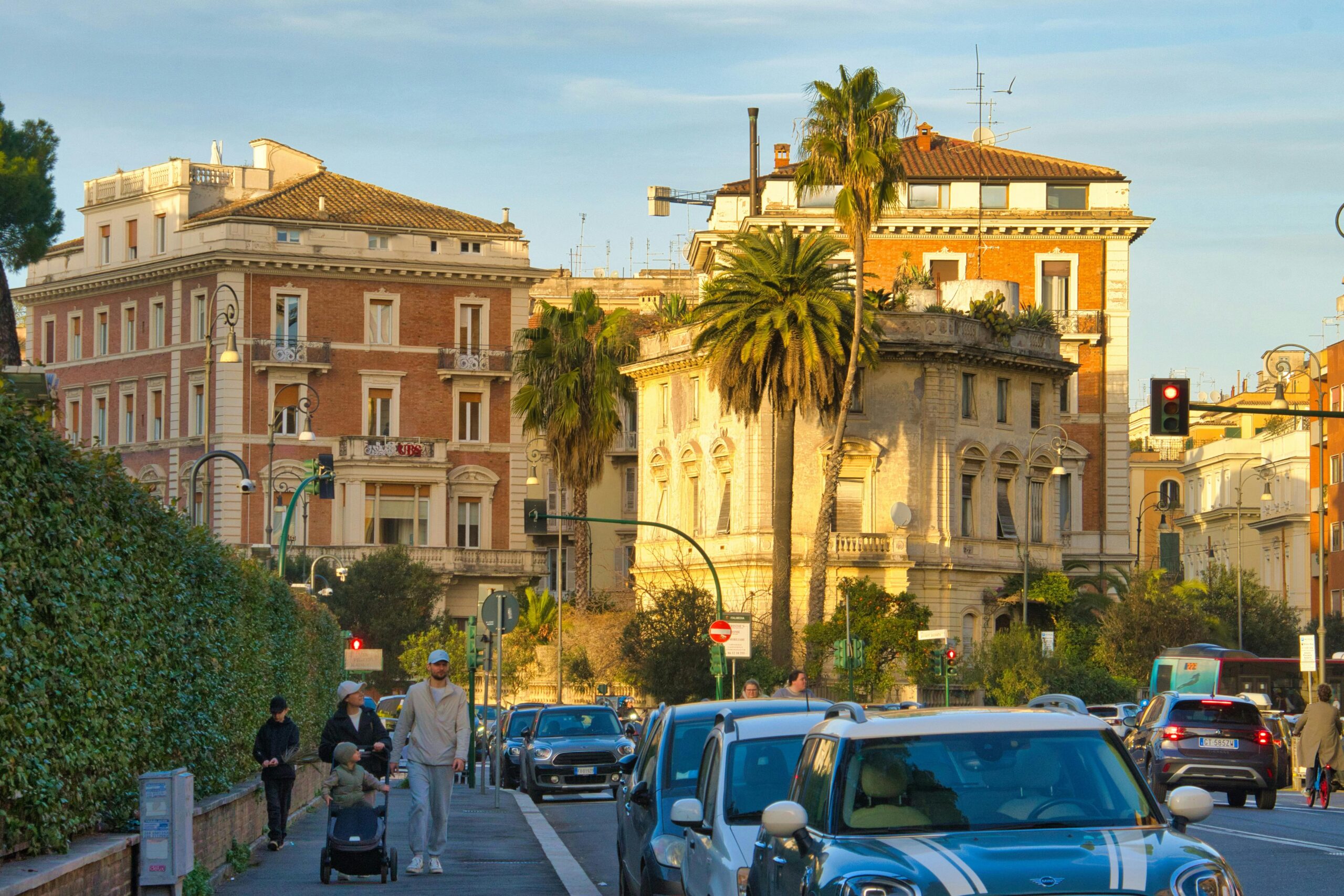
That creates a useful luggage rule:
- Use avenues such as Via Nazionale as your trunk route.
- Stay on the sidewalk of a major street rather than cutting through parallel historic lanes.
- Turn toward your hotel only when you are close to its address.
A route that is 300 metres longer on a decent pavement can be much easier than a shortcut over 300 metres of uneven stone.
The easiest streets and corridors for suitcases
Via Nazionale: one of the best routes from the Termini side of central Rome
Via Nazionale is the most useful luggage corridor between the Repubblica area and the historic centre. It is a large road with proper sidewalks rather than a narrow medieval lane, and its modern road surface makes it a much better reference route than the smaller streets of Monti immediately to the south.
From Roma Termini, leave toward Piazza dei Cinquecento and follow the main streets toward Piazza della Repubblica. Via Nazionale begins from the piazza. If your accommodation is between Repubblica, the Quirinal area and the northern edge of Monti, stay on this axis until the last sensible turn.
Do not cut prematurely through Via Urbana or Via Panisperna just because your phone says the route is two minutes shorter.
Via Cavour: useful for hotels on the Termini edge of Monti
Via Cavour runs from the Termini area toward Monti and the Colosseum side of the centre. Conditions are not perfectly smooth along every metre, but its sidewalks and role as a major street usually make it a more practical luggage corridor than the smaller lanes running through Monti.
If your hotel is on Via Urbana, Via Leonina, Via del Boschetto or another Monti side street, use Via Cavour as long as the address allows and make the final turn close to your accommodation.
There is an important exception: Monti is hilly. If your accommodation sits closer to Via Nazionale at the upper side of the district, approaching from Via Nazionale may save you from pulling a heavy case uphill from Via Cavour.
Via del Tritone and the Barberini approach
For accommodation around Barberini, Trevi and the upper Spanish Steps area, the large streets around Piazza Barberini and Via del Tritone are preferable to approaching through the tiny lanes immediately around the Trevi Fountain.
The attraction itself sits inside a dense network of narrow streets. A hotel described as “two minutes from Trevi Fountain” can therefore be less suitcase-friendly than one five or six minutes away on a wider road.
Prati: use the large grid before turning toward your hotel
Prati is generally less troublesome for luggage than the medieval centre because much of the neighbourhood follows a broader street grid. Viale Giulio Cesare and the larger streets around Lepanto and Ottaviano are useful approaches when arriving by Metro A.
Via Cola di Rienzo is another obvious reference axis, although Rome’s continuing historic-pavement works can temporarily alter which side of a street is easiest. The city still lists work in the Via Crescenzio and Via Cola di Rienzo area, so follow temporary pedestrian diversions rather than assuming an old map or street photo shows current conditions.
Via della Conciliazione for the St Peter’s side
If you are staying near St Peter’s, Via della Conciliazione is a much friendlier luggage approach than wandering through the lanes of Borgo. Its broad layout gives you considerably more space to manoeuvre a case.
Stay on it, or another major perimeter street, until you are close to your accommodation. Do not use Borgo Pio as a luggage shortcut unless your hotel is actually there.
The worst parts of central Rome for rolling suitcases
Monti: Via Panisperna, Via Urbana and the smaller lanes
Monti is wonderful once the suitcase is in your room. Arriving with one is another matter.
Via Panisperna is a particularly awkward combination because the historic paving comes with a noticeable slope. Via Urbana and the streets around Via Leonina, Via del Boschetto and Via dei Serpenti can also mean stone paving, narrow pedestrian space and parked vehicles or restaurant seating competing for room.
The problem is not simply vibration. On a slope, every bump either pulls the suitcase away from you downhill or requires extra force uphill.
For a large checked suitcase, use Via Nazionale or Via Cavour to get as close as possible, then accept the last short section through Monti.
Old Trastevere: beautiful streets, miserable little wheels
The historic part of Trastevere contains exactly the type of streets travelers picture when they imagine old Rome: narrow lanes, traditional paving and very little separation between pedestrians and vehicles.
The area around Via della Lungaretta, Vicolo del Cinque and the smaller streets leading toward Piazza di Santa Maria in Trastevere is much better for an evening walk than for dragging a 23-kilogram suitcase.
Trastevere is mostly less hilly than Monti, which helps, but the paving itself can continue for block after block. If your accommodation is deep inside the old neighbourhood, a taxi to the closest vehicle-accessible point can be far more sensible than walking from Trastevere railway station.
Borgo Pio
Borgo Pio and the surrounding Borgo lanes retain the old street character deliberately. That is good news for the neighbourhood and bad news for four tiny spinner wheels.
If your destination is near the Vatican but not actually on Borgo Pio, approach using larger streets such as Via della Conciliazione, Via Crescenzio or the Prati side instead of crossing the Borgo maze.
Piazza Navona, Via del Governo Vecchio and the surrounding historic lanes
The old centre between Piazza Navona, Campo de’ Fiori and the Pantheon has relatively few genuinely easy luggage corridors. Streets such as Via del Governo Vecchio and the narrow lanes surrounding Piazza Navona are places to explore after check-in, not routes to seek out with luggage.
Via dei Coronari is another classic example. It looks wonderfully direct on a map, but a long historic street is not necessarily a good suitcase corridor simply because it runs in a straight line.
If your accommodation is deep in this area, paying for the final taxi leg often makes more sense than walking all the way from Termini.
Best route from Termini for the main hotel areas
Termini is where many suitcase problems begin because travelers see that their hotel is only 15 or 20 minutes away and decide to walk. Sometimes that is perfectly reasonable. Sometimes those final 800 metres feel longer than the train ride from the airport.
Termini to Monti
Use Via Cavour for accommodation on the lower and eastern side of Monti. For hotels closer to Via Nazionale, approach from the Via Nazionale side instead. Avoid crossing the neighbourhood diagonally through small streets while carrying luggage.
Termini to Repubblica or Via Nazionale
This is one of the easier central-Rome walks. Leave the main station frontage toward Piazza dei Cinquecento, continue toward Piazza della Repubblica and use Via Nazionale as your main corridor.
Termini to Barberini or Trevi
With a light cabin bag, walking via the Repubblica and Via Nazionale side can be reasonable. With a full-size suitcase, Metro A to Barberini or a taxi removes much of the awkward final approach.
Termini to Piazza Navona, Pantheon or Campo de’ Fiori
A large suitcase changes the calculation here. The direct walking distance is substantial enough, and the final portion enters the old street network. Unless you have very light luggage, this is a good place to use a taxi rather than proving something to your suitcase.
Termini to the Vatican and Prati
Metro A is usually the useful public-transport option. Lepanto and Ottaviano put you onto the broader Prati street grid. With multiple large bags, a taxi is easier because moving luggage through Termini and onto a busy metro carriage can become more troublesome than the street surface itself.
For more detail on choosing the right arrival station and onward connection, see the Italy on Foot guide to Rome’s train stations.
Arriving at Trastevere station does not mean your Trastevere hotel is close
Roma Trastevere railway station lies well outside the postcard centre of the neighbourhood. This catches airport travelers using the FL1 train from Fiumicino.
If your hotel is around Piazza di Santa Maria in Trastevere, do not assume you can simply leave the station and roll there comfortably. You still have a significant urban journey before reaching the old centre.
For accommodation close to the station, walking may be easy. For the historic core, use onward public transport or a taxi. The closer your address gets to the maze of small streets around Santa Maria in Trastevere, the less attractive a long suitcase walk becomes.
How to use a spinner suitcase on sampietrini
A four-wheel spinner should usually become a two-wheel suitcase on rough Roman paving.
- Tilt the case back and pull it on the two larger trailing wheels rather than trying to roll all four wheels independently.
- Use the smoothest part of the sidewalk, even if it means changing sides at a proper crossing.
- Slow down where a sidewalk meets the road. The joint between paving materials can be rougher than either surface itself.
- Lift the case across especially broken patches, deep drainage channels and awkward curbs instead of forcing the wheels through them.
- On downhill sections, keep the suitcase behind or beside you rather than letting its weight pull your arm forward.
Tiny hard plastic spinner wheels suffer most. Larger rubberized wheels cope better, but no suitcase becomes truly happy on a long stretch of uneven Roman stone.
Useful Italian words when the pavement gets complicated
- marciapiede: sidewalk or pavement
- selciato: stone-paved road surface
- sampietrini: the characteristic small paving blocks
- attraversamento pedonale: pedestrian crossing
- scalinata: staircase or broad flight of steps
- salita: uphill street or ascent
- vicolo: narrow lane or alley
- lavori in corso: works in progress
- deviazione: diversion
- strada chiusa: road closed
Pay particular attention to scalinata. A walking app may consider stairs a perfectly sensible pedestrian shortcut. Your suitcase may disagree.
When a taxi is the better answer
A taxi becomes the sensible option when you have two large cases, a stroller plus luggage, a hotel deep inside the old centre, or an arrival after a long flight when nobody wants a 20-minute cobblestone workout.
Rome’s licensed taxis are white, display TAXI on the roof and carry a Rome licence number. Current official information is available on Roma Mobilità’s taxi page.
Do not worry that a hotel inside the historic ZTL automatically makes a taxi impossible. Licensed taxis are among the categories exempt from the normal ZTL access restrictions. However, that does not guarantee the vehicle can stop directly outside every accommodation. Pedestrian streets, bollards, temporary works and access restrictions can still force the driver to leave you at the nearest reachable corner.
If your hotel is on a tiny lane, send the property one useful question before arrival: “What is the closest street corner an official taxi can reach?” That answer is considerably more useful than being told the hotel is “five minutes from Piazza Navona.”
Late-night arrivals and early departures
Cobblestones do not become smoother after midnight, but public transport choices become less convenient and unfamiliar side streets are harder to read.
If you arrive at Termini late with substantial luggage, use the official taxi rank rather than walking several kilometres into the historic centre. The same applies to an early departure when you would otherwise be pulling a noisy suitcase through residential lanes before dawn.
If you are still comparing metro, bus and taxi options for the rest of your stay, the Italy on Foot guide to getting around Rome explains when each mode is most useful.
Strollers and reduced mobility need a stricter route test
A suitcase-friendly route is not automatically an accessible route. A smooth main street can still have high curbs, temporary barriers, narrow sidewalk sections or badly positioned street furniture.
Small stroller wheels behave much like spinner wheels on stone paving, so the same advice applies: use the broadest street, minimize historic lanes and avoid unnecessary slopes.
Travelers with limited mobility should not rely solely on a suitcase-oriented walking recommendation. Check the accessibility of the exact station, hotel entrance and final street section separately.
What to do if your suitcase wheel fails
If a wheel starts sticking or twisting sideways, stop dragging the case over the stones. Continuing for another kilometre can turn a damaged wheel into a broken mounting.
Move onto the nearest broad main street, where the pavement is easier and a taxi can reach you. If you are already within one or two blocks of the hotel, carry the case over the worst patches rather than grinding the damaged wheel against the road.
For a hotel on a pedestrian lane, ask reception for the nearest vehicle-accessible pickup point. Use that same corner when you leave Rome so you are not repeating the difficult arrival route with a heavier suitcase.
Choose the hotel entrance, not just the neighbourhood
Two hotels 100 metres apart can have completely different luggage access. One may open onto a broad avenue with a smooth sidewalk. The other may be halfway down a cobbled lane reached by a slope and three awkward curbs.
Before booking, look at the final 200 metres between the nearest major street and the accommodation entrance. Check for narrow lanes, steps and steep changes in elevation. For a multi-city trip, you can also build your Italy itinerary around realistic station-to-hotel transfers rather than treating every central address as equally easy to reach.
If you are carrying a large suitcase, the best Roman route is rarely the prettiest one. Keep the luggage on the big streets, save Monti’s lanes, Trastevere’s alleys and Borgo’s stone paving for after check-in, and make the final cobbled section as short as you can.