Take the 131R bus if your destination is Siena’s historic centre. It arrives at Via Tozzi beside Piazza Gramsci, already on the upper city level, whereas the train leaves you at Siena station below the centre and adds a mechanized ascent, local bus or taxi. For most day-trippers, the Florence to Siena bus vs train choice is simple: the bus wins on arrival. The train becomes more attractive with a large suitcase, a preference for rail comfort, or accommodation near the station.
Why the bus usually gives you the easier arrival
Autolinee Toscane operates two useful Florence to Siena routes: 131R, the rapid service, and 131, which makes more intermediate stops. For a straightforward trip between the two cities, look for 131R first. The operator confirms that Florence-Siena passengers need an extraurbano veloce ticket and that the same ticket can also be used on line 131 when travelling directly between the cities. Check the current route and departures on the official 131R page.
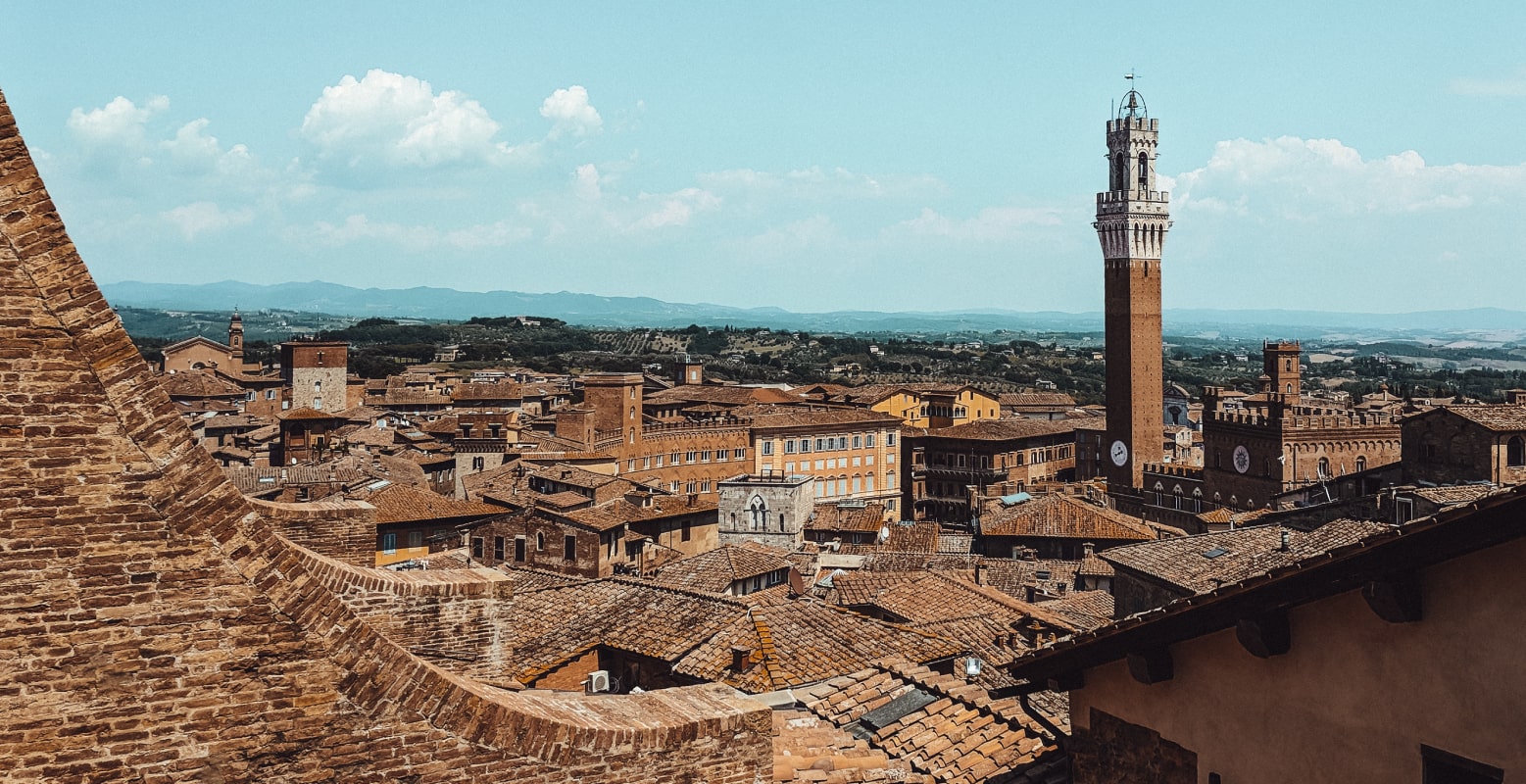
The important difference appears at the Siena end. The normal city-centre terminus is SIENA-VIA TOZZI, immediately beside the Piazza Gramsci bus area. You arrive close to the pedestrian streets rather than at the bottom of Siena’s hill.
From Via Tozzi you can simply walk into the historic centre. Piazza del Campo, Banchi di Sopra, San Domenico and the streets leading toward the Duomo are all reached without first dealing with the long station-to-centre climb.
Check whether your bus also stops at San Domenico
The current 131R route listing includes SIENA-P.za SAN DOMENICO before the Via Tozzi terminus on relevant journeys. If that stop appears in the live stop list for your specific bus, it can be particularly convenient for the Basilica di San Domenico, the western side of the centre and hotels around that part of Siena.
Do not automatically jump off there if you have a suitcase in the luggage hold. San Domenico is an intermediate stop, while Via Tozzi is the terminal. Autolinee Toscane states that unloading luggage from an extraurban bus at an intermediate stop is subject to the driver deciding that it can be done safely. With a bag underneath the bus, tell the driver where you intend to get off before departure.
Finding the Siena bus in Florence is the part that needs attention
The Florence bus terminal is beside Firenze Santa Maria Novella station, around Via Santa Caterina da Siena and Via Orti Oricellari. Do not assume every Siena departure will leave from exactly the same bay simply because you used the terminal on a previous trip.
There is a particularly relevant temporary change in summer 2026. Through 13 September 2026, Autolinee Toscane has moved numerous 131 and 131R departures to Via Orti Oricellari, outside the bus station. The affected departures vary between weekdays, Saturdays and holidays. Check the operator’s current Florence stop notice before going inside the terminal and waiting at the wrong bay.
Look for the Italian timetable labels feriale for working-day service, sabato for Saturday and festivo for Sundays and public holidays. This route does not have one identical schedule seven days a week.
What happens when you arrive by train
Trenitalia regional trains leave from Firenze Santa Maria Novella and reach Siena via the Empoli corridor. Search your exact departure because some results are through trains while other journey combinations may involve a change.
The train itself is easy. The inconvenient part is geography. Siena railway station is below the historic centre, at Piazzale Carlo Rosselli. Siena has a mechanized ascent, known locally as the risalita meccanizzata, linking the station area toward the Antiporto di Camollia. That removes much of the steep climb, but it does not deliver you to Piazza del Campo.
After reaching the Antiporto area, you still have to continue through the Camollia side of town toward the central streets. In practical terms, getting off the train is only the first part of the arrival.
Your three sensible options from Siena station
- Escalators and walking: follow signs toward Centro, Antiporto or the mechanized ascent. This works well with a backpack or small wheelie bag, provided the escalators are operating.
- Local bus: buses connect the station area with stops closer to Piazza Gramsci and the historic centre. Use the Autolinee Toscane planner for your actual arrival time rather than memorizing a line number, since urban routings can change.
- Taxi: the least complicated option with several suitcases, children or a hotel away from the obvious pedestrian route. Remember that Siena’s restricted historic streets may prevent a taxi from stopping directly outside every central hotel.
The city has been carrying out work connected with the station-to-Antiporto mechanized ascent, so it is unwise to build a tight itinerary around every escalator working perfectly. If the ascent is unavailable when you arrive, switch to a local bus or taxi instead of dragging luggage up the road toward the centre.
Which option is better with luggage?
This is where the apparently obvious answer changes. The bus gives you the better location, but Autolinee Toscane has more specific baggage restrictions than many visitors expect.
Under the operator’s current luggage rules, one piece up to a combined 105 cm in dimensions and 10 kg can be carried free. Larger luggage, within the operator’s stated maximum limits, may have to travel in the luggage compartment, only where the bus has one and space is available, and an additional fare can apply. The company can also refuse larger luggage when the vehicle is crowded.
That makes the train attractive if you are moving hotels with a substantial suitcase. Trenitalia allows passengers to carry luggage free provided it can be stored in the available luggage spaces without obstructing passengers or railway operations. You then have the less convenient Siena arrival, but fewer worries about whether your suitcase fits the bus rules.
A useful decision rule is therefore simple: light bag and central sightseeing, choose the bus; large suitcase and onward hotel transfer, seriously consider the train plus a taxi or local bus from Siena station.
Ticket validation is different on the two systems
On the bus
Buying the ticket is not enough. Autolinee Toscane requires passengers to validate or activate the ticket when starting the journey. A paper ticket goes into the validator on board, while tickets purchased in the AT app must be activated according to the app instructions. Contactless tickets bought through the onboard system are valid once the validator gives its confirmation.
For this route, ask specifically for a biglietto extraurbano veloce Firenze-Siena. The operator’s ticket FAQ explicitly identifies this as the appropriate ticket for both 131R and direct Florence-Siena travel on 131.
On the train
Trenitalia’s current regional ticket system is different from instructions still found on older travel pages. A Biglietto Digitale Regionale now validates automatically at the scheduled departure time of the selected train. A paper regional ticket still has to be stamped at a station validator before boarding. Trenitalia explains the current rules on its regional travel page.
If you will be using regional and high-speed trains elsewhere in Italy, the Italy by Train guide explains the ticket types and the validation differences that cause most first-time mistakes.
What to choose for a Siena day trip
For a morning out from Florence with a backpack or small day bag, the rapid bus is normally the most efficient choice. You save the extra transfer from Siena railway station and can start walking almost immediately after getting off.
The train makes more sense if you dislike road travel, want more freedom to move around during the journey, are carrying larger luggage, or find the particular rail departure substantially more convenient than the available bus.
You do not have to use the same mode in both directions. A perfectly sensible plan is to take whichever morning service gets you into Siena at the right time, then use the bus or train with the most comfortable evening departure. When Siena is one part of a longer Italian route, the Italy on Foot trip planner can help organize those connections around the rest of your itinerary.
Reduced mobility changes the calculation
Do not choose the train purely because Siena has escalators. Escalators are not a substitute for a step-free route.
RFI lists Siena as a station offering assistance for passengers with disabilities or reduced mobility. It also lists lifts serving platforms 2 to 5, with the station lifts normally operating from 06:00 to 22:00. Platform 1 has a level or ramped route, although RFI warns that temporary lift outages and differences between platform and train-floor height can affect accessibility. Check the RFI Siena station accessibility page for your journey.
Autolinee Toscane also identifies both Florence and Siena among its equipped bus stations for passenger assistance. If step-free travel is essential, verify the actual vehicle and assistance arrangements before travelling rather than assuming every 131R bus has the same boarding configuration.
What can go wrong, and the quickest recovery
- You cannot find the 131R inside Florence bus station: check Via Orti Oricellari and the live AT service notice before assuming you missed it.
- The rapid bus has gone: check the next 131R and also line 131. For direct Florence-Siena travel, AT says the fast extraurban ticket can be used on either.
- You reach Siena station and the mechanized ascent is unavailable: use a local bus or taxi. The road climb is a poor substitute with luggage.
- Your train itinerary shows Empoli: read the details carefully. It may simply be on the route, or the itinerary may require you to change trains there.
- You have a large suitcase for the coach: check the baggage rules before boarding. Do not assume airline-sized checked luggage automatically travels free.
- You plan to return after dinner: check the exact-date return timetable before leaving Florence. Sunday and holiday services can differ substantially from weekday schedules.
The easiest choice by traveler type
- First-time day trip to Piazza del Campo: 131R bus.
- Hotel near the Duomo, San Domenico or central streets: bus, then walk from the appropriate central stop.
- Large suitcase: train is often less awkward despite the station’s lower location.
- Prone to motion sickness: train.
- Staying close to Siena railway station: train.
- Want the fewest steps between transport and sightseeing: bus.
- Need guaranteed accessibility arrangements: compare the booked assistance available for your exact train or bus rather than choosing solely by map location.
For most visitors carrying only a day bag, the decisive fact is not the small difference in scheduled journey time. It is where the vehicle leaves you. Via Tozzi puts you beside Siena’s historic centre; the railway station puts you below it. That extra piece of geography is why the rapid bus is usually the easier way to arrive.