High water usually changes how you get in and out of a Venice hotel more than it changes the hotel stay itself. The practical questions are not simply “Will Venice flood?” but “Will my hotel doorway flood, will the route to my vaporetto stop stay usable, and does the tide peak overlap my arrival or departure?” acqua alta in Venice is highly uneven: low places can be wet while streets only a few minutes away remain dry, and the worst conditions normally cluster around the predicted peak rather than lasting all day.
For hotel guests, the safest routine is simple: check the official Venice tide forecast before bed, check it again before leaving the hotel, and ask reception about the exact route from the door to your transport stop. A hotel employee who knows the building’s entrance height is more useful than a citywide weather app.
First, understand what the tide number actually means
Venice tide forecasts are given in centimetres relative to the city’s historic mareographic reference at Punta della Salute. A forecast of “110 cm” does not mean there will be 110 cm of water in your street.
The city is not level. The Municipality of Venice notes that Piazza San Marco, one of the lowest major areas, can begin to flood when the tide rises above roughly 80 cm. The area by the Rialto vaporetto landings is affected at around 105 cm, while the pavement in front of Venezia Santa Lucia station is much higher, at about 135 cm. At 100 cm, roughly 5% of public ground in the historic centre and Giudecca is affected; at 110 cm, the figure is about 12%.

That is why “my hotel is in San Marco” is not enough information. Two properties in the same sestiere can have very different entrances, calle levels and routes to the nearest boat stop.
Use the Comune di Venezia Centro Maree for the predicted peak time, expected level and live readings. Treat that as the reference forecast for decisions about hotel access.
MOSE has reduced the biggest floods, but you still need the local forecast
Venice’s MOSE barriers can be raised at the lagoon inlets to block particularly dangerous incoming tides. Their operation has greatly changed what many forecast high-water events look like inside the city. It has not made local water problems impossible.
Water can affect low areas through several mechanisms, including overtopping, infiltration and drainage channels. The result for a traveler is straightforward: do not assume that “MOSE is active” means every hotel entrance and every low pavement will be dry. Check the observed city level and ask the hotel about its own doorway and approach.
What changes at your hotel
The entrance may be the problem even when the room is not
A property can remain fully operational while its lowest entrance or the calle outside takes water. Hotels and other ground-floor businesses in vulnerable locations may use removable flood barriers at doorways. That can create a temporary step or awkward threshold, so guests using wheelchairs, walkers or strollers should ask specifically whether the normal accessible entrance remains usable during a high-water event.
Do not assume a ground-floor reception means guest rooms will flood. Likewise, do not assume a first-floor room makes access irrelevant. The weak point may be the street outside, a courtyard, a lobby threshold or the short walk to the nearest vaporetto pier.
Your shortest walking route may stop being the best route
On a normal day, you may walk to the hotel by the shortest set of calli and bridges. During high water, a slightly longer route over higher paving can be much easier. Ask reception for the route they use during alta marea, and ask for landmarks or bridge names rather than relying only on a dropped map pin.
If you want a refresher on the city’s transport logic before arrival, see how to get around Venice. The important distinction on a high-water day is that walking access and vaporetto access can fail in different places.
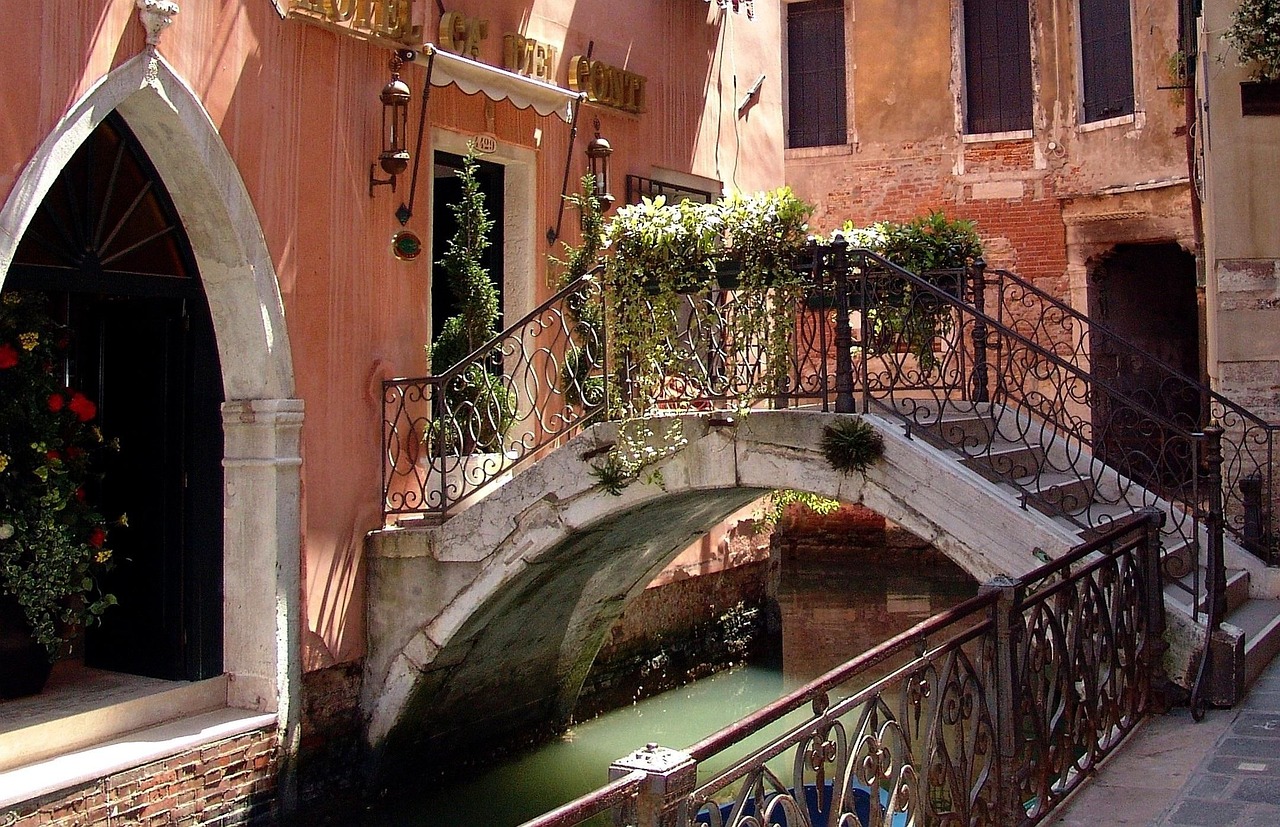
Luggage becomes a timing problem
A suitcase that is easy to roll at 08:00 can become a nuisance if the same lane is wet at 09:00. If your checkout overlaps a predicted peak, ask whether the hotel can hold your luggage so you can leave after the water drops, or arrange to depart before the peak if you have a flight or fixed train.
Keep passports, electronics, medication and a dry pair of socks above the bottom of your suitcase or day bag. Avoid dragging wheeled luggage through standing water if a dry route or a short delay is available. Wet wheels and suitcase fabric are unpleasant long after the tide has gone.
Raised walkways are seasonal, not a guaranteed Venice-wide backup
The raised platforms you may have seen in photographs are called passerelle. Venice’s municipal pedestrian plan normally deploys them from 15 September through 30 April, when high-water events are more likely. The city’s 2026 notices confirm that the service is suspended from 1 May until it resumes on 15 September.
The official walkway network is designed to preserve selected dry pedestrian routes up to about +120 cm, but it does not cover every street or every hotel. Above that level, some raised routes may themselves become unusable. Outside the deployment season, do not build an arrival plan around finding platforms in the street.
You can check the municipality’s official passerelle information and route maps, then ask the hotel which section is actually relevant to its entrance.
Vaporetto service can change before the city looks dramatically flooded
Hotel guests often make the mistake of looking out the window, seeing only a little water and assuming boat service will be normal. ACTV operates according to tide levels and the accessibility of individual docks.
Under the current high-tide operating plan, some changes can begin above +85 cm. More substantial route splitting and diversions occur above +95 cm, and individual stops can become inaccessible at higher levels. At exceptional levels above +140 cm, the normal network is broadly suspended, with only limited island connections from facilities that remain accessible.
The exact line-by-line plan can change with works and stop conditions, so check ACTV’s high-water service page on the day rather than memorising a route table. Information screens at vaporetto stops can also show current changes.
If a tide peak forces you to move a museum visit, meal or onward transfer, you can organize the rest of your Italy route around the fixed departure rather than trying to keep the original day in the same order.
What to do if high water overlaps check-in
- Check the peak time and level. A high number several hours after your arrival may be irrelevant to check-in.
- Message or call the hotel before leaving the station, airport or parking terminal. Ask whether its normal entrance is dry and which vaporetto stop or walking approach it recommends right now.
- Do not blindly follow the shortest Google Maps route. Mapping apps know streets and bridges; they do not reliably know which paving is currently under water.
- If arriving by water taxi, confirm the landing point. Ask the hotel or operator whether the usual hotel-side dock is usable at the predicted tide and where you should meet instead if it is not.
- If the peak is close and you have flexibility, wait somewhere dry rather than wandering with luggage. High water rises and falls with the tide, so a short timing change can matter more than a complicated detour.
What to do if it overlaps checkout or an early departure
This is the situation to plan most carefully because you cannot casually miss a flight, cruise connection or reserved long-distance train.
Check the next morning’s tide before going to sleep. If the predicted peak falls inside your transfer window, ask reception that evening which exit will be usable and whether your planned boat stop is expected to remain accessible. For a flight or other hard deadline, leaving before the water rises is usually safer than assuming you can improvise at the peak.
For a flexible train later in the day, it may be easier to leave luggage with the hotel and depart after the peak. The Municipality of Venice describes high-water events as temporary; even a substantial event is normally concentrated around its tidal maximum. The useful strategy is therefore to work around the peak, not to write off the entire day.
If you hear the high-water sirens
Venice uses an acoustic alert system for expected high tides. The first signal attracts attention, followed by tones that indicate the forecast level: one sustained tone for +110 cm, two rising tones for +120 cm, three for +130 cm and four for +140 cm or more.
If you hear the alert, check the current forecast rather than treating the sound as a reason to rush into the street. The municipal siren guide explains the sequence.
Shoes matter more than emergency flood gear
For an autumn or winter stay, water-resistant shoes with a grippy sole are more useful than planning your whole wardrobe around a rare dramatic flood. Stone paving and bridge steps can be slick even after the water has receded.
If a particularly high event is forecast, the hotel can tell you whether taller waterproof footwear is actually necessary for its street. Do not buy bulky boots days in advance simply because Venice appears on a high-water map. For broader seasonal packing advice, see what to wear in Venice.
Guests with reduced mobility, wheelchairs or strollers should ask one extra question
Ask not only “Does the hotel flood?” but “Is the step-free route from the vaporetto stop to the hotel still usable at the forecast tide?” Flood barriers at doors, temporary rerouting and crowded raised walkways can change an otherwise manageable route.
If the property has more than one entrance, ask which one is used during high water. If it recommends a different vaporetto stop, get the exact stop name and platform direction before leaving your current location.
The questions to send your hotel when high water is forecast
- Does your entrance normally take water at the forecast level?
- Which entrance should I use during the tide peak?
- What is the driest route from the nearest vaporetto stop?
- Is that vaporetto stop expected to remain accessible?
- If I have luggage, should I arrive before or after the predicted peak?
- For an early departure, should I use a different stop or arrange a water taxi pickup point?
- If I use a wheelchair or stroller, is the alternative route step-free?
A precise hotel answer such as “use the back entrance from Campo X and get off at stop Y” is far more useful than a general promise that the property is “not affected by flooding.” In Venice, a few centimetres of elevation and one different calle can be the difference between a normal checkout and carrying a suitcase through water.