A private Jewish heritage tour in Venice can combine the historic Ghetto, the Jewish Museum, and visits inside centuries-old synagogues. The crucial booking detail is access: hiring a private guide does not automatically give you permission to enter every synagogue. Some interiors are included in the museum’s visitor route, while others require a separate appointment. Before arranging a Venice Jewish Ghetto tour, confirm which buildings you will actually enter, who organizes admission, and whether tickets are included in the quoted price.
What Does a Private Jewish Heritage Tour Include?
Most Jewish heritage visits concentrate on Cannaregio, the Venetian district containing the historic Ghetto. The area is compact enough to explore on foot, although the amount of time spent inside buildings can make a significant difference to the itinerary.
There are several ways to experience Jewish Venice:
- Independent Ghetto walk: Explore the public streets, squares, memorials, and historic buildings from outside. No private guide or admission ticket is needed to walk through the neighborhood.
- Jewish Museum visit: Visit the museum’s exhibitions and the historic synagogues included in its authorized visitor route, subject to the admission arrangements in place on your date.
- Private neighborhood tour: Hire a guide for a personalized walk through the Ghetto and surrounding Cannaregio streets. Interior admission may be included, added separately, or excluded entirely.
- Private museum and synagogue experience: Arrange a dedicated visit through the museum’s booking service, potentially including additional synagogues and historic spaces that are unavailable on an ordinary visit.
The distinction matters because some private walking tours describe synagogue architecture and Jewish history entirely from outside. These can be informative, but travelers specifically interested in religious interiors should choose an itinerary that confirms authorized admission.
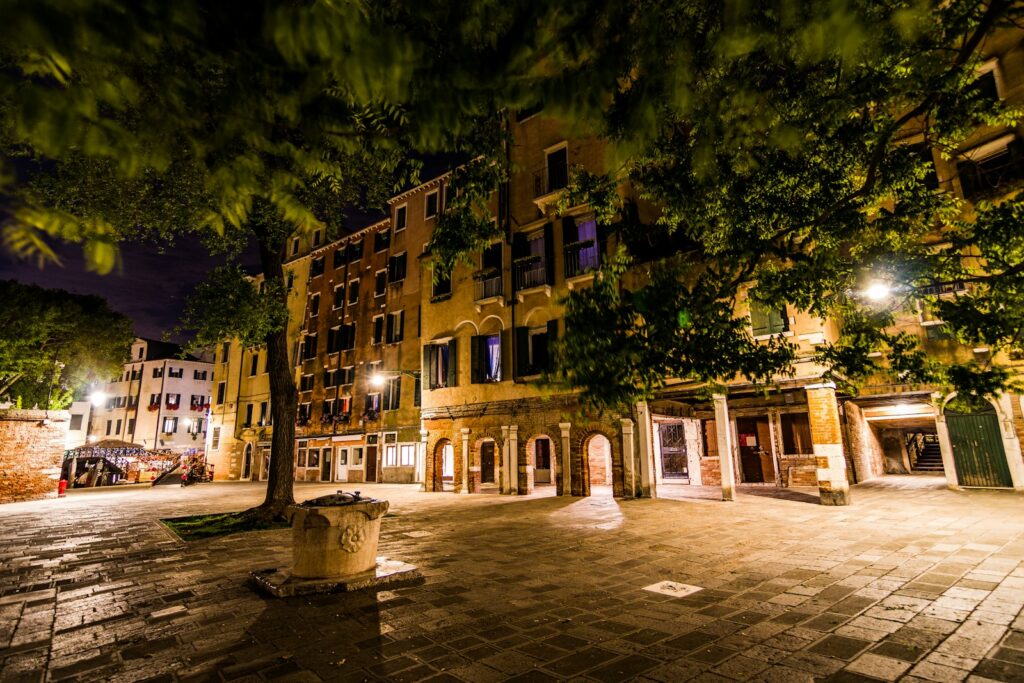
The Five Historic Synagogues: Which Can You Visit?
Venice’s historic Ghetto contains five synagogues, traditionally called scole or scuole. They reflect the different Jewish communities that settled in Venice, including German, Italian, Levantine, and Sephardic congregations.
The buildings are divided between the Ghetto Nuovo and Ghetto Vecchio. Despite the names, Ghetto Nuovo was the first area designated for compulsory Jewish residence in 1516. The names refer to the earlier foundry sites rather than the order in which the Jewish quarters developed.
Synagogues in Ghetto Nuovo
Three historic synagogues are associated with the Jewish Museum complex around Campo del Ghetto Nuovo:
- Scola Grande Tedesca (German Synagogue): Founded in the 16th century for the German-speaking Ashkenazi community.
- Scola Canton: Another historic Ashkenazi synagogue, known for its distinctive interior arrangement and decoration.
- Scola Italiana (Italian Synagogue): Established for the Italian Jewish congregation, with its own religious and architectural traditions.
These three synagogues form part of the museum’s renovated visitor complex. They occupy historic buildings whose relatively modest exteriors give little indication of the religious spaces within.
Synagogues in Ghetto Vecchio
The other two major synagogues are:
- Scola Levantina (Levantine Synagogue): Associated with Jews from the eastern Mediterranean.
- Scola Spagnola (Spanish Synagogue): Associated with the Sephardic community and historically one of the largest prayer spaces in the Ghetto.
These remain important religious spaces used by the Jewish community. They are not automatically included in an ordinary museum ticket or every private walking tour.
The Jewish Museum of Venice expressly offers private visits by appointment to the Levantine and Spanish synagogues. Visitors can also request access to additional spaces, including the women’s galleries, known as matronei, the Secret Garden, and the Midrash.
These are requests rather than guaranteed inclusions. Access depends on the museum’s arrangements and the requirements of the Jewish community.
If entering the Spanish or Levantine synagogue is your main reason for arranging a private tour, obtain written confirmation of that specific visit before paying. A general statement such as “includes the historic synagogues” is insufficient.
Visiting the Jewish Museum After Its Renovation
The Jewish Museum of Venice, also called the Museo Ebraico di Venezia or MEV, reopened to the public on October 22, 2026, following a major renovation.
The renewed complex includes exhibition spaces presenting Jewish life in Venice through historical objects, personal stories, religious artifacts, textiles, documents, and multimedia displays. Restoration work also covered the German, Canton, and Italian synagogues.
Older travel articles and tour listings may still describe the museum as closed for renovation. Those statements can be outdated, so travelers should verify the itinerary against the museum’s own website rather than relying on an older product description.
Opening hours and admission prices
The museum’s published schedule for November 1–15, 2026, listed opening from 10:00 am to 5:30 pm Sunday through Thursday and 9:00 am to 3:00 pm on Fridays. Its published adult admission was €18, with a €2 advance-sale charge. A reduced ticket of €14 was also listed, with qualifying categories including children aged six and above and eligible students. Children under six and qualifying disabled visitors with an accompanying person were listed among those eligible for free admission.
These details relate to the published November 2026 arrangements. They should not be treated as confirmed prices or hours for later travel dates. The official pages have also displayed differing final-admission times, making it sensible to check the exact last entry directly.
For 2027 trips, the museum had not published a confirmed full-year visitor schedule at the time of research. Check the official Ghetto visitor information and the museum’s booking calendar closer to your visit.
Saturdays and Jewish holidays
The museum and organized synagogue visits normally close on Saturdays for Shabbat and on Jewish religious holidays. Friday opening hours are shorter, and religious requirements can affect the availability of particular interiors.
The public streets of the Ghetto remain accessible, so an outdoor historical walk may still be possible when the museum is closed. However, a private guide cannot override synagogue closure rules.
Jewish holidays change dates on the civil calendar each year. For trips around Passover, Rosh Hashanah, Yom Kippur, Sukkot, and other important observances, check the museum’s specific closures before confirming travel arrangements.
Travelers who want to experience a religious service rather than a heritage visit should contact the Jewish community about appropriate arrangements. A sightseeing reservation is not permission to attend worship.
How to Arrange a Private Visit With Synagogue Access
The most reliable booking process starts by separating the guided walk from the admission arrangements.
- Choose the interiors you want to see. Decide whether the standard museum complex is sufficient or whether you specifically want the Levantine or Spanish synagogue.
- Check religious closures. Eliminate Saturdays and confirm whether your date coincides with a Jewish holiday or special community event.
- Contact the museum about private access. Ask whether the requested synagogues and additional spaces can be visited on that date.
- Discuss the walking itinerary. If hiring an independent guide, establish whether they will provide the entire tour or whether museum personnel will lead the interior section.
- Request a complete written quote. Confirm guide fees, admission charges, private-access costs, language, duration, and cancellation conditions.
- Receive the final confirmation. Check the date, meeting location, admission arrangements, and contact number before traveling.
The museum publishes private-visit enquiries through info.booking@museoebraicovenezia.it and telephone +39 041 5246083.
An independent guide may be able to coordinate the museum visit, but the historic religious buildings remain subject to the relevant access permissions. Ask who is responsible for arranging those permissions instead of assuming the guide’s booking covers them.
What to include in your first enquiry
A useful request should provide enough detail for the recipient to confirm the actual itinerary rather than offering a generic walking tour.
- Your preferred date and an alternative date.
- The number of adults and children, including children’s ages.
- Your preferred language.
- The specific synagogues or museum spaces you want to enter.
- Whether you prefer a private guide throughout or are comfortable joining a scheduled museum-led interior visit.
- Your preferred starting point, such as the Ghetto, railway station, or hotel.
- Any wheelchair, walking, hearing, or other accessibility requirements relevant to the visit.
- Your available time and any onward train or other fixed commitment.
For family-history research, mention the surnames, dates, congregations, or addresses you are investigating. A general sightseeing guide may be able to explain the historical setting, but access to archives or specialist genealogical research should be requested separately. Such research is not a standard tour inclusion.
How Long Should You Allow?
The historic Ghetto itself covers a relatively small area, but a worthwhile visit involves stopping to understand the buildings, memorials, and history rather than simply walking between them.
For planning purposes, the following time allowances are sensible:
- 45–60 minutes: A self-guided outdoor introduction to the main squares and streets.
- 90 minutes–2 hours: A guided historical walk with time for explanations and selected sites.
- 2–3 hours: A more substantial visit combining neighborhood history with the museum and authorized synagogue interiors.
- Half a day or longer: An extended itinerary with specialist interests, additional sites, or travel beyond Cannaregio.
These are suggested planning allowances, not promised tour durations. The actual time required depends on the confirmed museum entry and any additional visits.
A private tour can be particularly useful for visitors who want longer discussions about Jewish religious traditions, the Venetian Republic’s restrictions on Jewish life, or the community’s experiences during the Second World War.
It is also helpful when traveling with children or older relatives who benefit from a flexible walking pace.
Meeting Points, Hotel Pickup and Transport
The Jewish Ghetto lies in Cannaregio, within walking distance of Venezia Santa Lucia railway station. For many visitors, reaching the neighborhood independently is easier than arranging a separate transfer.
The Jewish Museum’s address is Cannaregio 2902/B, Campo del Ghetto Nuovo, Venice.
Private tours may begin directly in the square or at another nearby landmark, such as Campo San Geremia. Do not assume that every tour meets at the museum ticket office.
Arriving by train
From Venezia Santa Lucia, allow approximately 10–15 minutes to reach the Ghetto on foot, depending on the route and your walking pace. Add extra time if you have luggage or need to find a particular meeting point.
Arriving by vaporetto
The ACTV waterbus network serves the Cannaregio area, with Guglie and San Marcuola among the useful stops for approaching the Ghetto.
The most convenient stop depends on where your journey begins and which route has the fewest bridges for your needs. Check the actual boat route and direction rather than selecting a stop solely by its distance on a map.
For the wider transport arrangements, including how waterbuses connect with Venice’s railway station and other districts, see the Italy on Foot guide to getting around Venice.
What does hotel pickup mean?
In central Venice, hotel pickup for a walking tour generally means that the guide meets you on foot. It does not automatically include a water taxi or other private transport.
If your accommodation is distant from Cannaregio, ask whether travel time is included within the tour duration. A two-hour tour that starts near St. Mark’s Square may leave considerably less time for the Ghetto itself than one beginning in Campo del Ghetto Nuovo.
If a private water transfer is proposed, confirm its separate cost, boarding location, and where passengers will disembark. Most visitors staying in central Venice will not need a private boat solely to reach the Ghetto.
Accessibility: Bridges, Historic Buildings and Synagogue Interiors
Accessibility needs careful checking because reaching the Ghetto and entering its historic religious spaces present different challenges.
The museum’s recent renovation included accessibility improvements, with redesigned visitor areas and lifts. However, this does not guarantee that every synagogue, historic staircase, women’s gallery, or privately arranged additional space is accessible to wheelchair users.
Some synagogues occupy upper floors in older buildings. Even where the main museum route has been improved, particular heritage spaces may retain physical limitations.
Before confirming a private visit, ask:
- Is the complete booked route wheelchair accessible, including the specific synagogue interiors?
- Are there stairs between the museum and the requested religious spaces?
- Which lifts or alternative routes are available?
- Can visitors who cannot use stairs remain with the group for most of the experience?
- Are suitable accessible toilets available during the visit?
- Can the guide choose a route from the waterbus stop that avoids unnecessary bridges?
The official Accessible Venice information explains the city’s accessible transport and route-planning resources, including MoveIn, which identifies bridges, ramps, lifts, and possible obstacles.
Travelers using wheelchairs or mobility scooters should request confirmation of the actual route, not simply accept a general description of the tour as accessible.
Visiting With Children and Older Travelers
Jewish heritage tours can work well for families, particularly when guides adapt explanations to children’s ages and interests.
The Ghetto’s history offers several concrete subjects that younger visitors can understand: why the gates were once locked at night, why houses became unusually tall, how different Jewish communities shared a small neighborhood, and how religious traditions shaped daily life.
For children who are unlikely to enjoy a lengthy museum visit, a shorter outdoor tour with a carefully selected interior stop may be more manageable.
Check the provider’s minimum-age conditions, stroller access, and whether the quoted private fee changes with the number of children. Museum admission discounts do not necessarily reduce the private guide’s fee.
Older travelers may prefer a tour that begins directly at the museum, with regular opportunities to sit and limited walking beyond the main Ghetto area. Request this arrangement before booking, particularly if the itinerary includes several historic interiors.
Dress, Security, Photography and Luggage
The synagogues are places of religious significance, and some continue to be used for worship. Visitors should dress and behave accordingly.
Clothing that covers shoulders and knees is a sensible expectation for synagogue entry. Men may be required to cover their heads, and visitors should follow the instructions provided by museum or synagogue staff. Ask in advance if you are unsure about a particular requirement.
Photography may be restricted inside prayer spaces. Permission to enter does not automatically include permission to take photographs, use flash, film videos, or photograph worshippers.
Security arrangements can also affect what visitors may bring into the buildings. Avoid carrying large backpacks, suitcases, sharp objects, or unnecessary bulky equipment.
If you are arriving directly from the railway station, arrange luggage storage beforehand. Do not assume that the museum or your guide can store suitcases while you visit the synagogues.
Visitors should also remember that Campo del Ghetto Nuovo and the surrounding streets form part of a residential neighborhood. The memorials deserve particular respect, and any photography involving residents or religious activities should be approached carefully.
How Much Does a Private Jewish Heritage Tour Cost?
There is no single standard price for a private visit. Two itineraries with similar descriptions can have quite different inclusions.
The total may depend on:
- The number of participants and whether the guide charges a group fee or a per-person price.
- The duration of the walking tour.
- Whether admission to the Jewish Museum is included.
- Whether the booking includes a dedicated private synagogue visit or a place on a scheduled museum-led visit.
- Any additional access arrangements for the Levantine or Spanish synagogue, women’s galleries, or other requested spaces.
- The language, specialist knowledge, and research required.
- Hotel meeting arrangements, transportation, and optional extensions.
Some operators include synagogue admission in their prices. Others advertise a guided walk and require visitors to purchase tickets separately. Still others provide an outdoor tour without any interior access.
Ask for a breakdown showing the guide fee, admission charges, any booking fees, and the complete amount payable for your group.
When comparing quotes, the cheaper offer may be entirely suitable if you mainly want an introduction to the neighborhood. However, a low-priced outdoor walk should not be compared directly with a tour that includes reserved access to additional historic interiors.
Do You Actually Need a Private Guide?
A private guide is most useful when you want a personalized historical discussion, have a particular family or religious interest, need an adaptable pace, or hope to arrange spaces beyond the usual museum route.
Visitors whose main priority is seeing the museum and its standard accessible interiors may find the museum’s ordinary admission or scheduled guided arrangements sufficient.
The public Ghetto streets are free to explore independently. Visitors on a limited budget can learn about the area’s history, examine its urban layout, and see its principal memorials without paying for a private walking service.
One distinction remains important: a self-guided outdoor visit does not provide unrestricted synagogue entry.
Adding the Holocaust Memorial and Other Jewish Heritage Sites
A thoughtful itinerary should give time to the Holocaust memorial in Campo del Ghetto Nuovo.
The memorial includes bronze works by sculptor Arbit Blatas and commemorations of Venetian Jews deported during the Nazi-Fascist persecution. It is an important part of understanding the neighborhood’s history beyond the period of the Venetian Republic.
A knowledgeable guide should explain the Fascist racial laws, deportations, and the experiences of Venice’s Jewish community during the war without reducing the visit to a collection of architectural curiosities.
Travelers interested in earlier Jewish history may also ask about the Ghetto’s former gates, historic pawnshops, and the different congregations that shaped the neighborhood.
Can you add the Jewish Cemetery on the Lido?
Yes, but this requires separate planning.
The historic Jewish cemetery on the Lido is an important site associated with several centuries of Venetian Jewish history. The Jewish Community of Venice confirms that the ancient cemetery can be visited through guided arrangements.
The cemetery is on a different island from the historic Ghetto, so reaching it involves additional transportation and time. Its access arrangements are separate from an ordinary Ghetto tour.
If you want to include the cemetery, ask whether the visit is available on your chosen date, where the cemetery tour begins, and whether waterbus tickets and transfers are included. Allow a substantial extension rather than assuming it can be fitted into a short neighborhood walk.
Weather, High Water and Changes to the Route
Ordinary rain rarely prevents a walking tour in Venice, although it can make the outdoor portion less comfortable. Covered passages and indoor visits provide some shelter, but a guide cannot guarantee access to closed religious spaces simply because the weather is poor.
During periods of acqua alta, or unusually high water, parts of Venice may become difficult to reach. The most suitable pedestrian route can change, and transport connections may be disrupted.
Check the forecast and discuss the alternative plan with your guide if severe weather is expected.
For private visits with several interior reservations, ask what happens if:
- High water prevents the group from reaching the agreed meeting point.
- A waterbus delay causes late arrival.
- A religious service or community requirement makes a synagogue temporarily unavailable.
- The museum changes its visitor arrangements.
- The guide is unable to provide the agreed service.
A responsible booking confirmation should explain whether the itinerary will be adjusted, the visit rescheduled, or a refund considered. The precise entitlement depends on the agreed terms and the circumstances.
If you are incorporating Jewish Venice into a longer trip, the Italy on Foot trip planner can help organize your other destinations and daily routes around a museum reservation that has a fixed start time.
Cancellation Terms and Private Booking Deposits
Private tours frequently involve different payment arrangements from ordinary museum admission. Some providers require payment at booking, while others may request a deposit or a balance closer to the visit.
There is no universal cancellation deadline that applies to all private guides or museum-arranged experiences.
Before sending payment, obtain written answers to these questions:
- How much is due now, and when is the remaining balance payable?
- Is the deposit refundable?
- What is the latest date for cancellation without a charge?
- Can the date or departure time be changed?
- Are museum tickets and special-access fees refundable if the private guide is cancelled?
- What happens if a requested synagogue cannot be opened?
- Who should be contacted if a participant is delayed or cannot find the guide?
Payment should be made through a clearly identified and documented arrangement. Keep the invoice or receipt, booking conditions, and correspondence identifying the services purchased.
If a provider proposes a substitute itinerary, compare it with the original confirmation before accepting. Replacing a confirmed synagogue interior with an outdoor explanation may materially change the experience you paid for.
Questions to Ask Before Confirming Your Tour
The following questions help distinguish an ordinary neighborhood walk from a genuinely organized private heritage visit:
- Which synagogues will we enter? Request the names, not simply the number of buildings.
- Who authorizes the interior visits? Confirm that arrangements have been made with the museum or relevant managing organization.
- Will our private guide accompany us inside? Some itineraries use a separate museum guide for the religious interiors.
- Is museum entry included? Establish whether you will see the exhibition spaces as well as the synagogue interiors.
- Does the itinerary include the Spanish or Levantine synagogue? If so, request specific confirmation of the appointment.
- What happens if access changes? Ask about substitutions, partial refunds, and rescheduling.
- Is the entire route suitable for our group? Discuss stairs, walking distance, mobility equipment, and children’s needs.
- Where exactly do we meet and finish? Confirm whether transportation to and from the Ghetto is included.
Be cautious about descriptions promising access to all five historic synagogues without explaining the reservation arrangements. Likewise, an offer of “exclusive access” should identify the specific interiors and what makes the visit different from ordinary museum admission.
What to Do if Your Guide Is Late or a Synagogue Is Closed
Keep the booking confirmation accessible on your phone, including the guide’s contact details and the exact meeting point. Campo del Ghetto Nuovo has several entrances, so a vague instruction to meet “at the Jewish Ghetto” can easily lead to confusion.
If the guide is late, contact the provided number or messaging address and remain at the agreed meeting point while you establish what has happened. Avoid leaving to search the surrounding streets without informing the provider.
If the museum or a synagogue is unexpectedly unavailable, ask for the revised itinerary and clarify how any prepaid admission or special-access fees will be handled.
For an appointment arranged directly through the museum, contact its booking office rather than assuming that an independent walking guide can resolve a community access restriction.
Before your visit, the most useful final check is to confirm three details together: the exact synagogue interiors, the person responsible for securing access, and the meeting time for that authorized entry. Once those are settled, the rest of the itinerary can be arranged around them without risking the main reason for your visit.