Most family mask workshops in Venice let children paint and decorate a prepared papier-mâché mask in approximately one hour. Children can usually choose from half-face masks, full-face Carnival designs, animal shapes and other traditional or imaginative styles. They then add colors, patterns and decorative finishes under an instructor’s supervision.
A Venice mask making workshop that involves building the mask from paper and a mould is a different activity. It generally takes longer, may have a higher minimum age and sometimes requires additional drying time. Before booking, confirm whether your child will decorate an existing mask or construct one, how much they can do independently and whether the finished piece can be taken home immediately.
What can children actually make in one session?
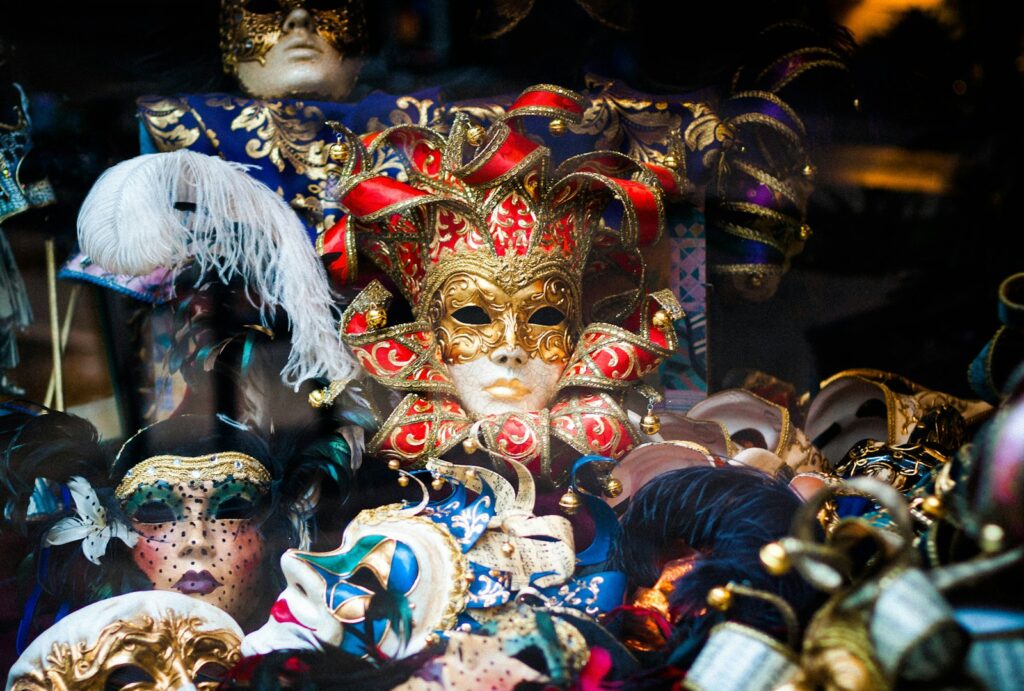
A typical beginner workshop provides each participant with a plain, handmade mask that is ready for painting. The child chooses the shape and colors, then learns one or more decorating techniques.
Most short classes concentrate on producing one finished mask. Some longer workshops allow two masks per participant, while specialist courses focus on making a single papier-mâché mask from scratch.
The available shapes depend on the studio. Several styles are especially common in Venice.
Colombina: a decorative half-face mask
The Colombina covers the upper part of the face, leaving the mouth and lower face uncovered. It is associated with Venetian masquerade traditions and is often decorated with colorful patterns, metallic finishes, ribbons or feathers.
This can be a practical choice for younger children because there is less surface to decorate. A simple design with two or three colors can be completed relatively quickly.
Children who enjoy detailed painting can add borders, dots, flowers or symmetrical patterns around the eye openings.
Ask whether the workshop’s version is sized for children. Some masks are intended for adult faces and may be better displayed on a wall than worn by a young child.
Volto: a full-face Carnival mask
The volto, sometimes called larva, is a traditional face-covering mask with a recognizable human form.
It gives children a larger surface for painting and can be decorated with geometric patterns, contrasting colors or designs inspired by Venetian Carnival.
A full-face mask can take longer to finish because it has a larger surface and more pronounced contours around the nose and cheeks.
If your child wants to wear the finished mask, check the fit and visibility. A full-face design may be less comfortable than a smaller eye mask, especially for younger children.
Animal masks: cats, foxes and imaginative designs
Animal-shaped masks are popular in family workshops because children can easily recognize the shape and develop their own design.
A cat mask might be painted with stripes, spots or bright colors. Some workshops offer foxes, birds and other animal-inspired shapes.
These designs can be particularly suitable for children who enjoy creative activities but are less interested in the historical background.
Ask whether ears, raised details and other decorative features are already part of the papier-mâché base. Children normally paint and embellish these elements rather than sculpt them during a one-hour class.
Bauta: a traditional Venetian design
The bauta is one of Venice’s distinctive historical masks. Its projecting lower section was traditionally associated with being able to speak, eat or drink while keeping the face concealed.
A bauta is an interesting choice for older children and teenagers who want to learn something about how masks were used in Venetian society.
Its unusual shape also provides opportunities to experiment with light and shadow, decorative borders and restrained historical colors.
However, not every studio includes a bauta among the children’s mask options. Ask whether the available version is suitable for the participant’s age and whether it can be worn comfortably.
Commedia dell’Arte and theatrical masks
Some workshops offer masks inspired by Commedia dell’Arte, the Italian theatrical tradition associated with recognizable characters and exaggerated expressions.
These may include designs inspired by Arlecchino, Pantalone or other theatrical figures.
They can be interesting for older children who enjoy drama and storytelling. The instructor may explain how a mask’s shape suggests a particular character.
For younger children, the detailed facial features may make painting more difficult. A simpler shape is often easier to complete without frequent adult assistance.
Plague doctor masks and fantasy designs
The long-beaked plague doctor mask is now a familiar image associated with Venetian Carnival souvenirs. Its origins relate to historical protective clothing worn by some plague physicians, and its later use as a Carnival costume belongs to a different context.
Some studios offer small versions for decorating, along with fantasy faces, suns, moons and other imaginative shapes.
The beak and raised details can take longer to paint than a flat eye mask. If your child chooses one, ask whether the workshop duration is sufficient for the design they have in mind.
Not every decorative mask is a historical Venetian design. That is not a problem for a creative family activity, but a studio should be able to explain which shapes come from historical traditions and which are modern interpretations.
Decorating a mask versus making one from scratch
The word “mask-making” is used for several different activities. This is the most important distinction when choosing a workshop.
Mask-decorating workshops
In a decorating class, the studio supplies a blank papier-mâché mask that has already been formed and dried.
The child selects the shape, paints it and applies suitable finishing materials. This is usually the easiest format for children because they can concentrate on creating a design rather than learning the entire construction process.
Most introductory classes last approximately 60 to 90 minutes.
Typical activities include:
- Choosing a blank mask from the available shapes.
- Applying a base color.
- Painting simple patterns or facial details.
- Using metallic colors or decorative effects.
- Adding suitable trimmings, feathers or other embellishments.
- Applying a finishing product under the instructor’s guidance.
At the end, participants generally take home the mask they decorated, provided the studio’s finishing process allows immediate collection.
Papier-mâché construction workshops
Traditional Venetian mask-making uses cartapesta, the Italian term for papier-mâché.
The process typically involves placing layers of paper and adhesive into a mould, allowing the shape to dry, removing it and preparing the surface for decoration.
Constructing a mask requires more patience than painting a prepared one. The materials must be handled carefully, and the drying process is part of the technique.
Some traditional courses require at least a day before the mask can be removed from its mould. Others use accelerated drying methods that allow participants to complete the construction stage within a shorter session.
This means that a class lasting two hours might involve making the mask but collecting it later, while a different course of similar length might provide a finished piece to take away immediately.
Ask exactly which stages your child will complete and whether the finished object will be ready before you leave Venice.
Combined construction and decoration courses
Longer workshops may teach both building a papier-mâché mask and decorating it.
These experiences are generally more suitable for older children and teenagers because they involve several stages, closer attention to technique and longer periods of concentration.
Some combined classes are divided into two sessions, which may take place at different times to accommodate drying.
A description such as “two-and-a-half-hour mask-making course” does not necessarily mean that everything happens during one uninterrupted visit.
Before booking, ask whether you must return later in the day or on another date.
What ages can participate?
Minimum ages vary by studio and by the type of workshop. A basic decoration activity may accept preschoolers, while a course involving moulds and several technical stages may be limited to older children.
Children under 4
Very young children may enjoy brushing color onto a mask, but they will usually need continuous adult assistance.
Some studios allow younger children to participate when a parent helps them. Others enforce a minimum age or require every active participant to have their own paid place.
Ask whether a two- or three-year-old can share a workstation with a parent and whether the instructor can provide a sufficiently simple project.
Also consider the materials. Small embellishments, loose decorations and certain tools may be unsuitable for toddlers.
If your child has difficulty remaining seated for an hour, a short shared family activity may be more practical than a full individual workshop.
Children aged 4 to 6
Many children in this age range can decorate a basic papier-mâché mask with some assistance.
A short class focused on painting is usually more manageable than one involving moulds and construction.
Look for a selection of simple shapes, larger brushes and decorating techniques that do not require fine detail.
A four-year-old may enjoy choosing colors and making broad patterns, while an adult or instructor helps with the finishing touches.
Check whether the child is expected to work independently. Even when a course accepts children from age four, individual ability and concentration vary.
Children aged 7 to 10
School-age children can usually manage more involved painting techniques, including symmetrical patterns, contrasting colors and decorative borders.
They may also enjoy learning about the historical uses of masks during the Venetian Republic and the meaning of different theatrical characters.
A 60- to 90-minute decoration session is often an appropriate choice, particularly when each child can select their own design.
If your child is particularly interested in crafts, ask whether the instructor demonstrates several decorative techniques rather than simply supplying paints and a mask.
Children aged 11 and older
Older children and teenagers may be ready for workshops involving papier-mâché construction, moulds and more detailed finishing work.
As a current example, one established Venetian mask studio sets an age requirement of eleven or older for its 90-minute papier-mâché construction course and its longer combined construction-and-decoration workshop.
That minimum belongs to the particular studio and course. It is not a citywide rule.
For a teenager who enjoys art, a more technical workshop may be more engaging than a short session focused only on painting a prepared shape.
What actually happens during a family decoration session?
Most workshops begin with an introduction to the craft and examples of finished Venetian masks.
The instructor then explains the available designs and demonstrates suitable painting techniques.
Children typically work at a table, using brushes and studio-provided materials. They may apply a base color first, wait briefly for it to dry and then add patterns or decorative details.
Some techniques involve layering colors, using metallic finishes or creating an aged appearance. Others use simple brushwork that younger participants can complete independently.
The instructor normally helps with difficult sections and explains how to apply finishing products.
The amount of historical explanation varies. A short practical class may provide only a brief introduction, while a longer family course might discuss the history of Carnival, traditional masks and the work of Venetian mask-makers, known as maschereri.
If your family wants a substantial historical explanation in English, confirm that the session includes it. Some short workshops rely mainly on practical demonstrations, which can be followed even when the instructor speaks limited English.
Will every child make their own mask?
Many workshops charge per active participant and provide one mask for each person. However, this should be checked before booking, especially for younger children who may need parental help.
Some courses allow an adult to assist a child without taking a separate workshop place. Others require the parent and child to participate together or charge for each person using the materials.
Clarify whether your booking includes:
- One mask for each paying child.
- A separate mask for adults who want to participate.
- An individual workstation for every active participant.
- All brushes, paints, finishing materials and decorations.
- Help from the instructor throughout the session.
- Packaging for taking the finished masks home.
For a family of four, the price can change considerably depending on whether all four people decorate masks or only the children participate while the adults watch.
Request a complete price for the arrangement you actually want.
Can children take their finished masks home immediately?
Usually, yes, when the workshop involves decorating a prepared papier-mâché mask. Several established Venetian studios use paints and finishing methods that allow participants to leave with a dry, decorated mask at the end of the session.
However, the word “finished” needs clarification. A mask may be dry enough for careful transport while still having delicate feathers, trim or raised decorative elements that could be damaged if packed tightly.
Workshops involving construction from wet papier-mâché require additional attention. Traditional mould-based techniques may need at least a day of drying before the mask can be removed and decorated.
Some specialist courses use accelerated drying methods. As one example, Ca’ Macana currently advertises a 90-minute papier-mâché express course for participants aged eleven and older, with the mask dried during the session so that no return visit is needed.
For any workshop, ask:
- Will the finished mask be completely dry when the class ends?
- Does the decorative finish need additional curing time?
- Will the mask be wrapped or boxed for transport?
- Can it be carried upright, or must it remain flat?
- Can we put it in our luggage the same day?
- Will we need to return to collect it?
- If collection is required, can the studio arrange shipping instead?
If you are visiting Venice for only one day, choose a workshop that explicitly confirms same-day collection. A class requiring next-day pickup is inconvenient when your train or flight leaves before the mask is ready.
Are the finished masks wearable or decorative?
Many traditional papier-mâché masks can be worn, but not every design is practical for children.
Some full-face masks have relatively small eye openings, while large beaks, feathers or raised decorations can make them uncomfortable to wear for extended periods.
Ask whether the studio supplies elastic, ribbons or another appropriate fastening system. Some masks are designed primarily as wall decorations and may not include wearable attachments.
If your child wants to wear the mask during Venice Carnival, confirm that it fits their face comfortably and provides adequate visibility. The child should be able to see obstacles, steps and other pedestrians clearly.
Children should remove masks that obstruct vision when crossing bridges, boarding water buses or moving through crowded areas.
For younger children, a lightweight half-face design is often easier to manage than a large full-face or long-beaked mask.
If the mask is mainly intended for display at home, a larger decorative shape may be suitable. Ask whether it has a ribbon or other attachment for hanging.
What paints, glues and tools do children use?
Mask-decorating workshops commonly use acrylic or water-based paints, brushes, waxes, varnishes and decorative materials.
Some studios also offer feathers, rhinestones, ribbon, metallic finishes or other embellishments.
The exact materials depend on the course. A beginner workshop for younger children may use simple brushes and paints, while a more advanced course may involve specialist techniques and additional tools.
Before booking, ask whether all materials are suitable for your child’s age and whether the instructor supervises their use.
Even materials described as non-toxic can create practical problems. Acrylic paint may stain clothing, some adhesives can irritate sensitive skin, and small decorative pieces may present a choking risk for very young children.
If your child has allergies, eczema or sensitivities to paints, glues, feathers or other materials, explain the specific concern beforehand. Ask what products will be used and whether suitable alternatives are available.
Do not assume that every workshop uses the same supplies. A studio offering both preschool-friendly painting and advanced papier-mâché construction may use different materials for the two classes.
What about children who dislike messy activities?
Some children enjoy painting but dislike getting their hands dirty or working with sticky materials.
A decoration class using a prepared mask may be easier for them than making papier-mâché from scratch.
Ask whether the instructor provides aprons, brushes of different sizes and help with any finishing processes that involve direct contact with adhesive or wax.
A child who is uncomfortable with small details may also benefit from choosing a simpler design.
For children with sensory sensitivities, ask about the number of participants, background noise, paint smells and whether a quieter session is available.
Some studios occupy relatively small rooms, and a full workshop can feel crowded. A private session may provide more control over the environment, although the operator must confirm what adjustments are possible.
Accessibility and seating arrangements
Most workshops take place indoors at tables, making them potentially suitable for visitors who cannot manage long periods of standing or walking.
However, Venice’s historic buildings can have entrance steps, narrow doorways and limited restroom facilities.
If someone uses a wheelchair or walking aid, ask whether the actual teaching room has step-free access and whether there is adequate space at the worktable.
Also check whether the table is at a suitable height and whether a chair with back support is available.
For a participant with limited hand mobility, ask whether the studio can provide larger brushes, prepared decorations or assistance with delicate work.
If reduced vision is a concern, a mask with a large, clearly defined design may be easier to decorate than one requiring detailed fine brushwork.
The workshop’s accessibility should include the entrance, classroom and restroom, as well as the walking route from the nearest vaporetto stop.
How much do Venetian mask workshops cost?
Prices depend on the duration, number of participants, materials and whether you are decorating one mask or learning to construct one from scratch.
Current published examples from October 2026 provide a useful comparison:
- La Bauta: Advertises a one-hour mask-decorating workshop for €45 per person. Participants select from approximately 60 handmade papier-mâché designs and take home the decorated mask.
- Ca’ Macana: Advertises a one-hour introductory decoration course costing €57 for one participant, €51 per person for two participants and €46 per person for groups of three or four.
- San Marco 596: Advertises a 75-minute painting and decoration workshop for €60 per participant, including materials, an apron and the finished mask.
These are examples of individual studio prices, not a standard rate applying throughout Venice. Prices and availability can change, and published 2026 charges should not be treated as confirmed for 2027.
Longer courses involving construction from papier-mâché can cost more. La Bauta currently lists a separate papier-mâché workshop at €100, while other specialist courses use quotations based on the selected format.
Before comparing prices, establish whether the fee covers one mask per participant, all finishing materials, instructor assistance and protective packaging.
Can parents watch without paying?
Some workshops allow adults to accompany their children without purchasing an individual painting place.
For example, Ca’ Macana’s one-hour ABC course currently requires reservations only for participants who actively decorate masks. Accompanying observers can remain in the workshop without booking a separate place.
Other studios may have different arrangements, particularly when space is limited or when an adult must supervise a younger child.
If two children want to decorate masks while both parents watch, ask for the exact price for two active participants and two observers.
Also establish whether the observing adults can help the children. A studio may permit assistance while restricting the number of people working at each table.
If the adults want to make masks too, count them as active participants and check whether the group qualifies for any available pricing reduction.
Shared workshop or private family lesson?
Many short mask-decorating classes operate with several unrelated participants at the same table or in the same room.
This can work well for families whose children are comfortable following group instructions. The participants may work on different designs while sharing the instructor’s attention.
A private workshop can be more useful when your children have different ages, someone needs additional help or you want more detailed explanations about the craft.
It may also allow a longer session or a more flexible choice of materials.
However, private does not automatically mean that an entire artisan shop will be closed to other customers. Some studios conduct private instruction in a designated area while the shop remains open.
Ask what the private arrangement includes and whether the price is charged per participant or as a group fee.
Also ask whether additional adults can observe and whether children of different ages can work on appropriately challenging designs during the same session.
Where are mask-making workshops located?
Artisan workshops are found in several neighborhoods within Venice’s historic center, including Dorsoduro, San Polo, San Marco, Castello and Cannaregio.
The exact address matters because Venice’s street numbering does not always follow the system used in other cities. An address such as Dorsoduro 3215 or San Polo 2867 identifies a building within a district, rather than an ordinary street number that necessarily follows the name of a road.
Several studios also operate more than one location, with a shop in one place and a teaching workshop elsewhere.
Ask whether the class takes place inside the retail shop, in a separate workshop or in another building nearby.
Request the complete address, a map pin and any specific instructions about the entrance.
If you are coming from Venezia Santa Lucia station, Piazzale Roma or another part of Venice, allow time for bridges and narrow pedestrian streets.
For families with strollers, find out whether the route includes stepped bridges and whether the stroller can be stored during the lesson.
Do workshops operate outside Carnival?
Yes. Several established Venetian mask studios offer workshops throughout the year, although individual opening hours and lesson schedules vary.
You do not need to visit during Carnival to paint a traditional mask.
Outside the Carnival period, studios may offer more flexibility for choosing a preferred time, depending on demand and instructor availability.
During Carnival, additional demonstrations, educational activities and special workshops may be organized. These should be checked separately from ordinary year-round classes.
Planning a workshop during Venice Carnival 2027
The official Venice Carnival website currently lists the 2027 Carnival period as January 23 to February 9.
For the 2026 edition, the official program included mask-decorating workshops for children and adults, as well as demonstrations explaining the history and techniques of traditional mask-making.
Those 2026 events do not establish the workshop program for 2027. Check the official 2027 schedule as it is published and confirm availability directly with the studio.
If you want to make a mask that your child can wear during Carnival, schedule the workshop before the day you plan to wear it. That gives you time to check the fit, let any delicate decorative elements settle and protect the mask while exploring the city.
Also consider that Venice can be crowded during Carnival. Allow extra walking time, especially if your workshop is near a busy square or an area hosting scheduled events.
What should children wear and bring?
Comfortable clothing is the best choice. Children will spend much of the workshop seated at a table, moving their hands and arms while painting.
Many studios supply aprons, but paint can still reach sleeves or trousers.
Bring or wear:
- Clothing that can tolerate an accidental paint stain.
- Comfortable shoes for the journey to the studio.
- A hair tie for children with long hair.
- Reading glasses if needed for detailed work.
- Any necessary medication.
- A small bag for personal belongings.
- Your booking confirmation and the payment method requested by the studio.
Most workshops supply brushes, masks, paints and other essential materials. There is usually no need to purchase craft supplies beforehand.
Check whether the studio provides a protective box or bag for the finished mask. If not, you may want to bring a lightweight shopping bag large enough to carry it without crushing the decorations.
How to pack finished masks for the journey home
Papier-mâché masks are relatively light, but they can be fragile. Raised shapes, long beaks, feathers and decorative trim may be damaged when pressed against other belongings.
For a small eye mask, a rigid box with protective paper is usually more practical than placing it loose in a backpack.
Full-face masks and masks with projecting decorations need additional space. Ask the studio to show you how the finished piece should be supported.
If possible, carry the mask in hand luggage where you can control how it is handled.
For an airline journey, check the size of the finished mask and packaging against your baggage allowance. A large decorative mask may not fit inside a small personal item.
Avoid placing heavy objects on top of the mask or wrapping delicate feathers tightly in clothing.
If the studio has applied a finish that is dry to the touch but not fully cured, follow its instructions about ventilation, packing and waiting time.
For a particularly large or fragile piece, ask about shipping. Confirm the cost, packaging, delivery arrangements and responsibility if the mask arrives damaged.
Is it worth making a mask if you can buy one?
Buying a finished mask is simpler when you want an elaborate design or have very little time in Venice.
Artisan shops sell masks with intricate painting, gilding, sculpted details and other finishes that would be difficult for a beginner to complete in an hour.
A workshop serves a different purpose. It allows children to choose a shape, work with the materials and understand some of the techniques involved in the craft.
If your child only wants a mask to wear during Carnival, buying a suitable ready-made design may be more practical, especially when the child is very young.
If the goal is a hands-on family activity, decorating a mask offers something different from an ordinary souvenir purchase.
For information about choosing handmade goods and identifying locally produced souvenirs, see the Italy on Foot Venetian shopping guide.
How to fit a mask workshop into your Venice itinerary
A one-hour class can fit conveniently between sightseeing activities, provided you allow time to reach the studio and carry the completed masks afterward.
A morning workshop may work particularly well for younger children who become tired after several hours of walking.
An afternoon session can also provide a break from sightseeing, especially during cold or rainy weather.
If you want to visit St. Mark’s Basilica, the Doge’s Palace or another attraction on the same day, keep enough time between reservations. Do not assume that a workshop will finish at the exact scheduled minute, especially if children need help completing their designs.
You can use the Italy on Foot trip planner to organize the workshop alongside sightseeing, meals and transport. Include the exact studio address and consider whether you will need to return to your accommodation to leave the finished masks somewhere safe.
For practical advice on reaching different neighborhoods by foot or vaporetto, see the Italy on Foot guide to getting around Venice.
If your family is taking the train out of Venice later that day, arrange the workshop early enough to allow for packaging, the walk to the station and any unexpected delays.
Payment, deposits and cancellation rules
Payment arrangements differ considerably between studios.
For example, Ca’ Macana currently allows customers to reserve its one-hour ABC decorating course without paying online, then pay cash at the workshop before beginning. Its published information states that credit and debit cards are not accepted for that particular course.
By contrast, La Bauta’s published decorating workshop is booked at the stated price of €45 per participant and is listed as non-refundable.
Longer and private experiences may require a deposit. Some studios allow rescheduling if sufficient notice is provided, but others have stricter arrangements.
Before reserving, check:
- Whether payment is due when booking or on arrival.
- Whether cash or cards are accepted.
- Whether a deposit is required.
- Whether the deposit is refundable.
- The cancellation deadline.
- Whether you can change the number of participants.
- What happens if a child becomes ill.
- Whether a late arrival shortens the lesson.
- What happens if the instructor cancels.
- Whether the studio can offer a replacement date.
For a private family workshop, make sure the final quote states the exact number of active participants and observers.
If your Venice plans are uncertain, prioritize a booking with suitable change or cancellation terms rather than assuming the studio will refund a missed appointment.
What if your child changes their mind during the session?
Children sometimes choose an elaborate design and later discover that they would prefer something simpler.
Ask whether the instructor can help adjust the decoration while the work is in progress. In many cases, a child can add another color, simplify the pattern or cover a small mistake without starting again.
However, the ability to change a design depends on the paint and finishing materials already applied.
If your child becomes tired or stops participating, an adult may be able to help complete the mask, subject to the studio’s rules.
Do not assume that abandoning a project halfway through creates a right to a refund or a replacement blank mask.
For children who are uncertain about their interests, choose a class with flexible decorating options and a realistic duration.
Questions to ask before booking a family mask workshop
Send the studio your preferred date, the children’s ages and the number of adults who want to participate. Then confirm the practical details before paying.
- Is this a mask-decorating class or a workshop where participants make papier-mâché masks from scratch?
- What is the minimum age for this specific course?
- Can children younger than the normal minimum age join with parental assistance?
- Is the workshop suitable for a child who has never painted or made crafts?
- What mask shapes are available for children?
- Will each paying participant make one mask or more than one?
- Are the mask bases handmade in papier-mâché or made from another material?
- What painting and decorative techniques will be taught?
- Are all paints, brushes, decorations and finishing materials included?
- Are the supplies appropriate for our children’s ages and any specific allergies or sensitivities?
- How much of the session involves explanation, and how much is hands-on work?
- Will the instructor provide explanations in English?
- Is the course shared with other visitors or private for our family?
- How many participants will share the instructor?
- Can parents watch without paying for a separate place?
- Can an adult help a younger child at the same workstation?
- Will the completed masks be dry and ready to take home immediately?
- Does the studio provide protective packaging?
- Will the masks be wearable, and are suitable fastenings included?
- Is the workshop room accessible for a stroller, wheelchair or someone with reduced mobility?
- Are restrooms available?
- Where exactly is the workshop entrance?
- What is the total price for our active participants and accompanying adults?
- What payment methods are accepted?
- What happens if we arrive late or a child becomes ill?
- What are the cancellation and rescheduling conditions?
For most families with children aged four to ten, a one-hour mask-decorating workshop is a practical starting point. Children can choose a prepared papier-mâché design, learn simple painting techniques and usually take their finished masks away the same day. Older children and teenagers interested in the craft itself may prefer a longer construction course.
Before booking, confirm the child’s age eligibility, the difference between painting and construction, and the collection arrangements. If you are leaving Venice on the same day, choose a class that guarantees a finished, transport-ready mask. That single detail can be the difference between taking home your child’s own Venetian creation and having to arrange an inconvenient return visit or shipping.