The Venice night vaporetto is ACTV Line N, but it is not simply Line 1 running later. It starts before the last daytime boats have completely disappeared, then links Lido, San Marco, the Grand Canal, Ferrovia, Piazzale Roma, Tronchetto and Giudecca through the night. The important rule is to check the timetable for your exact stop, because some N departures skip intermediate stops or operate only part of the full route.
ACTV describes its night network as operating roughly from midnight until 05:00, although the current Line N timetable begins before midnight. From Lido S.M.E., for example, N departures start at 23:23, while service from San Marco-San Zaccaria begins at 23:30. Different sections continue until roughly 05:30. There is no single moment when Venice’s daytime network stops and Line N suddenly takes over.
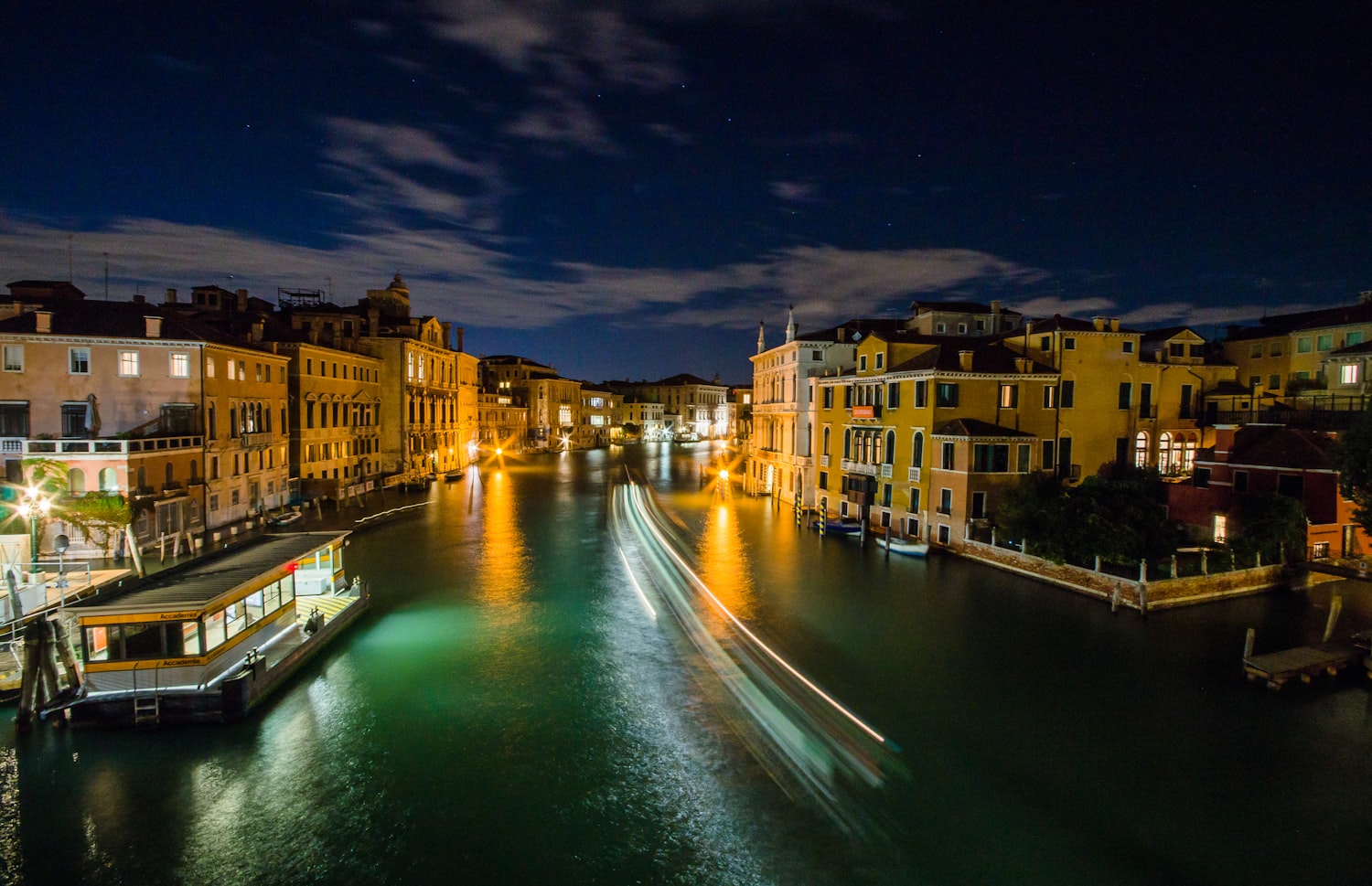
What route does Line N actually take?
The route combines two corridors that daytime passengers usually think of separately: the Grand Canal and the Giudecca Canal. It also reaches Lido at one end and Tronchetto, Piazzale Roma and Santa Lucia railway station on the western side of Venice.
In broad terms, one direction runs:
San Marco-San Zaccaria → Zitelle → Redentore → Giudecca/ Zattere → San Basilio → Sacca Fisola → Tronchetto → Piazzale Roma → Ferrovia → Grand Canal stops → Rialto → Accademia → San Marco → Giardini → Sant’Elena → Lido S.M.E.
The opposite direction starts at Lido, reaches San Marco, continues along the Grand Canal to Ferrovia and Piazzale Roma, then goes through Tronchetto and the Giudecca Canal before finishing back at San Zaccaria.
You can check every departure in the official ACTV Line N timetable. The currently published table is effective from the night of 4 to 5 November 2025.
The biggest mistake: treating N as one continuous all-stops boat
The timetable looks confusing because not every column contains a time at every stop. A blank cell matters. It means that particular journey does not make that stop as part of its scheduled pattern.
This is especially noticeable late at night, when there can be relatively frequent service over one part of the route but much wider gaps farther along it. Some boats effectively provide shorter links while other departures continue through more of the full route.
For that reason, do not use a rule such as “N comes every 30 minutes.” That may be approximately true for a particular section during part of the night, but it is not reliable across the whole route. After the denser late-evening period, waits of around an hour occur on some sections.
The safest method is simple:
- Find your exact departure stop on the ACTV timetable.
- Read horizontally across that stop’s row for departure times.
- Check that the same timetable column also contains a time at your destination.
- At the pier, confirm the destination and Line N on the electronic display before passing through the gate.
At San Zaccaria, the pier letter is crucial
San Marco-San Zaccaria is not one little floating platform. It is a group of separate ACTV piers spread along the waterfront east of St Mark’s Square. At night, walking to the words “San Zaccaria” and boarding whichever N boat appears can produce a very long detour.
Under the current timetable:
- San Marco-San Zaccaria B is used by N departures heading first toward Zitelle and the Giudecca Canal.
- San Marco-San Zaccaria F is used by N services continuing toward Giardini, Sant’Elena and Lido.
- San Marco-San Zaccaria C is used when arriving from Lido before the boat continues toward the Grand Canal on applicable journeys.
If your hotel is on Lido, therefore, do not automatically board the first Line N you see at pier B. A boat leaving B can take the long way through Giudecca, Tronchetto, Piazzale Roma and the Grand Canal before returning to the San Marco area and continuing east. Look specifically for the Lido-bound departure shown for the appropriate pier.
The same letter problem appears at Rialto, Ferrovia and Piazzale Roma
Several large ACTV stations have multiple floating docks. At night the distinction becomes more important because missing one departure can mean a much longer wait.
Rialto
The current N timetable uses Rialto C in the direction toward Ferrovia, Piazzale Roma, Tronchetto and Giudecca, while Rialto D appears for the opposite flow toward San Marco and Lido.
Do not confuse Rialto with Rialto Mercato. They are different vaporetto stops on opposite sides of the Rialto Bridge area.
Ferrovia
Ferrovia is the vaporetto stop directly outside Venezia Santa Lucia station. Line N uses different pontoons according to direction. The timetable currently shows Ferrovia A for services travelling from the Grand Canal toward Piazzale Roma and Tronchetto, and Ferrovia B for the opposite direction toward the Grand Canal.
If you arrive on a late train, come out of the station’s main doors, face the Grand Canal and read the ACTV departure displays before choosing a pontoon. Do not cross the Constitution Bridge to Piazzale Roma unless your onward plan actually requires it.
Piazzale Roma
N currently uses Piazzale Roma F when travelling from Tronchetto toward Ferrovia and the Grand Canal, and Piazzale Roma G in the direction from Ferrovia toward Tronchetto and Giudecca.
Piazzale Roma is also the useful interchange if your late journey continues onto the mainland. Line N itself does not travel to Mestre or Marco Polo Airport. ACTV operates separate mainland night services, so check the current bus departure board before assuming a waterbus connection continues beyond Piazzale Roma.
Why Palanca and Zattere appear twice in parts of the timetable
This is one of the stranger-looking details in the official schedule. Line N zigzags across the Giudecca Canal to serve both banks, so the same stop can appear twice during one directional sequence.
For example, a San Zaccaria departure can call at Giudecca Palanca, cross to Zattere and then return to Palanca before proceeding toward San Basilio. In the opposite direction, Zattere can appear twice with Palanca between the calls.
It is not a printing error. If you are staying on Giudecca, use the actual scheduled time for the relevant Palanca call rather than estimating it from the preceding stop.
Line N does not serve Murano or Burano
The letter N is easy to interpret as “the night boat for everywhere.” It is not. The central night route does not go to Fondamente Nove, Murano or Burano.
ACTV operates separate overnight services:
- NMU, Notturno Murano, links Fondamente Nove with Murano.
- NLN, Notturno Laguna Nord, serves the northern lagoon and includes services between Fondamente Nove, Murano Faro, Burano and other northern-lagoon stops according to the individual departure.
If you need Murano after midnight, the important name on the timetable is therefore F.te Nove, short for Fondamente Nove. Because central Line N does not stop there, allow time to reach Fondamente Nove on foot. Do not plan a two-minute “connection” between the networks simply because the timetable times appear close.
For Burano, the gaps can be much larger and individual NLN trips serve different combinations of stops. Check the current ACTV waterborne timetables before committing to a late dinner or event on an outer island.
Tickets cost the same at night
Line N uses normal ACTV waterborne tickets and time passes. There is no special night surcharge.
ACTV’s current standard visitor fare is €9.50 for a 75-minute Rete Unica ticket. Current time-based visitor passes cost €25 for 24 hours, €35 for 48 hours, €45 for 72 hours and €65 for seven days. Check ACTV’s current fares before travel because transport prices can change.
A timed pass runs for the stated number of hours from its first validation. It does not expire merely because midnight arrives. A 24-hour pass first validated at 18:00, for example, remains within its 24-hour period overnight and into the following day.
A 75-minute ticket needs a little more attention. Some full Line N journeys are long enough to exceed 75 minutes, particularly if you accidentally board a boat taking the long route around Venice. ACTV’s conditions require a valid ticket for the journey, so choosing the correct direction is also a ticketing issue, not just a time-saving trick.
Validate before you enter the pier
Having bought a ticket is not the same as having validated it. ACTV requires tickets to be validated at the start of the journey and again when changing service or vehicle.
At vaporetto stops, hold the ticket or Venezia Unica card against the validator and wait for the positive light and sound before going through. If you use the AVM app, follow the QR-code procedure shown on the validator.
Contactless bank cards can also be used through ACTV’s tap-to-pay system. Use the same physical card, phone or wearable consistently. On waterborne services there is no tap-out requirement.
If every validator at a vaporetto stop is genuinely out of order, ACTV instructs passengers to tell the sailor when boarding. Do not simply board without saying anything and plan to explain it if an inspector appears.
Buying a ticket when the ticket office is closed
Staffed ticket windows may be closed long before the boats stop running, especially away from the main transport hubs. That does not mean you can ride without a ticket.
You can use ticket machines where available, the official mobile options or contactless payment at the validator. ACTV also permits tickets to be purchased on board waterborne services where provided, but you must ask the crew immediately when boarding. Waterborne on-board purchases are paid electronically.
If you already know that several late journeys are likely, sorting out a valid pass before dinner is much easier than discovering at 01:00 that the small pier beside your hotel has no open ticket counter.
Luggage on a late vaporetto

Suitcases are allowed, but ACTV’s baggage limits still apply at night. A passenger with a valid ticket may carry up to three qualifying pieces free: two pieces whose length plus width plus height is no more than 120 cm each, plus one piece up to 150 cm. No individual item may exceed the permitted 150 cm total-dimensions limit.
Keep bags on the floor or in the designated area, never on seats or blocking the boarding passage. Crew can refuse luggage if crowding or safety makes carriage impractical.
Late service can actually be easier with a suitcase than an overloaded afternoon vaporetto, but the longer gaps make missed boats more painful. For a departure from Santa Lucia station or Piazzale Roma, arrive at the correct pontoon several minutes before the scheduled time instead of relying on the boat being visible from across the terminal.
Strollers, wheelchairs and reduced mobility
ACTV waterborne craft have spaces for wheelchair users. Wheelchairs and unfolded pushchairs can be carried where crowding and safety conditions allow, while empty pushchairs may need to be folded.
There is one particularly useful night detail at Rialto. ACTV states that passengers using wheelchairs who need alternative access at Rialto after the regular accessible arrangement changes can request use of the A/B pontoons instead of C/D. Advance booking is required for boarding arrangements, while passengers already on the boat should speak to the crew.
Children under six travel free on ACTV urban services within the Municipality of Venice, but accompanying adults still need their own valid ticket.
Late arrivals at Santa Lucia, Piazzale Roma and Lido
Arriving by train at Venezia Santa Lucia
Look for Ferrovia on ACTV signs. First identify which direction brings you closest to your accommodation. If you are staying near Rialto, Accademia or San Marco, you generally want the Grand Canal side of the N service. If your hotel is around Giudecca or the western waterfront, the opposite direction may make more sense.
Do not judge direction only by the final destination written in a route summary. Check the sequence of stops, because the full overnight route wraps around several parts of Venice.
Arriving by airport or mainland bus at Piazzale Roma
Your bus journey ends on land at Piazzale Roma. Find the ACTV navigation area beside the canal, then check whether F or G is the correct night pontoon for your direction. If your hotel is walkable from Piazzale Roma, walking may be quicker than waiting 30 to 60 minutes for the next appropriate boat.
Returning to Lido
Lido S.M.E. means Lido Santa Maria Elisabetta, the main vaporetto terminal on Lido. The current N timetable uses pontoon D for the night route. At San Zaccaria, pay particular attention to the departure pier because a boat heading directly toward Giardini and Lido is far more useful than an N departure beginning the long westward circuit through Giudecca.
If you are coordinating hotels, trains and late restaurant reservations across several cities, you can organize the rest of your trip around the transfer points that actually matter rather than treating Venice as a single transport stop.
What to do if you miss the last convenient departure
First, check the entire timetable rather than assuming service has ended. The next useful boat may start at a different point on the route or skip your particular stop.
If another N departure serves a nearby pier, walking can save a long wait. In central Venice, for example, Rialto Mercato and Rialto are separate stops but close enough that walking between areas may be practical. San Marco Vallaresso and the San Zaccaria waterfront are also separate stations, so check which one the next usable service actually calls at.
For Giudecca or Lido, walking obviously cannot replace the water crossing. In that situation, stay at the correct pier and use the official timetable rather than heading toward an apparently busier dock without confirming it serves your destination.
A private water taxi is the fallback when no public departure fits, but it is a completely separate service with a much higher price. Do not confuse a water-taxi landing with an ACTV pontoon.
Check again on unusual nights
Redentore, New Year’s Eve, strikes, major regattas and other large events can bring special overnight timetables. High water and fog can also cause stops to be suspended, routes to be divided or boats to be redirected. ACTV publishes operational changes rather than guaranteeing the normal N pattern in those circumstances.
During acqua alta, consult ACTV’s high-water service information and the notices at the pier. Do the same during heavy fog. A timetable downloaded weeks earlier is not enough when navigation restrictions are in force.
The most useful night habit is to check three things before leaving dinner or your hotel: your exact stop name, the pontoon letter and the individual departure that actually reaches your destination. Once those three match, Line N is straightforward. Most overnight vaporetto mistakes happen when one of them is ignored.