Beginner printmaking workshops in Venice range from one-hour screen-printing sessions to four-hour engraving classes and longer courses. Depending on the technique, you might make a postcard, an art print, a printed tote bag or a piece of traditional letterpress typography. You do not usually need drawing experience, but some workshops use prepared designs while others teach you to create an image from scratch.
Before booking a Venice printmaking workshop, confirm the technique, how much of the work you will do yourself, the number of prints included and whether they will be dry enough to take home immediately. A short screen-printing activity can produce a finished souvenir in one session, while traditional engraving may require more time for preparing a plate, printing and drying. The studio’s booking format also matters because some courses are designed for individual visitors and others accept only organized groups.
What happens during a printmaking workshop?
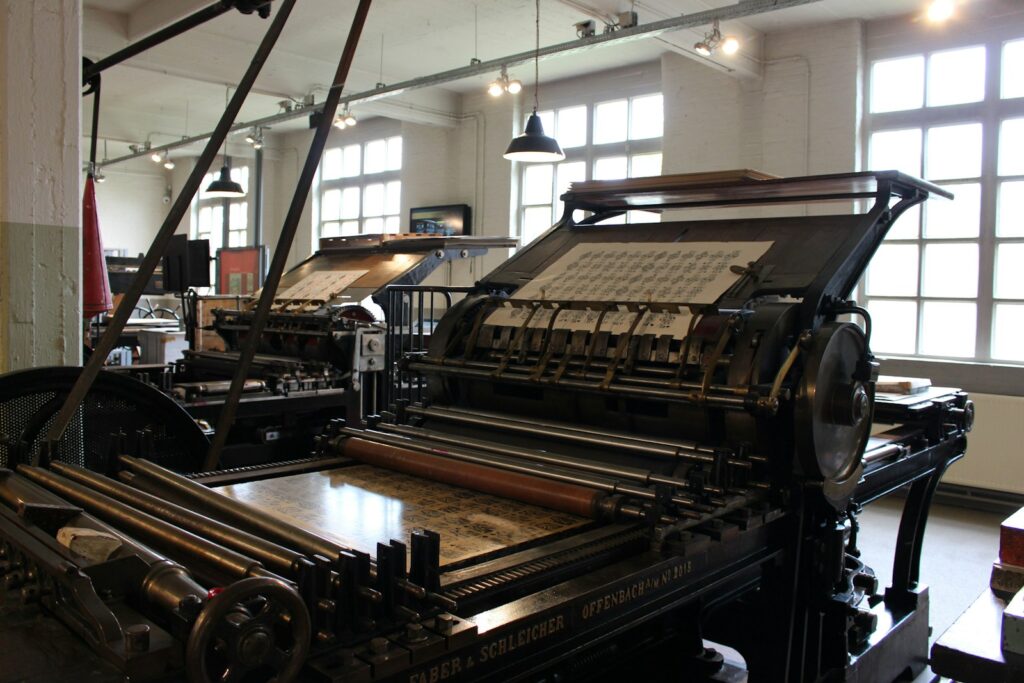
Printmaking is a process for transferring an image or text from a prepared surface onto paper, fabric or another material. The prepared surface is often called a matrix, or matrice in Italian.
Unlike ordinary drawing or painting, printmaking allows you to produce multiple impressions from the same design. These prints may be nearly identical, or you can experiment with different inks, colors and papers.
A typical beginner session involves:
- Choosing an image: The instructor helps you select a simple design or provides a prepared graphic.
- Preparing the printing surface: Depending on the technique, you might carve linoleum, scratch a plate, arrange wooden type or prepare a screen.
- Applying ink: The instructor demonstrates how ink is spread across the printing surface.
- Making the impression: You transfer the design onto paper or fabric using a press, roller, squeegee or another appropriate method.
- Examining the result: The instructor helps you identify areas that need adjustment before making another print.
- Finishing: The completed impressions are dried, packaged or stored for later collection.
The exact sequence depends on the workshop. In a short screen-printing experience, much of the design preparation may already be completed. In a longer engraving class, preparing the printing plate can occupy much of the session.
Ask whether you will use a historic printing press, a modern studio press or hand-printing equipment. Each offers a different introduction to the craft.
Which printmaking technique should a beginner choose?
Venice has studios specializing in several traditional and contemporary techniques. They differ in difficulty, equipment, time requirements and the type of print you can take home.
Screen printing: for color and a quick finished piece
Screen printing, also called serigrafia in Italian, uses a prepared mesh screen to transfer ink onto paper, fabric or another surface.
The instructor demonstrates how to place the material beneath the screen and pull a squeegee across it to push ink through the open areas of the design.
One-color printing is relatively quick, making it practical for beginners and shorter creative sessions.
More involved screen printing uses several colors. Each color may require a separate screen or printing stage, and the layers must be aligned accurately.
For example, Fallani Venezia offers a one-hour introductory experience in which participants print a single-color graphic onto cardboard, a T-shirt or a canvas bag. Its longer basic workshop introduces three-color printing onto paper.
If you want an attractive finished print but have limited time, screen printing is a sensible starting point.
However, ask whether the design is chosen from prepared options or created by you. In a one-hour session, there may not be enough time to design and prepare a completely original multicolor image.
Linocut: for making your own image from scratch
Linocut, or linoleografia, is a form of relief printing. You carve a design into a sheet of linoleum using specialist cutting tools.
The raised, uncut areas receive ink, while the carved sections normally remain unprinted.
You then place paper over the inked surface and transfer the image using pressure from a printing press or another suitable method.
Linocut works particularly well for simple shapes, bold contrasts, patterns and illustrations.
A beginner might create a small Venetian doorway, bridge silhouette, fish, plant design or geometric composition. The image should be simple enough to carve safely within the allotted time.
One important detail is that the printed result appears reversed from the carved matrix. If you want to include letters or numbers, the design must be prepared accordingly.
A three- or four-hour workshop generally gives more useful time for designing, carving and printing than a very short introductory session.
Ask whether the class includes the full process and whether you can take home the carved linoleum block as well as the finished prints.
Drypoint engraving: for detailed lines and traditional printing
Drypoint, called puntasecca in Italian, is an engraving technique in which the artist scratches lines directly into a plate using a pointed tool.
Beginner workshops may use Plexiglas, zinc or another suitable material.
The engraved plate is inked, and excess surface ink is wiped away, leaving ink in and around the engraved marks. Dampened printing paper and a press are then used to transfer the image.
Drypoint can produce expressive lines and delicate textures. It is useful for drawings of Venetian buildings, canals, boats and other architectural subjects.
The technique does not require the acid-based plate-biting stage used in traditional etching.
As a published example, Plum Plum Creations offers a four-hour beginner course in drypoint on Plexiglas or zinc. The class is taught in a small studio in Cannaregio and accepts no more than two students.
This can be a useful format if you want substantial individual instruction and enough time to create a print based on your own drawing.
Etching: for a more involved studio experience
Traditional etching, known as acquaforte, involves preparing a metal plate, drawing through a protective ground and using a chemical process to create the lines that will hold ink.
Related techniques such as acquatinta, or aquatint, allow artists to create areas of tone rather than relying entirely on individual lines.
Etching involves more preparation and specialist equipment than a simple one-color screen print. Some methods also involve chemical hazards, so the instructor must explain the safety procedures and control any operations unsuitable for beginners.
Some Venetian studios teach lower-toxicity or alternative methods. The Scuola Internazionale di Grafica, for example, offers sustainable printmaking workshops using alternative materials and processes designed to reduce reliance on conventional solvents.
If you want to learn genuine etching, ask exactly which process the class uses. A lesson advertised as engraving may teach drypoint rather than acid etching.
Both can produce original prints, but the techniques and equipment are different.
Monotype: for experimenting with colors and textures
Monotype printing involves applying ink to a smooth surface and transferring the image onto paper.
Unlike linocut or engraving, the process generally produces one principal impression rather than a series of substantially identical prints.
It is well suited to experimentation because participants can work directly with color, shapes and textures without carving a detailed matrix.
The Scuola Internazionale di Grafica offers workshops using Plexiglas plates and water-washable inks to explore this technique.
Monotype can be a good choice for someone who enjoys painting or abstract art and wants to try printmaking without preparing a complicated design.
Ask how many impressions you will make and whether the class involves one principal artwork or several experiments.
Letterpress: for words, quotes and traditional typography
Letterpress printing, or stampa tipografica, involves arranging movable type or other raised printing elements and transferring ink onto paper using a press.
Instead of creating an illustration, you might produce a printed quote, a short phrase, a greeting or a small typographic composition.
Some studios use traditional wooden type, allowing you to handle individual letters and see how the composition is assembled.
For example, Veneziastampa offers a traditional typography workshop in Campo Santa Maria Mater Domini. Participants work with wooden type and manual presses to create a printed piece on Fabriano Rosaspina paper.
This is particularly interesting if you enjoy books, typography and the history of printing.
Ask whether you can choose your own phrase, how many characters or lines are allowed and whether the studio has the letterforms needed for your language.
Lithography and other specialist techniques
Lithography, called litografia, is another established printmaking technique. It traditionally relies on the interaction between grease and water on a prepared stone or plate.
Learning the complete process requires specialist equipment and considerable preparation.
Venetian studios occasionally offer intensive courses in lithography and other advanced techniques. For example, Bottega del Tintoretto advertises multi-day summer courses covering traditional printmaking methods.
For a visitor with only two or three hours available, a shorter screen-printing, linocut or drypoint workshop is generally a more practical introduction.
What can you realistically finish in one session?
The number of prints you complete depends on the technique, the design’s complexity and how much preparation has been completed before the class.
In a one-hour screen-printing workshop, you may print one prepared design on a T-shirt, bag or sheet of paper.
In a two- or three-hour class, you might create a multicolor print or arrange a short letterpress composition.
A four-hour drypoint or linocut class may allow time to design a small image, prepare the printing surface and produce several impressions.
However, a workshop promising “make your own print” does not always guarantee a particular number of finished copies.
Ask whether the price includes:
- One finished print or several impressions.
- A prepared design or an original image you develop.
- One color or several colors.
- A choice of paper size and paper type.
- The printing matrix or plate to take home.
- Any additional proofs made during the lesson.
A proof is a test impression used to examine the design before producing the final version. The Italian term is prova di stampa.
Some studios allow participants to keep proofs, while others include only the completed prints.
Can you bring your own drawing or photograph?
Some workshops allow participants to bring a design, but its suitability depends on the technique.
A simple black-and-white drawing may work well for linocut or drypoint. A detailed photograph may be much harder to reproduce during a short class.
Screen printing may require an image to be prepared as a stencil or digital artwork before the session begins.
For letterpress, you may be able to choose a short phrase, but the design is limited by the available wooden or metal type and the size of the printing form.
If you want to use your own artwork, send it to the instructor in advance. Ask whether it can be used without modification or whether the design needs to be simplified.
Do not assume that a detailed portrait, family photograph or multicolor illustration can be prepared and printed within an hour.
For a first experience, a simple subject with clear outlines is often easier to complete successfully.
How much time should you allow?
Published workshops in Venice range from short visitor experiences to courses intended for serious art students.
One-hour workshops
These are usually best for prepared designs, simple screen printing or a short practical introduction.
For example, Fallani Venezia’s one-hour experience introduces screen printing and allows participants to print a single-color design.
This format works when you have limited time and want to take home something you have helped produce.
Do not expect an extensive introduction to every stage of preparing the printing screen.
Two- to three-hour workshops
This duration can allow more experimentation with materials and colors.
Veneziastampa’s letterpress workshops normally last at least two hours, while Fallani Venezia advertises a basic screen-printing workshop lasting approximately two and a half hours.
The Scuola Internazionale di Grafica offers three-hour introductory group workshops in printed images and traditional typography.
This is a useful duration if you want to understand the process as well as produce a finished piece.
Four-hour workshops
Four hours generally gives more time for preparing an original printing plate or experimenting with a particular engraving method.
Plum Plum Creations offers a four-hour drypoint course, while the Scuola Internazionale di Grafica arranges longer workshops in linocut, monotype and other techniques for organized groups.
You will usually have more time to correct mistakes, try different impressions and ask questions.
However, a four-hour class can be physically tiring if you are standing at a workbench for much of the session.
One-day and multi-day courses
Longer courses are more suitable when you want to develop a skill rather than try a single introductory activity.
For example, Bottega del Tintoretto, in Cannaregio, advertises a regular engraving course with four-hour weekly sessions and a five-day summer course involving different traditional printing techniques.
These experiences are designed for deeper learning. Their advertised duration does not mean visitors can join one isolated afternoon at the same monthly or weekly price.
Ask whether the studio accepts individual short-term bookings and whether the desired course operates during your travel dates.
How much hands-on work will you actually do?
A printmaking class can be described as hands-on even when some stages are performed by the instructor.
This may be necessary for safety, particularly when using sharp tools, chemicals or a large mechanical press.
However, you should understand what you are paying to learn.
Before booking, ask whether you will:
- Develop your own image or use a prepared design.
- Prepare the printing matrix.
- Carve or engrave the image yourself.
- Mix and apply the inks.
- Operate the press under supervision.
- Make several impressions.
- Choose the colors and paper.
- Sign or number your finished prints.
For someone interested in learning a traditional craft, preparing the matrix and making the impressions are important parts of the experience.
If you mainly want a personalized souvenir, a shorter activity using a prepared design may be sufficient.
Can you take your finished prints home immediately?
Sometimes. The answer depends on the ink, paper, printing technique and studio’s finishing arrangements.
Some screen-printing experiences are designed so participants can leave with a completed item at the end of the lesson.
For example, Fallani Venezia’s one-hour experience explicitly describes taking home the item you printed.
Other techniques can require additional drying time. Some traditional printing inks remain vulnerable to smudging for hours or longer, particularly when applied heavily to absorbent paper.
In drypoint or etching, paper is often dampened before printing. The resulting sheet may need to dry under appropriate conditions to remain flat.
For fabric printing, the ink may need heat-setting or a curing period before the fabric can be washed.
Ask the studio:
- Will the print be completely dry when the class ends?
- Can it be rolled, or must it remain flat?
- Does the studio supply a protective folder or tube?
- Will the print need additional drying or pressing?
- Can it safely be placed in a backpack?
- Does printed fabric need heat-setting before washing?
- Will we need to return later to collect the finished work?
- Can the studio ship the print if we cannot return?
If you are leaving Venice that afternoon, prioritize a workshop with confirmed same-day collection and suitable packaging.
How to transport prints without damaging them
Paper prints are relatively easy to carry compared with glass or ceramics, but they can crease, smudge or become damaged by moisture.
For a small print, a rigid cardboard folder is often suitable. It helps protect the corners and prevents the paper from bending inside a bag.
Larger prints may be transported in a tube, provided the ink is completely dry and the paper can safely be rolled.
Do not roll a freshly printed sheet unless the instructor confirms that it is safe. Wet or partially cured ink may transfer onto another part of the paper.
If the studio provides tissue, protective sheets or special packaging, ask how they should be used.
A finished print should be kept away from rain, spilled drinks and heavy objects during the journey home.
For airplane travel, check the dimensions of any rigid folder or tube against your baggage allowance.
If you intend to frame the piece later, ask about the paper size. Standard frame dimensions are often easier to manage than unusually sized sheets.
Are printmaking workshops suitable for children?
Some introductory workshops are suitable for children, but minimum ages depend on the equipment and technique.
There is no single age rule covering every Venice printmaking studio.
Fallani Venezia, for example, currently advertises a one-hour family screen-printing package for two adults and up to three children aged eight to fourteen.
The activities involve prepared screens and controlled printing rather than independent carving with sharp engraving tools.
Linocut requires more careful supervision because participants use sharp gouges. Drypoint involves pointed engraving tools, while specialist etching can involve additional materials that require stricter safety procedures.
For children under eight, ask whether the instructor offers an adapted activity using prepared matrices or simple printing methods.
For older children and teenagers, a longer workshop may be suitable when they can follow detailed instructions and handle the equipment responsibly.
Before booking, clarify:
- The minimum age for the exact workshop.
- Whether an adult must participate alongside the child.
- Which sharp tools or other equipment the child will use.
- Whether age-appropriate alternatives are available.
- Whether every child makes a separate print.
- How many instructors supervise the group.
- Whether the studio provides suitable safety equipment.
If a younger child is not eligible to participate, ask whether they can accompany the family as an observer and whether there is a safe place for them to sit.
What safety precautions should you expect?
Printmaking studios use tools and materials that require proper handling.
Linocut involves sharp carving tools. Drypoint uses pointed implements, and some etching techniques involve chemical processes. Printing presses have moving parts and can exert considerable pressure.
The instructor should demonstrate each process and explain which equipment participants may operate themselves.
A suitable beginner workshop should provide:
- Clear instructions before using tools.
- Supervision when operating printing presses.
- Appropriate protection for the materials and process.
- Safe procedures for carving and engraving.
- Suitable ventilation when required.
- Information about the inks and cleaning products.
- A safe place for finished prints to dry.
- Instructions for dealing with spills or accidental injuries.
If you have an allergy or sensitivity to printing inks, solvents, adhesives or cleaning products, contact the studio before booking.
Some workshops use water-washable or other lower-toxicity materials. The Scuola Internazionale di Grafica, for example, describes its sustainable printmaking approach and use of inks that reduce reliance on traditional solvents.
However, the term sustainable does not guarantee that every substance is suitable for someone with a particular allergy or medical condition.
Ask which materials will actually be used during your chosen session.
What should you wear?
Printmaking can be messy. Even experienced artists occasionally get ink on their hands or clothing.
Wear comfortable clothes that can tolerate a small stain. Avoid long, loose sleeves that might interfere with tools or printing equipment.
Closed-toe shoes are a sensible choice, particularly for workshops using heavy presses or sharp equipment.
Some studios provide aprons, but this should be confirmed rather than assumed.
If you use reading glasses for close work, bring them. Preparing an engraving plate or positioning small pieces of type can require careful attention to detail.
You will normally be supplied with paper, inks and the necessary tools, so there is little reason to buy materials before attending.
Can people with reduced mobility participate?
Many printmaking activities take place indoors at worktables, but accessibility differs between studios.
Some processes require standing at a press, moving between workstations or applying pressure with the arms and shoulders.
If you use a wheelchair or walking aid, ask whether the classroom has step-free entry, whether the worktable is suitable and whether the press can be operated from a seated position.
The Scuola Internazionale di Grafica, located at Cannaregio 1798, states that its premises are wheelchair accessible.
That does not establish the accessibility of every other studio in Venice.
For someone with limited grip strength, ask whether the instructor can provide assistance with carving or another technique requiring less sustained hand pressure.
If a particular process cannot be adapted, monotype or a prepared screen-printing activity may be more manageable than extensive linocut carving.
Also confirm that an accessible restroom is available. Some smaller historic workshops have limited facilities.
How much do printmaking workshops cost in Venice?
Prices vary according to the technique, duration, instructor, materials and whether you are booking individually or as part of an organized group.
Current published examples from October 2026 illustrate the differences:
- Fallani Venezia: A one-hour screen-printing experience costs €45 per person. Its family package is advertised at €100 for two adults and up to three children aged eight to fourteen.
- Fallani Venezia’s basic workshop: The approximately two-and-a-half-hour, three-color screen-printing class is advertised at €180 per person.
- Veneziastampa: A traditional letterpress workshop of approximately two hours or longer is advertised at €120.
- Plum Plum Creations: A four-hour introductory drypoint course is advertised at €120. The studio accepts a maximum of two students per session; confirm how the quoted fee applies to your party.
- Scuola Internazionale di Grafica: Its three-hour beginner workshop for organized groups costs €700 for up to ten students, or €850 for eleven to sixteen students.
- Bottega del Tintoretto: Its longer regular engraving course is advertised at €130 per month for participants attending the full program, while its five-day summer course is listed at €460 per person.
These are published rates for particular products, not a standard tariff for Venice. Some studios offer one-off tourist experiences, while others primarily teach recurring classes, school groups or specialist courses.
For travel in 2027, ask for the current calendar and price before committing. A workshop advertised during 2026 may not run on the same dates or under the same conditions the following year.
Individual booking or organized group?
One of the biggest pricing differences comes from whether a studio offers individual places or sells a complete session to a group.
At Fallani Venezia, visitors can choose from published short experiences and more involved screen-printing courses.
Plum Plum Creations offers small, personalized instruction, with a maximum of two students.
Veneziastampa asks visitors to contact the workshop to arrange its traditional typography experience.
The Scuola Internazionale di Grafica’s three-hour educational workshops, by contrast, are specifically designed for organized student groups and other agreed group arrangements.
Its €700 price is a group fee for up to ten students, not a price for an individual visitor.
If you are traveling alone or as a couple, do not assume you can book one place in a scheduled school-group workshop.
Ask whether the studio accepts individual participants, offers private lessons or has scheduled sessions you can join.
A group price may be reasonable for a school, art club or larger private party, but it can be impractical for two tourists who want a short creative activity.
How to book the right workshop
Start by choosing the printing technique and the amount of time you want to spend in the studio.
Then check the studio’s booking method. Some workshops have an online calendar and payment system, while others arrange appointments by email.
For a private or small-group experience, send a message specifying:
- Your preferred date and time.
- Number of adults and children.
- Participant ages, when relevant.
- Previous printmaking experience, if any.
- The technique you want to learn.
- Whether you want to use your own drawing.
- The finished object you hope to take home.
- Any accessibility or material-sensitivity requirements.
- Whether you need same-day collection.
Ask the studio to confirm that the instructor, equipment and materials will be available for your appointment.
Do not assume that normal shop opening hours mean a printmaking class is available throughout the day. Some studios operate as working printshops and teach only at specific times.
Also check the language of instruction. A workshop may be bookable in English, Italian or another language, depending on the instructor.
Where are the printmaking studios located?
Several established printmaking studios are in Cannaregio, a district in the northern part of Venice’s historic center.
Fallani Venezia is located at Cannaregio 5001/A, while Plum Plum Creations operates at Cannaregio 2681 near Fondamenta degli Ormesini.
Bottega del Tintoretto is at Fondamenta dei Mori 3400, close to the historic area associated with the painter Jacopo Tintoretto.
The Scuola Internazionale di Grafica is at Cannaregio 1798, near San Marcuola.
Veneziastampa is in Campo Santa Maria Mater Domini, Santa Croce 2173, within walking distance of the Rialto Market area.
Venice’s district-based street numbering can be confusing. An address such as Cannaregio 1798 or Santa Croce 2173 is more useful than the studio name alone when trying to find the correct entrance.
Ask for a map pin and any specific directions. Some workshops are inside courtyards or buildings that do not have an obvious street-facing entrance.
If you are arriving with a stroller or have mobility limitations, check the walking route for stepped bridges and confirm whether the studio has step-free access.
Should you combine a workshop with Venice’s printing history?
Venice has a particularly important place in the history of European printing. During the Renaissance, the city became one of Europe’s major publishing centers, producing books and printed images for readers across the continent.
The printer Aldus Manutius, known in Italian as Aldo Manuzio, played an influential role in Venetian publishing through his editions of classical texts and innovations in book design.
The city was also a center of woodcut printing and cartography.
One important example is Jacopo de’ Barbari’s large bird’s-eye view of Venice, produced around 1500 using woodblocks. The surviving work provides an extraordinary picture of the city at the beginning of the sixteenth century.
The Museo Correr, in St. Mark’s Square, holds this important historical work. The Scuola Internazionale di Grafica uses a large reproduction of the map in its educational printmaking workshops to connect traditional techniques with the history of Venice.
If you are interested in both art and history, a practical class can be complemented by seeing historical printed materials or visiting museums with relevant collections.
However, museum entry and professional guided visits are separate from the studio workshop unless explicitly included in your booking.
How to fit a printmaking session into your Venice itinerary
A short screen-printing or letterpress experience can fit into a morning or afternoon of sightseeing. A four-hour engraving class is better treated as the main activity for that part of the day.
For a studio in Cannaregio, you might combine the workshop with a walk around the neighborhood or lunch near Fondamenta degli Ormesini.
For a class near Campo Santa Maria Mater Domini, the Rialto area is relatively convenient for other activities afterward.
Remember that you may leave carrying a large sheet of paper or a printed fabric item. If the work needs to remain flat, it may be sensible to return to your accommodation before continuing through crowded museums or busy streets.
You can use the Italy on Foot trip planner to organize the appointment alongside sightseeing, transport and meals. Include the exact studio address and any collection time if the finished print needs to dry.
For more information about walking routes and public transport, see the Italy on Foot guide to getting around Venice.
What if you want to buy a print instead of making one?
Venice has working printshops and galleries selling original etchings, linocuts, screen prints and other graphic works.
Buying a finished piece may be more practical when your schedule is limited or you want a detailed image that would be difficult for a beginner to produce.
If you are purchasing an original print, ask whether it was produced using a hand-printing technique or is a digital reproduction of an original artwork.
Both may be sold as art prints, but their production methods are different.
For prints described as limited editions, ask how many copies were made and whether the work is signed and numbered by the artist.
An edition number such as 8/30 generally identifies a particular impression within an edition of thirty, although the artist may also produce proofs under separate designations.
For more advice about locally made objects, see the Italy on Foot Venetian shopping guide.
A workshop is worthwhile when you want to understand the printing process and make something yourself. If your priority is owning a particular detailed image of Venice, purchasing a finished work may be more suitable.
Cancellation and rescheduling rules
Printmaking workshops often reserve specialist equipment and teaching time in advance. For that reason, cancellation conditions can differ from those of ordinary museums and attractions.
Some private instructors may allow a change of date when they have availability. Scheduled group workshops can be less flexible because the class depends on a minimum number of participants.
As one example, the Scuola Internazionale di Grafica’s published terms for certain scheduled intensive workshops allow a 50% refund when cancellation is made at least twenty days before the class. Later cancellations are generally non-refundable.
The same studio states that it may cancel a scheduled workshop when the minimum number of participants is not reached, in which case the participation fee is refunded.
Other studios apply different policies, so check the terms attached to the exact workshop you book.
Before paying, ask what happens if:
- You cancel several days before the appointment.
- Your train or flight is delayed.
- You arrive after the workshop has started.
- The instructor becomes unavailable.
- The required printing equipment is out of service.
- The minimum group size is not reached.
- You cannot participate because of an age or safety restriction.
- Your finished work cannot be collected before you leave Venice.
- You need to reduce or increase the number of participants.
If the studio proposes replacing the booked technique with another activity, ask whether you can approve the change or receive a refund under the agreed terms.
A letterpress session, for example, is a different experience from a hands-on drypoint class even though both involve printing on paper.
Questions to ask before booking a printmaking workshop
Before making a reservation, send the studio your preferred date, group size and the technique you want to learn. Then clarify the arrangements that determine what you will actually do and take home.
- Is this a working demonstration or a hands-on printmaking class?
- Which technique will we learn: screen printing, linocut, drypoint, etching, monotype or letterpress?
- Is the class suitable for someone with no drawing or printmaking experience?
- Can we bring our own design, or must we use a prepared image?
- Will we personally prepare the printing matrix or screen?
- Will we apply the ink and operate the press under supervision?
- How much individual hands-on time will each participant receive?
- How many prints are included in the workshop fee?
- Can we choose the paper size, colors or printing surface?
- Can we keep the printing plate, linoleum block or other matrix?
- Will the finished prints be dry enough to take home immediately?
- Does the studio supply protective packaging?
- Will we need to return later to collect the prints?
- Can the studio arrange shipping if collection is not possible?
- Is the workshop private or shared with other participants?
- How many people will share the instructor and printing equipment?
- Does the studio accept individual visitors or only organized groups?
- What is the minimum participation age?
- Are sharp tools, chemicals or other potentially hazardous materials used?
- Can the activity accommodate our specific allergies, material sensitivities or mobility requirements?
- Are all paper, inks, tools and safety materials included?
- Will the instructor teach in English?
- Where exactly is the studio entrance?
- Is the classroom wheelchair accessible, and are restrooms available?
- How long does the full workshop last, including preparation and cleanup?
- What is the final price for our actual group?
- Are taxes, materials and booking fees included?
- How far ahead must we reserve?
- What happens if the class is cancelled or we arrive late?
- What are the cancellation, refund and rescheduling conditions?
For a first experience lasting around an hour, screen printing offers a practical introduction and can produce a finished souvenir without requiring extensive drawing or carving. A two- to three-hour letterpress or multicolor screen-printing session is a good option when you want to understand more of the process. Choose a four-hour linocut or drypoint class if you particularly want to create an original image and learn to use traditional printing tools.
Before booking, confirm the exact technique, individual working time, number of finished impressions and collection arrangements. If your stay in Venice is short, the most important detail is whether the print can leave the studio safely when the lesson ends. That should be settled before you pay, along with the full price and the conditions for changing your booking.