Most pasta-making classes in Florence teach you to mix dough, knead it, roll it out and shape fresh pasta before sitting down to eat what you have prepared. A typical session lasts around two and a half to three and a half hours, including the meal. Longer experiences may add a food market visit, several sauces or an Italian dessert.
A pasta making class Florence visitors can reach on foot is often the simplest option for a day that also includes sightseeing. The main things to compare are what you will actually cook, how much of the work you do yourself, group size, dietary arrangements and what the price includes.
What Do You Actually Make in a Florence Pasta Class?
The menu depends on the school and the type of class. Some workshops concentrate entirely on fresh pasta, while others combine pasta with tiramisù, gelato or a longer Tuscan meal.
The most common preparations include:
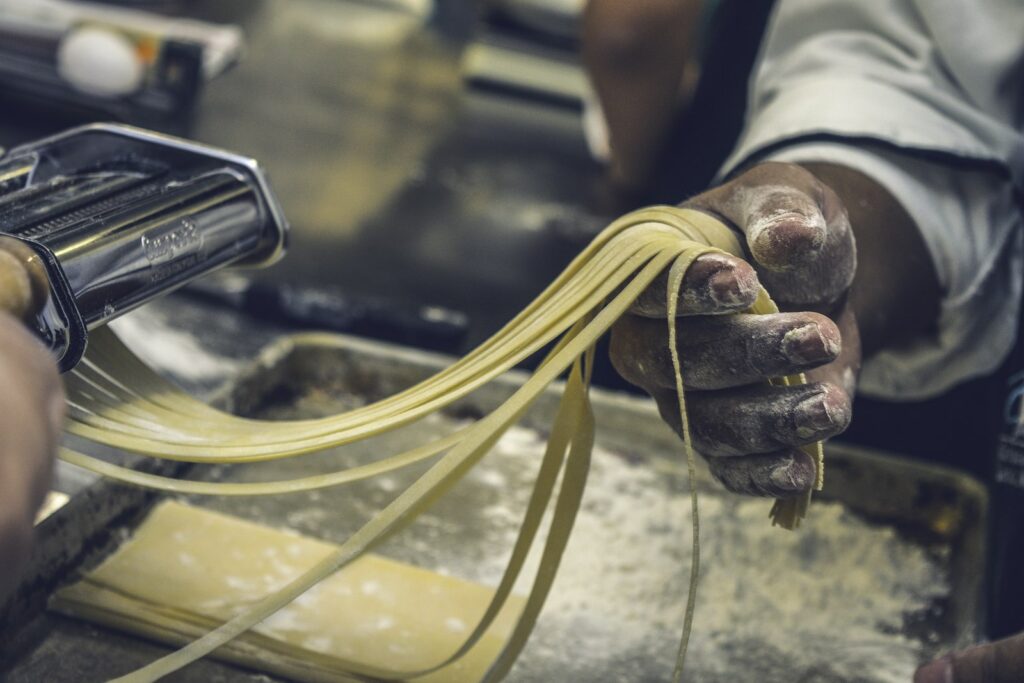
- Tagliatelle or fettuccine: Long ribbons cut from rolled pasta dough. These are useful for beginners because they teach the basics of kneading, dough thickness and cutting.
- Ravioli: Filled pasta parcels, often containing ricotta, spinach or another seasonal filling. You learn to prepare the filling, seal the pasta and prevent it from opening during cooking.
- Pappardelle: Broad pasta ribbons associated with Tuscan cooking, often served with a substantial sauce such as ragù.
- Pici: Thick, hand-rolled pasta particularly associated with southern Tuscany. Traditional pici dough is generally made without eggs, making it different from the egg pasta used for many ribbon shapes.
- Gnocchi: Soft dumplings commonly prepared with potatoes and flour. These involve a different technique from rolling traditional pasta sheets.
Classes frequently include one or two sauces. Depending on the menu, these might be tomato sauce, butter and sage, pesto or ragù. Some instructors demonstrate sauce preparation while participants concentrate on making the pasta.
Check the difference between making and tasting. A description promising three pasta dishes does not necessarily mean every participant makes three separate doughs. You might prepare one dough, shape it in several ways and then eat the finished dishes together.
That can still be a useful introduction. However, if you specifically want to learn how to make filled ravioli or prepare a sauce from scratch, make sure those activities are included in the hands-on portion.
Choosing Between the Different Types of Classes
Small-group pasta workshops
These are usually the most straightforward option for individual travelers, couples and beginners. You join other participants in a teaching kitchen, follow the instructor’s demonstration and work at a shared or individual preparation station.
Classes may accommodate anything from a handful of participants to around 20 people, depending on the venue. A group advertised as small is therefore worth checking rather than interpreting as a fixed number.
Choose a smaller group when your priority is learning technique and receiving individual correction. There is a real difference between watching an instructor roll dough and having someone explain why your own dough keeps sticking.
Pasta and tiramisù classes
These combine a pasta lesson with the preparation of tiramisù, the Italian dessert made with mascarpone, coffee and sponge biscuits.
They work well for travelers who want a broader cooking activity without committing half a day. They can also suit families, although the dessert recipe may involve coffee, alcohol or eggs, depending on how it is prepared.
Ask whether participants make their own tiramisù or assemble a shared dessert. You should also check how the instructor handles any ingredients requiring food-safety precautions.
Market visits followed by cooking
Some longer experiences begin with a visit to a food market, typically Mercato Centrale in San Lorenzo or Mercato di Sant’Ambrogio near Santa Croce.
Participants may learn about seasonal vegetables, cheeses, fresh ingredients and regional cooking traditions before moving to the kitchen.
These experiences can take around four to five hours or longer. The market portion is usually a guided walk, sometimes with tastings, rather than an opportunity to shop independently.
One important detail is the day of the week. Florence’s traditional covered food markets generally operate from Monday to Saturday and close on Sundays and most public holidays. The upstairs food hall at Mercato Centrale operates on a different schedule from the traditional market stalls downstairs.
You can check information about the markets through the City of Florence’s official market pages. For the practical difference between morning markets and later food-hall openings, see our guide to Florence markets by time of day.
If your class includes a market visit on a Sunday or public holiday, ask exactly what replaces it. Some operators substitute additional tastings or cooking activities, while others offer a different itinerary.
Private pasta-making classes
A private class gives your party exclusive use of the instructor’s time, and sometimes the teaching space. Depending on the operator, you may be able to select the pasta shapes, adjust the pace and arrange a convenient starting time.
Private sessions are particularly useful for families with young children, groups celebrating an occasion or travelers who need dietary or accessibility arrangements that a standard group class cannot provide.
They also make sense when you want to learn a specific technique rather than follow a fixed introductory menu.
Ask whether the quoted private price covers the entire group or is charged per participant. Some operators apply minimum group charges even when only two people attend.
How Long Does a Pasta-Making Class Take?
Do not assume the advertised duration refers entirely to cooking. It normally includes an introduction, preparation, instruction, cooking and the final meal.
- About 2 to 2.5 hours: A focused lesson, often involving one or two pasta preparations and a meal.
- About 3 to 3.5 hours: A more involved class with multiple pasta shapes, sauces or dessert.
- About 4 to 5 hours or more: A market visit, ingredient tastings, cooking and a seated meal.
These are useful planning ranges rather than guaranteed durations. Check the specific experience before arranging anything afterward.
An evening class that begins at 5:30 p.m., for example, may finish with dinner rather than leave you needing another restaurant reservation. A morning class ending after lunch can affect afternoon museum plans.
Allow some extra time after the stated finish. A delayed start, a large group or a leisurely meal can make a tightly scheduled train departure uncomfortable.
What Should Be Included in the Price?
Many Florence cooking classes include ingredients, an instructor, kitchen equipment, an apron and the meal prepared during the lesson. Some also provide wine, soft drinks, dessert and digital recipes.
However, inclusions vary considerably.
Before comparing prices, establish whether the fee covers:
- All ingredients needed for the advertised dishes
- Use of the kitchen, utensils and apron
- Instruction in your preferred language
- A full seated meal or only a tasting portion
- Wine, water and non-alcoholic drinks
- Recipe cards or a digital recipe booklet
- Any food market visit and tastings
- Taxes, booking fees and other mandatory charges
Wine may be included as a glass with the meal, offered in a specified quantity or provided under a different arrangement. Do not assume an unlimited-drinks policy applies unless the operator explicitly states it.
Pay attention to the phrase tasting included. It may describe a smaller amount of food than a full lunch or dinner. Ask if the portion is intended to replace a meal.
When comparing costs, use the final price for everyone attending. A cheaper class can become less attractive if it has additional charges or requires a costly transfer from your accommodation.
Where Do Classes Meet, and Do You Need Transport?
Florence cooking schools operate in several areas, including San Lorenzo, Santa Croce, the streets around the Duomo and the Oltrarno neighborhood south of the Arno.
Many central venues are within walking distance of major attractions and accommodation in the historic center. Hotel pickup is not normally necessary for a centrally located kitchen and is often excluded from group experiences.
However, do not rely on the words Florence city center alone. Some cooking experiences take place in residential neighborhoods, at countryside properties or in locations reached by a separate transfer.
Before paying, confirm the exact address, whether the class starts and ends at the same location, and whether transport is included.
Watch for Florence’s red street numbers
Florence has a distinctive street-numbering system. Commercial premises often carry a red number, written as rosso or abbreviated with an r.
For example, an address ending in 25r can refer to a different doorway from number 25 on the same street.
Keep the complete street address from your confirmation, including any letter or red-number designation. If the entrance is inside a courtyard or another building, request a clear description or location pin.
Driving to a class
Central Florence has a restricted traffic zone, known as the Zona a Traffico Limitato or ZTL. Access is regulated and monitored by cameras.
Drivers should check the municipality’s official ZTL information before attempting to drive to a central kitchen. A cooking class reservation does not itself give a visitor permission to enter the restricted zone.
For most central classes, walking or using public transport to reach the neighborhood is simpler than arranging parking.
Can Children Join a Pasta-Making Class?
Fresh pasta is a particularly approachable cooking activity for children because rolling dough and shaping pasta provide plenty of practical tasks.
However, age rules vary between operators. Some group classes accept children from around five or six years old, while others have different minimum ages. Private sessions may be more flexible, but this depends on the venue and supervision arrangements.
Parents should confirm the following before reserving:
- The minimum age for participating in the specific class
- Whether an adult must accompany each child or family group
- Whether younger children can join as observers
- Whether a child price applies and what it includes
- Whether the kitchen has suitable working heights or equipment
- Which tasks involve knives, hot water or other hazards
For younger children, a shorter class focused on simple pasta shapes may be more manageable than a long market-and-cooking experience.
Also consider the timing. A class that includes dinner late in the evening may be less convenient for families with small children, even if the cooking itself is suitable.
Vegetarian, Vegan, Gluten-Free and Allergy Requirements
Dietary arrangements deserve particular attention because a pasta class is a working kitchen where participants handle ingredients directly.
Vegetarian and vegan meals
Many schools can provide vegetarian recipes with advance notice. Filled pasta containing ricotta and spinach, tomato-based sauces and other vegetable preparations are common possibilities.
Vegan cooking is more complicated when the class focuses on fresh egg pasta, cheese-based fillings or dairy sauces. Some pasta, including traditional pici, can be prepared without eggs, but this does not mean a standard class can automatically provide a fully vegan menu.
Ask whether you will make a suitable dough yourself and whether the finished meal, including sauces and dessert, can meet your requirements.
Gluten-free classes and coeliac disease
This distinction is especially important.
A school might offer gluten-free pasta for someone to eat while still teaching the rest of the group with wheat flour. That is different from a fully gluten-free cooking environment.
Airborne flour, shared preparation surfaces, rolling equipment and utensils can create cross-contact risks. Anyone with coeliac disease should seek explicit confirmation that the kitchen and procedures are suitable for their needs.
Some Florence schools advertise dedicated gluten-free cooking sessions, but suitability still needs to be verified directly with the provider.
Do not rely solely on an online listing marked gluten-free options available.
Other food allergies
Fresh pasta classes commonly involve wheat, eggs and dairy. Some recipes may also contain nuts, meat, wine or other ingredients.
Tell the school about allergies before booking, identify the specific allergens and ask whether safe participation can be arranged. If a serious allergy is involved, obtain a clear written response about ingredient handling and cross-contact precautions rather than relying on a general promise to accommodate dietary requests.
Accessibility and Physical Requirements
Most classes involve a period of standing while kneading, rolling and shaping dough. Depending on the venue, participants may work at tall counters or move between cooking stations and dining areas.
Some kitchens are wheelchair accessible, while others occupy older buildings with steps, narrow entrances or limited toilet facilities.
Before booking, ask about:
- Step-free access from the street to the teaching area
- Accessible toilets and door widths
- Seated workstations or adjustable counter heights
- How long participants are expected to stand
- Whether assistance or an accompanying person is permitted
- Any walking involved in a market tour
If you have reduced mobility or limited hand strength, ask which parts of the lesson can be adapted. A private or smaller session may provide more flexibility, but the kitchen’s physical layout still determines what is possible.
What to Wear and What to Do With Luggage
You do not normally need to bring cooking equipment. An apron and the necessary utensils are commonly supplied.
Wear comfortable clothes and closed-toe shoes suitable for standing in a kitchen. Tie back long hair and avoid loose sleeves that could get in the way while preparing food.
Travelers arriving directly from the airport or train station should also consider their bags. Cooking schools are generally not designed to provide secure storage for large suitcases.
If you will have luggage, request permission before arriving with it. A small backpack may be manageable, but large bags can obstruct preparation areas and walkways.
Visitors arriving through Firenze Santa Maria Novella can consult our Florence main train station guide for station facilities and luggage-storage information.
Storing bags at your accommodation or an established luggage-storage facility is often easier than carrying them through a cooking session.
How Far Ahead Should You Reserve?
Advance booking is sensible when you need a particular date, language, menu or private session. Smaller kitchens have limited workstations, and private classes require arrangements that may not be available at short notice.
For travelers with flexible schedules, checking availability closer to the date may be perfectly reasonable. There is no universal reservation deadline across Florence cooking schools.
Some providers have already published dates for 2027, although individual menus, availability and booking conditions can change. Check the live calendar for your chosen date and obtain confirmation of the actual session rather than relying on a general annual schedule.
When booking, the process usually involves selecting a class, choosing a date and number of participants, submitting any dietary information and completing payment or a deposit.
Direct bookings and third-party booking platforms may have different change and refund procedures. Keep a copy of the actual conditions attached to the reservation you make.
Cancellation, Deposits and Changes
Cancellation policies vary. Some Florence classes advertise free cancellation until 24 hours before the experience, while others use a 48-hour deadline or different conditions for private bookings.
Never assume a flexible policy advertised by one cooking school applies to another.
Before paying, confirm:
- How far in advance you can cancel for a full refund
- Whether the booking is prepaid or requires a deposit
- Whether a private booking has separate cancellation terms
- What happens if you arrive late or miss the class
- Whether rescheduling is permitted and under what conditions
- What happens if the operator cancels or changes the venue
- Whether the class requires a minimum number of participants
If the experience includes an outdoor market visit, ask how closures or severe weather affect the itinerary.
The kitchen portion can generally proceed indoors during rain, but a market walk may be shortened, modified or replaced. The arrangements depend on the operator.
Check whether a significant itinerary change gives you a choice of an alternative date or refund, and what happens if you decline the replacement.
Questions to Ask Before Paying
A useful booking enquiry identifies the details that can affect your experience rather than simply asking whether a class is available.
If the booking page does not answer these questions, send the provider a short message:
- Which pasta shapes and sauces will we prepare on our chosen date?
- Will each participant make pasta from scratch, or will some preparation be demonstrated?
- What is the maximum group size, and how many people share a workstation?
- Is the experience suitable for complete beginners?
- Does the advertised time include the meal?
- Are drinks, dessert, ingredients and recipes included in the final price?
- Can you accommodate our dietary requirements, and how?
- What is the exact kitchen address and meeting time?
- What are the cancellation and rescheduling conditions for our reservation?
For private classes, add your preferred pasta dishes, group size, ages of any children and any accessibility needs.
You should receive a confirmation showing the date, local starting time, exact address, number of participants, class type, payment details and any special arrangements agreed upon.
How to Fit a Cooking Class Into a Day in Florence
A pasta lesson works particularly well when treated as the day’s main food activity.
For a morning class, you can leave the afternoon for sightseeing or a relaxed walk through Florence. For an evening session, avoid making a separate dinner reservation unless the experience ends before a full meal.
If you are combining a class with museum tickets, allow enough travel time and avoid scheduling two fixed-start activities too close together.
You can also organize your Italy itinerary around the class, nearby sights and any onward travel, rather than treating the cooking session as an isolated booking.
Visitors with only a short time in Florence may prefer a centrally located class over one involving a countryside transfer. A rural cooking experience can be appealing if you want to spend more time outside the city, but transport may account for a substantial part of the day.
If your main interest is simply eating excellent fresh pasta, you may not need a cooking class at all. A restaurant serving freshly made pasta is a simpler option. The value of a workshop lies in learning and practicing techniques you can use again at home.
Common Mistakes When Choosing a Pasta Class
Most disappointing bookings start with a mismatch between the advertised experience and what the traveler expected.
- Choosing by the number of dishes alone: Several advertised dishes may involve only one dough and limited individual preparation.
- Assuming every class is private: A small-group class still includes other guests unless the reservation explicitly says otherwise.
- Expecting a market visit on a Sunday: Traditional market stalls may be closed, so confirm the replacement activity.
- Confusing a demonstration with a workshop: Look for clear descriptions of what participants actually prepare.
- Assuming dietary flexibility means allergy safety: Confirm ingredients and kitchen procedures before paying.
- Ignoring the actual location: A class outside central Florence may require transport that is not included.
- Booking too close to a train departure: Cooking and dining can take longer than expected.
- Missing the cancellation deadline: The conditions of the specific booking apply, even if other listings advertise different terms.
A very low price is not automatically a warning sign. However, if the listing does not identify the location, duration, included activities or cancellation rules, request clarification before making a non-refundable payment.
What If the Instructor Is Late or the Class Changes?
Keep the provider’s contact information available on your phone, along with your confirmation and the exact meeting address.
If you cannot find the entrance, double-check the red street number and any instructions about courtyards or meeting outside the kitchen. Contact the operator promptly rather than spending a long time searching nearby streets.
If the instructor or host is absent at the agreed time, use the contact number supplied in your booking and check any messages about venue changes. If you booked through a platform, you may also need to notify that platform using its stated procedure.
Where a class has been materially changed, ask the operator to explain the replacement arrangements and your available options before agreeing to proceed.
Keep written records of cancellations, proposed changes and refund requests. This is particularly useful when a booking platform handles payment separately from the cooking school.
Which Florence Pasta Class Should You Choose?
For a first attempt at fresh pasta, a two- to three-hour hands-on workshop with a small group and a meal is usually sufficient. It gives you time to learn the basic dough, rolling and shaping techniques without occupying the entire day.
If you already cook regularly, look for a class centered on the skills you want to develop, such as stuffed pasta, hand-rolled Tuscan shapes or preparing sauces from scratch.
Choose a market-and-cooking experience when you are genuinely interested in ingredients and local food shopping. Choose a private class when you need a specific menu, more individual instruction or greater flexibility for your group.
Before completing any reservation, confirm three things in writing: what you will personally cook, where and when you must arrive, and what happens if you need to cancel. Those details will do more to determine whether the class suits your trip than a long list of dishes on the booking page.