A local planner can help arrange a marriage proposal in Florence by finding a suitable location, coordinating a discreet photographer, organizing flowers and managing the timing of the surprise. You can also arrange a simple proposal yourself, especially if you want to use a public viewpoint. The main decisions are how much privacy you need, what you want photographed and who will handle the arrangements if the weather or schedule changes.
For a marriage proposal Florence offers everything from free riverside viewpoints to private terraces overlooking the cathedral. Local assistance becomes particularly useful when several people or suppliers need to be in the right place without your partner knowing what is happening.
What Does a Local Proposal Planner Actually Do?
Proposal planning services vary considerably. Some are essentially photography packages with a little coordination included. Others involve event planning, venue reservations, decorations, transport and several suppliers.
There are three common ways to organize the experience:
- Photographer with proposal coordination: Suitable for a straightforward surprise in a public location. The photographer helps select the spot, agrees on the timing and discreetly photographs the proposal. A portrait session afterward may be included.
- Local proposal planner: Useful when you want flowers, a musician, decorations, a private location or assistance coordinating several services. The planner manages arrangements and communicates with suppliers.
- Private venue package: A hotel, restaurant or event venue may arrange a terrace, special dinner or decorated space. Photography, flowers and exclusive access may be included or charged separately.
For two people who would be happy with a quiet moment and a few photographs, hiring a photographer who understands proposal coordination may be enough. A full planner makes more sense when the surprise involves restricted access, multiple suppliers or a carefully staged setting.
Before comparing packages, decide whether your partner would enjoy being proposed to in front of other people. This matters more than the number of decorations or the view.
Where to Propose in Florence: Privacy, Access and Practicalities
Florence has several well-known proposal locations, but a beautiful photograph of an empty terrace does not tell you how crowded it will be when you arrive.
Piazzale Michelangelo
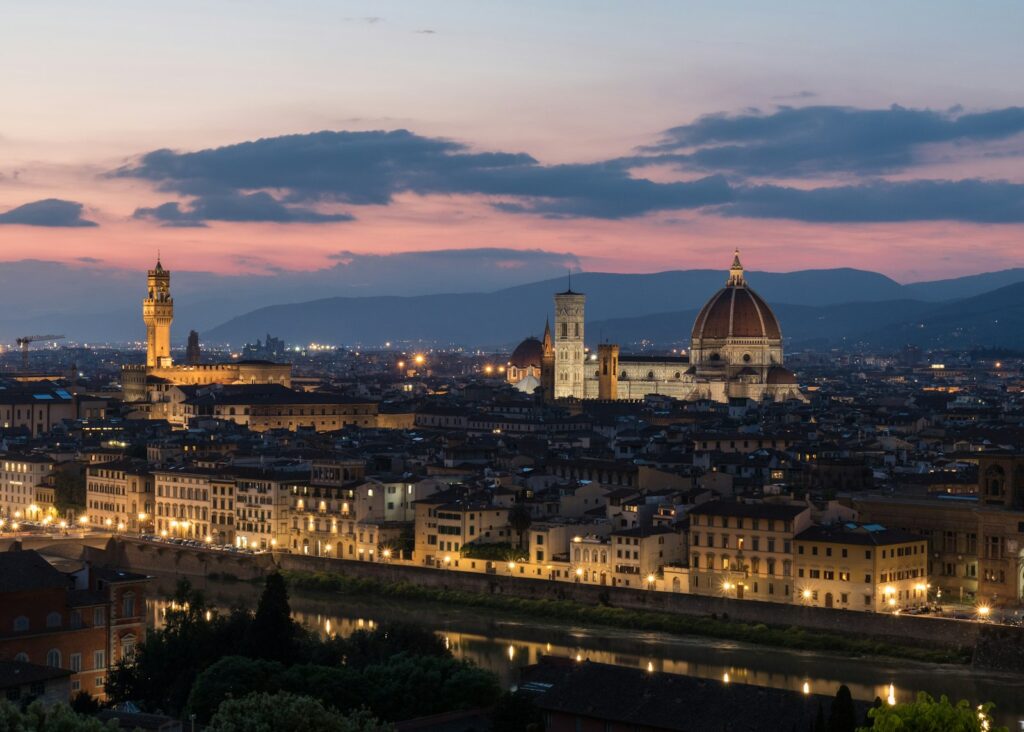
Piazzale Michelangelo offers the classic panorama of Florence, with the cathedral dome, Palazzo Vecchio, the Arno and the bridges below. It is a free public viewpoint and one of the simplest locations to arrange without reserving a venue.
The main difficulty is privacy. Sunset attracts large numbers of visitors, and a photographer cannot guarantee that other people will stay out of the frame. An early-morning proposal may be quieter, although the viewpoint remains open to everyone.
Ask your photographer to specify the exact part of the terrace where you should stand. An instruction to meet at Piazzale Michelangelo is insufficient when the photographer needs a clear view of the proposal.
The viewpoint is uphill from the historic center. Arriving by taxi or bus can be preferable to climbing the streets and steps from the river, especially in formal clothes.
The Arno and Ponte Vecchio
The river provides several opportunities for a proposal with Florence’s historic bridges in the background. The stretch along Lungarno degli Archibusieri and viewpoints around Ponte Santa Trinita are useful places to consider.
Proposing directly on Ponte Vecchio can be awkward because the bridge is a busy pedestrian route with shops, visitors and limited space to stop discreetly.
A nearby riverside position often allows the photographer to include the bridge in the background. Early morning is generally more practical for avoiding crowds, although pedestrian and delivery activity can still affect the setting.
Check that the chosen spot is on an accessible public walkway. Some river-level areas involve steps or may be affected by changing conditions.
Giardino delle Rose
The Rose Garden below Piazzale Michelangelo combines views of Florence with terraces, pathways and greenery. Admission is free, and it can feel more relaxed than the main viewpoint.
There are two details to check carefully. First, this is a public garden, so privacy is never guaranteed. Second, it has seasonal opening hours and closes earlier during the colder months.
The published Rose Garden visitor information provides seasonal hours and identifies the garden as partially accessible. Its published 2026 timetable should not be treated as confirmation of opening hours for 2027.
The garden is terraced, with slopes and steps in some sections. Agree on the precise entrance and proposal spot rather than assuming every pathway is suitable for someone with reduced mobility.
Giardino Bardini and Boboli Gardens
These historic gardens offer a more structured setting, with landscaped grounds and panoramic areas. However, they are ticketed attractions with opening hours, entry conditions and visitor regulations.
Giardino Bardini has several entrances at different levels, and its hillside layout can involve significant walking and steps. The official Bardini visitor information lists current admission arrangements, opening times, entrances and accessibility details, including a designated accessible entrance.
Boboli Gardens is another possibility, but its opening and closing times change by season, and the last admission is generally one hour before closing. Check the official Boboli Gardens information before organizing a timed proposal.
For either garden, ask the operator whether professional photography, decorations or a coordinated event are permitted. Buying an admission ticket does not automatically authorize a commercial photography setup or private event.
Private terraces, hotels and restaurants
A private terrace can provide more control over privacy, photography and timing, particularly if your partner dislikes crowds.
However, there is an important difference between reserving a table, reserving part of a terrace and hiring the entire space exclusively.
Ask the venue whether other guests will be present, whether photography is allowed, how long you can use the location and what happens if rain prevents access to the terrace.
For hotel rooftops, check whether access is available to non-residents and whether a room booking is required. For restaurants, establish whether the proposal will happen before dinner, during service or in a separate reserved area.
Do You Need Permission to Propose in Florence?
A simple personal proposal in a public space is generally different from organizing a commercial event or installing equipment. The complications usually begin when someone wants exclusive use of an area, elaborate decorations, professional filming equipment or a temporary structure.
The Municipality of Florence has procedures for certain photography and filming activities on public land, particularly those involving crews, substantial equipment or staged installations. Separate municipal rules govern occupations of public space.
A photographer working with a handheld camera is different from a production team with lighting stands, a large decorative arch and several assistants. Ask the organizer to establish which permissions apply to the actual setup.
Historic institutions have their own rules. For example, the Uffizi Galleries explicitly permit discreet marriage proposals inside their museum premises, including the cafeteria, provided other visitors are not disturbed. Their official proposal policy prohibits involving professional photographers or professional photography and video equipment in that arrangement, and ceremonial clothing or accessories are not allowed.
Anyone proposing inside a museum should check that institution’s rules before assuming a hired photographer can accompany them.
Be cautious if a package promises to close off a famous square, decorate a public monument or arrange drone filming without explaining how authorization is handled. A planner should be able to identify the relevant permissions and who is responsible for obtaining them.
Choosing the Right Time for the Proposal
Timing affects the light, crowds, privacy and the amount of coordination needed.
- Early morning: Often a sensible choice for public locations, particularly around the bridges and major viewpoints. It may be easier for a photographer to work discreetly.
- Late afternoon: Convenient if you want photographs followed by dinner. Allow time to travel between the proposal location and the restaurant.
- Sunset: Popular for panoramic photography, but viewpoints can be crowded. Check the actual sunset time for your travel date rather than booking according to a generic seasonal estimate.
- Evening: More suitable for a private terrace, restaurant or deliberately planned illuminated setting. Confirm that photography and access are possible after dark.
A sunset proposal needs more planning than simply arriving when the sun goes down. The photographer needs time to get into position, and your partner needs to arrive without feeling rushed.
Agree on a target arrival time and a small buffer. If the proposal involves a venue, check whether the reservation has a strict start or finish time.
For a surprise, the explanation for visiting the location should sound natural. A casual walk to enjoy the view is usually easier to manage than an elaborate story involving several unexpected appointments.
What to Send a Local Planner or Photographer
A clear first enquiry makes it easier to receive a useful quote and avoids several rounds of messages.
Include the following information:
- Date and flexibility: Your preferred date, possible alternative dates and whether you have a fixed dinner or travel reservation afterward.
- Accommodation area: The hotel or neighborhood where you are staying, so the provider can suggest practical meeting and travel arrangements.
- Preferred atmosphere: A public viewpoint, quiet garden, riverside location, private terrace or restaurant.
- Privacy: Whether you are comfortable with other visitors nearby or want an exclusively reserved space.
- Photography: Whether you want the exact proposal captured discreetly, followed by portraits, or simply a few photographs.
- Extra arrangements: Flowers, decorations, music, video, dining or transport.
- Accessibility: Any difficulties with stairs, steep walking, standing or uneven ground, plus arrangements for children if they will attend.
- Budget: An approximate total budget, including venue fees and extras.
Explain that the proposal is a surprise and specify which email address or messaging account the organizer should use. If your partner can see your phone notifications or shared travel bookings, agree on a discreet communication method.
What Should a Proposal Package Include?
Package names such as romantic experience, luxury proposal or exclusive surprise are not particularly useful for comparing services. A written breakdown is much more valuable.
Request confirmation of the actual services, their duration and any exclusions.
Photography and video
Check the number of shooting hours, whether the photographer arrives early, how many edited photographs are supplied and the expected delivery date. Ask whether the images are delivered through a downloadable private gallery.
Also check whether unedited files, additional photographs, video footage or expedited delivery cost extra. If you do not want your photographs published on a photographer’s website or social media, agree on privacy and usage terms before booking.
Venue and decorations
Establish whether the venue fee includes exclusive access, furniture, flowers, candles, signs and removal of decorations afterward.
Some venues may restrict flames, confetti, music or installations that could damage historic surfaces. Artificial candles, a small floral arrangement or a simple table setting may be easier to arrange, subject to the venue’s rules.
For a private terrace, ask how much of the space will actually be yours and for how long. A photograph showing an empty rooftop is not evidence that it can be reserved privately.
Transport and additional expenses
Clarify whether the quote covers transportation, admission tickets, venue rental, meals, delivery charges, taxes and the planner’s coordination fee.
If several suppliers are involved, find out whether you make one payment to the organizer or pay each supplier separately.
Check whether VAT, often identified as IVA in Italian quotations, is included in the total.
Getting to the Proposal Location Without Spoiling the Surprise
Transport becomes surprisingly important when a photographer is waiting at a particular location.
Florence’s historic center contains pedestrian streets and a restricted traffic zone known as the ZTL. A vehicle transfer may therefore involve a short walk from an agreed drop-off point rather than a pickup directly outside your accommodation.
For Piazzale Michelangelo, city buses offer a cheaper alternative to a private transfer. Autolinee Toscane operates line 13 to the viewpoint, although routes, stops and services can change. The practical distinction between the hill routes is explained in our guide to reaching Piazzale Michelangelo without walking uphill.
For a proposal involving formal clothing, reduced mobility or a very precise arrival time, arranging a taxi may be simpler. Confirm the destination and drop-off point beforehand.
Do not leave large suitcases with a photographer or planner unless luggage handling is an explicitly agreed service. If the proposal is planned immediately after arrival in Florence, leave enough time to check in, store bags and deal with transport delays.
The engagement ring should stay securely with you rather than in checked luggage or a bag someone else is carrying. Choose a pocket or small case you can access discreetly.
What Happens if It Rains?
A useful local proposal service should offer a realistic weather plan, especially for an outdoor setting.
Ask what will happen if rain starts shortly before the scheduled proposal. A covered location may work, but only if it is accessible and photography is permitted there.
For a private terrace, ask whether an indoor alternative is included in the booking or simply offered subject to availability. Also clarify whether flowers, music and photography can be moved indoors.
The written weather policy should explain:
- Who decides whether the original location remains usable.
- When the weather decision will be made.
- Whether the date or time can be changed.
- Whether the same photographer and other suppliers will remain available.
- Whether switching locations involves additional charges.
- What happens financially if the event cannot proceed.
Light rain may still allow a short outdoor proposal, particularly if everyone is prepared. Strong winds, storms or dangerous conditions are different, especially on exposed terraces or in gardens where access may be restricted.
Never assume that a photographer’s willingness to reschedule also means the venue, florist and musician will reschedule without charge.
Booking Deposits, Cancellation Terms and Payment
Proposal services commonly involve advance payments, particularly when a venue or several suppliers must be reserved. The amount and refund conditions depend on the provider.
Before paying, request a written agreement showing the total price, deposit, balance deadline, services included and cancellation terms.
You may encounter the Italian words acconto for an advance payment, caparra for a deposit with potentially different contractual consequences, and saldo for the remaining balance. Ask the provider to explain exactly what happens to the money if you cancel or change the date. The label alone is not enough to establish your refund rights.
Find out whether cancellation fees depend on how close the event is and whether payments to third-party suppliers are refundable.
It is also sensible to ask what happens if the photographer becomes unavailable, the venue unexpectedly closes or a transport disruption prevents you from arriving on time.
A clear contract should identify who is responsible for arranging a replacement or issuing a refund if the agreed service cannot be delivered.
How a Discreet Proposal Photographer Coordinates the Surprise
A professional proposal session requires more coordination than an ordinary couples’ photoshoot because the photographer must capture a moment that cannot be repeated naturally.
The photographer will generally need to know your approximate arrival time, the direction you will approach from, the position where you intend to stop and the signal that tells them the proposal is about to happen.
There should also be a way to communicate if you arrive early or late without alerting your partner.
Ask what happens immediately after the proposal. Some photographers remain discreet until the moment has finished, then introduce themselves and begin a separate portrait session. Others provide only a short session focused on the proposal itself.
For more detailed questions about camera positions, image delivery and coordinating the moment, see our Florence proposal photography guide.
It is helpful to agree on one primary position for the proposal, plus a nearby alternative if the first location is unexpectedly crowded or inaccessible.
Planning the Rest of the Day
Give yourselves some unstructured time after the proposal. Booking a tightly timed restaurant reservation immediately afterward can make the experience feel rushed, particularly if you have arranged portraits.
If dinner is part of the plan, tell the restaurant whether you are celebrating an engagement and confirm any arrangements in writing. Do not assume the restaurant will know the occasion because another person organized the photography.
For a longer stay, you can use the Italy on Foot trip planner to organize the surrounding sightseeing days and travel route, keeping the proposal day relatively light.
If family members or friends are involved, decide when they will join you. Having them appear after the proposal can be easier to coordinate than hiding a group of people near the exact location.
For proposals involving children, agree on who will supervise them during the moment and the photographs. Small children may need a stroller, snacks or a break, and the person proposing cannot realistically manage every detail at once.
Questions to Ask Before Confirming a Local Proposal Service
Before making a final payment, these questions will help distinguish an organized service from a vaguely described package:
- What is the exact proposal location, and is access guaranteed for our date and time?
- Will anyone else be present, and is the space genuinely exclusive?
- Who will be physically present to coordinate the proposal?
- How will the photographer identify us and know when the proposal is about to happen?
- Are all venue permissions and photography arrangements confirmed?
- What happens if we arrive late or the chosen spot is crowded?
- What is the indoor or alternative location in bad weather?
- What photographs or other deliverables are included, and when will we receive them?
- What is the full price, including taxes, fees and additional suppliers?
- What are the exact cancellation and rescheduling conditions?
Be cautious if an organizer cannot identify the precise venue, provide written cancellation conditions or explain how the surprise will be coordinated. The most elaborate package is of little use if no one knows where you are supposed to stand.
What to Do if the Plan Changes on the Day
Before the event, save the coordinator’s phone number, the exact meeting location and an alternative contact method. International visitors should check that their phone will have mobile data or calling access in Italy.
If you are delayed, contact the designated person privately as soon as practical. Do not rush into the proposal spot before the photographer confirms they are ready.
If the photographer is late, continue with the agreed cover activity, such as enjoying the view or taking a short walk, while contacting them discreetly. Use the backup meeting point if the original location becomes unsuitable.
If the arranged venue is unexpectedly unavailable, establish whether the organizer can provide the agreed alternative and whether you are entitled to a refund or price adjustment. Keep any communication and payment records.
Finally, check the practical details the day before: the location’s current opening hours, the weather forecast, transport arrangements, confirmed suppliers and the agreed arrival time. Make sure you have the ring, a charged phone and the correct meeting instructions.
The most reliable plan is one that still works if the location is busy, a taxi takes longer than expected or the weather changes. Choose the amount of local help according to how many moving parts the proposal actually involves, and get every essential arrangement confirmed before the day arrives.