Most horse-riding day trips from Florence take you to a countryside riding centre for a guided trail ride lasting about one to two hours. Beginners can join gentle walking routes, while longer treks may require previous riding experience. The main booking questions are how much time you will actually spend in the saddle, whether transport from Florence is included, and whether everyone in your group meets the riding centre’s age, weight and fitness requirements.
For horseback riding from Florence, the practical choice is usually between an organised excursion with return transfers and an independent visit to a riding stable. The first saves you from arranging rural transport. The second can be more economical if you already have a car and only want to ride.
What Does a Horse-Riding Day Trip Involve?
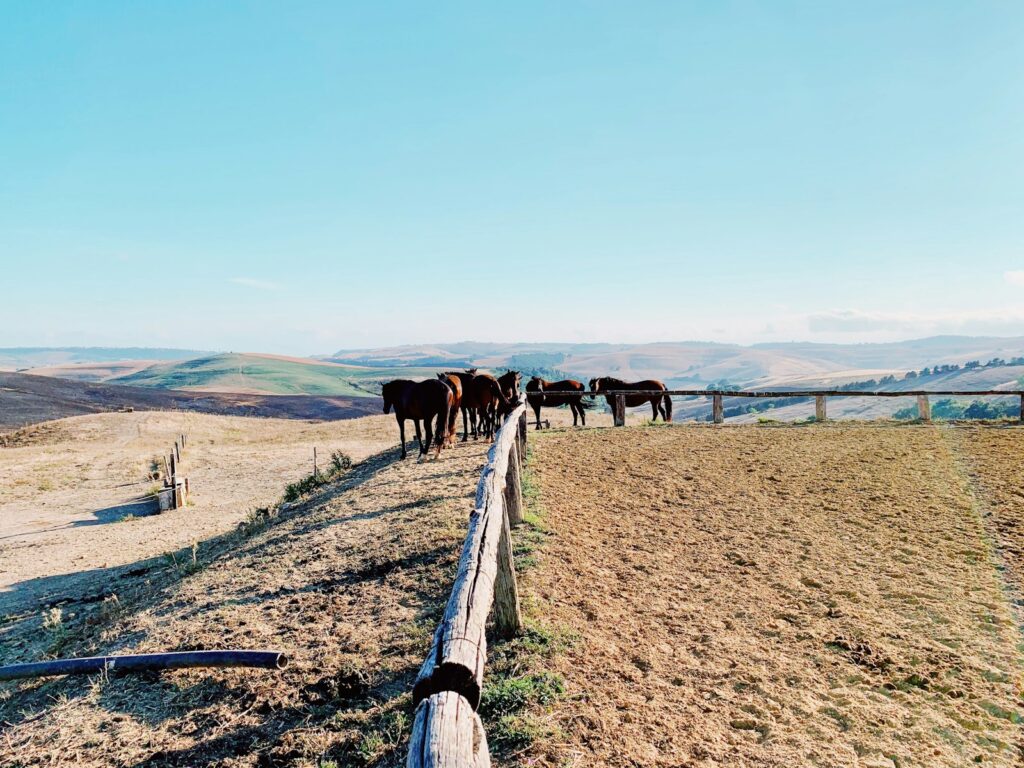
Most excursions take place outside Florence, in areas such as the Chianti hills, Impruneta, Pelago, Chianti Rufina and the countryside toward San Gimignano. These areas offer vineyard tracks, olive groves, woodland paths and traditional Tuscan farm roads.
You normally meet your guide at a riding centre, known in Italian as a maneggio or centro ippico. After checking your riding experience and fitting safety equipment, the staff introduce you to your horse and explain the basics of steering, stopping and maintaining your position in the saddle.
A typical visit follows this sequence:
- Arrive at the meeting point in Florence or directly at the riding centre.
- Travel to the stables and complete any registration or insurance paperwork.
- Receive a helmet, meet your horse and attend a safety briefing.
- Practise basic riding instructions before entering the trail.
- Ride with a guide along a route selected for the group’s ability.
- Return to the stables, dismount and continue to lunch, a tasting or the return transfer.
Some experiences combine the ride with a Tuscan lunch, farmhouse visit or winery tasting. Others are straightforward riding sessions with no additional activities.
There is one important distinction in the descriptions: a six-hour excursion does not mean six hours on horseback. A package advertised as a half-day experience may include only 60 minutes of riding, with the remaining time used for transfers, instructions and food.
Choose the Right Experience Level
Riding centres commonly advertise excursions as beginner-friendly, intermediate or suitable for experienced riders. The labels are useful starting points, although operators do not necessarily assess ability in the same way.
First-time riders: Short guided rides
For someone who has never ridden before, a 45 to 60-minute outdoor ride is a sensible starting point, provided the operator explicitly accepts complete beginners.
These rides generally proceed at walking pace, with the horses following a guide in a group. You should receive basic instruction and be assigned a suitable horse.
Ask whether the guide rides another horse or accompanies the group on foot. Both arrangements exist, and the supervision method should suit the terrain and riders.
Also check whether the route contains steep slopes, road crossings or narrow tracks. A tour described as easy can still involve uneven ground and situations that feel unfamiliar to a first-time rider.
Occasional riders: One to two hours on the trail
Travelers who have ridden a few times may be comfortable spending longer in the saddle. A 90-minute or two-hour route provides more time in the countryside without committing to a demanding trek.
Previous experience, however, does not automatically mean you can trot or canter during the excursion. Many mixed-ability groups remain at walking pace throughout.
If riding at faster gaits matters to you, ask whether the guide permits it, whether the trail is suitable and whether everyone in the group needs to demonstrate the same ability.
Experienced riders: Longer countryside treks
Some riding centres offer routes lasting three or four hours, occasionally with a stop for lunch. These may involve longer stretches of unpaved tracks, hills and more sustained riding.
Experienced riders should ask about the expected pace, terrain, total distance and opportunities for faster work. A provider may require you to demonstrate that you can control a horse independently before joining a more demanding route.
If you regularly ride and want a particular experience, such as extended trotting or cantering, a private excursion with a qualified guide may be more suitable than a standard sightseeing group.
One useful rule: book according to the least experienced rider in your group. A private booking can offer more flexibility, although it does not guarantee separate routes or faster riding for different participants.
How Long Should You Allow for the Trip?
The total duration depends on how far the stables are from Florence and whether the excursion includes other activities.
- Short riding session: Approximately one hour on the horse, plus arrival, briefing and any travel you arrange yourself.
- Half-day countryside excursion: Often four to six hours in total, including transfers, riding and possibly a meal.
- Longer riding and lunch experience: May occupy six to eight hours or more, especially when the horseback portion lasts several hours.
- Riding with sightseeing: Can become a full-day outing if it includes a winery, San Gimignano or another town.
These are planning ranges, not fixed schedules. Before paying, request both the total excursion duration and the actual time on horseback.
Also clarify whether the riding time includes the initial lesson. A 60-minute session that includes introductions and a practice period may leave considerably less time for countryside riding.
Transfers From Florence: What Are Your Options?
Transportation is often the deciding factor for visitors staying in Florence without a car. Many riding centres are located along narrow country roads, beyond practical walking distance from a railway station or bus stop.
1. Excursions with return transfers included
Some organised experiences include transportation from a designated meeting point in Florence to the riding centre and back.
Depending on the operator, meeting points may be near Firenze Santa Maria Novella railway station, Piazza Adua or Piazza dei Cavalleggeri beside the National Central Library.
These are examples of meeting areas used by existing operators, not universal departure points. Your confirmation must give the exact location, departure time and identifying instructions for the driver.
Check whether the transfer is shared or private. A shared minivan may require all guests to follow the same schedule, while a private vehicle can sometimes accommodate additional arrangements.
2. Hotel pickup or a separately priced private transfer
Hotel pickup is not automatically included just because the description says “transfer from Florence.”
Many operators collect guests at an agreed central meeting point instead. Accommodation pickup may be offered on request, sometimes for an additional fee.
Florence’s historic centre has a restricted traffic zone, the Zona a Traffico Limitato (ZTL). Vehicle access is regulated, so a driver may be unable to collect you directly outside a hotel in a pedestrian or restricted street.
You can check the city’s current traffic restrictions through the Comune di Firenze’s official ZTL information.
If you are staying near the Duomo, Ponte Vecchio or a pedestrian street, confirm the precise walking distance to your collection point. Families with children and guests with limited mobility should establish this before the excursion day.
3. Train plus a local pickup
Some countryside stables offer a collection service from a nearby railway station instead of central Florence.
For example, certain riding experiences around Pelago offer transfers from Pontassieve station by prior arrangement. The last section of the journey is then completed by car.
Use the official Trenitalia website to check services for your travel date. Confirm which Florence station your train departs from, as regional routes do not all use the same station.
For station orientation, the Florence Santa Maria Novella station guide explains the main station, its connections and practical arrival arrangements.
Before choosing this option, ask the riding centre to confirm that someone will meet your specific train and that a return transfer is available after the ride. An inexpensive train ticket is of little use if the stables are several kilometres away with no onward transport.
4. Driving yourself
If you already have a rental car, booking a riding session directly with a stable may be simpler than purchasing an excursion that includes transportation from Florence.
Ask for the exact address or map coordinates, whether the final approach uses an unpaved road, and whether parking is available. Avoid relying only on the name of the nearest village.
For a short riding session, hiring a car solely for this activity may be unnecessary once rental charges, parking and travel time are considered.
Children, Minimum Ages and Weight Limits
Horse riding in Tuscany is not automatically suitable for every member of a family. Individual riding centres set participation conditions based on their horses, staffing, routes and insurance arrangements.
Can children join?
Published local riding experiences demonstrate how much age policies can differ. Some beginner outings accept children from around eight or ten years old, while others set a minimum of 14 or 15. Certain packages have an adults-only policy.
For younger children, ask about a supervised pony experience or a short introductory lesson in an enclosed riding arena. That may be more appropriate than a countryside trail ride.
Confirm the following before including children in a booking:
- The minimum age for the exact route, rather than for the riding school generally.
- Whether there is a minimum height or other physical requirement.
- Whether a parent must ride too or may remain at the stables.
- How children are supervised on the trail.
- Whether child-sized helmets and suitable protective equipment are available.
- What happens if a child decides not to mount or wants to stop early.
If one child is too young to participate, ask whether a non-riding adult can wait with them at the centre. Check whether there is a sheltered waiting area, restroom and somewhere to obtain water.
Rider weight and height
Horse welfare and rider safety mean that many riding centres impose maximum rider weights. Examples in the Florence countryside range from approximately 90 to 110 kilograms, but these figures vary by operator, horse and route.
There is no single limit you should assume applies to every stable.
Some providers ask for each participant’s height and weight in advance so that they can allocate a suitable horse and check equipment.
Provide accurate information, ideally when making the first enquiry. If a centre cannot accommodate a rider safely, finding out before paying is considerably better than being refused on arrival.
Pregnancy, injuries and reduced mobility
Horse riding involves movement, balance and the possibility of a fall, even during a gentle guided walk. Many excursions exclude pregnant participants or advise people with significant back problems or other relevant conditions not to ride.
Anyone with a health condition that could affect safe participation should seek appropriate medical advice and disclose relevant limitations to the operator before booking.
Visitors with reduced mobility should ask about mounting blocks, assistance, staff experience, suitable horses and the accessibility of the stables themselves. Specialist or adapted riding requires appropriate arrangements and should never be assumed available on an ordinary tourist excursion.
What to Wear and Bring
You do not normally need a full riding outfit for a short beginner excursion. However, ordinary sightseeing clothes are not always suitable.
- Long trousers: Help reduce rubbing against the saddle and stirrup straps.
- Closed shoes: Wear secure footwear with a suitable sole. Avoid sandals, flip-flops and loose shoes. Ask the stable if your footwear is appropriate for its stirrups.
- Comfortable layers: Countryside weather can differ from conditions in central Florence, particularly during spring and autumn.
- Sun protection: Sunscreen and water are useful for warm-weather outings.
- A small, secure personal item: Keep your phone and essentials safely stored according to the instructor’s advice. Loose bags and dangling camera straps can create problems around horses.
The riding centre should provide a properly fitted equestrian helmet. Ask whether other protective equipment is supplied, especially for children. Do not assume a bicycle helmet is an acceptable substitute.
If you are traveling between hotels with luggage, confirm whether the transfer vehicle has space for suitcases and whether the riding centre can store them securely. Large backpacks and wheeled luggage cannot be taken on a trail ride.
It is also sensible to avoid drinking alcohol before getting on a horse. If your excursion includes wine tasting, check that this takes place after the riding portion.
Safety, Guides and Insurance: Questions That Matter
A beginner-friendly description should come with clear information about how the excursion is supervised.
Ask who accompanies the group, what professional riding qualifications or relevant experience they have, how many guests ride with each guide and what happens if somebody becomes uncomfortable.
In Italian descriptions, an accompagnatore equestre is an equestrian escort or riding guide. You may also encounter the term istruttore di equitazione, meaning riding instructor. The role and qualifications should be confirmed rather than inferred from the English word “guide.”
It is reasonable to ask whether the price includes participant accident insurance and third-party liability coverage, and what limitations or exclusions apply. Personal travel insurance may have separate conditions for horse riding, particularly for faster riding or more demanding terrain.
Some centres may require a daily membership, temporary riding registration or insurance arrangement, sometimes described as tesseramento or assicurazione giornaliera. Ask whether this is included in the advertised price. Do not assume every tourist must purchase the same federation licence or membership.
A responsible operator should be willing to explain its equipment, supervision and participant requirements before taking payment.
What Affects the Price?
Prices vary significantly because a short stable-based ride and a private Florence-to-Chianti excursion provide quite different services.
The main factors are the riding duration, group size, transport arrangements, guide supervision and any added experiences such as lunch or wine tasting.
When comparing two offers, check whether each includes:
- Return transportation from Florence or pickup at another agreed location.
- The actual time on horseback and any introductory lesson.
- Helmet use and other required safety equipment.
- Guide services and the maximum group size.
- Insurance, temporary membership and registration charges.
- Meals, wine tastings and any dietary alternatives.
- Taxes, payment fees and any additional charges.
Be careful with prices advertised per person. A private excursion may have a minimum booking amount or require a certain number of paying guests. A shared trip may only operate once a minimum group size has been reached.
The lowest advertised price can become less attractive if it excludes a costly taxi journey to an isolated stable. Conversely, visitors with their own car may have little reason to pay for a full transfer-and-lunch package.
Weather, Seasonal Conditions and Cancellation Rules
Spring and autumn can provide comfortable riding conditions, although rain and muddy ground may affect routes. Summer outings may be hotter, making morning departures or later sessions more comfortable. Winter operations depend on the riding centre, daylight, trail conditions and weather.
Some operators run guided rides in light rain and provide waterproof capes. Others reschedule when the guide considers conditions unsuitable. A rainy forecast does not necessarily mean you can cancel without charge.
Before paying, ask what happens in four situations:
- The operator cancels for safety: Will you receive a refund, a voucher or the option to reschedule?
- You cancel: What is the latest date and time for a full or partial refund?
- The group cannot operate: What happens if the minimum number of participants is not reached?
- The ride is shortened: Is there a partial refund or another arrangement if conditions require a shorter route?
Deposits and booking platforms can have different rules. Check whether a payment is merely pre-authorised or actually charged, whether a deposit is refundable, and which organisation processes any refund.
If you are arranging a trip for 2027, obtain current confirmation of schedules, pickup arrangements and cancellation terms. Some published excursion information still relates to the 2026 operating period, and it should not be treated as a confirmed 2027 timetable.
What to Send When Requesting a Booking
Giving the riding centre complete information at the start can prevent multiple exchanges and unsuitable reservations.
Your first enquiry should include:
- Your preferred date and, if possible, an alternative.
- The number of adults and children, including children’s ages.
- Each rider’s experience level, with a clear indication of complete beginners.
- Rider heights and weights if requested, or if suitability is uncertain.
- Whether you need return transport from Florence.
- Your preference for a short, gentle ride or a longer trail excursion.
- Any relevant mobility, health or dietary requirements.
Ask for a written reply confirming the route difficulty, saddle time, total duration, exact meeting point, equipment, total cost and cancellation conditions.
If the experience is described as private, clarify whether that means the vehicle, riding guide and horse-riding group are all exclusive to your party. Sometimes “private transfer” and “private riding experience” refer to separate services.
Combining Horse Riding With Other Activities
A countryside ride can be the main event or one part of a longer day outside Florence. The right combination depends on how much riding you want and how much time you are prepared to spend traveling.
Horse riding and a Tuscan lunch
This is a manageable arrangement for a half-day or slightly longer outing. After the ride, guests may eat at an agriturismo, farmhouse restaurant or nearby estate.
Confirm whether lunch is included, what type of meal is served and whether vegetarian, vegan or allergy-related needs can be accommodated with advance notice.
Horse riding and wine tasting
Some excursions include a winery visit or tasting after the ride. Ask whether transport between the stable and winery is included, especially if the locations are separate.
Travelers who are particularly interested in wine should look at how much time is actually allocated to the tasting. A brief farm tasting and a guided winery visit are different experiences.
Horse riding and San Gimignano
A longer day trip may combine riding with a visit to San Gimignano, the medieval hill town known for its towers.
This can make sense if you have only one day available for the Tuscan countryside. However, confirm the amount of independent time in town. An itinerary containing several stops may leave little time to explore each one.
For an alternative self-guided visit, see the Florence to San Gimignano day-trip guide, which covers the transport and town itinerary separately.
If you are combining a countryside excursion with other days in Florence or another Italian city, you can also use the Italy on Foot trip planner to organise the wider itinerary and keep your travel plans together.
Common Booking Mistakes to Avoid
Several details are easily overlooked when comparing attractive countryside photographs and short activity descriptions.
- Assuming everyone can join: Check the exact age, weight and experience restrictions before reserving for a family or group.
- Confusing total duration with riding time: Ask how many minutes are actually spent on horseback.
- Assuming hotel pickup: An included transfer may start at a designated square some distance from your accommodation.
- Expecting faster riding: Beginner group excursions often remain at walking pace, regardless of individual experience.
- Booking a rural stable without transport: A nearby town or station does not guarantee a practical connection to the riding centre.
- Overlooking minimum numbers: Some shared departures require a minimum number of riders before confirmation.
- Ignoring the weather policy: Decide in advance whether you would accept riding in light rain or a replacement date.
Another common mistake is filling a day too tightly. If your excursion returns to Florence in the afternoon, avoid arranging an expensive, non-refundable activity immediately afterward. Transport delays, weather changes and longer-than-planned meals can affect the return time.
What Happens if the Plan Changes on the Day?
Keep your confirmation, meeting-point instructions and the operator’s contact number available offline. If your driver is late, contact the operator using the details on your booking rather than assuming the pickup has been cancelled.
If you are delayed yourself, notify the provider before the scheduled departure. Shared transfers may be unable to wait without affecting the other passengers.
At the stables, listen to the safety briefing and raise concerns before mounting. If your assigned horse or equipment seems unsuitable, ask the instructor to reassess the arrangement. The guide should make the final decision about safe participation and trail conditions.
If bad weather, horse availability or another safety issue prevents the scheduled ride, confirm the revised plan and any refund or rescheduling agreement in writing. An alternative activity or voucher should be understood and accepted before you leave the property.
Which Type of Horse-Riding Trip Should You Choose?
For a complete beginner without a car, a short guided countryside ride with an included return transfer is generally the easiest arrangement. It removes most transport complications and keeps the physical commitment manageable.
For families, start with the children’s ages and the stable’s supervision policy. A dedicated introductory session may suit younger riders better than a standard group trail.
For confident riders, a longer private trek can provide more time in the saddle, provided the guide confirms the terrain and pace match your abilities.
And for anyone already traveling through Tuscany by car, a directly arranged riding session may be sufficient without paying for a full sightseeing package.
Before finalising any reservation, make sure the written confirmation answers three questions clearly: How long will I ride, exactly where will I be collected and returned, and what happens if the ride cannot go ahead? Those details will usually determine whether the excursion fits your Florence itinerary.