Choose a broken-in walking shoe with a grippy rubber sole, a stable base, enough cushioning for hours on hard stone, and a heel that stays securely in place. You do not need hiking boots for ordinary sightseeing, and you do not need to abandon good-looking shoes. You do need to avoid smooth soles, thin unsupportive flats, unstable heels, and anything you have not already worn for a long day.
The best shoes for Italy cobblestones are usually supportive sneakers, walking shoes, or rubber-soled leather sneakers that feel predictable when the ground is uneven. Grip and stability matter more than maximum softness. Italian historic centres can combine stone blocks, paving slabs, stairs, steep lanes, station platforms, and polished indoor floors in the same afternoon, so choose footwear for mixed surfaces rather than one perfect-looking street.
What actually matters on old Italian streets
“Cobblestones” is convenient shorthand, but the problem is not simply that the ground is made of stone. The real difficulty is the combination of hard surfaces, gaps, uneven edges, slopes, and stone that becomes slick after rain.
A rubber outsole with real grip
Look underneath the shoe before worrying about the logo on top. A rubber outsole with visible texture is generally a safer choice than a hard, smooth dress sole.
You do not need enormous hiking lugs for Rome or Florence. In fact, aggressive trail shoes can feel clumsy on ordinary city pavement. What you want is enough tread that the shoe does not feel slippery on a damp stone step or polished station floor.
Avoid assuming that every sneaker has good traction. Some fashion sneakers have surprisingly smooth soles and are designed more for appearance than wet pavement.
A stable base, not just lots of cushioning
Very soft shoes can feel wonderful on an airport concourse but less reassuring when one side of your foot lands on a raised stone and the other side lands in a gap.
Moderate cushioning with a reasonably broad, stable platform is often easier to live with on historic streets. The shoe should not feel as though your foot is balancing on top of a tall pillow.
Enough cushioning for hard surfaces
Old paving is unforgiving. Even when it is perfectly level, stone has very little give. Thin ballet flats, minimalist fashion sneakers, and very hard dress shoes can leave feet tired surprisingly quickly.
You do not need the thickest sole available, but you should be able to walk for several hours without feeling every edge beneath your forefoot.
A heel that stays in place
Your heel should not lift noticeably every time you climb a step. This becomes especially annoying in Venice, where bridges repeatedly interrupt otherwise flat walks, and in hill towns where streets can turn into staircases without much warning.
Laces usually make adjustment easier as your feet warm up or swell slightly during a long day. Secure straps can also work well on summer sandals. Loose slip-ons and backless shoes are less forgiving on steep or irregular ground.
Room for your toes
A shoe that feels merely “snug” in a shop can become painful after hours of walking, particularly on downhill streets where your foot shifts forward.
Your toes should not strike the front of the shoe on stairs or slopes. If you already use insoles or orthotics, bring the footwear that works with them rather than experimenting with an entirely new setup just before the trip.
Which type of shoe should you bring?
Supportive sneakers: the easiest choice for most trips
A comfortable walking or running-style sneaker is the simplest option for itineraries involving Rome, Florence, Bologna, Milan, Venice, Naples, or several cities by train.
Choose one with decent rubber coverage underneath, a stable heel, and an upper that will not become miserable in the season you are travelling. A highly breathable mesh shoe may be excellent in July but less appealing during a wet November week.
Leather sneakers: good when you want one pair for day and evening
A clean leather or leather-style sneaker with a proper rubber sole can be a useful compromise. It handles sightseeing while looking neater than a technical running shoe for dinner.
Check the sole carefully. Some dressier sneakers look sturdy from the side but have little tread underneath.
Trail shoes: useful when towns and countryside are on the same itinerary
Low trail-running or walking shoes make sense if your trip combines historic centres with rougher countryside paths, steep village approaches, or frequent wet weather.
For a purely urban trip, they are optional rather than necessary. A week split between museums and cafés does not require mountain footwear simply because Rome has stone streets.
Supportive sandals: possible in hot weather, but choose carefully
Sandals can work in summer when they have secure heel and forefoot straps, a cushioned footbed, and a sole with grip. They are much less convincing when they are flat, loose, smooth underneath, or held on mainly by your toes.
Flip-flops are useful for beaches, pools, and hotel showers. They are a poor main sightseeing shoe for long urban walks.
Ankle boots: useful in cooler or wetter months
A low boot can be comfortable in autumn and winter if it has a flexible rubber sole and is already broken in. Heavy hiking boots are unnecessary for most city itineraries and take up considerable luggage space.
For more seasonal packing decisions, the Italy packing list covers clothing and walking gear beyond footwear.
Shoes that commonly cause trouble
- High heels: narrow heels can catch between paving stones, and steep lanes make them even less practical.
- Smooth leather soles: elegant indoors, potentially slippery on wet stone.
- Very thin flats: little protection from hours of hard paving and rough edges.
- Brand-new shoes: Italy is a bad place to discover where a shoe rubs.
- Loose backless shoes: awkward on stairs, slopes, and uneven paving.
- Extremely soft, tall soles: comfortable for some walkers, but potentially less stable on badly broken surfaces.
Italy’s cobblestones are not all the same
Rome: small stone blocks and irregular gaps
Rome is the city most associated with sampietrini, the small basalt paving blocks found throughout parts of the historic centre. Their condition varies from street to street. Some sections are reasonably even, while others have depressions, gaps, repairs, or pronounced edges.
They are particularly awkward when wet. Watch the ground when stepping off a pavement, crossing a street, or walking while looking up at a monument. Rome has a remarkable ability to punish anyone trying to admire architecture and walk at the same time.
Venice: stone paving plus hundreds of bridge steps
Venice presents a slightly different challenge. Much of the pavement consists of relatively flat stone rather than the small blocks visitors picture when they hear “cobblestone,” but bridge after bridge adds steps to the day. Traditional Venetian paving stones are known as masegni.
Damp stone can also be slick. A secure heel and reliable outsole matter more here than ankle-high footwear. Our guide to what to wear in Venice covers the seasonal implications in more detail.
Florence and other historic centres: hard paving is the bigger issue
In Florence, Bologna, Verona, Siena, and many other historic centres, the surface can change repeatedly between large stone slabs, smaller paving blocks, asphalt, arcades, stairways, and indoor marble.
Even comparatively smooth stone can be tiring because it is hard. Cushioning becomes just as important as traction.
Hill towns: grip matters more than appearance
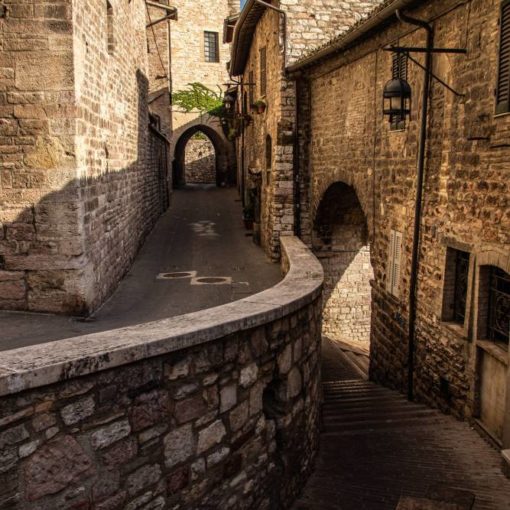
Places such as Assisi, Orvieto, Matera, Cortona, Montepulciano, and dozens of smaller towns add gradients to the equation. Streets that look charming in a photo may involve polished stone, steep ramps, steps, or all three.
If your itinerary contains several hill towns, favor secure lacing and good traction over a very flat fashion shoe. When deciding how much walking your route will actually involve, you can build your Italy itinerary before choosing what deserves suitcase space.
Wet weather changes the answer
A shoe that works beautifully on dry pavement can feel completely different after rain. Grip becomes more important, and soaked footwear can create a second problem the next morning.
For spring, autumn, and winter trips, some water resistance is useful. Full waterproof hiking footwear is not automatically better. It can be unnecessarily warm for city sightseeing, especially in mild weather.
If substantial rain is forecast, a second pair becomes more valuable. Alternating shoes gives the wet pair time to dry and changes the pressure points on your feet.
Pack socks that work with the actual shoes you intend to wear. Do not test a pair at home with thin socks and then arrive in Italy wearing thick winter socks that completely alter the fit.
One pair or two?
One good pair is enough for many trips. Two pairs are useful when they solve different problems rather than simply providing two outfits.
Bring one pair if your trip is short, primarily urban, the shoe is already proven on long walks, and it works with your evening clothes.
Bring two if you expect rain, are travelling for more than a few days, have feet that benefit from changing shoes, or want a lighter evening option.
Your second pair does not need to be formal. A lightweight sneaker, supportive sandal in summer, or rubber-soled loafer can give your feet a change without consuming half the suitcase.
City shoes and hiking shoes are not the same thing
Do not extend advice about urban paving to actual hiking routes. A sneaker that is perfectly sensible beside the Pantheon may not satisfy the requirements of a mountain-style trail.
This matters particularly in the Cinque Terre. The national park’s current hiking guidance requires appropriate closed footwear with a non-slip, treaded sole on its trails and prohibits open or smooth-soled footwear. Check the Cinque Terre National Park hiking guidance before setting out because trail conditions and restrictions can change.
If your plan includes serious hiking in the Dolomites, Cinque Terre, coastal paths, or mountain areas, choose footwear for that activity separately. “Good for cobblestones” is not a hiking certification.
Test your shoes before flying
Do not judge them from a five-minute walk around your house. Wear the exact shoes and socks on several substantial walks before departure.
Include stairs and slopes if possible. Pay attention to what happens after your feet are warm rather than how the shoes feel during the first ten minutes.
- Your heel should stay securely in place.
- Your toes should not hit the front when walking downhill.
- Nothing should rub repeatedly at the heel, ankle, or little toe.
- The sole should feel stable when you step on an uneven edge.
- Your feet should not feel battered by hard pavement after a long walk.
If a pair is already producing hotspots at home, do not rely on Italy to break it in. Italy has many excellent uses for your holiday time. Conducting an involuntary footwear experiment is not one of them.
If your shoes fail after you arrive
You can buy replacements easily in Italian cities, but give yourself enough time to try them on properly rather than grabbing the first pair near a station.
Useful words in a shoe shop include scarpe comode for comfortable shoes, suola in gomma for rubber sole, and antiscivolo for non-slip. For hiking footwear, you may see scarpe da trekking and suola scolpita, meaning a treaded or lugged sole.
Try the shoes rather than trusting a remembered size conversion. Fit varies between manufacturers even when the European size printed on the box is identical.
For a developing blister, look for the green cross marking a farmacia. Ask for cerotti per vesciche, blister plasters. Deal with rubbing early rather than walking another afternoon and hoping it will somehow improve.
What to wear if you still want to look polished
Comfortable footwear in Italy does not have to mean fluorescent running shoes with the rest of your wardrobe reluctantly attached.
A neutral walking sneaker or simple rubber-soled leather sneaker works with trousers, jeans, skirts, and many casual dresses. For most travelers, that is a better compromise than carrying painful shoes solely because they look appropriate in photographs.
If you have a genuinely formal dinner or event, pack a separate lightweight dress shoe and use a taxi when necessary. Do not design an entire sightseeing day around footwear intended for two hours in a restaurant.
The simplest rule is to choose the pair you can forget about once you leave the hotel. Good Italy footwear is not the shoe that attracts the most attention. It is the shoe that lets the street, the church, the museum, and the next plate of pasta get all of it.