In Venice, bridges usually feel like small public squares: open, windy, and full of life. The Bridge of Sighs is the opposite, and that is exactly why it fascinates people. It looks like a pale stone tunnel floating over a narrow canal, tucked beside the Doge’s Palace near St Mark’s Square. It is famous for its legends, but the real story is even more interesting because it mixes smart design, strict justice, and later romantic storytelling. This guide breaks down what the Bridge of Sighs in Venice really is, why it was built, and how you can see it in a way that feels meaningful, not rushed. You will learn where to stand for the classic view, what details to look for on the stonework, what the “sighs” likely meant, and how to walk through the bridge from the inside as part of a palace visit. You will also pick up a few small etiquette tips that make the experience better for everyone in crowded Venice. If you are planning your sightseeing flow in this busy part of the city, it helps to have a clear route so you do not zigzag through backstreets, and this Two Days in Venice Itinerary can slot the bridge into a practical plan. Keep reading and you will see how one short corridor over the Rio di Palazzo became a symbol of Venice itself: beautiful on the surface, complicated underneath, and full of stories that keep changing with every generation of visitors. It is one of the quickest stops, but it stays in your head.
Where the Bridge of Sighs is and what it connects
The Bridge of Sighs is called Ponte dei Sospiri in Italian, and it spans the Rio di Palazzo, a small canal that runs behind the main St Mark’s area. It connects two buildings that feel like opposites: the Doge’s Palace on one side and the New Prison, often called Prigioni Nuove, on the other. This is not a bridge built for everyday foot traffic. It was built as a controlled passage for moving detainees between rooms tied to justice and administration inside the palace and prison spaces across the canal. That is why it is enclosed and why it has small windows with stone bars instead of open railings. When you stand outside and look at it, you are seeing a piece of city planning that solved a real problem in a city built on water: how do you move people securely in the heart of government without creating escape chances, crowds, or public scenes? Venice answered with a bridge that works like a locked hallway.
The location also explains why it feels so loaded with meaning. Around you is some of the most famous, glittering Venice, but this bridge sits right where power met punishment. The “mystery” is not that it is hidden, because it is easy to find. The mystery is how something designed for control became one of the most photographed places in the city, and why so many visitors leave talking about feelings, not architecture. Even if you never go inside, knowing this connection changes what you see.
| Bridge of Sighs visitor cheat sheet | |
|---|---|
| Also known as | Ponte dei Sospiri |
| Over | Rio di Palazzo |
| Connects | Doge’s Palace and the New Prison (Prigioni Nuove) |
| What it is | An enclosed transfer corridor, not a public crossing |
| Inside access | Through a Doge’s Palace visit that includes the prison route |
| Best free view | Ponte della Paglia (classic angle); Ponte della Canonica (side angle) |
| Most common myth | It was only about romance; in reality it was built for security and separation |
Why it was built: Venice dressed security in beauty
The Doge’s Palace was not only a grand residence and a symbol of the Venetian Republic. It was also a working center of government, where decisions were made, laws were enforced, and people were questioned and judged. That created a practical issue: detainees and prisoners had to be moved safely between spaces tied to justice inside the palace and the prison building nearby. Venice expanded its detention facilities with the New Prison across the canal, close enough to be controlled but separate enough to function as a dedicated prison block.
The Bridge of Sighs connected these worlds with a short, secure route. It was enclosed so movement could happen out of public view and in any weather, and it reduced the chances of escape or communication with people outside. The bridge’s small, barred windows brought in limited light and air while still acting like a barrier. Over time, this functional design became emotional. Crossing from palace rooms toward prison cells marked a shift from uncertainty to confinement, and that is where the idea of “sighs” took root. Even if a person was not headed for a severe sentence, the moment could still feel final because it was a physical step away from normal life. Venice also made a choice that says a lot about the city’s mindset: it built a strict security tool, then gave it an elegant façade in pale stone and decorative framing. The message was simple: power here is organized, controlled, and confident enough to look beautiful while doing hard things.
Reading the architecture: the hidden story in the stone
What you can learn from the outside and the inside
The Bridge of Sighs is built in pale Istrian stone, a tough limestone that Venice used on important buildings because it handles salt air well. From a distance it can look almost delicate, but the design choices are all about containment. The bridge is fully covered, which blocks visibility and shields the passage, and the windows are small, set with stone bars. Those details tell you it was never meant for strolling or sightseeing. It was meant to move people who were not free to choose where they walked. One of the most surprising details is inside: the bridge contains two narrow corridors running side by side, separated so different groups could pass without contact.
This “double tunnel” layout fits a justice system that needed control over meetings and messages. When you eventually cross it on the palace route, the experience is short, but it changes the mood fast. The light narrows, the sounds of the city soften, and the view outside arrives in thin slices through the barred windows. That limited view is the key to the bridge’s lasting impact. It encourages you to imagine a person pausing for a last look at the lagoon light and the canal below, knowing they were being taken to confinement. There is also a modern layer to the architecture: the bridge has been carefully maintained, and like many Venetian landmarks, it has gone through restoration that sometimes sparked debate about how the city funds preservation. That adds a new kind of mystery: even today, Venice has to balance beauty, tourism, and the cost of keeping its most famous symbols alive.
Myths, sighs, and the romantic rewrite
The Bridge of Sighs is one of those places where the story people want can overpower the story the stone was built to tell. The popular explanation of the name is that prisoners sighed as they crossed, taking a last look at Venice through the small windows. That image fits the design and feels believable, but it was also shaped by later writers who loved dramatic contrasts. A famous line describes standing on the bridge with “a palace and a prison” close by, and that simple contrast helped fix the bridge in the public imagination. Over time, the bridge became a symbol not only of punishment, but also of Venice’s moodiness and romance.
That is where the gondola-kiss legend comes in: many visitors repeat the idea that a kiss beneath the bridge brings lasting love. It is a modern tourism myth, and it exists because Venice is very good at turning dark history into a dreamy postcard. The healthiest way to enjoy the bridge is to hold both truths at once. Yes, it is a beautiful piece of architecture. But it was designed for control, and the barred windows are not decoration. When you think of the bridge as a place where real people moved through a system they could not escape, the visit gains weight. Then, when you hear the romantic legends, you can enjoy them as part of Venice’s habit of rewriting itself. The bridge is “mysterious” because its meaning keeps shifting: from security corridor, to symbol of sorrow, to backdrop for love stories, all while remaining the same few meters of stone over water.
How to see the Bridge of Sighs from the outside
Best viewpoints, crowd strategy, and photo etiquette
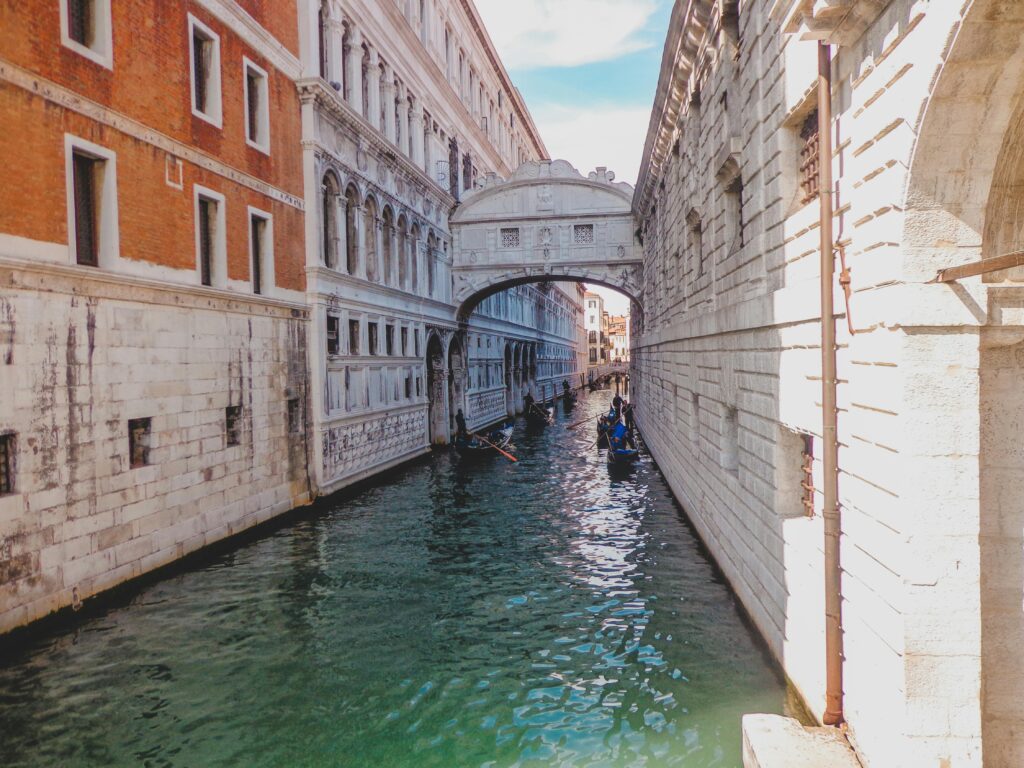
Seeing the Bridge of Sighs from the outside is easy and free, and it is still the best option if you are short on time or do not want to enter the palace. For the classic view, go to Ponte della Paglia and look down the canal so the bridge is framed between the palace walls and the prison building. This angle makes the bridge look like a floating tunnel, and you will often catch gondolas or small boats passing below for a very “Venice” shot. For a different perspective, walk to Ponte della Canonica for a closer side view that can show more of the bridge’s curves and stone details.
The main challenge at both spots is crowding, because these are narrow bridges used by everyone. A good strategy is to visit early in the day or later in the evening, when the light is softer and the walkway is less packed. Keep your photos quick so you do not block locals and other visitors, and avoid risky posing that can create safety problems or annoy people trying to pass. If you want your photos to feel more like a story, don’t only shoot the full bridge. Zoom in on the barred windows, the seams in the stone, and the way the bridge is squeezed between two massive buildings. Those details communicate the real point: this was a controlled passage. In a city of open bridges, the Bridge of Sighs stands out because it looks inward, not outward, and your best photos are the ones that capture that difference.
- Take one wide shot from Ponte della Paglia, then a tighter shot of the barred windows.
- If it is crowded, step aside and shoot fast instead of stopping in the middle of the bridge.
- Try a second angle from Ponte della Canonica to show the bridge’s side details.
Walking through the Bridge of Sighs from the inside
Tickets, special routes, and what to expect
To walk through the Bridge of Sighs, you need to visit the Doge’s Palace and follow the route that leads into the prison areas. There is no separate entrance for the bridge, so the smartest plan is to treat it as one dramatic moment inside a bigger palace experience. The shift is part of the impact: you move from grand halls that celebrate Venetian power into tighter spaces that show how that power was enforced. The bridge itself is a short passage, but it gives you a physical sense of why it became famous. You will see the light change, you will notice how limited the windows are, and you will understand why people imagined “sighs” in that space. If you want a deeper look at the justice-and-secrets side of the palace, consider booking a special itinerary that opens additional areas and focuses more on hidden rooms and the system behind them.
These departures are limited and timed, so it helps to book ahead, especially during busy travel months. For tickets and official information, use the museum’s official pages only: Doge’s Palace official visitor information, the broader museum network ticket page at MUVE official tickets, and the palace’s own page for official special itineraries. When planning your day, give yourself enough time for the palace, not just the bridge. Build in a short break nearby, because St Mark’s area can be intense, and you will enjoy the bridge more when you are not rushing. With the right pacing, the Bridge of Sighs becomes more than a photo stop. It becomes the moment you feel how Venice’s beauty and authority were always linked.