For a Venice airport to hotel transfer from Marco Polo (VCE), the best choice depends less on the hotel’s district than on its nearest boat stop and the number of bridges between that stop and reception. For most travelers, a bus to Piazzale Roma followed by walking or an ACTV vaporetto is the best-value route. Alilaguna is better when one of its airport boats stops close to your accommodation. A private water taxi costs far more but can remove almost all of the luggage hauling.
One distinction prevents a lot of confusion: the regular ACTV vaporetto does not run from Marco Polo Airport. From the airport you either take an Alilaguna airport water bus, take a road vehicle to Venice and then change to an ACTV vaporetto, or use a private water taxi. Alilaguna and ACTV are separate systems, and an ordinary ACTV ticket or tourist pass does not cover Alilaguna.
This page is for Venice Marco Polo Airport, code VCE. If your ticket says Treviso Airport or TSF, you need a different transfer plan.
Which option should you choose?
| Option | Best for | Current fare to consider | Main catch |
|---|---|---|---|
| ATVO express bus | Fast, simple trip to Piazzale Roma | €12 one way, €20 return | You still need to walk or take a boat to most hotels |
| ACTV Line 5 Aerobus | Budget travel, especially if continuing on ACTV | €10 one way, €18 return | It is a local bus rather than a nonstop coach |
| ACTV bus + vaporetto | Hotels convenient to an ACTV waterbus stop | €18 for the combined 90-minute airport bus and urban transport ticket | The 90-minute clock begins with the first validation |
| Alilaguna | Rialto, San Marco, Cannaregio, Castello, Dorsoduro, Giudecca, Lido or Murano when a stop is near the hotel | €18 airport to Venice, €32 return | Usually slower than the road bus and it may still leave a walk with bridges |
| Private water taxi | Heavy luggage, families, groups, awkward hotel locations or late arrivals | Triple-digit fare, with one major operator currently publishing €160 for a hotel-airport transfer | Not every hotel has a usable private dock |
The fares above are current published rates and can change. Check ACTV, Alilaguna and ATVO shortly before traveling.
The bus route: cheapest and often fastest for central Venice
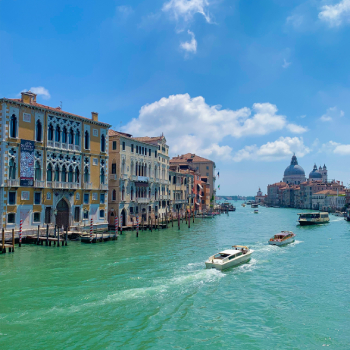
Both ACTV and ATVO buses take you from Marco Polo Airport to Piazzale Roma. That is Venice’s road terminus. Cars, coaches and ordinary land taxis cannot continue through the historic center from there. If this road-to-boat handoff is unfamiliar, our explanation of where cars stop in Venice makes the geography much clearer.
At the airport, follow the bus signs from Arrivals. The bus boarding area is in the second lane outside the terminal. ATVO also publishes its precise departure position and has ticket machines in the baggage-claim area, Arrivals and the outdoor bus lanes.
ATVO express or ACTV Line 5?
Choose ATVO if you simply want a comfortable, direct coach to Piazzale Roma. Its current timetable advertises a roughly 20-minute journey, and luggage is included. There are luggage compartments underneath the coach, which is considerably nicer than standing beside a large suitcase on a city bus.
Choose ACTV Line 5 if price matters or if you want to combine the airport bus with Venice’s regular public transport. The airport ticket is €10 one way. More useful for many hotel arrivals is the €18 Aerobus + 90-minute Rete Unica ticket, which covers the airport bus and then ACTV waterborne services within its validity period.
That combination has one detail worth underlining: the 90 minutes run from the first validation. Do not arrive at Piazzale Roma and spend half an hour having coffee before looking for your boat. Head for the ACTV docks, find your line and direction, and continue the journey while the ticket is still valid.
If you are buying a 1-, 2-, 3- or 7-day ACTV travel ticket anyway, ACTV currently allows an airport-bus supplement to be added when the pass is purchased. The published surcharge is €7 for one airport journey or €13 return. This can make more sense than treating your arrival transfer and your Venice transport pass as completely separate purchases.
What happens when the bus reaches Piazzale Roma?
Do not assume you have reached your hotel just because the airport bus says “Venezia.” You have reached the edge of the pedestrian city.
From Piazzale Roma you have three practical choices:
- Walk if your hotel is genuinely close and the route has few bridges.
- Take an ACTV vaporetto if your accommodation is convenient to a waterbus stop.
- Take a water taxi from Piazzale Roma if the first part of the trip went well but the last stretch looks miserable with your bags.
For the vaporetto, follow signs for Vaporetto or ACTV and check the line number, direction and boarding platform before entering. Piazzale Roma has multiple docks. The regular visitor waterbus fare is currently €9.50 for 75 minutes if you have not bought a combined airport ticket or travel pass. ACTV tickets must be validated at the start of the journey and again when changing service or vehicle as required by the system.
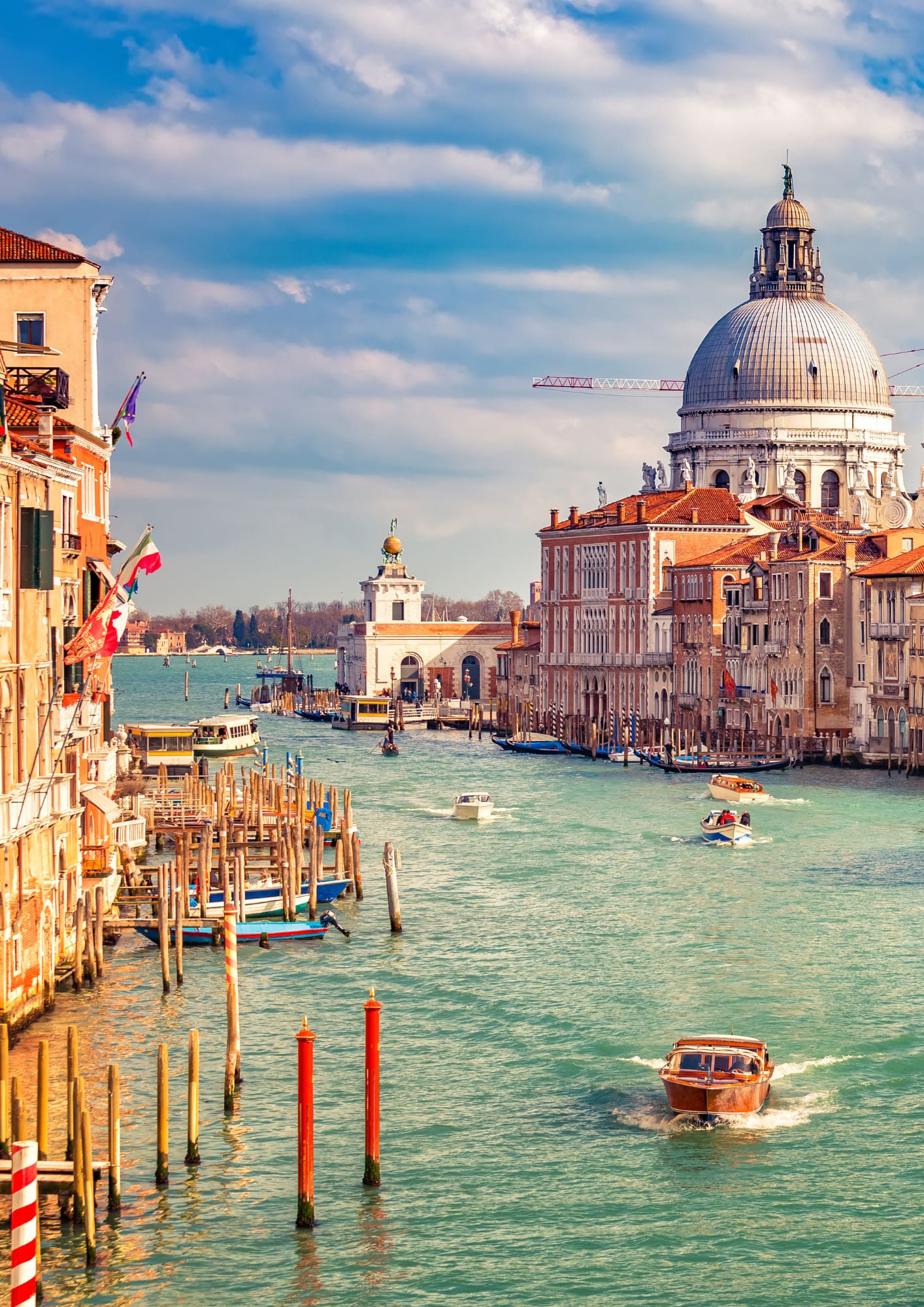
A hotel that looks ten minutes away on a map may still involve three stepped bridges. With a backpack, that barely matters. With two large rolling suitcases, a stroller or reduced mobility, it can change the best transfer completely.
Alilaguna: the airport boat that goes directly into Venice
Follow the airport signs for Water Transport or Trasporti via acqua. The boats leave from the airport darsena, or marina, which is separate from the road-bus area and connected to the terminal by a covered moving-walkway route. Alilaguna and private water taxis use this waterside transport area.
Alilaguna currently charges €18 one way between Marco Polo Airport and Venice and €32 return. One suitcase plus one hand-luggage item is included. Under its current conditions, the suitcase may measure up to 160 cm when height, width and depth are added together; extra luggage costs €4 per piece.
Which Alilaguna line is useful for your hotel?
Do not choose a line because its color sounds familiar. Choose it by the stop nearest your hotel entrance.
- Orange Line is particularly useful for parts of Cannaregio and the Grand Canal side of central Venice, with stops including Madonna dell’Orto, Guglie, San Stae, Rialto, Sant’Angelo, Ca’ Rezzonico and Santa Maria del Giglio.
- Blue Line serves areas including Fondamente Nove, Lido, Arsenale, San Zaccaria, San Marco Giardinetti, Zattere, Giudecca Stucky and eventually Ferrovia at Santa Lucia station.
- Red Line is seasonal. In the current schedule it operates from April to November and serves a selection of airport, Murano, Lido and central Venice stops.
Check the live Alilaguna lines and timetables before departure because navigation schedules and stop patterns can change, especially around major regattas and Venetian events.
Alilaguna is not automatically better for San Marco
“My hotel is in San Marco” is not enough information. A room near San Zaccaria may suit the Blue Line very well. A hotel toward the western side of the sestiere may leave you with a longer walk from the boat than you expected. Likewise, an address advertised as “near Rialto” could be much easier from the Orange Line’s Rialto stop than from a San Marco landing.
Ask the hotel for the nearest Alilaguna stop by name. A useful question is: Qual è la fermata Alilaguna più vicina all’hotel?
For Santa Lucia station, do not automatically take Alilaguna to Ferrovia
The Blue Line reaches Ferrovia (S. Lucia), but that stop comes late in its airport route. With manageable luggage, the road bus to Piazzale Roma followed by the short walk across Ponte della Costituzione can be more practical. With heavy luggage or difficulty on bridge steps, the calculation changes, so compare the final walking route rather than looking only at the stop name.
When a private water taxi is worth the money
A private water taxi is the closest Venice gets to a door-to-door airport transfer. Boats operate from the Marco Polo marina and can take you to a hotel’s water entrance or to the nearest suitable public or private dock. Current operators provide airport transfers around the clock, although advance booking is sensible for late-night and early-morning journeys.
The important phrase is nearest suitable dock. A booking website saying “hotel transfer” does not guarantee that the boat can nose up to the hotel reception door. Canal depth, tides, weather, bridge clearances and the property’s own water access can affect where you are dropped. One major operator explicitly states that some hotels cannot be reached directly under certain tide conditions and that passengers are then left at the nearest available landing point.
Before paying, ask your hotel:
- Can a private water taxi from Marco Polo stop at the hotel entrance?
- If not, what is the exact name of the nearest taxi dock?
- How many bridges are between that dock and reception?
That last question matters more than “How many minutes is the walk?” For more detail on the difference between road taxis, boat taxis and public transport, see our guide to how taxis work in Venice.
The best choice by hotel location
Near Piazzale Roma or western Santa Croce
Take the bus and walk unless the hotel confirms that the walking route is awkward. Paying for an airport boat makes little sense if it carries you around the lagoon only to leave you near the same end of Venice.
Near Rialto
Compare Alilaguna Orange with ACTV Line 5 plus a regular vaporetto. Alilaguna avoids the Piazzale Roma transfer; the bus-and-vaporetto combination is often cheaper and gives you more frequent onward options.
San Marco and San Zaccaria
Alilaguna Blue can be convenient, but confirm which landing is closest. “San Marco” covers a large enough area that choosing the wrong stop can add an unpleasant walk with luggage.
Cannaregio
Hotels near Guglie or Madonna dell’Orto can work particularly well with Alilaguna Orange. Accommodation closer to Fondamente Nove may suit another airport boat routing. A hotel near the railway station can also be reached via Piazzale Roma, so compare bridges and walking distance.
Dorsoduro
Alilaguna can be excellent if your accommodation is close to Ca’ Rezzonico, Santa Maria del Giglio across the Grand Canal, or Zattere. For an address well inland, bus plus ACTV may give you a better final stop.
Castello
The Blue Line is useful around Arsenale and San Zaccaria. Farther into Castello, check the walking route carefully before deciding that a central San Marco stop is “close enough.”
Giudecca, Lido or Murano
Alilaguna deserves serious consideration because it can avoid entering Venice at Piazzale Roma only to transfer onto another boat. For Murano, the current airport fare is €10 one way.
Mestre or Marghera
Do not take a bus to Piazzale Roma just because your booking confirmation says Venice. Mestre and Marghera are on the mainland. Marco Polo Airport has road connections toward Mestre, including ACTV Line 15 and ATVO airport services. Use the stop appropriate to your actual hotel address, then walk, take local transport or use a land taxi.
If Venice is only one stop on a longer journey, it helps to build your Italy itinerary around these real transport handoff points rather than treating every hotel pin as if a vehicle can reach its front door.
Luggage changes the answer
Public transport accepts ordinary vacation luggage, but Venice itself is the difficult part. ACTV requires bags to be kept on the floor or in designated areas without blocking seats, aisles or exits, and oversized or excess luggage can require an additional ticket. Alilaguna has its own separate baggage allowance and €4 extra-piece charge. ATVO’s express airport coach includes luggage and provides dedicated storage.
A traveler with one cabin bag can reasonably choose the cheapest route. A family with a stroller, three suitcases and a hotel four bridges from the nearest vaporetto stop is solving a different problem. In that situation, spending more on the arrival transfer can be sensible even if you use cheap public transport for the rest of the stay.
Ticket validation: do not skip the tap
For ACTV, physical tickets and passes must be validated according to the transport system’s rules, including when changing services. At vaporetto stops, place the ticket or pass against the validator before boarding. App tickets have their own activation procedure.
Alilaguna has separate validators and separate tickets. Its conditions require passengers to validate before boarding; if a validator is unavailable or not working, present the ticket to staff rather than simply getting on and hoping for the best.
The classic mistake is buying an ACTV tourist pass and assuming it covers the airport boat. It does not. Alilaguna services are specifically excluded from ordinary ACTV urban tickets and passes.
Late arrivals and missed connections
Airport buses run surprisingly late. ATVO’s current 2026 timetable lists departures from Marco Polo to Piazzale Roma through 01:10 and describes the service as daily. ACTV also publishes separate late services, but its schedules vary between feriale and festivo days. Always check the timetable for your actual arrival date instead of relying on a screenshot saved months earlier.
On Italian transport schedules, feriale and festivo matter. Sunday and public-holiday service may have a different pattern, and Saturday does not always behave the way an English-speaking traveler expects from the word “weekday.” Read the timetable legend.
Do not count on Alilaguna simply because your flight is scheduled before its last useful departure. Immigration, baggage reclaim and the walk to the marina all consume time. Check the live timetable and service alerts, especially during large events, regattas or unusual lagoon conditions.
If you miss your planned airport boat, the recovery route is usually straightforward: take a late bus or a 24-hour land taxi to Piazzale Roma, then continue by the ACTV service available at that hour or by water taxi. The airport currently lists the fixed land-taxi fare to Piazzale Roma at €40. A land taxi cannot continue to a hotel inside the canal city.
Traveling with a wheelchair or reduced mobility
Do not choose solely on the basis that a boat or bus is described as accessible. The final route from the landing point to the hotel can be the harder part because of bridges and steps.
Venice Marco Polo provides free PRM assistance and has facilities extending to the airport marina. Alilaguna states that adapted vessels can carry passengers with reduced mobility, with a maximum of one standard wheelchair per vessel under its current conditions; boarding can still be limited for safety or crowding. Contact the operator if this affects your trip.
For a private water taxi, never assume that ordinary boat access will work for a wheelchair. Ask the operator about the specific vessel and ask the hotel about the dock. Tide height and the difference between dock and boat levels can matter.
Three questions to send your hotel before you fly
Venice hotels answer these questions every day, and the replies are more useful than a generic directions app:
- What is the best arrival stop from Marco Polo Airport with luggage? Ask for the exact Alilaguna or ACTV stop name.
- How many bridges are there from that stop to reception? “Five minutes on foot” tells you almost nothing about suitcase difficulty.
- Can a private water taxi stop directly at the hotel? If not, ask for the exact nearest taxi dock.
Once you have those three answers, the choice is usually obvious: bus for a short, easy final walk; bus plus vaporetto for good-value public transport; Alilaguna when its landing is genuinely close; and a water taxi when avoiding bridges and transfers is worth paying for.