Bologna is one of the few Italian cities where steady rain does not have to ruin a walking day. The practical trick is to use the arcades as a network rather than expect one unbroken roof. For a Bologna rain walk from the station into the historic centre, leave Bologna Centrale at Piazza delle Medaglie d’Oro, cross Viale Pietramellara, get under the porticoes of Via dell’Indipendenza, then stay close to the covered edges around Piazza del Nettuno and Piazza Maggiore. From there, the Pavaglione and Via Farini provide an excellent sheltered route farther across the centre.
How much of Bologna can you really walk without getting wet?
A lot, but not all of it. Bologna has about 62 kilometres of porticoes across the city, and the network is extensive enough that long journeys through the historic centre can be made with only short periods in the open. The city’s official porticoes map is useful for seeing how the main groups connect.
The important detail is that a portico is not a tunnel. Coverage usually stops at side streets, road junctions and the middle of piazzas. Wind-driven rain can also reach several metres beneath an arcade. Expect to open your umbrella for crossings, then close it again once you are properly under cover.
Do not be surprised when a route that looks completely sheltered on a street map contains five or six brief wet gaps. Bologna makes rain much easier, not invisible.
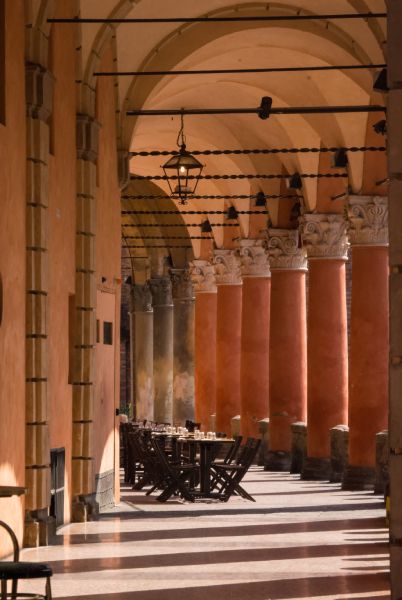
From Bologna Centrale to Via dell’Indipendenza
If you arrive by train, start by choosing the correct station exit. Bologna Centrale has several access points. The main entrance is on Piazza delle Medaglie d’Oro, facing the historic centre. You can confirm station facilities and accessibility on the official RFI Bologna Centrale page.
This matters particularly if you arrive on the underground high-speed platforms. Follow station signs for Piazza Medaglie d’Oro rather than simply taking the first available street exit. The Via de’ Carracci side places you north of the railway tracks and is the wrong side of the station for a straightforward walk into the centre.
- Leave through the Piazza delle Medaglie d’Oro side of the station.
- Head toward the pedestrian crossing over Viale Pietro Pietramellara.
- Cross the avenue. This is one of the unavoidable exposed sections, so have your umbrella ready before leaving the station canopy.
- Continue into Via dell’Indipendenza, the main street running directly toward central Bologna.
- Move under whichever side’s portico is easiest to reach and stay there rather than repeatedly crossing the street for slightly better-looking shelter.
Via dell’Indipendenza is the simplest rainy-day spine between the station area and the monumental centre. Shops, cafés and building entrances line the arcades, so there are also plenty of places to stop if the rain suddenly becomes much heavier.
The gaps that catch people out on Via dell’Indipendenza
The street feels covered until you reach an intersection. Then the roof stops at the building line and resumes on the other side. In light rain these gaps barely matter. During a downpour they are where shoes, luggage and trouser legs get wet.
Watch ahead rather than waiting until you are standing at the curb. If the crossing light is red, remain a few metres back under the arcade instead of queuing in the exposed section. The Italian sign or marking to look for is attraversamento pedonale, a pedestrian crossing.
Also watch the edge of the arcade after prolonged rain. Water sometimes falls heavily from gutters at exactly the point where you are about to step into the street. The driest line is not always directly beside the columns.
How to reach Piazza Maggiore while staying under cover
At the southern end of Via dell’Indipendenza you reach the Piazza del Nettuno and Piazza Maggiore area. This is where many visitors unnecessarily abandon the shelter and walk diagonally across the open squares.
If it is raining hard, resist the shortcut. Follow the architecture around the edges instead. The UNESCO-listed group here includes the porticoes of Piazza Maggiore, Palazzo del Podestà, Palazzo dei Banchi and the Pavaglione.
A useful sequence is:
- come out of Via dell’Indipendenza toward Piazza del Nettuno;
- keep near the buildings rather than cutting through the centre of the square;
- use the portico beneath Palazzo del Podestà along the north side of Piazza Maggiore;
- continue around the eastern edge by Palazzo dei Banchi;
- from the southeast side of the piazza, join Via dell’Archiginnasio.
This takes slightly more walking than crossing the square in a straight line, but during serious rain the difference is worthwhile. You also pass the Voltone del Podestà, the large covered passage beneath Palazzo del Podestà, which is a convenient place to stop without blocking the narrower arcade.
The Pavaglione is your best rainy-day corridor
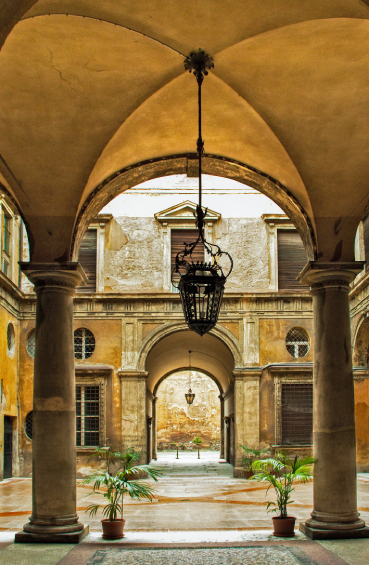
Via dell’Archiginnasio runs beside San Petronio and the Archiginnasio beneath the elegant Portico del Pavaglione. For a wet-weather walk, this is one of the most useful stretches in central Bologna: broad, central and directly connected with the Piazza Maggiore area.
Follow it south toward Piazza Galvani. You will pass the Museo Civico Archeologico and the entrance to the Archiginnasio without needing to abandon the arcade for long.
Piazza Galvani itself introduces another short open section. Stay around its perimeter if the rain is heavy rather than walking toward the statue in the middle.
If showers are changing the order of your sightseeing, this is also a sensible point to organize the rest of your Italy route around indoor stops instead of repeatedly crossing the city between attractions.
Continue across the centre on Via Farini
From Piazza Galvani, pick up Via Farini. Its substantial porticoes continue through the elegant Piazza Cavour and Piazza Minghetti area, another of Bologna’s UNESCO-listed portico groups.
This route is particularly useful because it lets you move east through the historic centre without depending on the more obvious Via Rizzoli and Two Towers axis.
Keep following Via Farini until it meets Via Santo Stefano. Turn onto Via Santo Stefano and continue toward Piazza Santo Stefano. The buildings surrounding the widening in front of the basilica have porticoes, although the centre of the piazza is open to the sky.
Again, choose the perimeter in heavy rain. Walking directly down the middle gives you the postcard view but none of the weather protection.
Why the Two Towers route is not always the best choice
On a map, Via Rizzoli toward the Due Torri looks like the obvious eastbound route. In normal conditions it can be convenient, but temporary construction and the continuing works connected with the Garisenda tower can change pedestrian flows around Piazza di Porta Ravegnana.
In August 2026, works and monitoring are still affecting this part of the centre, with local restrictions around Via Rizzoli and the Garisenda area. Pedestrian access remains possible through surrounding streets, but the intuitive straight line may be interrupted by barriers or directed crossings.
If rain is heavy, there is little reason to wrestle with a temporary diversion just to pass the towers. Use the Pavaglione and Via Farini line instead, then approach Santo Stefano from Via Farini. Before relying on a particular central street, the Comune di Bologna’s current roadworks map is the place to check for changing restrictions.
Porticoes are public passageways, not private shop space
A feature that sometimes confuses first-time visitors is the relationship between buildings and arcades. Many Bolognese porticoes are privately owned while remaining open for public use. You are meant to walk through them.
You do not need to step into the rain because a café has tables under an arcade or because the passage runs immediately beside shop windows and residential doors. Keep to the available pedestrian line, leave space around entrances and do not weave through restaurant tables when a clear passage exists beside them.
With a suitcase, stay on the broadest arcades
Rolling luggage makes Bologna’s rain protection even more valuable, but the historic paving changes the calculation. Wet stone, joints between paving slabs and shallow gutters can make small suitcase wheels awkward.
From Bologna Centrale, Via dell’Indipendenza is preferable to improvising through smaller side streets. Once near Piazza Maggiore, the Pavaglione and Via Farini are generally more comfortable choices than narrow medieval lanes in the Quadrilatero.
Avoid dragging a suitcase through the central food-market streets purely to remain under occasional awnings. They are narrow, crowded and less predictable than the principal porticoes.
If you have a large wheeled case, allow people to pass before entering a narrow section rather than taking the centre of the arcade. Bologna residents use these passages as everyday pavements, not just sightseeing corridors.
Strollers and reduced mobility
The broad nineteenth-century porticoes and the main Via dell’Indipendenza route are generally the easiest choices with a stroller, wheelchair or mobility aid, but Bologna’s historic centre is not uniformly level. Portico floors can change height from one building to the next, and some entrances have ramps or small changes in gradient.
The station itself has lifts serving many platforms, including the underground high-speed platforms. Temporary lift outages can alter an accessible route, so travellers who depend on step-free access should check RFI information before arrival.
In the centre, avoid assuming that a sheltered side street is automatically the more accessible option. A wider open crossing followed by a broad portico can be much easier than a dry but cramped passage with uneven paving, café furniture and bicycles.
What to do with your umbrella under the porticoes
Close it once you are properly under cover. An open umbrella in a busy Bologna arcade occupies more space than you think and puts the metal tips roughly at other people’s eye level.
During intermittent showers, keep a compact umbrella somewhere you can reach without unpacking your bag. You may need it for only twenty seconds at each crossing, but those twenty seconds arrive repeatedly.
When the porticoes are crowded, especially on weekends, pause against the building side before opening or closing it. Do not stop between two columns where everyone else has to squeeze around you.
Wet stone is the bigger problem than the rain
Bologna is comparatively flat, so the rain itself is rarely the hardest part of the walk. Slippery paving can be.
Polished stone beneath the porticoes may remain damp long after the rainfall has eased. Painted road markings, metal utility covers and smooth paving at crossings can also become slick. Shoes with a useful tread are more valuable than waterproof trousers for most central sightseeing.
Be particularly careful where an arcade slopes toward a street crossing. These are natural drainage points and can collect shallow water even when the covered pavement behind you looks dry.
When the porticoes are not enough
For ordinary rain, keep walking. For a thunderstorm, strong wind or extremely heavy downpour, treat the porticoes as temporary cover rather than a reason to remain outside indefinitely. They are open on one side, and gusts can push rain well underneath them.
The centre gives you plenty of indoor fallback points: cafés, museums, churches where access is permitted, the Archiginnasio, shops and other public interiors. It is usually better to stop somewhere substantial for twenty minutes than spend that time pressing yourself against the back wall of an arcade while water blows sideways.
The simple route to remember
If you want one sequence stored in your phone before arriving, use this:
Bologna Centrale, Piazza Medaglie d’Oro → Via dell’Indipendenza → Piazza del Nettuno → portico of Palazzo del Podestà → Palazzo dei Banchi → Via dell’Archiginnasio and the Pavaglione → Piazza Galvani → Via Farini → Via Santo Stefano.
That line gets you from the railway station through the monumental core and into the eastern side of the historic centre while making unusually good use of Bologna’s covered streets. You will still cross patches of open sky, particularly at Viale Pietramellara and the major piazzas, but you should never need to spend long searching for the next roof.