One narrow lane carries traffic in both directions, but only one direction should use it at a time. The phrase senso unico alternato in Italy does not mean an ordinary one-way street. Priority is controlled by temporary traffic lights, road workers with red and green paddles, or a pair of two-arrow signs. A round red-bordered sign with a red upward arrow means you must yield to oncoming traffic. A blue square with a white upward arrow means your direction has priority.
The two arrow signs that decide who goes first
The easiest mistake is to look at the narrowing itself and guess that the driver who arrived first should go. That is not how a formally controlled section works. Look for the arrows before the road becomes too narrow for two vehicles to pass.
Round sign with a red border: you give way
The official sign is called dare precedenza nei sensi unici alternati, Figure II.41. It is circular, with a red border and two vertical arrows. Facing the sign, the upward arrow represents your direction of travel and is red; the downward arrow represents approaching traffic and is dark.
Red upward arrow means your direction yields. Stop before entering the narrow section if an approaching vehicle is already coming through or is close enough that both of you would meet inside it.
Do not confuse this with Italy’s normal triangular dare precedenza sign. The two-arrow version is specifically for priority through a constriction shared by opposing traffic.
Blue square sign: your direction has priority
The opposite sign is diritto di precedenza nei sensi unici alternati, Figure II.45. It is a blue square containing a large white upward arrow and a smaller red downward arrow.
White upward arrow means your direction has priority over vehicles approaching from the other end. That still does not give you permission to drive into a section that is physically blocked. If an opposing car, bus or cyclist is already inside the narrow lane, let it clear first.
The Italian Ministry’s technical rules for temporary road signing show both signs and describe how they are used at roadworks.
There are three common ways the alternating traffic is controlled
A narrowing may look similar from the driver’s seat but operate differently. Check which control system is actually in use before moving.
1. Transito alternato a vista
A vista means the two ends can be managed by sight. The Ministry’s roadwork standard uses the paired priority signs for relatively short sections where drivers can see the situation clearly. For temporary works, this method is intended for modest traffic and sections whose ends are no more than 50 metres apart.
On the side where traffic encounters the obstruction and has to move across the road, drivers will normally see the red-bordered give-way sign. The less obstructed direction normally receives the blue priority sign.
This explains an otherwise puzzling setup: the lane may be physically on “your” side of the road, yet the sign can still require you to wait. Read the arrows rather than trying to reconstruct what the road looked like before the excavator arrived.
2. Transito alternato da movieri
A moviere is a worker controlling traffic at one end of the narrowing, usually coordinated with another worker at the far end. The proper paddle has a red face and a green face.
- Red paddle: stop.
- Green paddle: proceed when the route through the works is clear.
You may also see a worker using a fluorescent orange flag. Under the temporary-signing rules, that flag is used to make drivers slow down and exercise greater caution. It is not the same thing as being shown the green face of the traffic-control paddle.
If police or another authorized traffic officer is actively directing vehicles, follow the officer’s instructions. Under the Italian Highway Code, traffic officers’ signals take precedence over ordinary signs and traffic rules.
3. Transito alternato a mezzo semafori
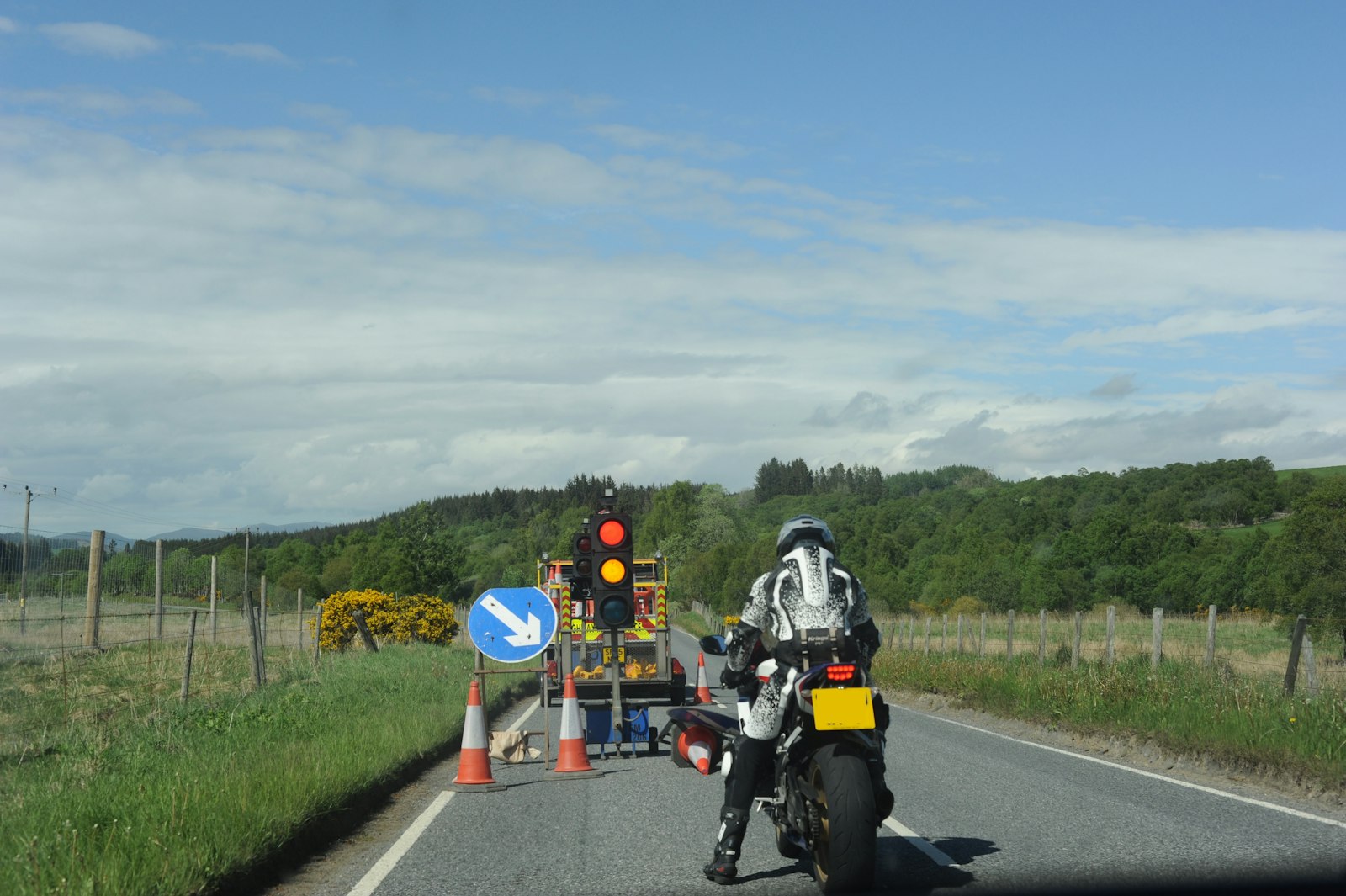
Longer sections, bends and roadworks where drivers at opposite ends cannot see one another are commonly controlled by temporary traffic lights. The Ministry’s standard provides for two linked signals, operated automatically or manually. Outside built-up areas, there should also be advance warning of the temporary signal.
Stop at the temporary stop line if one is marked. If there is no obvious line, stop before the point where the road narrows, leaving enough space for vehicles emerging from the works to return to their side of the road.
A long red phase is not unusual if the controlled section is lengthy. Do not decide that the signal must be broken simply because nothing has happened for a minute or two.
How to drive through the narrowing step by step
- Slow before the constriction. Signs such as lavori for roadworks or strettoia for narrowing may appear first.
- Find the active control. Look for a temporary signal, a worker with a paddle, or one of the two-arrow priority signs.
- Stop before the shared lane when required. Do not creep halfway into the narrowed section while deciding what the sign means.
- Let the previous opposing group clear completely. On a longer section, the last vehicle may appear well after the first one.
- Check that there is somewhere to exit. Do not enter behind another vehicle if traffic at the far end is backed into the narrowing.
- Proceed in single file. Keep a sensible gap so you can react if a work vehicle, cyclist or pedestrian appears.
- Return fully to the right once clear. Do not cut the corner around the final barrier or cone.
If your light turns green but cars are still coming toward you
Wait. The opposing queue may have entered legally near the end of its previous green phase and still be clearing the works. A green signal does not make a narrow lane wide enough for two vehicles.
This is especially common where the controlled section goes around a bend. You may see no traffic when your signal changes, start to move, and then meet the tail end of the previous group. Checking that the lane is actually clearing before committing yourself is much easier than reversing beside barriers.
If you have the blue priority sign but another driver keeps coming
Do not try to enforce your priority with the front bumper. Stop while you still have room and let the conflict resolve. The other driver may have entered before you became visible, may be following a larger vehicle, or may simply have misread the sign.
If both vehicles have already entered a short constriction, the driver with the easiest nearby place to pull aside or reverse should avoid turning a simple mistake into a stand-off. Once clear, the formal sign controls the next movement again.
What to do if the temporary traffic light appears faulty
A signal showing red continuously should not be treated as optional merely because other drivers become impatient. First look for a worker controlling traffic manually or for instructions directing vehicles around the signal.
If the signal is dark, visibly damaged or apparently malfunctioning and the lane ahead is blind, do not drive into it on the assumption that the opposite signal must also have failed. Wait for site staff or use a signed alternative route if one is available. Turning around is inconvenient; meeting an oncoming bus between concrete barriers is considerably more so.
Roadworks can also remain signed overnight when no workers are present. If the traffic lights and temporary restrictions are still in place, do not assume the controls have ceased just because the construction crew has gone home.
Do not confuse formal alternating traffic with an ordinary blocked lane
Sometimes there are no paired arrows, no temporary signal and no worker. A delivery van, parked car, landslide or small work site may simply block part of an otherwise two-way road.
In that situation, the general rule in Article 150 of the Italian Highway Code applies: when an obstruction prevents two vehicles from passing and the obstacle is on your side, you must stop and allow opposing traffic to pass if you cannot remain near the right-hand edge of the carriageway. The current wording can be checked through ACI’s publication of Article 150.
A specific alternating-traffic sign, temporary light or authorized controller is different. Follow that control rather than relying only on which side appears obstructed.
The mountain-road rule is different again
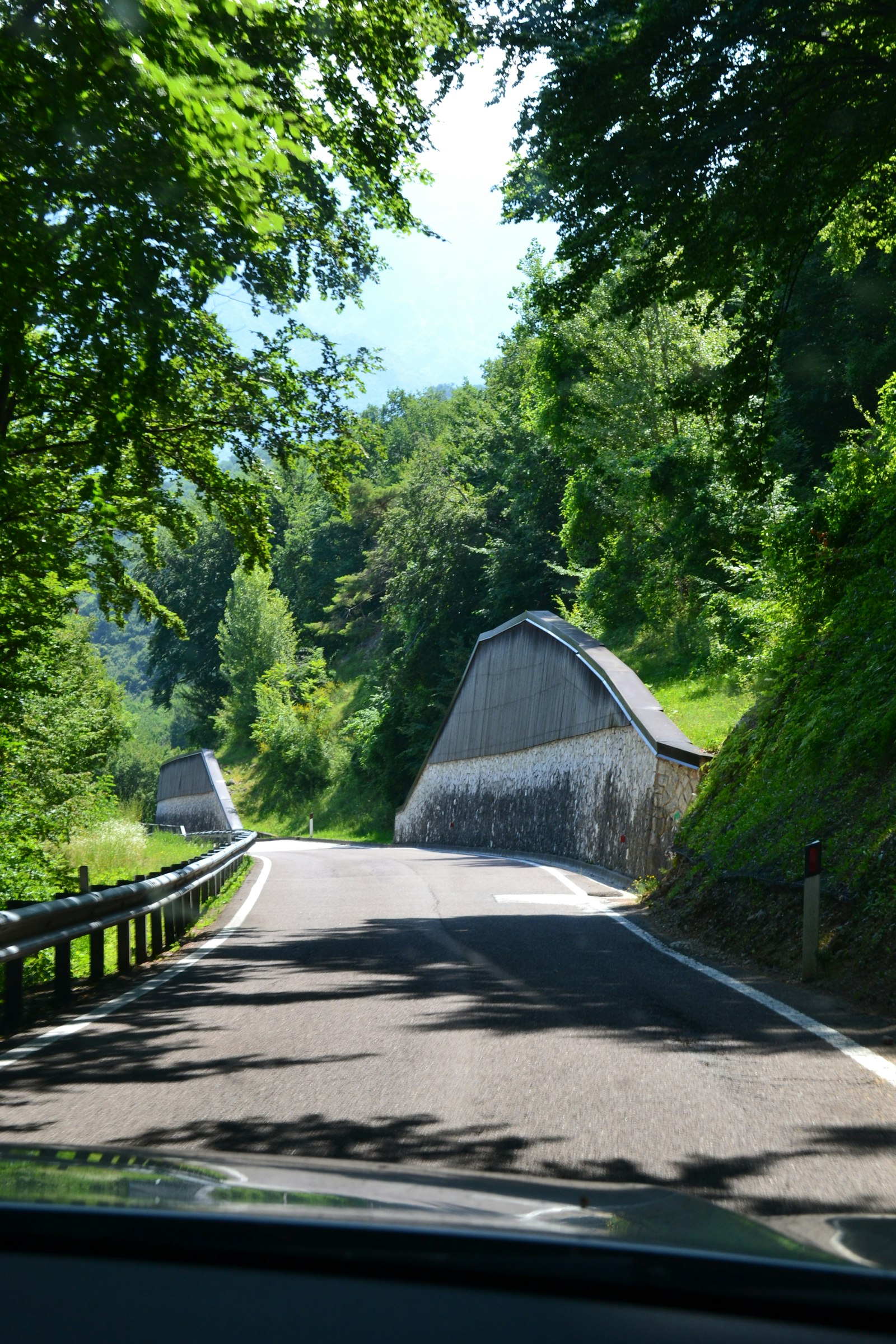
On steep mountain roads without a formal alternating-traffic installation, Italian law contains another rule for places where two vehicles cannot pass comfortably: the vehicle travelling downhill normally stops and moves as far right as possible, or uses a passing place.
There is an important exception. If the uphill driver has a convenient passing place and otherwise one of the vehicles would have to reverse, the uphill vehicle should use that space. The point is to avoid unnecessary reversing on a steep, narrow road, not to make the downhill rule an excuse to ignore an obvious lay-by.
This distinction matters on mountain routes where a permanent single-lane bridge with priority signs may be followed a few kilometres later by an unsigned village street. The bridge is governed by its arrows; the ordinary pinch point is governed by the general passing rules.
Leave room for buses, trucks and wide rental cars
A common error is stopping directly at the narrowest point. If a bus or truck is already coming through, it may need the full mouth of the roadworks to swing back onto its side. Stop far enough back to leave that exit usable.
With a rental car, remember that the mirrors are often the widest part of the vehicle. Follow the temporary lane rather than trying to hug cones on one side while an oncoming vehicle squeezes past on the other. If the site has been set up for one-direction-at-a-time traffic, wait for your turn instead of inventing a two-way lane.
Allow extra time on rural driving days
A single roadworks stop is usually just an inconvenience, but several alternating sections can make arrival times unpredictable, particularly on mountain and secondary roads where there is no practical parallel route. For transfer days with timed museum entries, ferries or hotel check-ins, add some margin rather than planning each driving leg to the minute.
You can build your Italy itinerary with the driving legs and important timed stops together, which makes it easier to see where a delay buffer is sensible. If you are still deciding how much of the trip to make by car, the Italy on Foot car rental guide also covers the broader rental and road-trip basics.
The quickest way to read the situation
- Round red-bordered sign, red arrow pointing your way: you wait for oncoming traffic.
- Blue square, white arrow pointing your way: your direction has priority.
- Red worker’s paddle: stop.
- Green worker’s paddle: proceed when the section is clear.
- Temporary traffic light: obey the light and stop before the narrowing.
- No special control, obstacle on your side: you normally yield to opposing traffic.
- Unsigned steep mountain pinch point: downhill traffic normally gives way, subject to the passing-place exception.
The useful habit is to decide who controls the section before entering it. Once two vehicles are nose to nose between barriers, correctly identifying the red arrow becomes much less satisfying.