A traghetto is the cheap, practical way to cross Venice’s Grand Canal when the nearest bridge is inconvenient. The fare currently published by the Comune di Venezia is €2 per crossing for ordinary passengers, paid directly at the gondola station rather than with an ACTV ticket. A Venice traghetto gondola ride lasts only long enough to reach the opposite bank. Standing is traditional, but it is not a test of Venetian credentials: sit down if the gondolier directs you to, or if you are uncomfortable standing in a moving boat.
There is no reservation, sightseeing route or scheduled departure every ten minutes. You go to the stazio, wait for the boat, board when directed and cross with the other passengers. The service is intended as everyday transport, even if the experience happens to involve a gondola and a rather good view.
Where the traghetti cross the Grand Canal
The Comune di Venezia currently lists five active traghetti da parada. The names used on municipal information are often the names of one boarding station rather than both ends of the crossing, which can make them surprisingly difficult to identify on a map.
- Santa Sofia to Pescheria di Rialto: connects Campo Santa Sofia in Cannaregio with the Rialto Market side of the Grand Canal. This is particularly useful between the Ca’ d’Oro area and the fish-market side of Rialto without walking around to Rialto Bridge.
- San Tomà to Sant’Angelo: crosses between San Polo and the San Marco side of the canal. On the San Tomà side, look toward the waterfront behind Campo San Tomà and for street names containing Traghetto.
- Santa Maria del Giglio to San Gregorio: links the San Marco side with Dorsoduro, landing near the San Gregorio approach toward the Salute and Peggy Guggenheim area.
- Riva del Carbon to Riva del Vin: crosses near Rialto between the San Marco bank and the San Silvestro side. The municipality referred to the Rialto-San Silvestro service again when a new ferry gondola was launched in June 2026.
- Punta della Dogana to Calle Vallaresso: connects the Dorsoduro tip near Punta della Dogana with the San Marco side near Vallaresso.
The city also lists San Samuele and San Marcuola as closed, so do not build a walking route around old maps showing those crossings. The safest source for changes is the Comune di Venezia’s official traghetti da parada page.
Which crossing should you use?
Choose a traghetto because it saves you a detour, not simply because one appears somewhere on your sightseeing map. The Grand Canal has only four pedestrian bridges, so a functioning ferry can remove a surprisingly awkward loop.
Santa Sofia is especially useful around Rialto Market. If you are on the Cannaregio side near Ca’ d’Oro and want the market, crossing here puts you on the correct bank without walking south to Rialto Bridge and back again.
San Tomà is useful in the middle section of the Grand Canal. It can save a substantial zigzag when moving between San Polo and the Sant’Angelo side, particularly when neither Rialto nor Accademia Bridge suits your route.
Santa Maria del Giglio is useful between central San Marco and Dorsoduro. It is worth checking before automatically walking to Accademia Bridge, especially if your destination is around Salute.
The Carbon and Dogana services can also be handy, but their usefulness depends more heavily on where you are headed and whether they are actually operating when you arrive.
Current operating hours are not the same at every crossing
Do not assume that seeing a traghetto marked on a map means it will run all day. The municipality’s published schedule currently gives different hours for each station:
- Dogana: 09:00 to 18:00.
- Santa Maria del Giglio: 09:00 to 18:00.
- San Tomà: 08:30 to 19:00 Monday to Friday; 09:00 to 18:30 on Saturdays, Sundays and public holidays.
- Carbon: 09:00 to 12:00 Monday to Friday; closed on Saturdays, Sundays and public holidays.
- Santa Sofia: 08:30 to 19:00 Monday to Friday; 09:00 to 18:00 on Saturdays, Sundays and public holidays.
The published holiday rules also state that the service does not operate on 15 August, 25 December, 26 December or 1 January, and finishes at 13:00 on 24 and 31 December.
These are service windows, not a promise that a boat leaves at a particular minute. Weather, water conditions, operational issues and local interruptions can affect crossings. If an individual station posts information locally that differs from an older online timetable, follow the instructions at the station.
How boarding actually works
- Find the small gondola landing. You are looking for a traghetto or stazio, not an ACTV vaporetto pontoon. Street names such as Calle del Traghetto, Campiello del Traghetto or Fondamenta del Traghetto are useful clues.
- Wait at the landing. There is no need to buy an ACTV ticket or reserve a place online.
- Let the gondolier control boarding. The boat moves as weight is added, so do not jump aboard merely because it has touched the pier.
- Pay the crossing fare. Have €2 per person readily available. Small cash is the sensible choice because the municipality publishes the fare but does not promise card acceptance at every crossing.
- Move where you are told. The gondolier may distribute passengers around the boat for balance.
- Cross and disembark promptly. This is a shuttle between two banks, not a sightseeing stop in the middle of the Grand Canal.
Do you stand or sit in a traghetto?
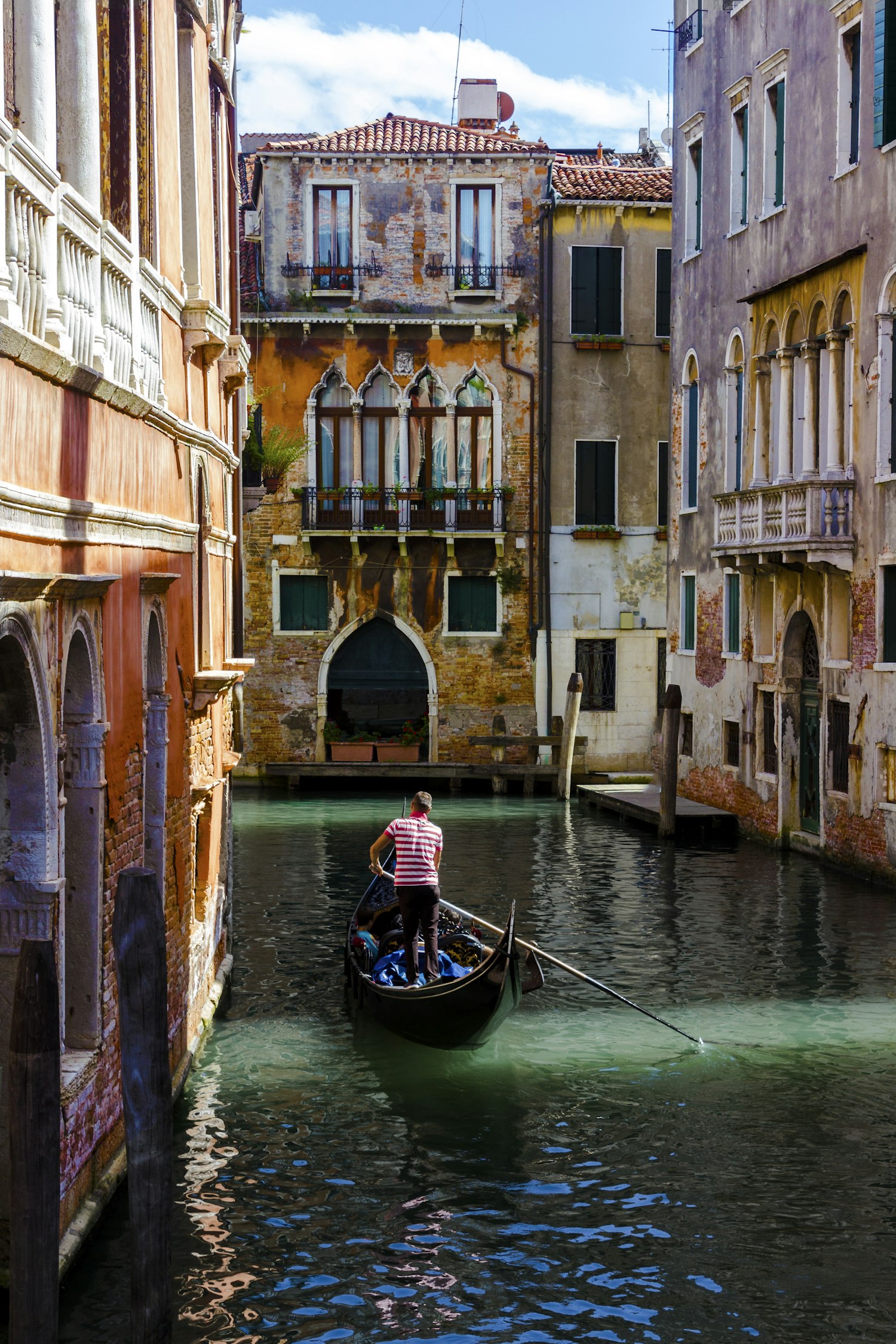
Standing is the traditional Venetian way to make the crossing, and you will still see experienced passengers doing it. That does not mean visitors are required to stand.
If you have good balance and the gondolier is happy for passengers to remain standing, you can do the same. Keep your feet planted, avoid sudden movements and do not turn the few minutes aboard into a photo shoot requiring everyone else to shift around you.
If you would feel safer seated, sit. More importantly, follow any instruction from the gondoliers about where to position yourself. They are managing a heavily trafficked waterway as well as the balance of a narrow boat. Their instruction takes priority over whatever etiquette advice you have read online.
Children should not be encouraged to copy adults standing simply for the novelty of it. Keep them close and use the position indicated by the crew.
How to pay, and what your vaporetto pass does not cover
The municipal fare is currently €2 for other passengers and €0.70 for residents and qualifying IMOB card holders.
This is separate from AVM/ACTV public transport ticketing. You do not tap a vaporetto pass, validate a paper ticket or buy a single-journey water-bus ticket for the crossing. Pay the gondolier at the station as directed.
Carry coins or a small euro note rather than arriving with only a large denomination. Even where a gondolier happens to have another payment option available, there is no reason to make a two-euro crossing dependent on it.
If you are comparing this with the rest of Venice’s transport system, our guide to getting around Venice explains when walking, a vaporetto, water taxi or ordinary gondola makes more sense.
A traghetto is not a €2 sightseeing gondola ride
The low price sometimes creates the wrong expectation. The purpose is to cross the Grand Canal. There is no circuit through side canals, no private boat, no guaranteed seat, no commentary and no reason for the gondolier to prolong the trip.
A regular gondola service is priced and operated differently. If somebody in your group wants the classic half-hour experience, treat that as a separate activity rather than trying to turn a commuter crossing into one.
This distinction also helps at gondola stations offering more than one type of service. If necessary, say “traghetto per attraversare il Canal Grande”, meaning the ferry to cross the Grand Canal, rather than simply asking for a gondola.
What to do with luggage, strollers and bulky bags
The municipality’s public fare page does not publish a tourist-style baggage allowance for these crossings. That is a good reason not to treat the service as a reliable luggage transfer.
A daypack or small shopping bag is uncomplicated. A large rolling suitcase is another matter: you have to get it down to a low boarding point, step into a moving gondola and remove it again at the opposite bank without obstructing other passengers.
For the same reason, do not assume that an unfolded stroller can simply be wheeled aboard. If you are traveling with a pushchair, folding it before reaching the front of the queue makes boarding easier, but the gondolier still decides what can safely be carried on that particular crossing.
If you are planning several Venice transfers with bags, you can organize the rest of your trip around the correct bridges and water-transport stops rather than depending on a traghetto that may be closed when you reach it.
Wheelchairs and limited mobility
Do not count on a traditional traghetto as a step-free way across the Grand Canal. Boarding involves a small gondola rather than the larger accessible infrastructure found on suitable vaporetto services, and water level changes can alter the height difference at the landing.
If stepping down into the boat or balancing during boarding is difficult, use an accessible vaporetto connection or an appropriate bridge route instead. Someone who can walk short distances but struggles with balance should also tell the gondolier before stepping aboard rather than discovering the problem halfway through boarding.
What happens if the traghetto is closed when you arrive?
There is no special replacement shuttle just because a crossing is not operating. Your alternatives are to walk to a Grand Canal bridge or use the regular vaporetto network.
The four pedestrian crossings are:
- Ponte della Costituzione between Piazzale Roma and the Santa Lucia station side.
- Ponte degli Scalzi beside Venezia Santa Lucia station.
- Ponte di Rialto in the central commercial area.
- Ponte dell’Accademia between San Marco and Dorsoduro.
If a closed traghetto leaves you staring across the canal at a destination that looks fifty metres away, check the nearest bridge before blindly following the waterfront. Venice’s canals and dead-end calli mean the apparently obvious walking direction is not always the shortest route.
Do not plan a late-night crossing
These gondolas are daytime and early-evening transport. Even the longest published schedules finish by 19:00, with some crossings stopping much earlier.
For dinner reservations, theatre, late trains or an evening return to your accommodation, plan around a bridge or the vaporetto network instead. Turning up at 21:00 because a map still displays a ferry symbol will leave you with a walk.
Small mistakes that cause most of the confusion
- Waiting at the vaporetto stop: a traghetto has its own small landing and is not an ACTV service.
- Searching only for the destination-side name: municipal listings may identify a crossing as Santa Sofia, San Tomà or Dogana even though the opposite landing has another name.
- Expecting a timetable: think repeated crossings during operating hours, not departures listed at 10:07 and 10:17.
- Assuming every old map is current: San Samuele and San Marcuola are currently listed as closed.
- Relying on a card: carry the small cash fare instead of making payment technology the deciding factor.
- Confusing it with a gondola tour: the €2 fare gets you to the opposite bank and nothing more.
- Standing when you are not steady: tradition is less important than safe boarding and the gondolier’s instructions.
The best way to use the service is also the simplest: check that the crossing is operating, arrive with €2 ready, let the gondoliers tell you where to board or sit, and treat the boat as the public ferry it is. If it saves a twenty-minute detour around the Grand Canal, the gondola view is a very pleasant bonus.