A Venetian rowing lesson usually lasts between 60 and 90 minutes and teaches you how to propel a traditional wooden boat while standing and facing forward. An instructor demonstrates the technique, helps you practice with a long wooden oar and then guides the boat through Venice’s canals. No previous rowing experience is normally required, although you should be comfortable standing, balancing and moving around inside a small boat.
Booking a Venice rowing lesson is different from arranging a gondola ride. You are there to participate, and everyone who wants to row takes turns using the equipment. Before paying, check which traditional boat will be used, how many people can join, whether children can participate, and where the lesson begins and ends. Some experiences include time on the open lagoon or Grand Canal, while others concentrate on quieter canals where beginners can practice.
What is traditional Venetian rowing?
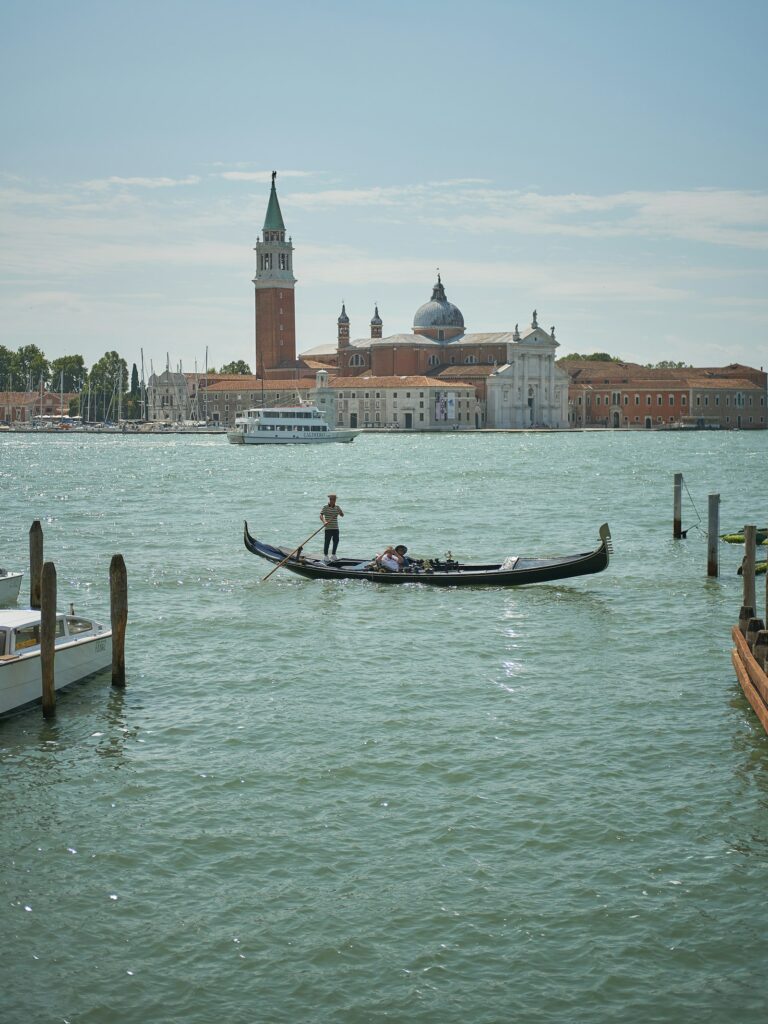
Venetian rowing is known locally as voga alla veneta. Unlike conventional recreational rowing, where the rower normally sits facing backward, the Venetian technique is performed standing up and facing the direction of travel.
The rower uses a long wooden oar, called a remo, which rests against a specially shaped wooden support known as a forcola.
The forcola is an open oarlock with carefully shaped curves and notches. Its design allows the rower to change the oar’s position for different movements, including propelling, slowing and steering the boat.
This technique developed in the Venetian Lagoon, where narrow canals, shallow waterways and the need to see ahead made forward-facing rowing particularly useful.
It is the technique associated with Venice’s gondoliers, although it is also used on several other traditional boats.
Venetian rowing should not be confused with punting. You do not push a long pole against the bottom of the canal. Instead, the oar moves through the water to provide propulsion and control.
What happens during your first rowing lesson?
Most introductory experiences begin with a demonstration while the boat is still secured beside the landing. This gives beginners an opportunity to understand the equipment before navigating the canals.
The instructor normally remains aboard throughout the activity and controls the boat when necessary.
A typical beginner session follows this sequence:
- Meet the instructor: Arrive at the designated canal-side meeting point and receive an introduction to the boat and safety arrangements.
- Learn about the equipment: The instructor explains the traditional oar, the forcola and the standing rowing position.
- Practice while moored: You try the basic movement while the boat remains secured to the landing.
- Begin rowing: The instructor guides the boat into a suitable canal while you practice moving it forward.
- Take turns: Other participants have opportunities to row while their companions sit and watch.
- Try steering: Depending on conditions and your progress, you may move to the stern and practice controlling the direction.
- Return to the landing: The instructor brings the boat back to the agreed finishing point.
The exact route and activities depend on the lesson format and weather. Some instructors may spend more time on the basic stroke if a participant is struggling, while others introduce additional steering movements when everyone is comfortable.
What will you actually learn to do?
A beginner lesson usually concentrates on two rowing positions: voga a prua and voga a poppa.
Voga a prua: rowing at the bow
Prua means the bow, or front, of the boat.
Beginners often start here because another rower or the instructor can control the direction from the stern while they concentrate on the movement of the oar.
You learn how to position your feet, hold the oar and coordinate your arms and body to move the boat forward.
The movement involves more than pulling with your arms. You use your body weight and leg position to produce a controlled stroke.
It can take several attempts to develop a smooth rhythm, especially if you have previously rowed using conventional oars while seated.
Voga a poppa: steering from the stern
Poppa means the stern, or rear, of the boat.
This position is more demanding because the rower must provide propulsion while controlling the boat’s direction.
In traditional Venetian rowing, the stern rower is called the poppiere. The forward rower is sometimes called the proviere.
The stern rower uses different movements and positions of the oar to turn the boat, keep it moving straight and respond to changes in current or traffic.
Some introductory lessons allow participants to try the stern position after learning the basic stroke. Others concentrate on forward rowing and leave more advanced steering techniques for subsequent lessons.
Ask whether you will have an opportunity to steer independently under supervision, particularly if that is the part of the experience that interests you most.
Will you learn to row a real gondola?
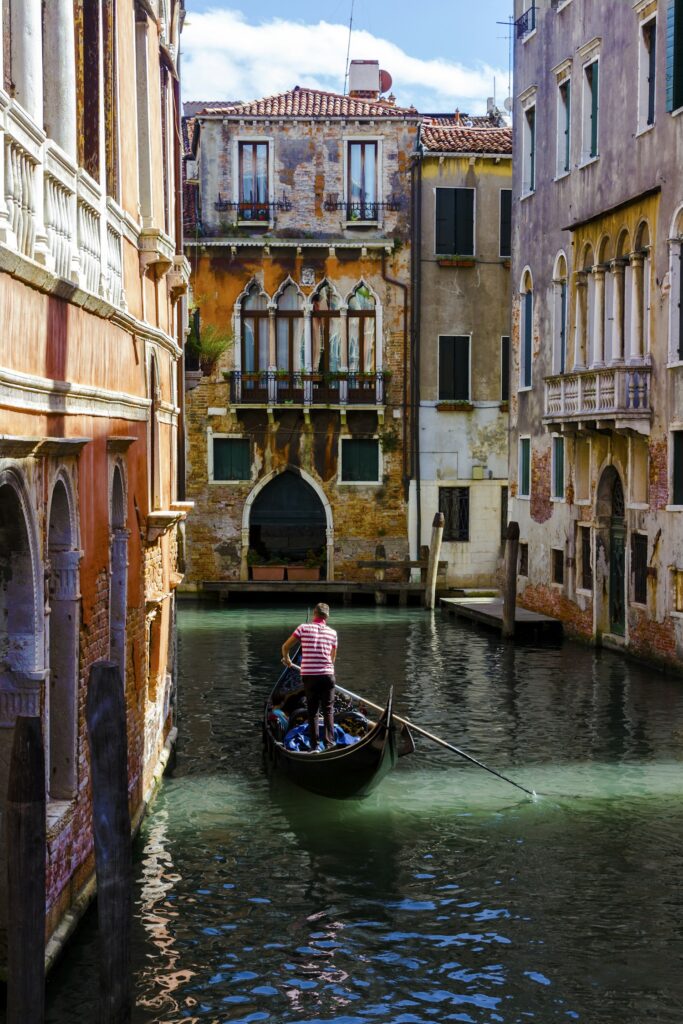
Not necessarily. This is one of the most common misunderstandings about Venetian rowing experiences.
Although the rowing technique is closely associated with gondolas, many beginner lessons use a different traditional wooden boat that is more suitable for instruction.
These boats may be wider, more stable and easier for several participants to share.
Batela and batelina
A batela is a traditional Venetian working boat, while batelina is used for a smaller version or related type.
One particular traditional craft used for rowing lessons is the batela a coda di gambero, sometimes translated as a shrimp-tailed batela because of its distinctive stern.
These wooden boats were once used for practical transport around Venice and the lagoon.
They are relatively spacious compared with a gondola and provide a stable platform for beginners learning to stand and move an oar.
A lesson using a batela teaches genuine Venetian rowing techniques even though the boat is not a gondola.
Sandolo and mascareta
Other traditional Venetian boats include the sandolo and mascareta.
A sandolo is a smaller, relatively flat-bottomed boat that has historically been used for different practical purposes around the lagoon.
The mascareta is a light Venetian rowing boat associated with recreational rowing and traditional regattas.
Both can be used for Venetian-style rowing, although their handling and stability differ from the larger teaching boats.
If you are booking with children or have concerns about balance, ask about the specific craft that will be used rather than relying on the phrase “traditional Venetian boat.”
Actual gondolas
Some rowing associations own traditional gondolas and may use them for particular lessons or specialist activities.
However, learning the basic stroke in another type of Venetian boat is usually more practical for first-time participants.
If your main goal is to stand at the back of an actual gondola, ask the operator to confirm that the vessel will be a gondola rather than another traditional craft.
One introductory lesson does not qualify you to work professionally as a gondolier. Professional gondoliers require formal training and must meet Venice’s licensing requirements.
How difficult is Venetian rowing for beginners?
Venetian rowing requires coordination and balance, but an introductory lesson is generally designed for people without previous experience.
The most unfamiliar part is standing while making a repeated movement with a long oar. You must maintain your balance as the boat moves and responds to your stroke.
At first, the oar may feel heavier or more awkward than expected. You also need to learn how it rests against the forcola without allowing it to slip out of position.
The instructor should demonstrate the movement and correct your posture before expecting you to row continuously.
For most beginners, the goal is to become comfortable moving the boat forward and trying simple steering movements. You are unlikely to finish an 80-minute lesson with the skills needed to navigate Venice independently.
If you have already used a kayak, canoe or conventional rowing boat, you may recognize some principles of moving through water. However, Venetian standing rowing uses a different position and technique.
Previous water-sports experience can help with confidence and balance, but it is not normally a requirement.
Do you need to be physically fit?
You do not need to be a competitive athlete, but the activity involves standing, shifting your weight and using your arms, shoulders and legs.
You should be able to remain upright on a moving boat and move safely between rowing and passenger positions.
In a private lesson with several participants, you will normally take turns, so you do not have to row continuously throughout the entire session.
However, the rowing position requires more balance than sitting in a conventional sightseeing boat.
If you have back, shoulder, knee or balance problems, describe them before booking. Ask whether the instructor can adapt the activity and how much standing is required.
A seated passenger may be able to accompany the group even when they do not wish to row, provided they can board safely and the operator accepts the arrangement.
For someone who cannot stand securely or transfer safely into a small boat, a conventional sightseeing cruise may be more appropriate.
Do you need to know how to swim?
Operators use different safety policies, so ask directly whether participants must be able to swim.
Traditional Venetian rowing boats are designed for stability, but there is still a risk associated with being on open water.
Some lessons take place in relatively sheltered canals, while others may enter more exposed lagoon waters when conditions permit.
Before booking, confirm whether life jackets or other personal flotation equipment are supplied, whether they are required and whether suitable sizes are available for everyone.
If someone in your group cannot swim, inform the instructor in advance and ask whether the activity is appropriate.
Do not treat the boat’s stability or the presence of an experienced instructor as a guarantee that nobody can fall into the water.
Children should be supervised throughout boarding, rowing and disembarking. They should also understand that leaning over the side or attempting to touch the canal water is unsafe.
Will you row through the Grand Canal?
That depends on the lesson you book.
Many beginner experiences use quieter canals in Cannaregio or another suitable part of Venice, where there is more space to learn the technique away from the busiest boat traffic.
Some routes also enter an open section of the lagoon, depending on the weather and the participant’s ability.
The Grand Canal is a different environment. It carries public water buses, water taxis, commercial vessels and other working boats.
For that reason, operators may reserve Grand Canal rowing for particular times, such as evenings, Sundays or public holidays when some commercial activity is reduced.
Ask whether the Grand Canal is included in the actual route. A lesson described as taking place “on Venice’s canals” does not necessarily enter it.
If you particularly want to row beneath the Rialto Bridge, request confirmation before paying. This should be treated as a specific route requirement rather than an assumption.
The instructor must decide whether the route is suitable for the group and conditions on the day.
Can couples and families share one boat?
Yes. Many introductory lessons are organized for one to four participants, with larger boats or additional vessels available for bigger groups.
The number of people permitted aboard depends on the boat, the operator’s rules and the combined weight and mobility of the group.
For couples, a private lesson often allows both people to learn the basic stroke and take turns steering.
For a family of four, the instructor may rotate participants through the rowing position while the others sit and watch.
Ask whether everyone who wants to row will have enough time to practice. A group of four naturally provides less individual rowing time than a private lesson for one person.
If your group includes several children, describe their ages and sizes rather than booking solely according to the number of passengers.
Some providers offer larger traditional boats that accommodate five participants. Others require two boats and instructors for a group of that size.
A larger family may find that two boats provide more individual rowing time than placing everyone in one vessel, although the total price may be higher.
Are Venetian rowing lessons suitable for children?
Children can participate in many Venetian rowing experiences, but the minimum age and the amount of independent rowing permitted vary between operators.
Some family-oriented outings allow young children to accompany adults and help move the oar under supervision. More structured individual courses may set a minimum age of six.
For children aged four or five, the emphasis is usually on trying the movement alongside an adult or instructor.
Children aged six and older may be able to row with increasing independence, provided they can follow instructions and concentrate on the activity.
Older children and teenagers can normally try the same basic techniques as adults, with appropriate adjustments to the equipment and supervision.
Ask whether the operator provides:
- Age-appropriate instruction and assistance.
- Oars suitable for smaller participants.
- Properly sized life jackets or other required flotation equipment.
- Secure seating when children are not rowing.
- Clear adult-supervision arrangements.
- Opportunities for younger children to participate without independently controlling the boat.
If you are traveling with a toddler, ask whether they may accompany the group as a passenger, even if they cannot actively row.
Do not assume a child is eligible simply because a booking page allows you to enter their age. The operator should confirm that the selected boat and lesson are appropriate.
What if someone uses a wheelchair or has limited mobility?
Access to traditional Venetian rowing boats can be difficult for wheelchair users and people who cannot manage steps.
Boarding often involves stepping down from a stone canal landing into a wooden boat. The distance and height difference may change with the tide.
Once aboard, participants may need to stand, change position and move past other passengers.
Some traditional boats can carry a folded wheelchair, but that does not mean the passenger can remain seated in it while rowing or during the journey.
Before booking, ask whether the person can board and disembark safely, whether a transfer to a boat seat is required and whether staff can provide appropriate assistance.
Also confirm the accessibility of the meeting point. A canal landing reached by a stepped bridge may be unsuitable even when the person could otherwise use the boat.
If standing is not possible, ask whether the person may remain seated as a passenger or whether an adapted boat excursion would be more appropriate.
When is the best time of day for a lesson?
Morning is often a practical choice for first-time rowers, particularly during summer when temperatures can become uncomfortable later in the day.
Early sessions may also encounter less boat traffic in some areas, although conditions vary by neighborhood and weekday.
Afternoon lessons can work well during spring and autumn. In summer, however, rowing during the hottest part of the day may be tiring because traditional open boats offer limited shade.
Evening lessons are available from certain operators, sometimes with routes that include the Grand Canal.
These require additional consideration of visibility, navigation conditions and the amount of daylight available for learning.
If this is your first time rowing, a daytime lesson in relatively quiet canals may be easier than starting with an evening excursion in a busier waterway.
What happens if it rains or becomes windy?
Weather is an important part of booking a traditional rowing experience.
These boats are relatively low in the water and usually have no enclosed passenger cabin. Rain can make the equipment and deck wet, while wind affects the boat’s ability to maintain a steady course.
Some traditional craft have no keel or conventional rudder, so steering depends heavily on the rower’s technique and the conditions.
Even moderate wind can make a beginner lesson difficult, particularly when the route includes more exposed waters.
Operators establish their own safety limits. Some may proceed in very light drizzle but cancel during heavier rain or stronger winds.
Ask who decides whether the lesson can operate and whether the instructor can substitute a more sheltered canal route if the open lagoon is unsuitable.
Do not assume that a light shower automatically prevents the activity, or that the lesson will continue simply because it is still possible to walk around Venice.
Booking early in your stay is useful because it leaves another opportunity to reschedule if the weather is unsuitable.
Do tides and acqua alta affect rowing lessons?
Venice’s tidal conditions influence the water level throughout the city.
During unusually high tides, known as acqua alta, the clearance beneath certain bridges becomes lower. Boarding areas and walkways can also be affected.
High water does not necessarily mean every rowing lesson will be cancelled, but the instructor may need to change the route or wait for conditions to improve.
Very low water can create different problems, particularly in shallow canals.
Venice’s tidal forecasting service publishes information about expected water levels. You can check the City of Venice’s official tide forecasting service before your visit.
For a booked lesson, follow the operator’s instructions rather than independently deciding whether conditions are safe.
Where do rowing lessons meet in Venice?
The meeting point depends on the provider. Several traditional rowing activities operate in Cannaregio, away from the busiest sightseeing areas around San Marco.
Unlike an ordinary gondola ride, you may not be able to board at whichever canal is closest to your hotel.
Row Venice meeting point
Row Venice’s current meeting point is on Fondamenta Gasparo Contarini, near the Sacca della Misericordia marina and Ponte della Sacca bridge in Cannaregio.
The operator specifically instructs participants to wait beside the canal steps near the bridge rather than enter the private marina.
It does not operate a public office at the meeting point, so you should not expect to find a reception desk or a permanent sign.
The nearest convenient public transport options include the Madonna dell’Orto vaporetto stop and, with a longer walk, San Marcuola.
According to the operator’s published directions, the walk from San Marcuola is approximately twelve minutes. Walking from Venezia Santa Lucia railway station takes approximately thirty minutes.
Check the official Row Venice meeting instructions before leaving your accommodation. These include photographs and directions from different parts of Venice.
There are no public restrooms at the meeting point, so use facilities before arriving.
Veniceonboard meeting arrangements
Veniceonboard operates from Cannaregio 3009/G and uses traditional Venetian boats restored by its association.
Its rowing lessons and group outings are arranged directly with the association, with the exact time and activity agreed in advance.
Ask whether you should report to the association’s headquarters or a separate boat landing.
Veniceonboard’s activities are reserved for members, with the possibility of registering before participating. Confirm whether any membership charge is included in the quoted amount.
The association publishes its activities and contact information on the official Veniceonboard website.
How much does a Venetian rowing lesson cost?
Prices vary according to the duration, number of people and whether the lesson is a private teaching session, a group outing or a combined food-and-rowing experience.
As a current published example, Row Venice advertises its standard 80-minute private rowing lessons at the following prices:
- One or two participants: €100 for the boat.
- Three participants: €130 for the boat.
- Four participants: €150 for the boat.
- Five participants: €220 for a larger batela.
These prices cover the number of people aboard, whether they actively row or remain seated as passengers.
The operator also publishes different rates for holiday and certain later departures. Because its individual information pages do not all show identical holiday supplements, confirm the current total in the booking system before paying.
These are one provider’s published 2026 prices, not a standard rate for all Venice rowing lessons.
Another Venice hospitality provider, Al Ponte dei Sospiri, currently advertises a 90-minute Venetian rowing experience from €50 per person, with optional additions for cicchetti or an evening Grand Canal outing.
Veniceonboard arranges individual one-hour rowing lessons and longer activities on request rather than displaying one fixed public price for every visitor experience.
For travel in 2027, request an updated quotation. Do not assume the rates published in 2026 will remain unchanged.
What should the lesson price include?
A standard booking should specify the boat, instructor, lesson duration and number of participants.
Ask whether the following are included:
- Exclusive or shared use of the traditional boat.
- A rowing instructor for the entire session.
- Instruction in English or your preferred language.
- Use of the oars and other rowing equipment.
- Any required life jackets or safety equipment.
- Insurance applicable to the activity.
- Association membership, if required.
- All booking fees and applicable taxes.
- Any refreshments or additional activities specifically advertised.
Photography services, hotel transfers, meals and additional sightseeing stops should not be assumed to be included.
Also ask whether the advertised time includes the initial safety explanation and practice while moored.
Private lesson or group rowing outing?
A private lesson generally means the instructor works only with your party. This can be useful when participants want more time learning the technique or when children require additional help.
Row Venice currently advertises all its standard rowing lessons as private, while Veniceonboard offers one-to-one lessons and longer or shared sessions by arrangement.
Veniceonboard also offers a group experience called Vogavia, which combines an introduction to traditional boats and their restoration with a rowing outing of approximately 90 minutes.
That format may be appropriate for families or groups interested in the craft and its history as well as trying the rowing technique.
Before booking, clarify how much actual rowing time each participant receives.
A small private lesson can provide more individual practice than a larger group outing, even if both last 90 minutes.
If you are traveling with six or eight people, ask whether the group will be divided between several boats and whether each boat will have its own instructor.
Can you combine rowing with cicchetti or another activity?
Some operators offer longer experiences combining rowing with Venetian food traditions.
A cicchetto is a small Venetian snack, often served in a wine bar known as a bacaro. The plural is cicchetti.
Row Venice currently advertises a Cicchetto Row lasting approximately two hours and fifteen minutes. The experience combines rowing with stops at two bacari for food and drinks.
The same provider offers a specialist activity combining rowing with a visit to a traditional boatyard, called a squero.
These are different from the ordinary introductory lesson and have separate pricing and availability arrangements.
If you want a food stop, ask how much of the total duration involves rowing and how much is spent eating or visiting the establishments.
Also check dietary requirements before booking. Venetian cicchetti commonly include fish, wheat, dairy and other allergens.
For children and adults who do not drink alcohol, confirm that suitable non-alcoholic drinks are included.
Alcohol should not interfere with safe participation in an activity requiring balance and coordination. Follow the instructor’s directions and discuss the order of food and drink stops when booking.
Should you book a special Grand Canal rowing experience?
Some operators offer a separately priced lesson that includes rowing on the Grand Canal at selected times.
Row Venice currently advertises an 80-minute Grand Canal Row, with evening and Sunday or public-holiday options.
Its published prices include €180 for a one- to four-person boat on the standard evening experience, with different rates for Sunday and holiday departures.
The route may include sections of the Grand Canal around the Rialto area, but actual navigation depends on the conditions and operator’s arrangements.
This type of session is more appropriate if you particularly want the experience of rowing on Venice’s principal waterway.
For first-time rowers mainly interested in learning the technique, a standard quiet-canal session may be easier because there is less commercial traffic to work around.
The operator’s published lesson descriptions explain the distinction between the classic, food-related and Grand Canal options.
How far ahead should you book?
Availability depends on instructor schedules, the number of suitable boats and the type of experience.
For a standard lesson with flexible dates, a short-notice appointment may sometimes be possible.
However, specific times, family groups requiring multiple boats and specialist experiences can require more preparation.
Row Venice advises visitors wanting a particular time or multiple boats to consider booking more than two months in advance, particularly during school holidays.
The same operator allows online reservations more than 24 hours ahead and asks guests seeking a lesson within the next 24 hours to make a direct enquiry about availability.
Other providers may use different procedures.
When booking, make sure you have received confirmation of the actual date and time. Submitting a contact form or receiving an initial availability message is not necessarily a completed reservation.
Cancellation, rescheduling and no-show rules
Rowing is weather-dependent, so cancellation terms deserve particular attention.
Row Venice’s current published policy provides a useful example of how the arrangements may work.
Under its terms:
- Customer cancellations made at least 48 hours ahead receive a refund minus a €25 administration fee per boat.
- Cancellations within 48 hours generally do not qualify for a refund.
- Participants may reschedule online without a charge until 24 hours before the lesson.
- If the operator cancels because of weather, it attempts to arrange another time.
- If weather prevents the lesson and no suitable alternative can be arranged, the operator currently refunds the payment minus a €5 administration fee.
- Late arrival can shorten the experience because instructors have subsequent lessons scheduled.
These are that provider’s published conditions and should not be assumed to apply to every rowing association.
Check the current terms and conditions before paying, particularly if your booking is for a holiday, a large group or a date near your departure from Venice.
For any provider, ask what happens if heavy rain, strong wind or unusually high tides prevent the planned session.
Also confirm whether you can receive a refund if the instructor cannot provide a suitable replacement date.
What if you arrive late or cannot find the instructor?
Venice can be difficult to navigate when you are trying to reach a specific canal-side landing. A meeting point that looks close on a map may require several bridges and an indirect walking route.
Before the day, save the exact meeting location and the instructor’s contact number.
Allow enough time to arrive a few minutes before the scheduled start, and remember that a boat may not be waiting permanently at the landing.
If you are delayed, contact the operator immediately rather than simply arriving late and expecting the lesson to begin when you reach the pier.
Some instructors work on consecutive bookings and cannot extend a session to make up for lost time.
If a boat is not visible when you arrive, remain at the confirmed meeting point and contact the operator. Avoid entering a private marina or approaching unrelated boat operators.
Do not expect a rowing instructor to collect you from your hotel unless that service has been specifically arranged.
What should you wear and bring?
Comfortable clothing and flexible footwear make the rowing movements easier.
Wear closed-toe shoes with a secure grip, such as trainers or lightweight sports shoes. Avoid high heels, loose sandals and shoes that can slip while boarding.
Clothes should allow you to bend your knees and move your arms freely.
Depending on the season, consider bringing:
- A reusable water bottle.
- A hat and sunscreen during warmer months.
- A light jacket or extra layer in spring and autumn.
- Gloves and warmer clothing during winter.
- A waterproof layer when light rain is possible.
- A small securely closed bag for essential belongings.
- Any required medication.
- The booking confirmation and instructor’s contact details.
Expect the temperature to feel different when you are rowing and when you are sitting. Physical movement can make you warm, but wind and cool air may become noticeable during breaks.
Ask whether the boat has secure storage for your phone, camera and small personal items.
Avoid taking large luggage. Traditional teaching boats are designed for rowing and may not have appropriate space for suitcases.
Can someone take photographs while you row?
Photographs are usually possible when it is safe to do so, but handling a phone or camera while standing and controlling an oar is unwise.
If you want photographs of yourself rowing, ask a companion to take them while seated or request a suitable opportunity when the instructor has control of the boat.
Some operators may help take a photograph at an appropriate moment, but do not assume a professional photography service is included.
Keep phones secured so they cannot fall into the canal.
For a couple who both want photographs of themselves rowing, ask whether the instructor can help organize a brief exchange of positions without interrupting the lesson unnecessarily.
When a rowing lesson makes more sense than a gondola ride
A rowing lesson is useful when you want to participate in a traditional Venetian activity and learn a practical skill.
It can be especially interesting for travelers who enjoy crafts, local history or active experiences that involve working with an instructor.
A conventional gondola ride serves a different purpose. You remain seated while a professional gondolier handles the boat, so you can concentrate on the scenery without learning how to row.
If you want a relaxed canal cruise, a gondola may be the more appropriate choice.
If you want to learn why Venetian boats are rowed standing up and try controlling one yourself, a rowing lesson offers a more direct experience of the technique.
For differences in routes, prices and boarding arrangements, see the Italy on Foot guide to gondola rides in Venice.
How to fit a rowing lesson into your Venice itinerary
A standard 80- or 90-minute lesson can fit into a morning or afternoon of sightseeing, but allow additional time to reach the meeting point and return to your next activity.
If your lesson takes place in Cannaregio, you could arrange other sightseeing in that neighborhood rather than traveling immediately across Venice.
For example, you might have lunch nearby or spend time exploring the quieter streets around Madonna dell’Orto after the lesson.
A combined rowing and cicchetti experience will occupy more time and may reduce the need for a separate meal immediately afterward.
If you are organizing several booked activities, you can use the Italy on Foot trip planner to coordinate the rowing lesson with sightseeing, meals and public transport. Keep the exact rowing meeting point and any weather-related contact instructions accessible on your phone.
For information about reaching Cannaregio and using the vaporetto network, see the Italy on Foot guide to getting around Venice.
Schedule the rowing lesson early enough in your stay to leave another possible date if bad weather prevents it.
Questions to ask before booking a Venetian rowing lesson
When contacting an operator, provide your preferred date, the number and ages of participants and any mobility or safety requirements.
Before paying, confirm the following:
- Will we row a real traditional Venetian boat, and what type is it?
- Is the vessel a batela, sandolo, mascareta or gondola?
- Is the lesson private or shared with other participants?
- How many people can travel safely on the same boat?
- Does everyone have an opportunity to row?
- How much individual rowing time can we expect?
- Will we learn only the basic forward stroke, or can we also try steering from the stern?
- Does the lesson stay in quiet canals or include the lagoon or Grand Canal?
- Do we need previous rowing or boating experience?
- Must participants know how to swim?
- Are properly sized life jackets or other required safety equipment provided?
- What are the minimum age and participation rules for children?
- Can a younger child remain aboard with a parent without rowing?
- Can someone in our group accompany us as a seated passenger?
- Can the activity accommodate a participant with reduced mobility?
- Does the boat have room for a folded wheelchair or stroller if permitted?
- Where exactly will we board and finish?
- Does the price include instruction, equipment, insurance and any required membership?
- How long is the lesson, including the introductory demonstration?
- Is the instructor able to teach in English?
- Can we take photographs during the session?
- What happens if rain, wind or tides make rowing unsafe?
- Can we reschedule during our stay?
- What are the cancellation, refund and no-show conditions?
- What is the total price for our group, including anyone who will only watch?
For most first-time visitors, a private 60- to 90-minute lesson in a stable traditional boat is enough to learn the basic movement and try rowing through Venice’s canals. Choose a longer or specialist lesson if you particularly want to practice steering, visit the Grand Canal or combine rowing with another activity.
Before confirming, make sure the boat type, participant count, safety arrangements, precise meeting point and cancellation policy are clear. If learning the technique is your priority, ask how much individual rowing time you will receive. That is the detail most likely to determine whether the lesson provides the hands-on experience you expect.