Most pasta-making classes in Rome teach you to prepare fresh dough, roll and shape pasta, then sit down to eat it with a traditional sauce. Many also include tiramisù, wine and recipes to take home. A typical session lasts two to three hours, with ingredients, equipment and instruction included in the price. The main difference between classes is how much cooking you actually do, particularly whether you prepare the sauce yourself or watch the chef finish it.
When comparing a pasta making class Rome visitors can book, look beyond the number of dishes advertised. One class might teach fettuccine and tiramisù, while another covers ravioli, several Roman sauces and a full meal. Both can be enjoyable, but they teach different skills. Before reserving, check the exact menu, group size, location and what your payment covers.
What Do You Actually Cook in a Roman Pasta Class?
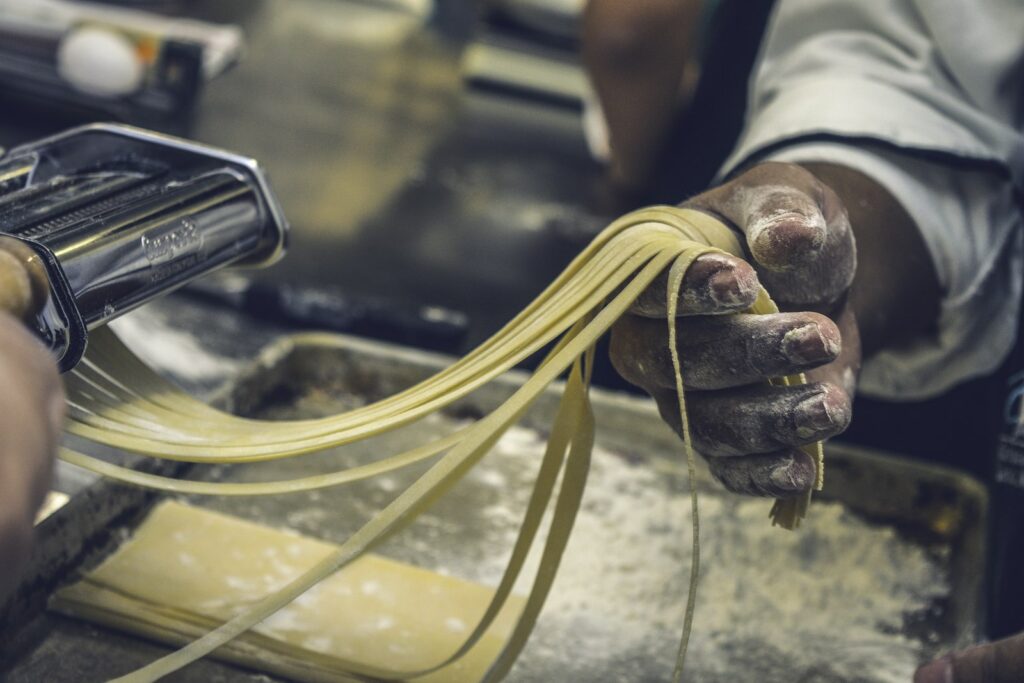
Most beginner workshops start with flour and eggs. You mix the ingredients, knead the dough until it becomes smooth, allow it to rest, then roll and cut it. Depending on the kitchen, you might use a rolling pin, a hand-cranked pasta machine or both.
The pasta shapes vary considerably between experiences.
- Fettuccine: Flat ribbons of egg pasta, commonly taught because beginners can make them without specialist equipment.
- Tagliatelle: Another ribbon pasta, similar to fettuccine. Workshops may use the terms loosely, although the traditional shapes and widths differ.
- Tonnarelli: Square-cut strands associated with Roman dishes such as cacio e pepe.
- Ravioli: Filled pasta that involves making the dough, preparing or adding a filling, sealing it and cutting individual pieces.
- Gnocchi: Small dumplings, often made with potatoes and flour. They require a different technique from rolled egg pasta.
A short class may concentrate on one shape. A longer workshop might cover two or three, although the extra dishes sometimes share the same batch of dough.
One useful question is whether each person makes their own pasta or the group works on a shared batch. Both approaches can work, but individual preparation generally gives you more practice with kneading and rolling.
Will you learn carbonara, cacio e pepe or amatriciana?
Rome’s four classic pasta sauces are frequently mentioned in cooking-class descriptions:
- Carbonara: Traditionally made with eggs, Pecorino Romano, guanciale (cured pork cheek) and black pepper. The main skill is combining the ingredients without scrambling the eggs.
- Cacio e pepe: Pecorino Romano, black pepper and pasta water. Getting a smooth sauce takes more attention than the short ingredient list suggests.
- Amatriciana: A tomato-based sauce with guanciale and Pecorino Romano.
- Gricia: Guanciale, Pecorino Romano and black pepper, without the tomatoes used in amatriciana.
There is an important distinction between a class that serves carbonara and one that teaches you to make carbonara.
Some workshops concentrate on fresh pasta while the chef prepares the sauces. Others involve participants in rendering guanciale, emulsifying cheese with pasta water or combining the carbonara sauce off the heat.
Also, traditional Roman restaurants frequently serve these sauces with dried pasta such as spaghetti or rigatoni. A fresh-fettuccine workshop paired with carbonara can be a useful cooking lesson without reproducing the exact pasta-and-sauce combination you would commonly find in a Roman trattoria.
Choose a sauce-focused class if you want to recreate Roman restaurant dishes at home. Choose a fresh-pasta workshop if kneading, rolling and shaping dough are your main interests.
What about tiramisù and gelato?
Many Roman cooking experiences combine pasta with a dessert. Tiramisù workshops commonly involve preparing a mascarpone mixture, dipping savoiardi biscuits in coffee and assembling the layers.
However, a three-hour class may not have time for participants to make every component from scratch. Some kitchens provide prepared ingredients or a dessert that has already been chilled.
Gelato is another popular addition. Check whether participants actually prepare the mixture or watch a demonstration. Both formats appear in Roman cooking-class listings.
How Much Does a Pasta-Making Class in Rome Cost?
Prices depend on the number of dishes, duration, group size, drinks, teaching format and location.
For budgeting, operator prices published in November 2026 include standard shared pasta-and-dessert sessions around €65 to €85 per adult, more elaborate Roman cooking experiences at approximately €125, and a specialist gluten-free workshop advertised at €149. These are examples from individual providers, not fixed citywide prices. Discounts, dates and booking channels can change the amount payable, and these figures should not be treated as confirmed 2027 prices.
The useful comparison is what you receive for the final amount.
What is normally included?
A typical hands-on class includes:
- A chef or cooking instructor, often teaching in English.
- Ingredients needed for the advertised recipes.
- Cooking utensils, work surfaces and equipment.
- An apron for use during the lesson.
- The pasta or other dishes prepared during the session.
- A seated meal after cooking.
- Water or another basic refreshment, depending on the provider.
Many operators include wine, prosecco, an aperitivo or a digital recipe booklet, but none of these should be assumed.
What might cost extra?
- Alcohol: One glass of wine may be included, while additional drinks are charged separately. Other experiences include wine throughout the meal.
- Extra courses: An antipasto, tiramisù or gelato might be included in one menu and offered as an upgrade in another.
- Special dietary arrangements: Some operators charge more for alternative ingredients or require a different class.
- Private instruction: A private chef, exclusive kitchen or customised menu may have a substantially higher total price.
- Transport: Travel to and from the kitchen is generally the participant’s responsibility.
- Tips: Gratuities are normally discretionary rather than part of the advertised lesson price.
Recipes are particularly worth checking. Some schools email them afterwards, others hand out printed instructions, and some provide no formal recipe at all.
If you want to repeat the dishes at home, ask whether the recipes include ingredient quantities, cooking times and sauce instructions rather than only a general description of the method.
Shared Class or Private Cooking Lesson?
A shared workshop usually offers better value for one or two adults who are comfortable cooking alongside strangers. Participants often work in pairs or small groups, with the chef moving between stations.
Look at the maximum number of guests and, just as importantly, how many instructors will be present. A class limited to twelve participants with one instructor can feel quite different from six participants with the same instructor.
A private class becomes more useful when you need flexibility. Consider one if:
- Your family includes young children who need extra supervision.
- You want to focus on carbonara, ravioli or another specific recipe.
- Someone has mobility needs that require a suitable kitchen setup.
- Your group needs instruction in a particular language.
- You have dietary requirements requiring a specially agreed menu.
- You want a cooking session at a time outside the standard timetable.
Ask for the total private-group price rather than comparing only the advertised price per person. Some private experiences have a minimum charge equivalent to several paying guests.
For someone mainly interested in eating traditional Roman pasta, a restaurant meal may make more financial sense. The added value of a workshop is the instruction and practical cooking time.
How Long Does the Experience Take?
Most standard classes last approximately two to three hours, including the meal. Some shorter workshops take around 90 minutes, while experiences incorporating market shopping or several courses can run four hours or longer.
A typical session follows this sequence:
- Arrival and introduction: The instructor explains the menu, equipment and basic preparation.
- Making the dough: Participants combine ingredients, knead and prepare the pasta.
- Resting and rolling: Dough rests before being rolled, cut or filled. Dessert preparation may happen during the waiting period.
- Cooking: The pasta is boiled and the sauces are prepared or finished.
- Eating: Everyone sits down to eat the dishes, often with wine or another drink.
Check whether the published duration includes the meal. A listing that advertises two hours of activity might allocate significantly less time to actual hands-on cooking.
A three-hour evening class beginning at 6:30 pm could finish around 9:30 pm. Avoid arranging a timed attraction, train departure or another dinner reservation immediately afterwards. Cooking and serving times can vary slightly.
Dietary Requirements: What to Confirm Before Booking
Fresh pasta workshops frequently use wheat flour and eggs, and traditional Roman sauces can contain pork, dairy and other animal products. Dessert may add further allergens.
Tell the provider about dietary needs before paying, even if a booking platform shows a general dietary-options label.
Vegetarian and vegan participants
Cacio e pepe contains no meat, but traditional Pecorino Romano may be made with animal rennet, which matters to strict vegetarians. Carbonara, amatriciana and gricia normally include guanciale.
Vegetarian alternatives may be available with advance notice. Vegan options require more substantial changes because fresh egg pasta, cheese-based sauces and tiramisù all commonly contain animal products.
Ask which complete dish you will prepare and eat. A vegetarian alternative served at dinner does not necessarily mean you will learn to cook that alternative during the workshop.
Gluten-free cooking and coeliac disease
This needs particular attention because flour is handled directly in pasta classes.
A provider offering gluten-free pasta to eat may still run the activity in a kitchen where other participants knead ordinary wheat dough. That arrangement may be unsuitable for someone with coeliac disease.
The Italian Coeliac Association’s guidance on gluten contamination explains why shared surfaces, utensils and preparation procedures matter.
For coeliac guests, ask whether the entire lesson is gluten-free, how the kitchen prevents cross-contact and whether the instructor can accommodate the participant safely throughout the cooking process. A dedicated gluten-free cooking facility or an appropriately controlled private class may be more suitable than a standard shared workshop.
Other allergies and food restrictions
Eggs, milk, wheat and sometimes nuts appear in cooking-class menus. Tiramisù can also contain alcohol or ingredients involving uncooked eggs, depending on the recipe.
Guests with severe allergies, pregnant participants concerned about specific ingredients, and those avoiding alcohol should obtain clear confirmation of the actual recipe and preparation method.
Do not rely on a general promise that dietary preferences can be accommodated. Ask about the specific ingredients, equipment and cross-contact precautions relevant to your needs.
Are Pasta-Making Classes Suitable for Children?
Many workshops welcome families, but minimum ages vary. Some providers offer places for children as young as four, while other cooking experiences accept participants only from age twelve or have separate family sessions.
Check the age rules for the particular class, rather than assuming that every cooking school follows the same policy.
For younger children, ask whether:
- They can actively knead and shape their own dough.
- They must share a workstation with an adult.
- The instructor supervises knives, pasta machines and hot equipment.
- There is a reduced child price.
- Non-cooking infants or younger siblings can attend.
- Child-friendly drinks and suitable food are included.
Making fettuccine is often an approachable activity for school-age children. Longer lessons devoted to sauces and complex techniques may suit older children better.
A free infant place, where offered, does not necessarily provide an extra seat, workstation or meal.
Where Do Classes Meet, and Is Hotel Pickup Included?
Most city-centre cooking classes are meeting-point experiences. You go directly to a restaurant, cooking school or studio, and the lesson ends there.
Workshops operate in areas including Trastevere, Monti, the historic centre, Prati and other neighbourhoods. Some descriptions reference a famous landmark even though the kitchen is several streets away.
Before the day of the class, save:
- The complete street address, including building number.
- The actual entrance or meeting location if different from the kitchen.
- The start time and requested early-arrival time.
- A working contact number for the organiser.
- Any entrance instructions, such as a particular door or business sign.
Allow approximately 10 to 15 minutes for arrival unless your confirmation specifies otherwise. Some providers cannot admit late participants once the group has begun cooking.
Public transport is normally sufficient for centrally located workshops. Rome’s operator ATAC publishes current ticket options and fares for buses, trams and the metro.
Check the final walking route, particularly in Trastevere or the historic centre, where cobbled streets and limited vehicle access may make door-to-door taxi travel less straightforward.
Hotel pickup should only be expected when explicitly included. A private cooking class does not automatically come with a driver or transfer.
Can you bring luggage?
Do not assume a kitchen can store suitcases. Cooking studios may have limited space, and bags cannot always be kept near food-preparation areas.
If your class falls between hotel checkout and an evening train, arrange luggage storage separately or ask the organiser in advance whether secure storage is available.
Small backpacks and coats are generally easier to accommodate, but even these may need to be left away from the cooking stations.
Accessibility, Standing Time and Weather
Cooking typically involves periods of standing, reaching across a work surface and using both hands. Some older buildings also have steps, narrow entrances or toilets that are difficult to access with a wheelchair.
For anyone with reduced mobility, ask whether the premises have step-free access, an accessible toilet, a suitable worktop height and seating available during the preparation stages.
If a participant cannot stand for long, check whether they can knead and shape pasta while seated. A private session may allow more adjustment, but accessibility needs to be confirmed rather than assumed.
Most cooking workshops take place indoors, so ordinary rain rarely prevents the class from running. Experiences that include an outdoor market visit are different. Ask whether a market component continues in bad weather, changes route or is replaced by another activity.
How to Book Without Missing an Important Detail
For a standard shared class, the process is usually straightforward: select a date, choose the number of adults and children, provide any dietary information and complete the payment.
However, the total cost and cancellation conditions may differ between the cooking school’s own website and a third-party booking platform.
Before paying, check these details:
- Menu: Which pasta shapes and sauces will participants prepare themselves?
- Dessert: Is tiramisù or gelato included, and is making it hands-on?
- Group size: What is the maximum number of participants, and how many instructors teach?
- Price: Does it include taxes, the meal, drinks and any advertised extras?
- Dietary needs: Have your specific requirements been accepted by the provider?
- Location: Where exactly do you arrive, and is transport included?
- Timing: Is the published duration for the entire experience, including eating?
- Payment: Is the full amount due immediately, or is a deposit required?
- Cancellation: What is the deadline for refunds, and what happens if the operator cancels?
Shared classes are often booked directly through an availability calendar. For private sessions, send the number and ages of participants, preferred date and time, requested menu, language requirements, dietary restrictions and any accessibility needs in the first enquiry.
This allows the provider to give you a quote for the actual experience rather than a generic starting price.
How far ahead should you reserve?
If you have a flexible schedule and no special requirements, you may find spaces close to the date. If your group needs a specific time, private instruction, a special menu or a dedicated gluten-free environment, earlier enquiries are more practical.
For travel in 2027, check the booking calendar for your actual date. A provider’s current advertised price, operating days or menu may change before your visit. A published schedule extending into 2027 is not by itself proof of confirmed availability for every session.
Fitting the Class Into Your Rome Itinerary
It helps to treat a pasta lesson as your lunch or dinner, rather than scheduling another full meal immediately afterwards. Many experiences include a substantial plate of pasta and dessert, with an aperitivo or starter in some menus.
A midday workshop can work well after a morning of sightseeing. An evening lesson is convenient when you want an indoor activity followed by dinner without changing locations.
If you are choosing between neighbourhoods, the Italy on Foot guide to Rome neighbourhoods explains how areas such as Monti, Trastevere and Prati relate to different parts of the city.
When building your sightseeing schedule around a confirmed cooking class, you can also use the Italy on Foot trip planner to organise the rest of your Rome itinerary and keep activities together by area.
Leave a buffer after the workshop for unexpected delays, especially if you need to reach Roma Termini or Roma Tiburtina for an evening train.
Cancellation Policies, Late Arrivals and Changes
Refund rules vary considerably between cooking schools. Some publicly listed workshops allow cancellation around 24 or 48 hours before the start. Others, particularly certain private or specialist sessions, require much earlier notice and may deduct an administration fee.
Never assume that every listing offering free cancellation uses the same deadline.
Check the policy attached to the particular ticket or quote. Pay attention to the difference between a refund, a credit for a future booking and permission to change dates.
What if you arrive late?
Contact the organiser as soon as you realise there is a problem. A cooking class may involve a coordinated sequence of preparing dough, resting it and cooking the meal. Late arrivals can disrupt that timetable.
Some kitchens may admit you partway through; others may refuse admission or treat the booking as a no-show. There is no general right to a refund because a bus was delayed or you could not find the entrance.
Keep the booking confirmation and contact details accessible without relying entirely on an internet connection.
What if the provider cancels?
Small-group workshops can sometimes depend on minimum participant numbers. Other cancellations may result from staffing or unexpected kitchen problems.
Before paying, confirm whether the organiser offers a refund if the class cannot operate, whether a replacement date is optional and how the payment will be returned.
If the venue or meeting address changes, request the new details in writing. Do not assume a replacement location is within walking distance of the original one.
What if the promised menu changes?
Ingredient availability or dietary arrangements may occasionally require substitutions. A small adjustment to a sauce is different from losing a major advertised part of the experience.
If you booked specifically to learn ravioli and are told that the class will only prepare fettuccine, ask the organiser to clarify the change before the session begins. Keep a copy of the original description and your confirmation if you need to raise the issue with the operator or booking platform.
Which Type of Pasta Class Makes Sense for You?
The most useful way to choose is to decide what you want to learn.
- For a first cooking lesson: A two- to three-hour fresh-pasta and tiramisù class provides a manageable introduction and a meal.
- For serious Roman cooking: Look for a workshop that explicitly teaches the sauce techniques behind carbonara, cacio e pepe, amatriciana or gricia.
- For families: Choose a class with a stated child policy, manageable group size and plenty of dough-shaping time.
- For travellers with coeliac disease: Prioritise verified kitchen procedures and safe ingredients over a general gluten-free menu label.
- For a group celebration: Compare private-session quotes based on the total group cost, included food and drinks, and flexibility.
- For a limited budget: A shorter shared workshop focused on one pasta shape may be enough. Paying more for wine pairings or extra courses is unnecessary if you primarily want to learn the dough technique.
Before confirming, make sure you can answer three questions: What will I make with my own hands? What exactly will I eat and drink? What happens if I need to cancel? If the description leaves any of those unclear, obtain an answer in writing before paying. Those details matter far more than how many dishes appear in the class title.