On the Amalfi Coast, a bus timetable is a departure plan, not a boarding guarantee. In peak season, passengers queue for SITA Sud buses at terminals such as Amalfi and Sorrento, but boarding stops when the vehicle reaches capacity. At intermediate stops, an already-full bus may take few passengers or none at all. The safest way to handle Amalfi Coast bus queues is to buy your ticket first, identify the correct destination line, arrive with time to spare, and keep at least one later departure as a backup.
Current service note, 22 August 2026: the standard Sorrento–Positano–Amalfi journey is currently affected by the SS163 closure at Tordigliano. SITA Sud’s published temporary arrangement sends a number of Amalfi–Sorrento services via Agerola and operates separate connections between Amalfi and Positano. Check the latest SITA Sud service notice immediately before travelling rather than relying on an older timetable screenshot.
How the queue actually works
SITA Sud’s coastal buses are ordinary local public transport, not reserved-seat coaches. Buying a ticket does not reserve a particular departure or give you priority over people already waiting.
At a capolinea, or terminus, the bus starts its run and a queue normally forms before the vehicle arrives. Sorrento and Amalfi are therefore much better places to board a busy route than an intermediate roadside stop.
Once the bus arrives, passengers board until the driver considers the vehicle full. Standing passengers are normal on busy services. If there is no more capacity, the remaining passengers wait for another bus. There is no useful argument involving the timetable at this point: a ticket valid for the journey does not create extra space on the vehicle.
At an intermediate fermata, the situation is less predictable. SITA’s conditions state that stops are on request, so signal clearly to the driver when you want to board. If the bus is already packed, however, it may be unable to take additional passengers.
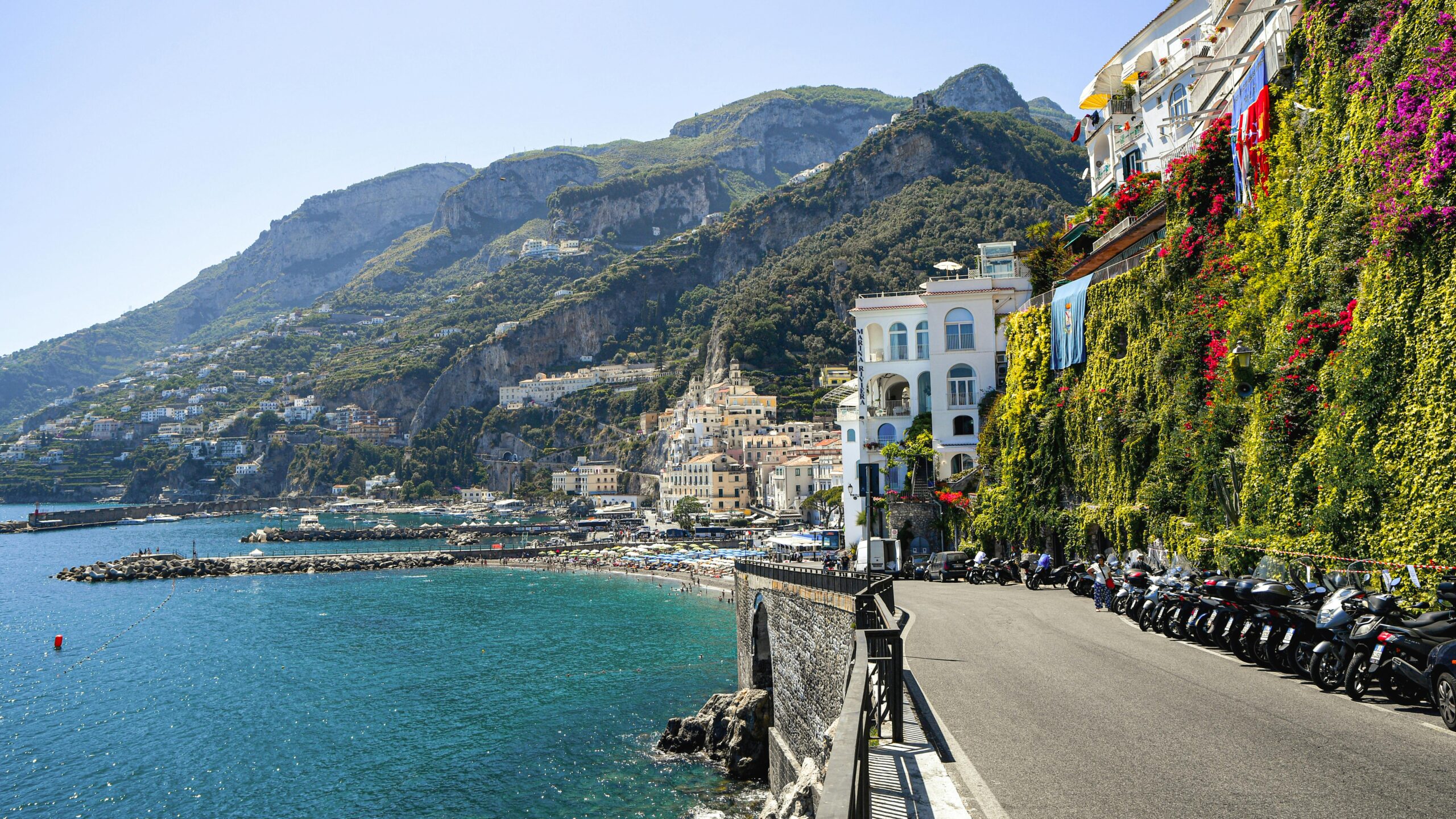
Amalfi: make sure you are waiting for the right bus
Amalfi is one of the coast’s main bus hubs. Buses converge around Piazza Flavio Gioia by the waterfront, with services heading toward Positano and Sorrento, Ravello and Scala, Agerola, Maiori and Salerno, and other destinations.
The practical problem is that a large crowd around the bus area is not necessarily one queue. Do not simply attach yourself to the longest line. Look at the destination displayed on the bus and any signs or instructions being given by staff.
If you are uncertain, ask a short question before committing to a queue:
- Per Sorrento? means “For Sorrento?”
- Per Positano? means “For Positano?”
- Per Ravello? means “For Ravello?”
- È questa la fila? means “Is this the queue?”
- Qual è il prossimo autobus? means “Which is the next bus?”
Being near the front for the wrong destination is not a victory. Check first, then wait.
Sorrento: queue at the start of the route
Under the normal routing, SITA buses for Positano and Amalfi leave from the area by Sorrento’s Circumvesuviana railway station. This is the western terminus, so everyone boarding there is competing for space on an empty bus rather than hoping for someone to get off first.
That makes Sorrento one of the more sensible places to start a coastal bus journey. It does not make the queues disappear. In summer, form your plan around boarding capacity rather than arriving two minutes before the printed departure.
If you have a train, tour, flight transfer, or boat connection later that day, do not choose a bus that works only if everything runs exactly on schedule. SITA itself warns that it cannot guarantee connections when services are delayed.
Positano: Sponda and Chiesa Nuova are not interchangeable
On the standard Sorrento–Amalfi route, Positano has two important SITA stops: Chiesa Nuova, high on the western side of town, and Sponda, on the eastern side.
When the normal route is operating, the order depends on direction:
- Heading from Sorrento toward Amalfi: the bus normally reaches Chiesa Nuova before Sponda.
- Heading from Amalfi toward Sorrento: it normally reaches Sponda before Chiesa Nuova.
This matters during crowded periods because boarding at the first Positano stop encountered by the bus can improve your chances before more passengers join. It is not a guarantee, especially if the vehicle arrived from Amalfi or Sorrento already full.
Do not blindly follow old online advice telling everyone to use one particular Positano stop. Direction matters, and temporary route changes can change the calculation completely. During the current August 2026 disruption, for example, SITA’s temporary Amalfi–Positano notice specifically refers to Positano Chiesa Nuova.
Walking between Positano stops also involves steep streets and stairs. Do not walk along an unsafe section of the SS163 simply to get “one stop ahead.”
Why intermediate stops are the biggest gamble
Praiano, Conca dei Marini, roadside sections of Furore, and other smaller stops have a structural disadvantage during peak season: passengers are trying to board a bus that began its journey somewhere else.
If twenty people leave the bus, space suddenly appears. If nobody leaves, everyone at the stop may continue waiting. That is why the printed arrival time at an intermediate stop tells you when a bus is supposed to pass, not how many people it will be able to carry.
For a journey you absolutely must make, use a simple rule: plan as though you might miss one bus because of capacity. Near the end of the service day, give yourself even more protection. The last suitable departure is a poor choice for returning to a hotel, catching a train, or reaching an airport.
Buy your ticket before you join the queue
Do not plan on buying an ordinary coastal ticket from the driver. SITA’s on-board sales arrangements apply only in specified circumstances and on specified services. For the coastal network, the safe assumption is that you need a valid ticket before boarding.
Tickets are sold through authorised outlets, including tabaccherie, bars and ticket offices listed by SITA Sud, and digital tickets are available through the UnicoCampania app. SITA publishes its current options and authorised sales information on its ticket page and ticket-office directory.
Buying first is especially important in a long queue. Discovering that you need a ticket when the bus doors open can mean losing the place you spent half an hour protecting.
Validation still matters
For ordinary tickets, SITA’s transport conditions require passengers to validate the ticket on each vehicle used. If the validator is unavailable or broken, SITA instructs passengers to write the date and time on the ticket.
The current COSTIERASITA ticket costs €10 and provides unlimited travel on eligible SITA Sud services in the listed coastal municipalities for 24 hours from first validation. It is personal and non-transferable. Follow the instructions printed on your particular ticket or shown in the official app.
The words to recognise are convalidare and obliterare, both used in connection with ticket validation.
Understand the timetable codes before joining a Sunday queue
The letters above SITA’s timetable columns matter. A departure shown on the wrong type of day is not going to appear simply because people are waiting for it.
- F means feriale, which on SITA’s coastal timetable means Monday through Saturday.
- H means festivo, covering Sundays and public holidays.
- G means the service runs every day.
- L indicates Monday through Friday on timetables where it appears.
Use SITA’s official route page instead of assuming a timetable saved months earlier is still valid. Seasonal schedules, road restrictions and local events can all alter coastal services.
What to do with luggage while everyone is trying to board
SITA Sud allows hand luggage up to 50 × 30 × 25 cm free of charge if it can be kept with you without obstructing other passengers.
For luggage exceeding those limits, SITA currently requires a €1.50 luggage ticket for each applicable bag. Larger pieces go in the bus luggage compartment if sufficient space and permitted capacity are available. You load the bag yourself; the driver does not provide a checked-luggage service.
Have your luggage ready before the vehicle pulls in. Do not stand at the door opening a suitcase or searching for a luggage ticket while the rest of the queue is boarding.
More importantly, do not block the aisle with a full-size suitcase because you are afraid of putting it below. SITA’s rules specifically require luggage not to obstruct other passengers.
Children, strollers and reduced mobility
One child under six can travel free with each fare-paying adult provided the child does not occupy a seat and the accompanying adult can prove the child’s age if requested. SITA also permits strollers to be carried free when folded to reduce their bulk.
Fold a stroller before the bus arrives rather than attempting it in the doorway during boarding.
Travellers who require step-free boarding should be more cautious about relying on a particular crowded coastal departure. Vehicle accessibility and available space can vary, and a packed roadside stop is a poor place to discover that the next bus does not suit your needs. Contact SITA Sud about the specific journey in advance if boarding equipment or wheelchair space is essential.
Use ferries to remove the worst bus legs
During the main ferry season, you do not have to use the bus for every movement between coastal towns. Ferries can remove the most capacity-sensitive road journeys between places such as Salerno, Amalfi and Positano, while buses remain useful for Ravello, Agerola, Praiano and other places without equivalent boat connections.
A practical peak-season combination is often ferry for one long coastal leg and bus for the inland or uphill section. The trade-off is that ferries depend on sea conditions and generally stop operating earlier in the evening than the last buses, so check the return journey before setting out.
Our Amalfi Coast with a car vs no car comparison explains where buses, boats and driving each make sense. For a trip involving several Italian destinations, you can also plan your Italy route around the transport links instead of treating every town as an isolated day trip.
What to do when the bus arrives full
At Amalfi or Sorrento
Stay with the correct queue and ask staff whether another bus for your destination is expected. Additional operational decisions can be made on busy days, but never assume an extra vehicle will appear. Base your plan on the published service.
At Positano or another intermediate stop
If the bus cannot take passengers, you have three realistic choices: wait for the next suitable service, use a ferry where one exists, or arrange a licensed taxi or NCC private-car service.
Moving to an earlier stop in the route can sometimes improve your boarding chances, but only do this where you have a safe pedestrian route. The Amalfi Coast road has narrow sections with poor pedestrian space. Saving one bus is not worth walking around a blind bend beside traffic.
If several buses pass full
Reconsider the journey rather than automatically losing another hour to the same strategy. If your destination is served by boat, check the port. If you are returning to accommodation, ask whether a taxi can be shared with other stranded passengers heading in the same direction.
For Positano in particular, it can be useful to understand the town’s wider transport limitations before committing to a bus-only day. The practical transport section in our Positano guide covers the bus and ferry trade-offs.
Do not make the last bus your Plan A
A last bus is more vulnerable to every problem that has accumulated through the day: road traffic, earlier delays, a vehicle already full at your stop, temporary diversions, and unusually large evening crowds.
Check the final few usable departures, not merely the final one. Aim for a bus that leaves another workable service behind it. If a ferry is your backup, remember that the last boat may leave significantly earlier than the evening bus network.
The same rule applies in the morning when catching a flight or a reserved high-speed train. Do not calculate a transfer using the timetable’s theoretical arrival plus five minutes. Coastal road traffic can destroy that margin very quickly.
The simplest peak-season boarding strategy
- Check SITA Sud’s service notices on the day of travel, especially after bad weather, road incidents or local events.
- Confirm that you are reading the correct feriale, festivo or daily timetable column.
- Buy the correct passenger and luggage tickets before joining the crowd.
- At Amalfi, confirm the destination before assuming you have found your queue.
- At roadside stops, stand visibly at the marked stop and signal the approaching bus.
- Use a terminus whenever practical if boarding capacity matters.
- In Positano, pay attention to direction when choosing between Sponda and Chiesa Nuova.
- Assume you could miss one departure because the bus is full.
- Never rely on the final bus for a critical connection.
- When the road network is struggling, use a ferry for any suitable coastal leg instead of spending the afternoon watching full buses pass.
The timetable tells you when to expect the bus. In summer, your real job is making sure you are standing in the right place, with the right ticket, early enough that the bus still has room for you.