Short answer: Salerno is usually the easier arrival for Amalfi, Minori, Maiori, Cetara and often Positano because the railway station is close to the main coast ferry pier. Naples makes more sense if you are flying into Capodichino, spending time in Naples first, combining the trip with Pompeii or Sorrento, or can match your arrival to a direct ferry from Molo Beverello.
For most travelers, Salerno vs Naples for Amalfi Coast comes down to transfers rather than distance. Arriving by train in Salerno can mean walking from the station to the ferry and boarding for the coast. Arriving in Naples usually leaves another decision: cross the city to a ferry, take a train onward to Salerno, use a direct bus, or pay for a road transfer.
The simple decision: choose by how you are arriving
Coming by train from Rome, Florence, Bologna or Milan? Choose Salerno if a convenient direct train is available. Both Trenitalia Frecciarossa and Italo serve Salerno, so you do not automatically need to get off in Naples. Trenitalia’s high-speed network continues through Naples to Salerno, while Italo also runs direct services from major northern cities.
Flying? Naples Airport has the much larger flight network, so it remains the normal air gateway for international travelers. But Salerno Costa d’Amalfi Airport is worth checking before booking. If a suitable flight lands there, you are already on the eastern side of the coast and can avoid crossing Naples completely.
Already staying in Naples? Do not travel to Salerno automatically. Seasonal fast ferries run from Naples Molo Beverello to Amalfi and Positano, so a well-timed sailing can be easier than taking a train south and changing again.
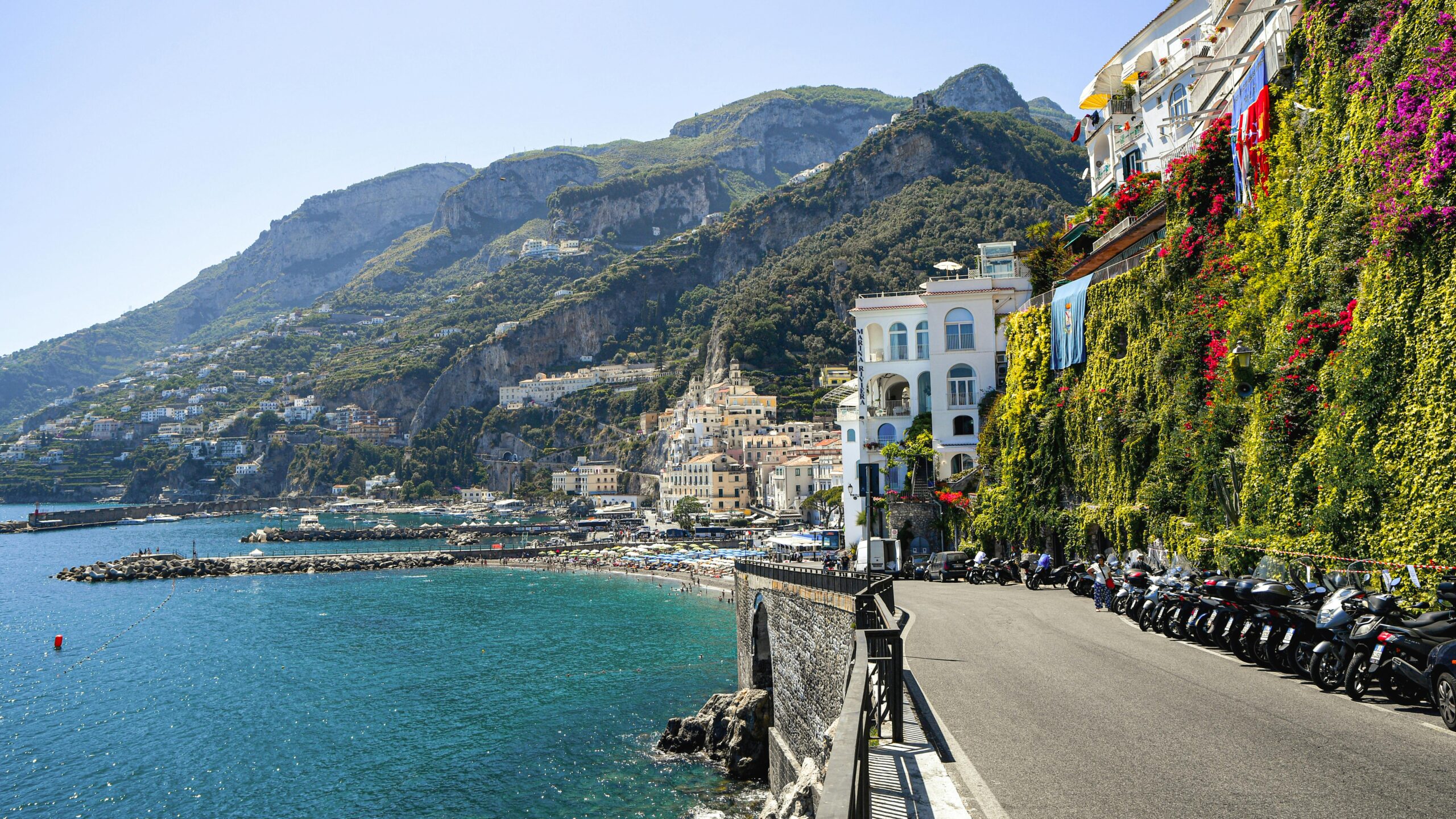
Why Salerno works so well for train arrivals
Salerno’s biggest advantage is physical layout. The railway station and the tourist port at Piazza della Concordia are close enough to connect on foot. Travelmar describes the walk from the station to Molo Concordia as roughly ten minutes.
The sequence is refreshingly short:
- Get off your train at Salerno.
- Leave through the main station exit and head toward the waterfront and Piazza della Concordia.
- Check which pier is printed on your ferry ticket.
- Board the coast ferry with no additional city transport required.
That last point matters with luggage. You are not dragging a suitcase into a metro station, changing trains beneath Naples, finding a bus stop and then joining a coastal bus queue.
On Travelmar’s 2026 timetable, ferries from Salerno Concordia take about 35 minutes to Amalfi and about 70 minutes to Positano, with additional services serving places such as Vietri sul Mare, Cetara, Maiori and Minori. The published 2026 full fares are €12 from Salerno to Amalfi and €17 to Positano.
Do not confuse Concordia with Molo Manfredi
“Salerno port” is not one single boarding point. This is an easy mistake to make when booking different ferry companies.
Salerno Concordia, sometimes shown as Piazza Concordia or Porto Turistico Masuccio Salernitano, is the convenient pier beside the railway-station end of the city. Most Travelmar coast departures use this area.
Molo Manfredi is farther west along the waterfront near the Stazione Marittima. NLG, for example, publishes some Amalfi Coast departures from Molo Manfredi. If your ticket says Manfredi, do not walk to Concordia simply because someone told you “the ferry is beside the station.”
What arriving through Naples actually involves
Naples is not difficult, but it gives you more possible routes, which creates more opportunities to choose the wrong one.
Option 1: Naples Airport to Centrale, then train to Salerno
This is often the most dependable public-transport route when ferry times from Naples do not suit your flight.
The airport’s official transport information lists Alibus services from Capodichino to Piazza Garibaldi beside Napoli Centrale, with an approximate journey time of 15 minutes in normal conditions. From Napoli Centrale, trains continue to Salerno throughout the day. Italo’s fastest Naples-Salerno services are currently scheduled at around 36 minutes, with Trenitalia providing additional services.
Once you reach Salerno, you make the short transfer to Concordia and continue by ferry.
It sounds strange to fly into Naples and then travel away from the coast before approaching it from Salerno, but for Amalfi, Minori or Maiori this can be much calmer than tackling the SS163 coastal road from the Naples side.
Option 2: Naples Airport straight to Molo Beverello
Alibus also runs from the airport to the port area at Molo Beverello. The airport publishes an approximate airport-to-port journey of 35 minutes, although Naples traffic can stretch that considerably.
From Beverello, NLG operates seasonal 2026 sailings to both Amalfi and Positano.
This can be an excellent connection if your flight arrives early enough and the timetable lines up. Check the individual sailing carefully, though. Some published Naples-to-coast departures involve a vessel change at Capri rather than a single uninterrupted boat journey.
Direct fast ferries from Naples are also considerably more expensive than Travelmar departures from Salerno on the current 2026 fare schedules, so “direct” does not necessarily mean best value.
Option 3: Napoli Centrale to Molo Beverello
If you arrive in Naples by train and want the direct ferry, you still need to cross central Naples. The usual public-transport route is to descend from Napoli Centrale into the connected Garibaldi metro station, take Metro Line 1 toward Municipio, then walk down to the Beverello ferry terminal.
With one small bag, that is manageable. With two large suitcases, children and a hot August afternoon, the Salerno train-and-walk connection starts looking rather attractive.
Which arrival is easiest for each Amalfi Coast town?
Amalfi
Salerno wins for most rail travelers. You can arrive by mainline train, walk to Concordia and take a ferry directly into Amalfi’s harbor. Naples works well only when a Beverello sailing fits neatly with your arrival or you are already staying in the city.
Minori, Maiori, Cetara and Vietri sul Mare
Salerno is the clear choice. These towns sit on the eastern half of the coastline, and direct coast ferries from Salerno avoid travelling all the way around from the Naples side.
Positano
Salerno usually has the cleaner transfer, but Naples can compete. Travelmar’s current Salerno-Positano journey is about 70 minutes and starts close to Salerno station. Naples offers seasonal direct fast ferries from Beverello, which can be convenient if you arrive at Naples Airport and have a comfortable connection.
If you are deciding solely on ease with luggage, the Salerno station-to-pier setup is hard to beat.
Ravello
Ravello has no railway station and no sea-level ferry port. The straightforward public-transport approach is usually Salerno to Amalfi by ferry, followed by the bus or a taxi uphill to Ravello.
Do not search for a “Salerno to Ravello ferry.” The sea portion ends in Amalfi.
Praiano, Furore and Agerola
These require more attention because the useful stop may be above sea level rather than at a ferry landing. SITA’s 2026 network includes routes through Conca dei Marini, Furore and Agerola, and the operator is also publishing a seasonal 5131 service from Salerno Costa d’Amalfi Airport toward the coast.
For these villages, compare the exact address of your accommodation with the bus stop before deciding which airport or city is “closer.” A hotel labelled Praiano can still involve a steep road or staircase from the waterfront.
What changes if you land at Salerno Costa d’Amalfi Airport?
Do not confuse Salerno Airport with Salerno railway station. The airport is outside the city near Pontecagnano, so landing there does not put you within walking distance of the Concordia ferry pier.
The airport can nevertheless be the easiest possible arrival when your flight and onward transport match. SITA’s summer 2026 line 5131 serves the airport and continues toward Vietri, Cetara, Maiori, Minori, Amalfi, Conca dei Marini, Furore and Agerola.
The catch is frequency and seasonality. A smaller airport does not give you the constant onward options of a major railway station. Check the timetable for your actual travel date rather than assuming a bus will be waiting for every flight.
Luggage favors Salerno, with one small catch
Travelmar includes one piece of hand luggage up to 45 x 35 x 20 cm in the standard ticket. Larger or additional bags require a luggage ticket under the company’s conditions of transport.
You remain responsible for carrying, loading and watching your luggage. The crew can also refuse unusually bulky items when space or safety makes them unsuitable for the vessel.
Even with that extra luggage charge, the Salerno route often feels simpler because the awkward part is short: station, pavement, pier, boat. The equivalent Naples journey may involve an airport bus or metro plus escalators, station corridors and a second transfer before you even reach the coast.
What to do when ferries are cancelled
A ferry should never be your only possible plan on the Amalfi Coast. Wind and sea conditions can cancel sailings, sometimes on a day that looks perfectly pleasant from your hotel window.
From Salerno, the main land backup is SITA Sud’s line 5120, which links Salerno with Vietri, Cetara, Maiori, Minori, Atrani and Amalfi. Check the current SITA Campania timetable because coastal schedules change by season and the service pattern can differ on Sundays and public holidays.
For Positano, you may need to reach Amalfi first and change, depending on the day’s bus pattern. Do not assume the bus replacing your cancelled ferry follows the same direct route as the boat.
It is useful to keep both the sea route and the road route visible while you organize the rest of your Italy trip, particularly on the day you have a flight or long-distance train to catch.
Late arrivals are where Naples loses its advantage
The later you arrive, the less useful the ferry network becomes. Coastal boats are daytime and early-evening transport, not a late-night airport shuttle.
If your flight lands at Naples after the useful ferries have finished, you have three realistic choices: continue by available train and bus services, book a taxi or private transfer, or spend the night in Naples or Salerno and reach the coast the following morning.
The last option is often the least stressful after a delayed evening flight. A midnight road transfer to a cliffside hotel is rarely the moment when you appreciate saving one hotel night.
The same principle applies in Salerno. Missing the final ferry does not strand you permanently, but it moves you onto the road network, where journey times depend much more heavily on traffic and the current bus timetable.
When Naples is actually the better choice
Naples deserves the win when your Amalfi Coast stay is part of a wider western Campania itinerary. Choose it when:
- you want several nights in Naples before the coast;
- you are visiting Pompeii or Herculaneum first;
- you are also staying in Sorrento;
- a direct Beverello ferry matches your arrival comfortably;
- your flight options to Naples are substantially better than those to Salerno;
- you have arranged a private road transfer and want door-to-door transport.
Naples is also the more logical base for Capri and the islands. There is little point travelling to Salerno simply to travel back across the Gulf later.
When Salerno is worth choosing even if your train passes through Naples
Stay on the train to Salerno when your first accommodation is in Amalfi, Atrani, Minori, Maiori, Cetara or Vietri and you want the fewest possible moving parts.
It is particularly sensible with children, a stroller or substantial luggage. One longer train ride followed by a short walk is usually easier than getting off earlier and assembling several shorter transfers.
For travelers debating whether to bring a rental car instead, the same transport logic is covered in Italy on Foot’s Amalfi Coast car versus no-car guide. Public transport is not perfect, but neither are coastal traffic, parking garages and the SS163 in August.
The easiest choice in one glance
- Direct train from Rome or northern Italy: Salerno.
- Amalfi, Minori, Maiori, Cetara or Vietri: Salerno.
- Positano: usually Salerno, unless a Naples direct ferry fits perfectly.
- Ravello: Salerno to Amalfi, then bus or taxi uphill.
- Flight with a convenient service into Salerno Costa d’Amalfi Airport: check the direct coastal bus before defaulting to Naples.
- International flight with many schedule choices: Naples Airport, then choose Beverello or the train to Salerno.
- Naples, Pompeii or Sorrento also on the itinerary: Naples.
- Heavy luggage and a long-distance train: Salerno.
- Late-night arrival: whichever city lets you stop for the night rather than forcing an awkward final coastal transfer.
If both train itineraries cost roughly the same and your first hotel is on the central or eastern Amalfi Coast, book through to Salerno. The extra few minutes on the train usually remove an entire layer of transport once you step onto the platform.