Do not buy a replacement boat ticket immediately. An Amalfi Coast ferry cancellation can mean one vessel is out of service, one port is temporarily unusable, or rough sea conditions are affecting several companies at once. Confirm what has actually been cancelled, keep your original ticket and booking details, ask about rebooking or a refund, then check the land alternative before leaving the pier. If you have a flight, train, or hotel check-in riding on the transfer, switch to the bus or taxi plan early rather than waiting for the sea to improve.
What to do as soon as your sailing is cancelled
- Confirm whether it is one departure or the whole route. An operator may cancel a single sailing for a technical reason while later departures still run. Bad weather is different: several departures, operators, or ports may be affected.
- Ask whether you can be moved to another departure. Do this before requesting a refund if you still want to travel by sea.
- Keep evidence of the disruption. Save the ticket, booking email, boarding card if one was issued, and any cancellation email, text, or screenshot from the operator.
- Check another operator only after confirming that its boat is actually running. A timetable showing a departure is not the same thing as a confirmed departure during rough weather.
- If you need to travel that day, check the bus situation immediately. Ferry passengers tend to make the same switch at the same time, so waiting an hour can turn a manageable bus queue into a much less pleasant one.
At the ticket window you may hear corsa annullata or corsa soppressa for a cancelled service, servizio sospeso for a suspended service, condizioni meteo avverse for adverse weather, mare mosso for rough sea, and rimborso for refund.
Three useful questions are:
- È annullata solo questa corsa o tutte le partenze? Is only this sailing cancelled, or all departures?
- Posso essere spostato sulla prossima corsa? Can I be moved to the next sailing?
- Come posso chiedere il rimborso? How can I request a refund?
Do not assume another ferry company solves the problem
On the Amalfi Coast, different companies can make different operational decisions because they use different vessels and routes. A technical failure affecting one boat does not necessarily stop the others.
Weather is the warning sign. If staff are talking about wind, swell, or unsafe docking conditions, do not walk from ticket office to ticket office buying speculative replacements. Ask the second operator specifically whether your exact departure is confirmed to operate.
Travelmar provides a live next-departures page, but information given by staff at the port remains important when conditions are changing quickly.
Your refund and rerouting rights
For most covered scheduled passenger ferry services leaving an EU port, EU passenger-rights rules require the carrier to offer a choice between reimbursement and rerouting after a cancellation. The rules have exceptions, including many sightseeing and excursion boats, so a coastal tour product should not automatically be treated the same way as a regular point-to-point passenger service. The European Union explains the distinctions on its official ship passenger rights page.
Severe weather also changes some entitlements. For covered services, bad weather does not simply turn a cancelled ticket into a lost ticket, but it can remove rights to accommodation or arrival-delay compensation that might apply in other circumstances.
Travelmar
Travelmar has a dedicated refund request procedure that includes an option for a trip cancelled by the operator. Its conditions also describe reissuing tickets on the same route following qualifying service failures. If you merely want to change the date or departure time instead of cancelling the booking, Travelmar asks passengers to contact the company rather than submit the refund form.
NLG
NLG publishes both passenger-rights information and an online refund request. Its rules for NLG tour products specifically provide a full refund when the whole tour is cancelled because of adverse weather or technical problems, with separate rules where only one portion of a multi-leg tour is lost.
Alicost
Alicost has an official refund form for tickets purchased online through its own website. If you bought through an agency or third-party booking site, check the ticket conditions before submitting anything directly to the ferry company, because the seller may need to process the refund.
Do not voluntarily cancel a booking in an app if the operator has already cancelled the sailing. Passenger-initiated cancellation terms can be less favorable than the procedure for a service cancelled by the carrier.
Best land backup from each main port
If you are in Amalfi
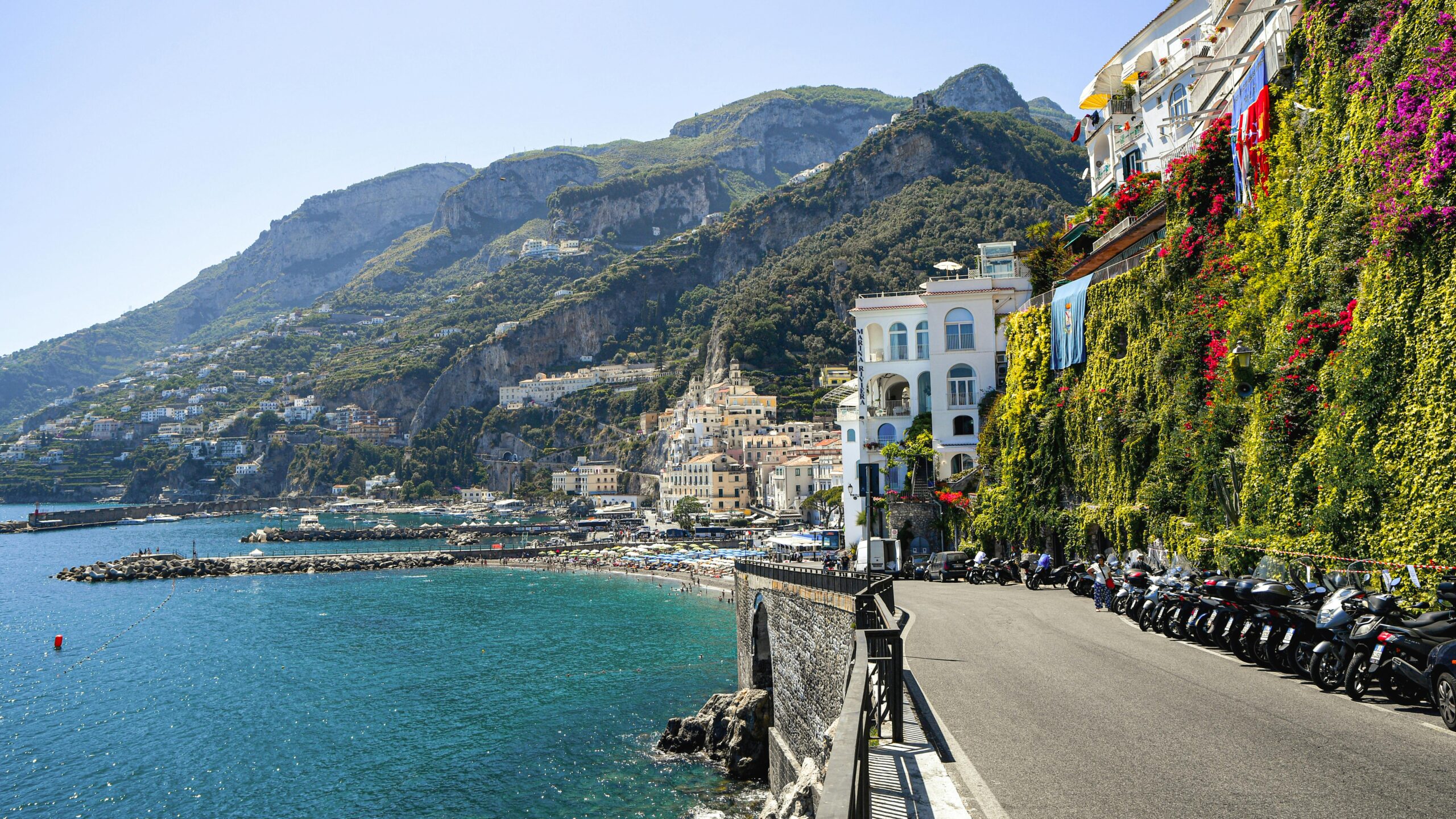
Amalfi is one of the easiest places to recover. Ferry boarding is on the waterfront, and the main SITA bus area is at Piazza Flavio Gioia, immediately around the seafront transport hub.
From here SITA services run west toward Praiano, Positano, and Sorrento, and east toward Atrani, Minori, Maiori, Vietri sul Mare, and Salerno. Check the current SITA Sud timetables rather than relying on a screenshot from earlier in your trip.
If your ultimate destination is Naples, Rome, or another city served by the national rail network, heading east to Salerno and continuing by train is often the cleaner recovery from Amalfi than spending hours working west toward Sorrento.
If you are in Positano
This switch requires more effort. The ferry lands down at Spiaggia Grande, while the intercity SITA buses use stops on the SS163 road much higher in town. You will see the names Positano Sponda and Positano Chiesa Nuova on SITA schedules.
Do not picture a flat port-to-bus interchange. With a suitcase, stroller, limited mobility, or a tired child, the climb from the beach level can be the hardest part of the backup journey. Ask locally about the easiest road-based route to the appropriate stop rather than automatically following pedestrian stairways.
For Naples, the usual land escape is west to Sorrento and then an EAV train toward Napoli. EAV publishes current Napoli-Sorrento services on its official railway timetable page. If you are travelling east toward Amalfi or Salerno, check the SITA destination displayed on the bus before boarding.
If you are in Salerno
Salerno gives you the most forgiving fallback. Travelmar uses the tourist port at Piazza della Concordia, close to Salerno railway station. If the coast boats stop running and your priority is reaching Naples, Rome, an airport connection, or another mainland city, walk back toward the station and switch to rail.
If you still need to reach the coastal towns, check the SITA service toward Vietri, Cetara, Maiori, Minori, and Amalfi. For a wider comparison of road and public-transport options, the Italy on Foot article on travelling the Amalfi Coast with or without a car is useful once the ferry plan has fallen apart.
If you are in Sorrento
Sorrento’s ferry port at Marina Piccola sits below the town and railway level. If your onward boat is cancelled, the practical land option is to get back up toward central Sorrento and the EAV station by local transport or taxi, especially with luggage, rather than treating the transfer as a simple platform change.
From Sorrento, SITA connects toward Positano and Amalfi while EAV trains run toward Pompeii, Ercolano, and Naples.
If your destination is Capri, there is no true land backup
A cancelled boat to Capri is different from a cancelled Amalfi-to-Positano sailing. You cannot finish that journey by bus or taxi.
If your operator says only its own sailing is affected, check confirmed departures from another company. If the cause is rough sea or port conditions, travelling overland to Naples or Sorrento in the hope that a boat will leave from there can waste several hours. Make that move only after confirming that the alternative port is actually operating departures to Capri.
If the day’s sea services are broadly suspended, the practical solution is usually to move the island visit to another day and reorganize the mainland part of the trip. You can use the Italy on Foot trip planner to rearrange the surrounding stops without rebuilding the itinerary from scratch.
Check the coast road before trusting the bus backup
Ferries are vulnerable to sea conditions, but the bus alternative has its own weak point: the SS163 coastal road. Rockfalls, accidents, traffic restrictions, and temporary closures can force SITA to divert services or alter which sections are served.
Before leaving the port, check the current SITA notices as well as the timetable. A scheduled Amalfi-Sorrento bus is not very useful if a temporary road closure has changed its route. This matters particularly around Positano and Praiano, where a diversion can affect the stop you planned to use.
Buying and using the SITA bus ticket correctly
Do not assume you can simply pay the driver on the coastal bus. SITA sells tickets through authorized sales points and digitally through services including UnicoCampania. On-board sales exist only in specified circumstances and on specified routes, so buying before joining the queue is safer.
SITA’s current conditions require tickets to be validated. If you are using a ticket that covers several vehicles, follow the validation instructions each time you board. A paper ticket that has not been properly validated can still be treated as invalid during an inspection.
Stops are generally request stops. At a roadside stop, make it clear that you are waiting for the bus, and press the stop button in good time before getting off.
What changes if you have luggage
A ferry-to-bus switch is much less graceful with a large suitcase. Under SITA Sud’s current Campania conditions, a piece of hand luggage up to 50 x 30 x 25 cm can travel free if it can be kept without obstructing other passengers. Larger or additional bags require a luggage ticket, currently €1.50 per piece, and oversized bags go in the luggage compartment subject to available space. Check the latest details in the official conditions of carriage.
At Amalfi and Salerno, the physical transfer is relatively straightforward. Positano is the problem case because the ferry dock and intercity road are at very different levels. If you have several heavy bags, paying for a taxi or arranged transfer can be worth far more than the euros saved by forcing the bus option.
If the replacement bus is full
Do not start walking along the SS163 because the queue looks hopeless. The coastal road is narrow, busy, and frequently unsuitable for walking with luggage.
At a major terminus such as Amalfi or Sorrento, remain near the correct departure area and ask staff which queue corresponds to your destination. At an intermediate stop, decide how many services you can realistically wait for before a fixed connection becomes endangered.
If you have a same-day flight, cruise departure, or non-flexible long-distance train, this is the point to price a taxi or private transfer. The cost is unpleasant; missing the connection is usually worse.
Late cancellations need a different strategy
Once the last useful coastal bus or ferry has gone, searching for a clever public-transport combination usually stops paying off. Ask your accommodation to arrange a licensed taxi or transfer, particularly if you are staying above Positano, in Praiano, Ravello, or an inland hamlet where the final leg is not walkable from a main bus stop.
If there is no time-critical connection that night, staying where you are and travelling early the next morning may be better than paying for a long after-hours road transfer. Confirm the next morning’s sea status before heading back to the pier, because rough conditions can continue beyond the first cancelled departure.
Keep every document until the money is back
Do not discard the ticket because the boat never left. Keep the booking code, original payment confirmation, any boarding card, the cancellation message, and the refund request confirmation. If separate legs were bought under separate booking references or from different companies, deal with each one separately unless an operator explicitly confirms that the bookings are protected together.
The safest recovery sequence is simple: confirm the scope of the cancellation, ask for rebooking before buying anything new, preserve the evidence, check both ferry and road conditions, and only then commit to the bus, train, taxi, or a changed travel day.