The best cities to visit in italy in april are the ones where you can spend an entire day on foot and never feel like you are missing something because you did not take a bus or hail a taxi. Italy has more genuinely walkable cities than any other country in Europe, and April is the month when walking them feels best: warm enough for long days outside, cool enough that you are not stopping every 20 minutes for shade and water. This is a ranked guide to the italian cities that reward spring travel italy on foot, with specific attention to weather, terrain, and the kinds of walking experiences each one delivers.
The Short Version
Ranked for April walkability: Venice (pure pedestrian city), Bologna (best in rain, porticoes, food), Lucca (calmest compact core, wall walk), Verona (prettiest classic center), Lecce (warmest, sunniest), Turin (arcades, museums, underrated), Trieste (best seafront wildcard). All offer flat or mostly-flat walking through historic centers where cars are restricted or absent. April temperatures (15-20°C) make all of them comfortable for full-day walking.
What Makes a City “Walkable” for April Travel
Walkability is not just about pedestrian zones. A truly walkable cities italy experience in April depends on four things: can you reach all the major sights on foot without public transport? Is the terrain manageable for long days (flat or gently hilly, not punishing staircase cities)? Does the city handle spring rain well, with covered walkways or sheltered routes? And is the city compact enough that walking feels efficient rather than exhausting?
The cities below all score high on these criteria. They are places where walking is not just possible but is genuinely the best way to experience everything. No buses needed. No taxi calculations. Just comfortable shoes and a direction.
Venice: The Ultimate Pedestrian City
Venice is the most walkable city in Italy because it is the only major city in the world where walking (and boats) is the only way to move. There are no cars, no buses within the historic center, no metro. You walk from your hotel to breakfast, from breakfast to San Marco, from San Marco to Rialto, from Rialto to a bacaro for cicchetti, and from there to wherever your feet take you. The city is officially framed as a place you navigate on foot or by vaporetto.
In April, Venice is at its walking best. Temperatures around 18°C and 9°C are comfortable for all-day wandering. The summer crowds have not yet peaked (though the access fee applies on April 24-30 in 2026, which signals busy days). The light on the canals in spring is extraordinary. And the joy of Venice walking is that getting lost is part of the experience: the city is small enough that every wrong turn leads somewhere interesting, and you are never more than 15 minutes from a landmark.
The caveats for April: Venice has no covered walkways to speak of, so rain means walking in rain. The stone surfaces are slippery when wet. And the acqua alta flooding, while more common in autumn and winter, is not impossible in spring. Check the forecast and bring water-resistant shoes.
Bologna: The Best All-Weather Walker
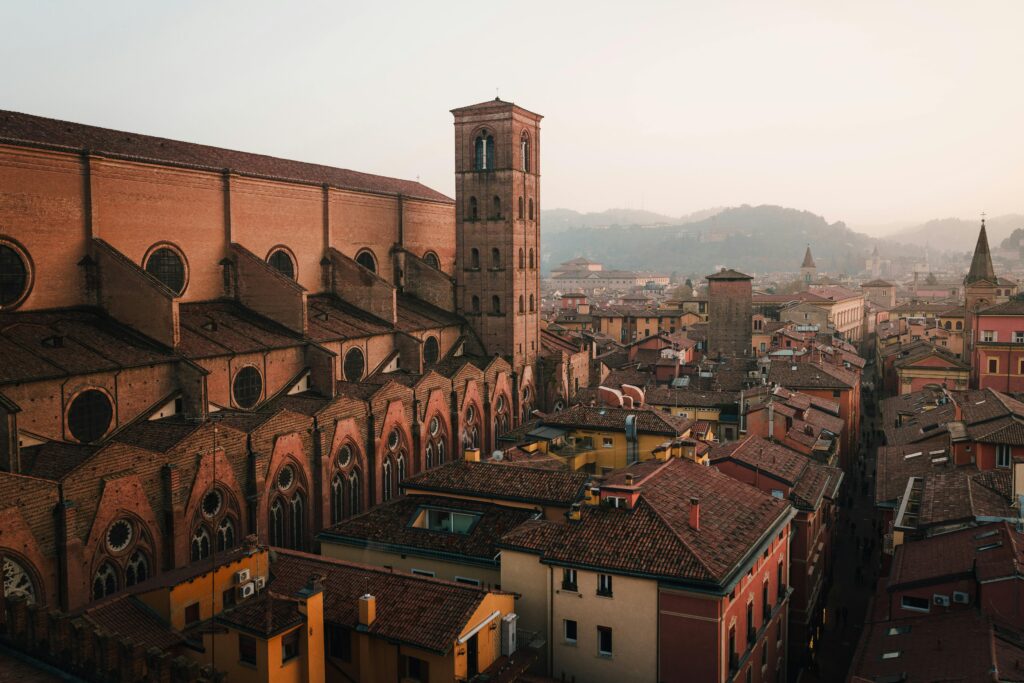
Bologna is the city where April weather becomes almost irrelevant to your walking plans. The 42 kilometres of porticoed walkways in the historic center mean you can walk from one end of the old town to the other, stopping at markets, churches, cafes, and piazzas, without ever being exposed to rain. No other Italian city offers this, and in a month where showers are frequent, it is a genuine superpower.
Beyond the porticoes, Bologna’s flat terrain, compact center, and pedestrian-friendly streets make it ideal for italy city breaks april. The main sights, Piazza Maggiore, the Two Towers, the university quarter, the food market Quadrilatero, and the basilica of San Petronio, all sit within a 20-minute walking radius of each other. The city’s food culture, widely considered the best in Italy, rewards the kind of slow, exploratory walking where lunch is a destination rather than an interruption.
Lucca: The Calmest Compact Core
Lucca offers a fundamentally different walking experience from the bigger cities: quiet, unhurried, and contained within a perfect ring of Renaissance walls. The walls themselves form a 4-kilometre elevated walking circuit, shaded by trees, used by locals for cycling and jogging, and offering views down into the terracotta roofscape of the old town. Walking the walls is the single best “city walk” in Tuscany, and in April the trees are green and the wildflowers are out along the ramparts.
Inside the walls, the center is flat, car-free in most areas, and small enough that you can cover every major sight in a day without rushing. Piazza dell’Anfiteatro (built on the foundations of a Roman amphitheater), the Guinigi Tower with its rooftop garden, the cathedral, and dozens of Romanesque churches fill the streets without the tourist density of Florence or Siena. Lucca is the best spring travel italy destination for people who want to walk at their own pace rather than race through a sightseeing checklist.
Verona: The Prettiest Classic-Center Stroll
Verona’s UNESCO center is one of the most visually rewarding compact walks in Italy. The Arena, Piazza Bra, Piazza delle Erbe, Juliet’s House, Ponte Pietra, and the Roman Theatre sit in a tight loop that you can walk in an afternoon. The city is flat along the Adige river, well-maintained, and the scale is small enough that nothing feels far away.
April temperatures (19°C/8°C) are ideal for this kind of gentle strolling. The city has less rain shelter than Bologna or Turin (no extensive portico system), but the compact layout means you are never far from a cafe or museum when a shower hits. Verona pairs well with a day trip to Sirmione or other Lake Garda towns (30 minutes by transport), adding a lakeside walking dimension to an already strong city base.
Lecce: The Warm-Weather Walker
Lecce is the best walkable city in Italy for travelers who prioritize sunshine. April temperatures average 18°C and 11°C with significantly less rainfall than the north, which means more consistent outdoor time and fewer rain-plan disruptions. The Baroque architecture of the old town, carved from honey-coloured local limestone, looks its best in direct April sunlight.
The walking pattern in Lecce is different from the northern cities: less density of “must-see” sights, more immersive neighbourhood wandering. You walk through ornate church facades, ducal gates, artisan workshops, and piazzas where the pace is genuinely southern Italian. The two-day walking route suggested by Italy’s national tourism board is essentially a chain of gates, piazzas, and churches linked by pedestrian lanes. It is the kind of city where the walk itself, not the destination list, is the point.
Turin: Superb for Arcades, Squares, and Museums
Turin is cooler than the other recommendations at about 15°C in April, which puts some travelers off. That is a mistake. The city’s 18 kilometres of arcaded walkways make it extraordinarily comfortable in variable spring weather: you walk from museum to cafe to piazza under continuous shelter, and the architecture around you is some of Italy’s grandest. The wide, elegant boulevards and the grid layout make orientation easy, which is a practical advantage that chaotic medieval centers like Venice and Bologna do not share.
For a museum-heavy walking trip, Turin is arguably the best city on this list. The Egyptian Museum, Cinema Museum, Automobile Museum, and the Savoy royal residences give you world-class cultural content connected by covered walking routes. The aperitivo culture, born in Turin, gives your walking days a natural evening endpoint: settle into a cafe around 6:00 PM and let the spritz and complimentary snacks restore your legs.
Trieste: The Best Underrated Seafront Option
Trieste is the wildcard that rewards travelers who have exhausted the obvious list. It sits at Italy’s northeastern tip, on the Adriatic, with a Habsburg-era center, a dramatic waterfront, and a literary cafe culture that feels more Central European than Italian. April temperatures around 18°C and 11°C come with brighter, breezier conditions than inland cities, and the seafront promenade adds a coastal dimension that no other walkable Italian city on this list offers.
The old town includes three large pedestrian areas, and the Piazza Unità d’Italia, open to the sea on one side, is one of Europe’s most dramatic squares. Trieste is compact enough to explore on foot in two days, and the cafe culture (Trieste was the coffee-import capital of the Habsburg Empire) gives you world-class espresso stops on every block. It is the least “obvious” city on this list, and that is exactly why it works so well for travelers looking for something genuinely different in spring.
How to Choose: Matching the City to Your Trip
The best cities to visit in italy in april depend on what kind of walking experience you want. For pure walkability with zero transport needed, Venice wins. For rain-proof all-weather walking, Bologna is unmatched. For calm, slow-paced exploration, Lucca. For the most iconic sights in the smallest space, Verona. For the warmest, sunniest walking days, Lecce. For covered-arcade comfort plus world-class museums, Turin. For seafront atmosphere and something different, Trieste.
Any of these seven cities delivers a spring travel italy experience that the bigger names (Rome, Florence, Milan) cannot quite match in April, because the bigger cities bring bigger crowds, bigger distances, and bigger logistical overhead. The cities on this list are the ones where walking is not just a way to get around. It is the entire trip. Lace up, head out the door, and let April do the rest.