The safest rule is simple: cover your shoulders and knees before entering an Italian church. A normal T-shirt with trousers, a below-the-knee skirt, or other modest clothing will avoid problems at most sites. The Italy church dress code is not one national rule enforced identically everywhere, however. Individual basilicas, cathedrals, and monument complexes set their own entry standards, and famous churches are much more likely to check your clothing at the door.
Hot weather is not an exception. Neither is having a ticket, joining a tour, attending for only five minutes, or having already waited in a security line. If a church has a published clothing rule, staff can refuse admission.
The safest definition of “shoulders and knees covered”
If several churches are on your sightseeing day, dress for the strictest one rather than trying to judge what each guard might accept.
- Shoulders: wear a top with actual shoulder coverage. T-shirts and short-sleeved shirts are the easy option. Tank tops, spaghetti straps, strapless tops, and sleeveless shirts are commonly prohibited at major churches.
- Knees: choose trousers or a skirt, dress, or other garment that clearly covers the knee. Clothing that ends noticeably above it is the problem.
- Chest and back: avoid very low necklines and clothing that leaves much of the back exposed.
- Hats: ordinary caps and sun hats should be removed inside. Several major sites specifically prohibit them.
- Footwear: there is no single rule for every Italian church. Some sites impose their own restrictions, so flip-flops or going barefoot can cause problems even when ordinary sandals are fine elsewhere.
Do not plan around borderline clothing. Shorts that ride above the knee when you walk or sit, a tiny cap sleeve that still exposes most of the shoulder, or a transparent cover-up can leave the final decision to the person controlling the entrance.
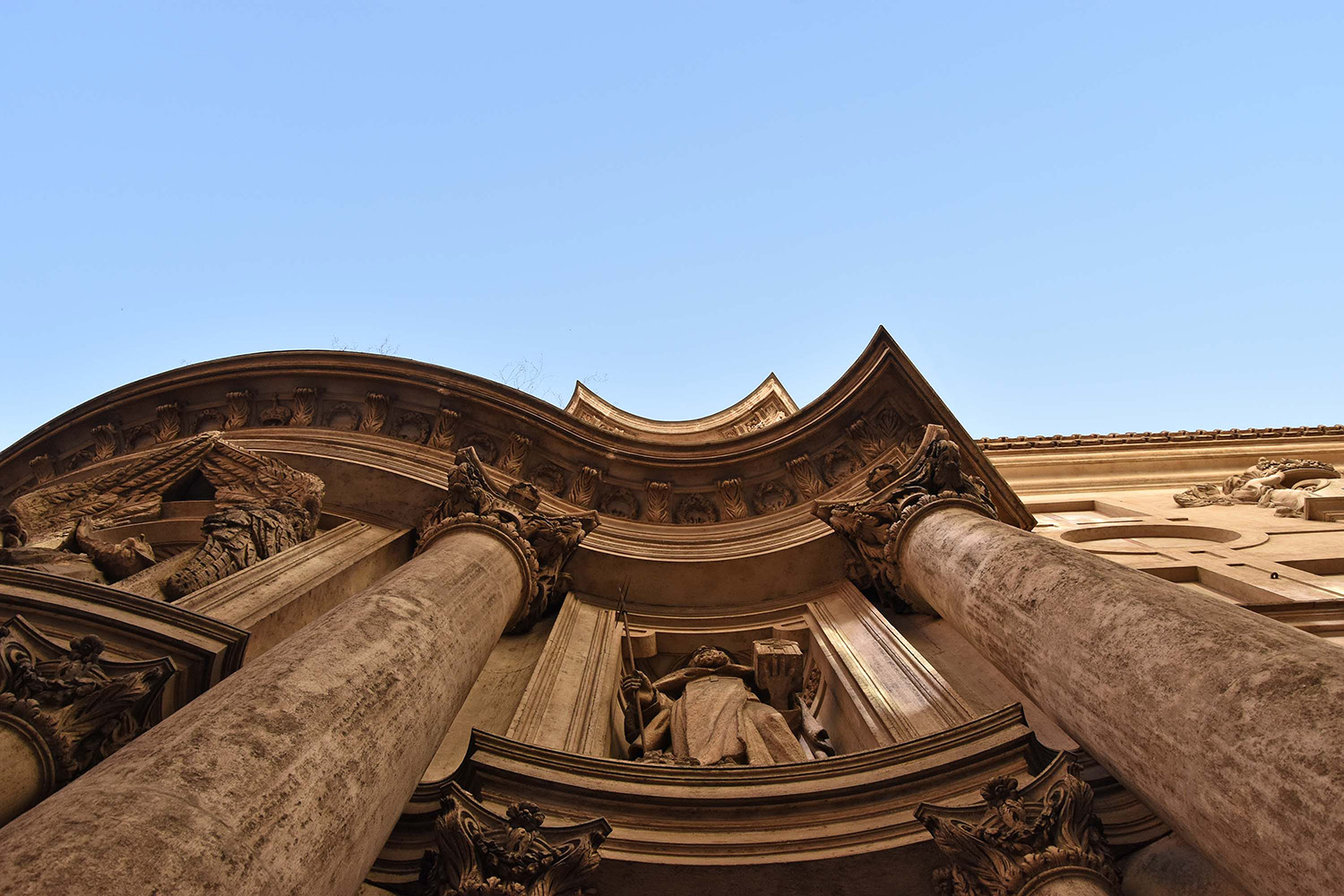
The Vatican is one of the places to be especially careful
The Vatican Museums’ official visitor information says that sleeveless or low-cut clothing, shorts above the knee, miniskirts, and hats are not permitted. The rule covers the Vatican Museums, Sistine Chapel, Vatican Gardens, and other Vatican visitor areas listed by the Museums.
St. Peter’s Basilica publishes its own wording. Its current official dress instructions require covered shoulders and specify long trousers for men, with trousers or skirts below the knee for women. That is stricter than simply assuming any pair of knee-length shorts will be accepted.
If your Rome day includes both the Museums and St. Peter’s, the low-risk choice is therefore trousers for men and trousers or a genuinely below-the-knee skirt or dress for women, plus covered shoulders for everyone. For more detail on the Vatican specifically, see the Italy on Foot guide to what to wear when visiting the Vatican.
Florence, Milan, and Venice show why the exact rules matter
Florence Cathedral
Florence’s Opera del Duomo currently states that appropriate clothing is required for the Cathedral and Baptistery. Bare shoulders and legs exposed above the knee are prohibited, and there is an extra detail many travelers miss: flip-flops are not permitted.
The official Florence Duomo FAQ also says this clothing rule does not apply to the other monuments in the complex. That distinction matters because a Duomo pass can cover several different attractions. If the Cathedral or Baptistery is part of your day, simply dress to the church standard from the start. The Italy on Foot overview of the Florence Duomo monuments explains how the different parts of the complex fit together.
Milan Cathedral
Milan Duomo requires appropriate clothing inside the Cathedral. Its official rules prohibit sleeveless or low-cut clothing, shorts, miniskirts, and hats. The rooftop areas also have practical footwear requirements because visitors use stairs and uneven walking surfaces.
Because the Milan wording does not give travelers a useful centimeter-by-centimeter test for shorts, treating covered knees as the safe standard is much easier than debating whether a particular hem is sufficiently long at the entrance. You can check the latest Duomo di Milano regulations before visiting.
St. Mark’s Basilica in Venice
St. Mark’s makes the rule unusually clear: shoulders and knees should be covered. Its access regulations also prohibit entering barefoot, and the Basilica has separate luggage restrictions that can cause just as much trouble as clothing if you arrive with a trolley or oversized bag.
The current requirements are published through the official St. Mark’s ticket office. This is a good example of why “I entered another church dressed like this yesterday” is not a useful argument. The building you are entering sets the rule.
What to wear in summer without roasting outside
The awkward part is that church clothing and August sightseeing clothing are not natural allies. You may be walking through a sunny piazza at 34°C and then immediately entering a cathedral that expects modest dress.
A few combinations work particularly well:
- Lightweight linen or cotton trousers with a short-sleeved top.
- A midi or maxi skirt with a T-shirt.
- A below-the-knee dress with covered shoulders.
- Light trousers with a sleeveless top plus an opaque overshirt that you put on before joining the church queue.
A thin button-up shirt is often more useful than a tiny scarf because it reliably covers both shoulders and upper arms and stays in place while you move through security. It also folds easily into a day bag.
If your sightseeing day mixes churches with outdoor ruins, viewpoints, and neighborhoods, it can help to organize the rest of your Italy route so you are not repeatedly changing clothes or carrying unnecessary layers across town.
Can you just carry a scarf?
For bare shoulders, an opaque shawl or large scarf can be useful, but it is smarter to consider it a backup rather than a guaranteed loophole. Staff are responsible for deciding whether your clothing satisfies that particular site’s rules.
A scarf tied around the waist to turn very short shorts into an improvised skirt is even less dependable. If you have an important timed visit, wear a garment that already covers your legs adequately instead of depending on a creative arrangement at the door.
Also avoid sheer fabrics as your only covering. If skin remains clearly visible through the material, you have created an argument you did not need to have.
Are shorts allowed in Italian churches?
Sometimes, but the length and the individual church matter. The Vatican Museums specifically prohibit shorts above the knee. St. Peter’s Basilica currently publishes the stricter instruction that men should wear long trousers. Florence Cathedral prohibits legs exposed above the knee. Other churches may simply display a general request for modest clothing.
For a day containing several major religious sites, long lightweight trousers remove almost all of this uncertainty. If you prefer shorts, check the official rules of the exact attraction rather than assuming one cathedral’s policy applies across Italy.
Do children have to follow the rules?
Do not assume that buying a child’s ticket or traveling with younger visitors creates an automatic dress-code exemption. For school-age children and teenagers in particular, use the same practical standard: covered shoulders and clothing reaching the knee or lower.
Very young children may encounter more flexibility at an ordinary parish church, but this is not something to build an important Vatican or cathedral reservation around. A lightweight outfit that meets the normal requirements is the simpler solution.
Sandals, flip-flops, and bare feet
Ordinary walking sandals are accepted at many religious sites, but footwear rules are a good example of local differences. Florence Cathedral and the Baptistery currently prohibit flip-flops. St. Mark’s access rules say visitors cannot enter barefoot.
There is little advantage in wearing beach footwear on a church-heavy sightseeing day anyway. Historic centers involve stone paving, steps, long periods standing in queues, and sometimes rooftop or tower climbs. Secure walking sandals or comfortable shoes solve both the access problem and the cobblestone problem.
Hats, tattoos, and clothing with slogans
Take off an ordinary sun hat, baseball cap, or similar headwear before entering a church unless signs or staff indicate otherwise. Religious head coverings are a different matter and should not be treated like casual tourist headwear.
The Vatican also warns that visible personal signs, including tattoos, can become an issue if they are considered offensive to Catholic religion, morality, or common decency. This does not mean tattoos in general are banned. The practical concern is offensive imagery or messages.
The same common-sense approach works for clothing. If a T-shirt carries graphic sexual imagery, deliberately insulting religious material, or an offensive slogan, cover or change it before visiting a place of worship.
Going to Mass is not a way around the dress rules
Italian churches are working religious buildings, even when their art and architecture attract large numbers of tourists. Entering for Mass, prayer, or another service is not a reason to dress less respectfully.
Also pay attention to the distinction between visita turistica and access for preghiera or celebrazioni. A cathedral may have separate doors, hours, or areas for worshippers and tourists. Follow the signs and staff directions rather than moving into a worship entrance because the tourist queue looks longer.
Useful Italian words you may see at the entrance
- Abbigliamento consono: appropriate or suitable clothing.
- Abbigliamento decoroso: respectable or modest clothing.
- Luogo di culto: place of worship.
- Spalle coperte: shoulders covered.
- Ginocchia coperte: knees covered.
- Non sono ammessi: are not permitted.
- Vietato l’ingresso: entry prohibited.
- Togliere il cappello: remove your hat.
You may not see a detailed illustrated poster. Sometimes the only warning is a small sign beside the door or a staff member stopping people immediately before the security checkpoint.
What to do if you are refused entry
Step out of the entrance flow and fix the specific problem. Put on your overshirt, change into longer clothing, remove the hat, or return after changing. Do not count on explaining that another guard or another church allowed the same outfit.
If you have timed admission, the stakes are higher. Correct your clothing before joining a long security line, because a dress-code refusal does not automatically entitle you to a later time slot or a refund. Some attractions have very limited tolerance for late arrival.
Street vendors around heavily visited churches may sell scarves or other cover-ups, but there is no reason to make your reservation depend on finding one, its price, or whether entrance staff consider it sufficient.
The easiest pre-church check
Before leaving your accommodation, look at yourself as you will actually arrive, without counting a jacket you plan to leave at the hotel. Shoulders covered? Knees clearly covered at the strict sites on today’s route? No very low neckline or bare back? Hat easy to remove? Footwear allowed at the specific cathedral? If the answer is yes, you can spend your time looking at the church instead of negotiating with the person guarding its door.