The boats are easier to use once you stop treating them as one network. The Lake Como ferry timetable is really a set of schedules: ordinary battelli and fast SR services on the Como-Colico axis, a separate Bellagio-Lecco line, and the frequent central-lake traghetto links between Bellagio, Varenna, Menaggio and Cadenabbia. For summer 2026, the current schedules run from 1 July through 4 October. Always use the date range on the official Navigazione Laghi timetable page, because spring, summer and winter PDFs are different.
First, choose the right type of boat
Battello: the ordinary passenger service
Battello is the useful word for the normal passenger boat. These services make more stops, take longer over a large section of the lake and are usually the better choice when the boat ride itself is part of the day.
From Como toward Bellagio and the central lake, an ordinary sailing can take around two hours or more depending on the stops. That sounds slow until you realize that the route passes Cernobbio, Moltrasio, Torno, Argegno, Lenno, Tremezzo and other villages. For sightseeing, that is a feature rather than a flaw.
Choose an ordinary boat when you have a large suitcase, want to make intermediate stops, are carrying a bicycle on a sailing that accepts bikes, or simply do not need to save an hour.
Rapido: look for SR in the timetable
Fast services are shown as SR, short for Servizio Rapido, and are normally printed prominently in the official PDF. They use hydrofoils or catamarans and skip many smaller stops.
A rapid service is the sensible choice for a time-sensitive journey such as Como to Bellagio, but it requires an additional fast-service fare. When using the official ticket search, select Includi servizio rapido or “Include fast service.” Do not assume an ordinary ticket automatically covers an SR sailing.
There is another catch that matters to travelers with luggage: fast vessels have stricter baggage rules. More on that below.
Traghetto: the central-lake ferry
Traghetto means ferry, and on Lake Como the word usually refers to the vehicle-carrying services around the central lake. The important ports are Bellagio, Varenna, Menaggio and Cadenabbia. Foot passengers can use these services too.
This is normally the network you want for simple hops such as Varenna to Bellagio or Bellagio to Menaggio. It has its own timetable, separate from the long Como-Colico passenger-boat sheet.
On direct central-lake sailings, typical scheduled journey times are about 15 minutes between Bellagio and Varenna, about 10 minutes between Bellagio and Cadenabbia, and about 15 minutes between Bellagio and Menaggio. Some departures travel via another port and take longer, so check the individual column rather than assuming every boat follows the same path.
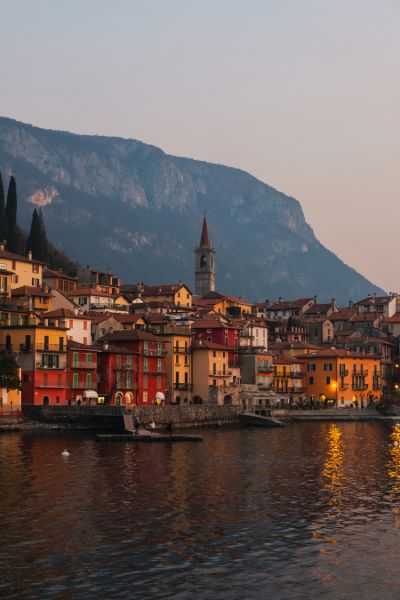
How to read the official timetable without getting lost
The PDF looks intimidating because dozens of departures are squeezed onto a single sheet. The trick is to read it vertically.
- Check the validity dates first. For the current summer schedule, use the PDFs marked 01/07/2026 to 04/10/2026. A beautifully saved timetable from June is still the wrong timetable in August.
- Choose the correct service. Como-Colico services, Bellagio-Lecco services and the central-lake ferry have separate sheets.
- Check the direction. The main passenger timetable has one direction for Como toward Colico and another for Colico toward Como.
- Find your departure town in the left-hand column. Then locate a departure time.
- Follow that same vertical sailing column to your destination. If the destination cell is blank, that boat does not stop there.
- Read the code at the top of the column. SR identifies a fast service. Other numbers are individual corse, or runs.
- Read the legend and footnotes. A small number beside a sailing can indicate routing via another town, passenger-only operation or a required change.
Do not build a route by reading along one horizontal row and choosing the next attractive-looking time. Each vertical column represents one actual boat movement through the lake.
The abbreviations travelers regularly misread
- Fer. means feriale. On the current Lake Como timetable, that means Monday through Saturday. Saturday is included.
- Gior. means giornaliero, running Monday through Sunday.
- Fest. means Sundays and the public holidays specified by that timetable.
- SR means Servizio Rapido, requiring the fast-service supplement.
- Part. is partenza, departure.
- Arr. is arrivo, arrival.
- Pontile means pier.
- Imbarcadero is the boat landing.
- Biglietteria means ticket office.
- Cambio a… means change at that port.
- Via… means the service travels via the named port.
- Solo passeggeri means passengers only.
The distinction between feriale and festivo causes a surprising number of mistakes. For the mid-lake ferry, use the weekday timetable on Saturday, not the Sunday and holiday sheet.
The central-lake timetable is the one most visitors actually need
For a day based around Varenna, Bellagio and Menaggio, there is usually little reason to study the enormous Como-Colico grid. Open the separate ferry timetable for Bellagio, Cadenabbia, Varenna and Menaggio instead.
Those short crossings make it possible to treat the middle of the lake almost like a small network. Varenna is particularly useful because it also has a railway station. Travelers arriving from Milan can get off at Varenna-Esino, walk downhill toward the lake following signs for Imbarcadero, and continue by boat to Bellagio or Menaggio. Allow roughly 10 to 15 minutes between the station and ferry area rather than treating them as one interchange.
The uphill walk matters even more in the opposite direction. If a train from Varenna-Esino is important, do not plan to step off a boat five minutes before the train. A sensible minimum is around 30 minutes between the scheduled ferry arrival and rail departure, with more time in busy summer periods or unsettled weather.
For rail options and the different ways of reaching the lake, see our guide to traveling from Milan to Lake Como.
Cadenabbia and Tremezzo are not interchangeable
This matters if Villa Carlotta is on your itinerary. Cadenabbia is part of the central-lake vehicle-ferry network, while Tremezzo is served by passenger boats on the longer lake route.
The official timetable notes roughly a 900-meter lakeside walk from Cadenabbia to Villa Carlotta, compared with about 450 meters from the Tremezzo pier. On foot, a boat calling at Tremezzo can therefore be the more convenient choice. With a car, Cadenabbia is the useful ferry port.
What happens when you reach the pier
Navigazione Laghi recommends arriving at the ticket office about 20 minutes before departure. In July, August and on busy weekends, giving yourself more time is sensible because the queue for tickets can become the real bottleneck.
- Check the destination and service number before buying.
- If taking an SR sailing, make sure the fast-service option or supplement is included.
- Look for the correct pontile. Como in particular has several adjacent piers, and more than one vessel may be boarding at the same time.
- Listen to shore staff rather than boarding the boat that merely looks as though it is leaving next.
- If your timetable shows a cambio, ask the crew where the change happens and whether you need to disembark immediately.
The operator specifically warns that several boats can be departing from the same port area. A two-minute question to the person at the gate is much cheaper than discovering you are heading toward Colico when you wanted Como.
Can you buy a ticket on board?
Yes, but the circumstances matter. If a port has no operating ticket office, tickets can be purchased on board without an additional charge. The timetable’s fare notes state that onboard purchase otherwise carries a €1 surcharge per passenger, baggage item or vehicle.
Buying online can remove the need to queue at the ticket counter, but still leave enough time to find the correct pier. Vessel capacity is limited, and a ticket does not make a crowded summer departure any less crowded.
The website’s “Booking Rapid Service” section can also be confusing. That reservation function is designed for qualifying season-ticket holders. Ordinary visitors normally use the regular ticket search and select a fast-service journey there.
Luggage can decide whether Rapido is a good idea
The 2026 baggage rules allow each passenger one piece of luggage free when it has a longest side of no more than 60 cm, a volume of no more than 40 dm³ and a weight of no more than 20 kg. Extra or oversized baggage is chargeable under the current tariff.
The important restriction is on fast vessels. According to the official 2026 baggage rules, accompanied luggage with a longest side above 60 cm is not accepted on hydrofoils and catamarans. Bicycles are also excluded from those rapid vessels.
That means a large checked suitcase can turn a tempting SR departure into the wrong choice. With substantial luggage, plan around an ordinary battello or an appropriate ferry instead of assuming the faster boat will take everything.
Baby strollers are carried free under the current baggage tariff. Bicycle carriage on ordinary boats can depend on the vessel and available space, and the timetable uses bicycle symbols to identify recommended, restricted or non-bicycle sailings.
Wheelchairs and reduced mobility
The timetable marks departures recommended for passengers using wheelchairs. Navigazione Laghi also warns that vessels can be substituted for operational reasons, which may change boarding conditions. If a particular sailing is essential, check with the operator rather than relying only on the wheelchair icon in a saved PDF.
This is especially important when an itinerary involves a train connection or an attraction reservation with little room for delay.
Which service should you choose?
- Como to Bellagio, with limited time: look for an SR service and pay the rapid supplement.
- Como to Bellagio, with scenery as the priority: choose an ordinary battello and treat the longer journey as part of the sightseeing.
- Varenna to Bellagio: use the central-lake ferry timetable. A direct crossing is normally around 15 minutes.
- Bellagio to Menaggio: use the central-lake timetable and check whether the sailing is direct or routed via another port.
- Bellagio to Villa Carlotta on foot: compare a passenger boat to Tremezzo with the ferry to Cadenabbia. Tremezzo leaves you closer to the villa.
- Traveling with a large suitcase or bicycle: do not make an SR sailing your default choice.
- Taking a car across the lake: use a route marked traghetto between the vehicle-ferry ports.
- Going between Bellagio and Lecco: open the separate Bellagio-Lecco timetable rather than searching the Como-Colico sheet.
For a multi-stop day, work backward from the one connection you cannot afford to miss, usually the final boat or a train from Varenna. Then plan the rest of your Italy route around that fixed point instead of trying to squeeze in one more village.
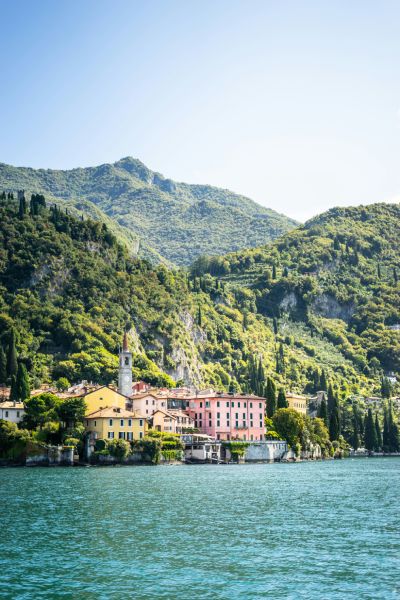
Do not rely on the last ferry of the night
Late service is not uniform around the lake. One central-lake pair may continue operating after another has finished, and weekday times can differ from Sundays and holidays. Always check the last departure for your exact origin and destination, not simply the latest boat you can see anywhere on the timetable.
This matters particularly in Bellagio. There is no bridge across the central lake. Miss the final boat to Varenna and a taxi cannot simply drive across the water; the road journey has to go around a branch of the lake. What looked like a 15-minute crossing can become a long and expensive recovery.
If you have an evening train from Varenna toward Milan, crossing from Bellagio earlier and waiting near the station is usually safer than gambling on the final workable connection.
What to do when the normal plan fails
The boat is delayed
Do not build a tight train transfer around the published arrival time. Port traffic, boarding and lake conditions can cause delays. If the onward connection matters, increase your buffer before leaving.
Your sailing disappears or is suspended
Strong wind, rough water and operational problems can alter or suspend services. Check the operator’s current notices on the morning of travel, particularly after storms or when lake levels are unusually high or low.
If a cancellation leaves you on the wrong shore, ask the ticket office about the next boat before committing to a road alternative. Depending on where you are, buses toward Como or Lecco and taxis may provide a backup, but they rarely reproduce the speed of a 10 or 15-minute central-lake crossing.
You boarded the wrong boat
Tell the crew immediately. Do not wait until the boat reaches a distant stop. Staff can tell you the first sensible place to get off and which return connection works with the remaining service.
You missed a connection at Menaggio or Bellagio
Look for cambio a Menaggio or cambio a Bellagio in the timetable legend. If a planned change has gone wrong because of disruption, speak to shore or onboard staff before buying a completely new sequence of tickets. They know which sailings are actually operating and which pier the replacement connection will use.
Drivers need to check ferry notices as well as times
Vehicle transport is allowed only between the stops designated for traghetto service. Cars queue separately for loading, so reaching the waterfront at the printed departure time is not the same as being ready to board. Leave additional time for the vehicle line in summer.
There is also a current operational restriction worth checking before driving. As of 22 August 2026, Navigazione Laghi has a notice in force limiting vehicles boarding Lake Como ferries to a total mass of no more than 10 tonnes because of the low water level. Ordinary cars are comfortably below that threshold, but the restriction can matter to heavier commercial vehicles and some large vehicles. Recheck the notices immediately before travel because temporary lake-level restrictions can be changed or removed.
Recheck the schedule whenever the season changes
Lake Como does not operate one permanent year-round boat schedule. Service becomes denser in the warmer months and contracts outside the main season. The current summer timetable ends on 4 October 2026, so anyone traveling after that date should wait for or download the next official schedule rather than planning from a summer screenshot.
The safest routine is simple: check the correct seasonal PDF when building the trip, check it again the evening before travel, and look at operational notices on the morning itself. Once you have the right sheet, the system is quite logical. The expensive mistakes usually come from using the wrong season, overlooking the SR label, or assuming every boat in the central lake follows the same route.