Lucca sits just 80 minutes west of Florence by regional train, but it operates on a completely different frequency. Where Florence packs millions of visitors into narrow streets between blockbuster museums, Lucca wraps you inside Renaissance walls that double as a shaded park. If you’ve already spent two days in Florence and want a slower pace, or if you’re looking for a Tuscan base that doesn’t require elbowing through crowds, Lucca deserves a serious look.
TL;DR: Lucca is a compact, walkable walled city about 1 hour 15 minutes from Florence by direct Trenitalia regional train (roughly €8-10 each way, no reservation needed). Go for the Renaissance walls you can walk or bike on top of, Piazza Anfiteatro, Guinigi Tower, and a calmer Tuscan rhythm. It’s not a Florence substitute – it’s a Florence antidote.
Why Lucca Feels So Different from Florence
Florence draws around 10-11 million tourist presences per year. Lucca recorded just under a million in 2023. You feel that gap the moment you step off the train. No lines snaking around buildings. No tour groups blocking sidewalks. Lucca has tourists, and its numbers are growing, but the ratio of visitors to residents is a fraction of what Florence deals with.
Make this trip easy: grab the step-by-step digital guide
The physical layout amplifies that calm. Lucca’s historic center is almost entirely pedestrianized, and it consistently ranks among Italy’s top cities for walkable space relative to its size. The streets are wide enough to breathe, the piazzas are generous, and you can cross the entire old town in 20 minutes without breaking a sweat. Florence’s center, by contrast, funnels you through tight corridors where a single stopped group can create a bottleneck.
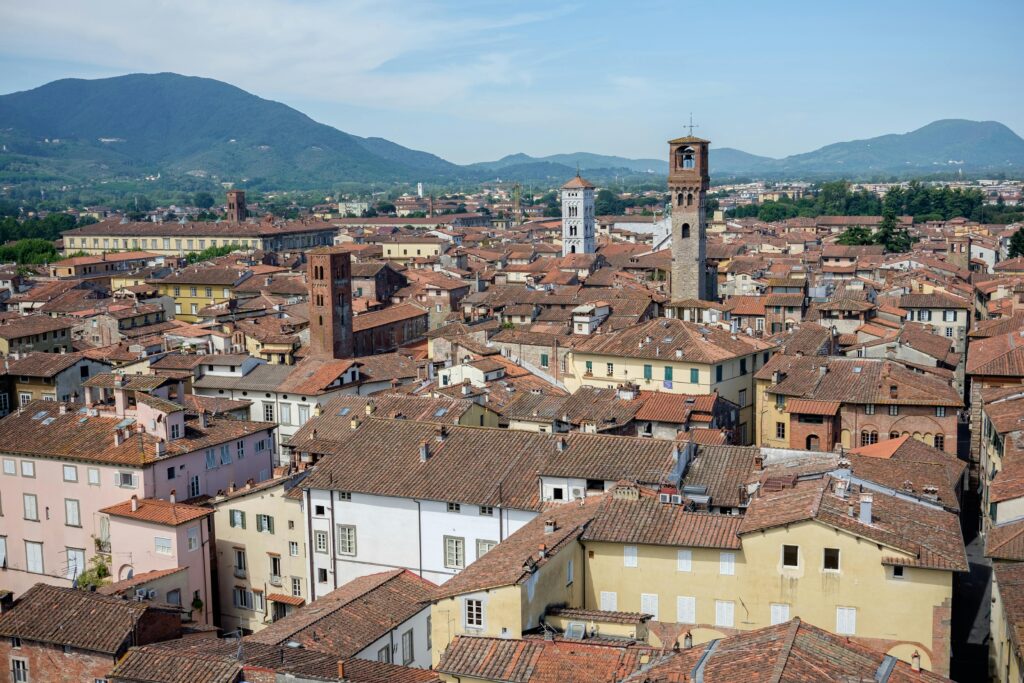
Then there are the walls. Lucca’s Renaissance-era fortifications were never torn down. Instead of being demolished like most Italian city walls, they were converted into a tree-lined promenade over four kilometers long. Plane trees, lime trees, and holm oaks shade the path. Locals jog here in the morning. Families cycle it in the evening. You can walk the full circuit in about an hour and look down at the city on one side, the Tuscan plain on the other. There is genuinely nothing like this in Florence, and few cities anywhere in Italy offer it.
About that “cooler” claim: it’s real but modest. Lucca’s average July high sits around 31°C compared to Florence’s 32°C, and Lucca sees roughly 12 days above 34°C in a typical summer versus Florence’s 20. Not dramatic on paper, but it matters when you’re walking all day. The walls provide shade, the pedestrian streets keep car exhaust at a distance, and the greenery helps. Lucca feels more walkable in August than Florence does.
Taking the Florence to Lucca Train
The Florence to Lucca train is one of the easiest day trips in Tuscany. You don’t need to plan much. You don’t even need to book in advance.
Trenitalia runs direct regional trains from Firenze Santa Maria Novella (Florence’s main station) to Lucca roughly every hour throughout the day. The journey takes about 1 hour and 15 to 20 minutes on a Regionale train. Tickets cost around €8-10 for a one-way second-class fare. No reservation is required or even possible on these regional services – you just buy a ticket, find a seat, and go.
If you’re staying in northern Florence, trains also stop at Firenze Rifredi, which might be more convenient. Both stations are well-connected to local buses. The route passes through Pistoia and Pescia, giving you glimpses of the Tuscan countryside rolling past the windows.
A few practical notes for the Florence to Lucca train that save headaches. If you buy a paper ticket at the station, validate it in the small machines on the platform before boarding. Electronic tickets bought through the Trenitalia app are already timestamped and don’t need validation. Regional tickets purchased online are valid on the train you selected and on any other regional train covering the same route within four hours, which gives you flexibility on the return.
Trains run from early morning (around 5:00 AM) until roughly 10:00 PM. Weekend service is slightly less frequent, so check the Trenitalia Tuscany Line page or the Trenitalia app for current schedules. The last trains back to Florence are late enough that you can comfortably have dinner in Lucca and still make it home.
Where does the train drop you off?
Lucca’s train station sits on Piazza Ricasoli, just outside the southern stretch of the city walls. Walk 200-300 meters from the station and you pass through one of the gates into the old town. No taxi needed, no bus transfer. The station has a ticket desk, a bar, and bathrooms.
What to Do in Lucca on Foot
Lucca rewards aimless walking in a way that Florence, with its must-see pressure, sometimes doesn’t. But here’s a loose plan for a day without rushing.
Walk the walls
Start here. The four-plus kilometers of Renaissance walls are Lucca’s signature, and morning is the best time to walk them. The air is cooler, the light is soft, and you’ll share the path mostly with locals walking dogs or commuting by bike. The walls are wide and flat, shaded by rows of trees. You get panoramic views in both directions. This isn’t a hike. It’s a stroll with an extraordinary vantage point.
Stand inside a Roman amphitheater
Piazza Anfiteatro preserves the oval footprint of a Roman amphitheater from the 2nd century. The arena is long gone, but the medieval buildings that grew on top of it followed the original curve. The result is an enclosed elliptical piazza, entered through narrow archways. Cafés line the perimeter. In the morning it’s quiet; by evening it fills with families and conversation bouncing off stone walls.
Climb Guinigi Tower
The 45-meter Guinigi Tower is immediately recognizable because holm oak trees grow from its rooftop. The climb is 230 steps with no elevator, up a narrow staircase. At the top, you get a 360-degree view of Lucca’s rooftops, the walls, and the Apuan Alps. If you have mobility issues, skip this one – there’s no alternative way up. But the view justifies the effort.
Visit San Martino Cathedral
Lucca’s cathedral sits on Piazza San Martino and is one of the richest churches in the city. The asymmetrical façade – one arcade is narrower than the others because the bell tower was already there – gives it a character that perfectly symmetrical churches lack. Inside, look for the Volto Santo, a wooden crucifix that has drawn pilgrims since the Middle Ages, and Jacopo della Quercia’s tomb of Ilaria del Carretto.
Find the Puccini connection
Giacomo Puccini was born in Lucca in 1858. His birthplace is now the Puccini Museum, a small house-museum that gives you a window into the composer’s early life. Even if you’re not an opera fan, it adds texture. Lucca produced the man who wrote La Bohème and Tosca. That’s worth a 20-minute visit.
Lucca vs. Florence: Choosing the Right Base
This isn’t really a competition. Florence and Lucca serve different purposes, and understanding that saves you from choosing wrong.
Florence is the masterpiece city. Its historic center is a UNESCO World Heritage Site, with six centuries of art visible in the Duomo, Santa Croce, the Uffizi, and the Pitti Palace. If your trip is built around Renaissance art, Florence is not optional. No amount of charm compensates for missing the Uffizi or standing under Brunelleschi’s dome.
Lucca is the livable city. It excels at slow urban pleasure rather than blockbuster accumulation. You come here to settle in, not to check things off. The walls, the piazzas, the cycling paths along the plain toward the Serchio River and the old aqueduct – these are experiences, not attractions. Lucca gives you an inhabited city, not a monument field.
The practical rule: if you have three days in Tuscany and haven’t been to Florence before, stay in Florence and day-trip to Lucca. If you’ve already done the Florence essentials, or if you dislike crowd density and want Tuscany at a slower rhythm, stay in Lucca. It also works beautifully as a base for Pisa (20 minutes by train), the Garfagnana valley, and the Versilia coast.
What to Eat in Lucca
Lucchese food is Tuscan but with its own local vocabulary. Two things you should try, at minimum.
Tordelli are half-moon pasta stuffed with meat and typically dressed in a simple ragù. They’re a Lucca specialty, not something you’ll find done this way in Florence or Siena. Every trattoria in the center makes them, but the ones slightly off the main piazzas tend to be better and cheaper. Ask for tordelli lucchesi and you’ll get the real thing.
Buccellato is a ring-shaped sweet bread studded with raisins and anise seeds. It’s subtle rather than sugary, meant to be eaten with coffee or as an afternoon snack. The traditional bakeries near San Michele in Foro and along Via Fillungo have been making it for generations. Buy a small ring and tear pieces off as you walk.
Lucca’s restaurants are generally less expensive than Florence’s, and the quality floor is higher because there are fewer tourist-trap operations. Look for places where the menu is handwritten or short. A four-course dinner with house wine will typically run €30-40 per person, compared to €45-60 in Florence’s center.
When Lucca Is Not Quiet
The “quieter neighbor” label has two major exceptions, and you need to know about them before you book.
Lucca Summer Festival runs through June and July, with major international acts performing in Piazza Napoleone and along the historic walls. The 2026 edition features Ludovico Einaudi, David Byrne, Jamiroquai, John Legend, Katy Perry, and Tom Jones, among others. During concert nights, the old town fills with thousands of music fans and hotels sell out. If you’re coming for quiet, check the Lucca Summer Festival schedule and plan around it.
Lucca Comics & Games runs from October 28 to November 1 in 2026, marking the festival’s 60th anniversary. It’s the largest comics and pop-culture convention in Europe. Over 280,000 tickets were sold for the 2025 edition, with 30,000 cosplayers filling the streets. The entire walled city becomes the venue. Check the official site for dates before finalizing travel plans.
Outside these events, Lucca is genuinely calm. Spring and early fall are ideal. Summer is busy but manageable. Winter is quiet and atmospheric, though some restaurants reduce their hours.
Getting Around Lucca Without a Car
You don’t need one. A car is actually a hindrance inside the walls. Parking is restricted in the historic center, and pedestrian zones mean you’d be leaving your car outside anyway.
Walking covers everything in the old town. The city is flat and compact. From the train station to Piazza Anfiteatro is about 10 minutes on foot. You can reach every major sight without ever needing transport.
Cycling is Lucca’s other mode. Bike rental shops cluster near the train station and along the walls. The flat terrain makes this one of the most genuinely bike-friendly cities in Italy. Beyond the walls, cycling routes extend along the old aqueduct, down to the Serchio River, and out toward Lake Massaciuccoli on gentle, flat paths through the Lucchese plain.
For getting to Pisa, Viareggio, or back to Florence, the train station handles everything. Pisa is 20-30 minutes away by rail. Lucca’s position on the network makes it a natural hub for car-free exploration of western Tuscany.
Is Lucca worth an overnight stay or just a day trip?
Both work, but an overnight unlocks Lucca’s best hours. Day-trippers leave by 6:00 PM. After that, the piazzas belong to residents. Evening passeggiata along the walls, dinner at a quiet trattoria, a nightcap in Piazza Anfiteatro under warm lights – this is Lucca at its finest, and you only get it if you sleep here.
Can you combine Lucca and Pisa in one day trip from Florence?
You can, but it’s a long day and you’ll shortchange both cities. If you insist, take the early train to Lucca, spend the morning, then hop a 20-minute train to Pisa for the afternoon. A better plan: give Lucca a full day and save Pisa for another trip.
Is Lucca accessible for travelers with limited mobility?
Mostly yes. The historic center is flat, a major advantage over hilly Tuscan cities like Siena or Volterra. The walls have ramps at several access points. Guinigi Tower has no elevator – 230 steps, no alternative. Most churches and piazzas are at ground level.
Florence to Lucca Train: Quick Reference
| Detail | Info |
|---|---|
| Departure station | Firenze Santa Maria Novella (or Firenze Rifredi) |
| Arrival station | Lucca (Piazza Ricasoli, inside the walls) |
| Journey time | 1 hour 15-20 minutes (Regionale) |
| Frequency | Roughly hourly, all day |
| Price | Approximately €8-10 one way (2nd class) |
| Reservation required? | No – open seating on regional trains |
| Where to buy | Trenitalia.com, Trenitalia app, or station machines |
| First / last train | Approx. 5:00 AM / 10:00 PM (check for your date) |
Lucca doesn’t try to compete with Florence, and that’s exactly why it works. Florence gives you the greatest concentration of Renaissance art on the planet. Lucca gives you a city where the walls are a park, the piazzas are for sitting, and the rhythm is set by foot traffic and bicycle bells rather than tour bus schedules. Take the Florence to Lucca train for the day, or better yet, stay the night. Either way, you’ll understand why so many repeat visitors to Tuscany quietly start spending more time here than they planned.
