Area B is the large low-emission zone covering most of Milan, while Area C is the smaller central restricted zone around the historic center, a limited traffic zone with a congestion charge. For most drivers, Milan Area B vs Area C comes down to two questions: is your vehicle clean enough to enter the wider city, and are you driving far enough into the center to cross a camera gate of the inner ring? If your destination is inside the inner ring, you normally have to satisfy both sets of rules, not choose between them.
The two zones at a glance
| Rule | Area B | Area C |
|---|---|---|
| Where | About 72% of the municipal territory, almost the whole built-up city | The central core inside the Cerchia dei Bastioni |
| Main purpose | Keep higher-emission vehicles out | Reduce both traffic and emissions in the center |
| Normal operating hours | Monday to Friday, 7:30 to 19:30, public holidays excluded | Monday to Friday, 7:30 to 19:30, public holidays excluded (a weekend extension has been announced, see below) |
| Cost for an ordinary eligible car | Free | Usually €7.50 per day |
| Camera-controlled gates | Nearly 190 | 43 |
| If the vehicle itself is prohibited | You cannot simply pay to enter | Buying the ticket does not make a prohibited vehicle legal |
The practical sequence is therefore the outer zone first, the central zone second. A car heading into central Milan must be eligible for the wider emissions zone before you even consider the central entry charge.
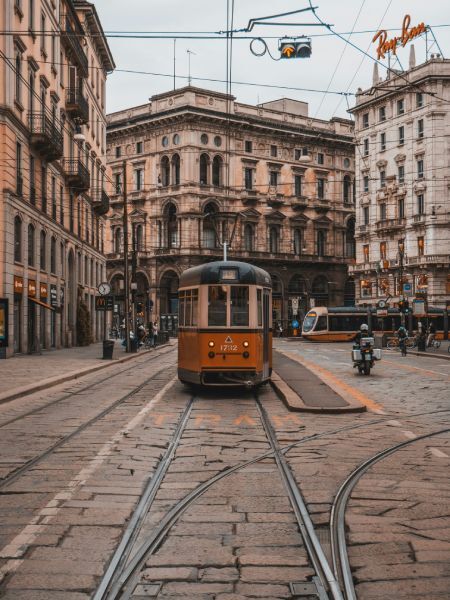
Area B: the restriction you meet first
Area B covers roughly 72 percent of the municipality and has nearly 190 camera-controlled access points. The Comune di Milano describes the perimeter using blue access gates on its interactive map. During normal operating hours, cars that meet the environmental requirements can enter without paying anything. Check the current map, vehicle checker and rules on the official Area B page.
For ordinary passenger cars, the rules in force in October 2026 exclude petrol cars up to and including Euro 3 (Euro 3 petrol has been banned since 1 October 2025) and diesel cars up to and including Euro 5, although the detailed diesel rules contain technical distinctions involving particulate filters and registration-document values. Euro 6 diesels of the A, B and C sub-classes can circulate until 30 September 2028. A simple rule for a traveler is not to guess from the age of the car. Use the official plate checker or check the environmental class shown on the vehicle registration document.
Look for the Euro class on the registration document. On Italian documents this is associated with field V.9; the fuel type is shown under P.3. Older diesel vehicles can involve additional FAP or particulate-filter conditions, which is another reason the official checker is safer than a homemade age chart.
Since 1 October 2026 there is a second layer for diesel drivers: a Lombardy regional measure restricts Euro 5 diesel cars on weekdays from 7:30 to 19:30, all year, in the urban areas of Milan, Monza, Bergamo and Brescia. For a visitor the practical effect is the same as the municipal rule, a Euro 5 diesel should not be driven in the city on a weekday, but it means the ban no longer depends only on which gate you cross.
It is a low-emission zone, not a toll
This catches many visitors out. There is no normal day ticket that turns an otherwise prohibited car into an allowed one. If your car is permitted, entry is free. If it is prohibited, you need a valid exemption or you need to stay outside the zone.
Some restricted vehicles qualify for limited exemption days. The current rules provide 50 access days during the first year in which a particular vehicle category becomes restricted. After that, residents have 25 days a year and a non-resident has a five-day annual environmental exemption, but this requires the plate to be registered on the municipal portal and the automatic exemption-day function activated before relying on it. Do not treat this as a general tourist pass, and remember that Milan’s municipal exemption cannot override a separate regional circulation ban.
Area C: the extra restriction in central Milan
Area C is the inner ZTL, the Zona a Traffico Limitato of the Cerchia dei Bastioni. It has 43 electronic entry gates around the central zone. This is the restriction that matters when you drive toward places such as the Duomo and the streets around it. The official Area C page includes the gate map and a vehicle checker that allows the nationality and plate to be entered.
The central zone has two separate tests. First, the vehicle must meet the environmental requirements. Second, if it is admitted but not exempt from payment, you need the entry ticket. Paying is therefore not a way around the emissions ban.
How much the central charge costs
The standard daily ticket is currently €7.50. A ticket covers the same vehicle for the day, including repeated entries, rather than charging you each time you cross a gate. Residents of the zone have a number of free entries each year and then pay a reduced €3 ticket. Vehicles parking in a participating garage inside the zone pay €4.50, and a forgotten entry can be settled late for €22.50, both explained below.
Fully electric vehicles are exempt from the charge. Hybrids are also exempt when the CO2 value in field V.7 of the registration document is 100 g/km or less; other hybrids need the normal ticket. Do not assume that the word hybrid on a rental agreement automatically means free entry.
The environmental rules can differ between the two zones
As of October 2026, the headline restrictions for an ordinary passenger car are similar in both zones: petrol cars through Euro 3 and diesel cars through Euro 5 are already prohibited. The calendars are published separately, however, and they have diverged before. The next published step for the outer zone is 1 October 2028, when Euro 4 petrol cars and Euro 6 A, B and C diesels are due to be excluded, with the later Euro 6 diesels following from 2030. The planned ban on older motorcycles and scooters in both zones was postponed from October 2026 to 1 October 2027. Always recheck both calendars before driving if your trip is months away.
What the map looks like: where each zone starts
On a map the two zones are concentric. The inner one follows the line of the old Spanish walls, the ring of boulevards that links Porta Venezia, Porta Romana, Porta Ticinese, Porta Genova, Porta Magenta, Porta Volta, Porta Garibaldi and Porta Nuova; everything inside that ring, including the Duomo, La Scala, Brera, the Castello Sforzesco and the fashion district, is in the charged zone. The outer one reaches almost to the municipal boundary and the Tangenziale ring roads: it includes Milano Centrale, Porta Garibaldi station, CityLife, San Siro, the Navigli and Città Studi. Malpensa and Bergamo airports, the Rho Fiera exhibition site and the motorways themselves are outside both.
The gates are marked by overhead signs with the zone name, the operating hours and a camera symbol, placed where the last legal turn-off is still possible. Both official pages carry an interactive map with every gate, and it is worth looking at your hotel or garage on it before you set off, because the boundary runs down the middle of some streets.
Three common driving examples
You are driving to the Centrale station
Milano Centrale is outside the charged center but inside the much larger emissions zone. In normal weekday daytime conditions, you therefore need to check that your car is permitted in Area B, but you do not need a ticket simply to reach Centrale.
You are driving to a hotel near the Duomo
This is the two-zone situation. Your vehicle must first be legal in the outer zone, then legal in the inner one, and an eligible vehicle may also require the central entry ticket. A hotel reservation does not cancel those rules. Ask the hotel for the exact legal approach route and whether it has a specific arrangement with a nearby garage before following your navigation app into the center.
You plan to use a metro park-and-ride and continue by train
Do not assume every parcheggio di interscambio, or park-and-ride facility, sits safely outside the emissions zone. Several are inside it or have specific access arrangements. Check the car park and your approach road against the official map before driving there. This matters particularly for an older diesel car.
What to do with a rental car
A rental car follows the same traffic restrictions as a privately owned car. The useful information to collect at pickup is the registration plate, fuel type, Euro emissions class and, for a hybrid, the emissions details needed by the checker. Do not rely only on a description such as compact automatic in the booking confirmation. Rental fleets are recent, so the emissions ban rarely applies, but the daily charge and the fines do, and the rental company passes on any fine with its own administration fee.
- Get the actual plate number after the car is assigned.
- Check eligibility for the outer zone before entering Milan.
- If your destination is in the center, check the inner zone separately.
- Find out whether the rental vehicle has any automatic payment service configured before buying a second ticket yourself.
- Keep the rental agreement and vehicle information available until the trip is finished.
If Milan is a stop in a longer driving trip, it helps to plan the rest of your Italy route around the point where the car becomes useful. A common approach is to use trains for central Milan and collect the rental car when leaving for smaller towns or countryside destinations.
Buying the ticket is only half the job
If you buy a normal ticket, it must also be activated against the vehicle’s plate. The Comune allows standard tickets to be activated from the day of entry until midnight on the following day. Online activation does not require MyAreaC registration. Tickets are sold online on the municipal portal, in the ATM and parking apps, at tobacconists and newsstands, at ATM points and at many parking meters, and electronic toll devices such as Telepass can pay automatically if the service is enabled.
This is the easiest mistake to make: buying a ticket and leaving the PIN unused. An unactivated ticket does not cover the camera-recorded entry. If you use a participating garage inside the zone, there is currently a discounted €4.50 entry ticket when the parking stay exceeds one hour. That ticket is purchased through the participating garage and must be activated by midnight on the same day, not the following day.
If you accidentally entered the center without paying
If your vehicle was legally allowed into the zone but you simply forgot the charge, you still have a recovery window. Buy and activate the ordinary ticket by midnight on the day after the entry. If that deadline has already passed, Milan currently allows an entry to be regularized within seven days using the €22.50 delayed-payment ticket through the MyAreaC procedure called Entro 7 giorni. Deal with it immediately rather than waiting for a notice, because after that the entry becomes a fine of roughly €80 to €100 plus notification costs. This remedy covers failure to pay the charge. It does not turn an emissions-prohibited vehicle into an authorized one.
If you accidentally entered the outer zone with a prohibited vehicle
There is no equivalent €7.50-style ticket to buy afterward. Check the vehicle’s exact status immediately, including whether it falls within a first-year access allowance or another valid exemption. If no exemption applies, simply paying money online will not legalize the entry, and each recorded day can produce its own fine. For future entries, non-residents relying on the standard five-day environmental exemption must register the vehicle and activate the automatic detection of exemption days before the first access.
Read the road signs even if your GPS says continue
The terms that matter are ZTL, short for Zona a Traffico Limitato, the two zone names, and varco, meaning an access gate or checkpoint. Camera enforcement means there is no barrier that physically stops an unauthorized car. You can make the mistake at normal driving speed and only discover it later. Navigation apps are useful for reaching an address, but they do not decide whether your particular plate, Euro class or exemption is legal at that moment. If the sign conflicts with the route on your screen, follow the sign.
Weekends, public holidays and driving outside the active hours
Both zones normally operate Monday through Friday from 7:30 to 19:30, excluding public holidays. Saturday and Sunday are therefore outside the normal operating periods. There is a caveat for the center: in 2025 the mayor announced that the charge would be extended to weekends from 2026, and many websites now state that it applies seven days a week. The extension was then put on hold, and through summer 2026 local reporting and the operating rules still described the charge as a weekday measure. Because this can change with little notice, check the official page in the days before a Saturday or Sunday drive into the center.
Outside the active hours central Milan is still not unrestricted. Other ZTLs, pedestrian areas, reserved public transport lanes, parking restrictions and street-specific signs still apply. An inactive camera period is not permission to drive down a street reserved for trams, taxis or authorized traffic.
Be careful if an older vehicle is parked inside overnight
A prohibited vehicle can enter the outer zone before 7:30, but once the restriction becomes active it cannot simply be driven out during the 7:30 to 19:30 period. The Comune specifically states that a prohibited vehicle already inside the zone cannot circulate toward the exit during active hours. If you have an older car in a hotel garage, plan the departure time accordingly.
Parking does not cancel the driving restriction
A garage being willing to accept your car does not automatically mean the route to that garage is legal. This matters most in the center, where you may cross a camera before reaching the garage entrance, but it also matters for car parks inside the wider zone. Before booking central parking, check three separate things: whether your vehicle can reach the garage under the emissions rules, whether the garage lies inside the charged ring, and whether the garage participates in the discounted ticket scheme. For the parking colors, garages and park-and-ride options after you have solved the access question, see our guide to parking in Milan.
The other restricted zones in the city
The two big zones are not the only ones. Inside and outside the charged ring there are smaller neighborhood ZTLs with their own cameras and hours, including the Navigli zone, the Chinatown zone around Via Paolo Sarpi, and a growing list of pedestrian areas and school streets. In 2024 the city also introduced a restricted zone in the Quadrilatero della Moda, the fashion district, where only residents, garage users, taxis and authorized vehicles may enter. These zones are signed individually and are not covered by the daily ticket.
Administratively the city is divided into nine numbered boroughs called Municipi, with Municipio 1 corresponding to the old center and the other eight arranged around it like slices; they matter for residents’ permits and local services, not for visitors’ driving rules. The wider metropolitan area is covered by the public transport fare zones Mi1 to Mi9, which are something else again.
Park outside and use public transport
For most visitors the cheapest way to deal with both zones is not to drive into them. ATM runs park-and-ride car parks at metro terminals such as Lampugnano, Bisceglie, San Donato, Famagosta, Cascina Gobba and Molino Dorino, where a day’s parking costs a few euros and the metro reaches the Duomo in 15 to 25 minutes; check each one against the map, as noted above, if your car is an older diesel. A single urban ticket costs €2.20 for 90 minutes and can be paid by tapping a contactless bank card at the gates. If you are arriving by air, the train from Malpensa to Milano Centrale avoids the question entirely, and for onward trips such as Milan to Venice the high-speed trains leave from Centrale, which is easier to reach by metro than by car.
The safest decision rule
- Check the vehicle first. Find its fuel type and Euro class, then verify eligibility for the outer zone.
- Check the destination. If it is inside the central Cerchia dei Bastioni, check the inner zone too.
- Do not confuse admission with payment. A ticket only helps a vehicle that is already allowed to enter.
- Check the date and time. Both zones normally operate weekday daytime hours, but other restrictions can remain active outside them.
- Never assume parking, a hotel booking or a rental contract creates an exemption. Confirm the plate and the legal approach before you drive.
If you remember only this, make it: Area B decides whether your car can drive through most of Milan; Area C adds a second, central-city test and usually a daily charge. Checking both before the first camera is much easier than trying to work out afterward which gate you crossed.
Frequently asked questions
Can I drive in zone B in Milan?
Yes, free of charge, if your car meets the emissions rules: petrol Euro 4 or newer, diesel Euro 6, or electric. Petrol cars up to Euro 3 and diesels up to Euro 5 are banned on weekdays from 7:30 to 19:30 unless a registered exemption day applies.
What is Area C in Milan?
It is the charged ZTL covering the city center inside the Cerchia dei Bastioni. Admitted vehicles pay €7.50 per day on weekdays between 7:30 and 19:30, the ticket must be activated against the plate, and the most polluting vehicles cannot enter at all.
What are the different zones in Milan?
For drivers there are three layers: the emissions zone covering most of the city, the charged central zone, and smaller neighborhood ZTLs and pedestrian areas with their own signs and hours. For public transport there are separate fare zones, Mi1 to Mi9.
What are the different regions of Milan?
The city has nine boroughs, the Municipi. Municipio 1 is the old center, and Municipi 2 to 9 surround it, taking in districts such as Centrale and Greco, Città Studi and Lambrate, Porta Romana, the Navigli, San Siro, and Niguarda.
How much does it cost to drive into the center?
€7.50 per day for a standard ticket, €4.50 if you park for more than an hour in a participating garage, and €22.50 if you pay late within seven days. The outer zone is free for permitted vehicles.