The flat airport taxi price is not based on a vague idea of “central Rome.” It applies when an official Roma Capitale taxi travels directly between Fiumicino or Ciampino Airport and an address inside the city’s officially mapped Mura Aureliane tariff zone. The current set fare is €55 per vehicle from Fiumicino and €40 from Ciampino. The Rome airport taxi fixed fare boundary is therefore an address test, not a neighborhood-name test.
The Aurelian Walls taxi zone is an official map, not just the ancient walls
Roma Capitale uses a specific municipal perimeter for taxi fares. It is based on the boundary established by a 2006 city resolution and reproduced on the current official taxi tariff map. The Italian wording you will see is Mura Aureliane.
This causes plenty of confusion because the taxi zone is not the same thing as the surviving Roman walls, the Centro Storico ZTL, Municipio I, or the Grande Raccordo Anulare. The official polygon extends well beyond the literal ancient-wall circuit in some places, including across the Tiber into much of the Prati and Vatican-facing area. It also covers central Trastevere and Testaccio.
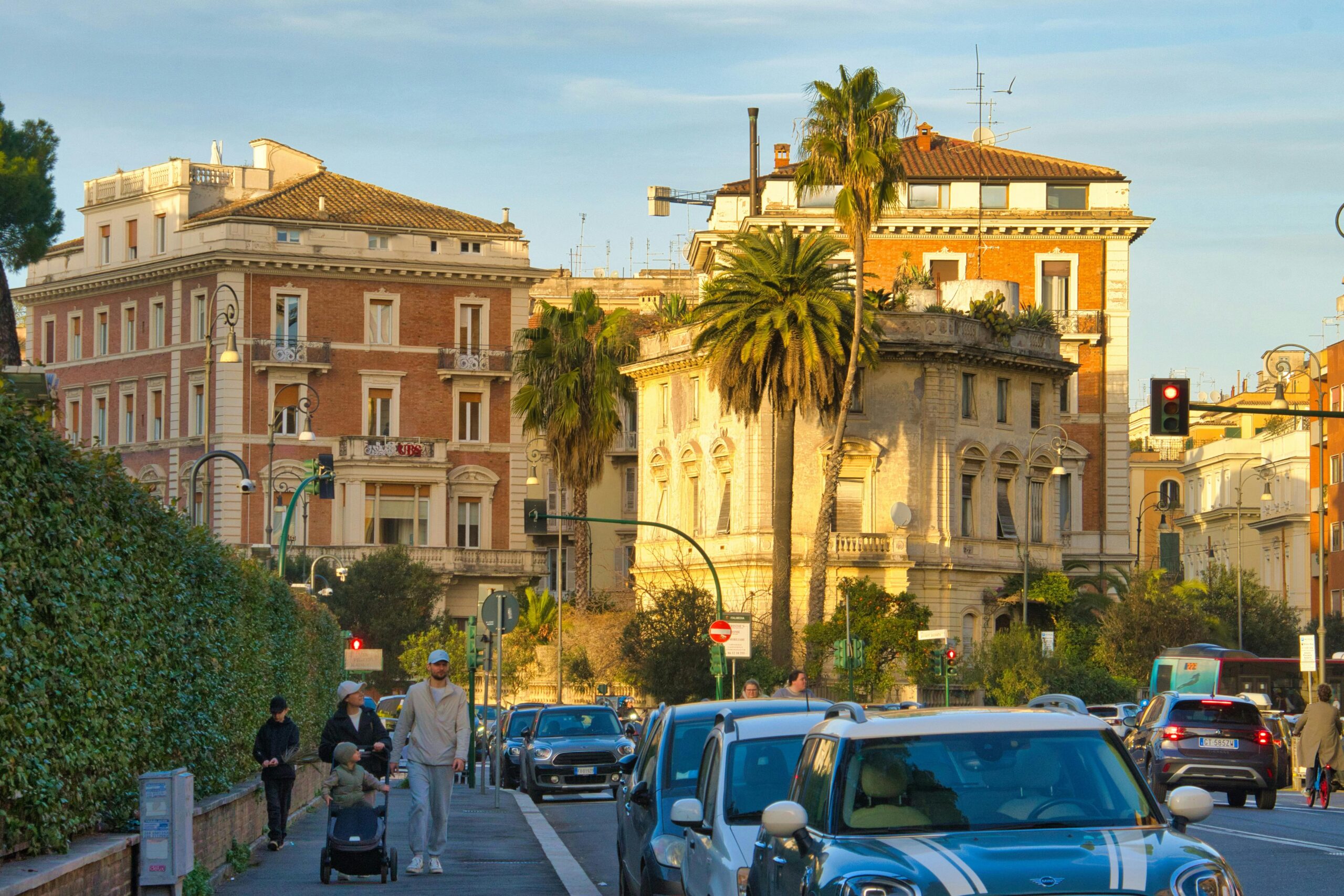
Addresses around the Pantheon, Trevi Fountain, Spanish Steps, Colosseum and Roma Termini are comfortably within the mapped area. The difficult cases are accommodations marketed with broad neighborhood names such as “Vatican,” “Trastevere,” “San Giovanni” or “Rome center.” Those labels can cover streets on both sides of the tariff line.
A particularly useful example is Trastevere: the historic neighborhood close to the river falls within the central zone, but Roma Trastevere railway station sits beyond the municipal perimeter. Likewise, accommodation described as San Giovanni may be close to the basilica or considerably farther east toward Re di Roma and Appio, where the boundary has already been crossed. The precise street matters.
Current airport taxi fares for the central zone
| Route | Predetermined fare |
|---|---|
| Fiumicino Airport to an address inside the mapped Mura Aureliane zone | €55 |
| Ciampino Airport to an address inside the mapped Mura Aureliane zone | €40 |
| Fiumicino Airport to Roma Tiburtina station | €60 |
| Fiumicino Airport to Roma Ostiense station | €50 |
| Ciampino Airport to Roma Tiburtina station | €40 |
| Ciampino Airport to Roma Ostiense station | €40 |
These are fares a corsa, meaning per taxi ride rather than per passenger. Under the current Roma Capitale tariff, predetermined fares also include motorway tolls and the normal supplements. The exception is a vehicle carrying more than four passengers: from the fifth passenger onward, there is a €5 supplement for each additional person, provided the taxi is licensed to carry that many people.
That detail matters for families and larger groups. Several suitcases do not turn a qualifying €55 Fiumicino transfer into a metered ride simply because ordinary city taxi rides have baggage supplements.
How to check your accommodation before you land
- Find the complete street address. Do not rely on “near Vatican,” “Trastevere” or whatever neighborhood appears in the booking title.
- Check the address against the official Roma Capitale taxi tariff and Mura Aureliane map. The final page shows the central tariff area and also prints the streets forming the perimeter.
- Be especially careful if the property is close to the edge. The west side around Gregorio VII and Anastasio II, the south around Porta Portese and Ostiense, the east around San Giovanni and Porta Maggiore, and the north around Porta Pia and Flaminio are places where a few streets can change the answer.
- If it is still unclear, ask the accommodation about the exact address. The useful Italian question is: “Questo indirizzo è dentro le Mura Aureliane per la tariffa taxi dall’aeroporto?”
For a trip involving several Italian cities, it can also help to organize the rest of your Italy route before choosing whether the airport taxi, train or a connection through Termini makes most sense.
At Fiumicino and Ciampino, use the official taxi rank
At Fiumicino, the airport authority lists taxi service outside the Terminal 1 and Terminal 3 Arrivals areas. At Ciampino, taxis are available outside Arrivals. Authorized vehicles are white, carry a roof TAXI sign, display the municipality symbol and show a licence number on the vehicle.
Fiumicino is one place where checking the municipality on the taxi is particularly sensible because taxis licensed by different municipalities can operate around the airport. If you are relying on Roma Capitale’s published tariff to Rome, look for the Roma Capitale identification rather than accepting the first unsolicited car offer in the terminal.
People approaching arriving passengers inside the terminal and offering a “taxi” or special price are not the official rank system. Private chauffeur vehicles are usually described as NCC, short for noleggio con conducente, and their prices are not the municipal taxi tariff. Aeroporti di Roma specifically advises passengers to use authorized vehicles at the designated taxi areas.
Before luggage goes into the boot, give the driver the exact address. For a qualifying central trip, a simple “Tariffa predeterminata Mura Aureliane, giusto?” is enough. From Fiumicino you can add “cinquantacinque euro”; from Ciampino, “quaranta euro.”
The fixed price requires a direct ride
Roma Capitale states that predetermined rates apply to a direct journey with one passenger pickup point and one destination, without an additional stop or deviation. That means airport to hotel is straightforward. Airport to hotel, then onward to a friend’s apartment is not the same qualifying journey. Neither is collecting another passenger somewhere in Rome on the way.
Ordinary traffic does not make the published price disappear simply because the drive takes longer. The fare is predetermined for the qualifying origin and destination. What causes trouble is turning the transfer into a different journey by requesting extra pickups, stops or destinations.
There is another less obvious rule when traveling from Rome to the airport. If a predetermined-fare taxi is summoned through a radio taxi service, app or taxi-rank telephone system, the current rules allow a maximum passenger wait of 10 minutes after the taxi’s declared arrival time. If you keep the vehicle waiting longer, taximeter pricing applies instead. When pickup occurs within that limit, the driver switches off the meter when you board.
What happens when your address is outside the zone
Being one street beyond the central perimeter does not mean the driver can invent another flat price. Unless your destination has its own published predetermined fare, the journey is handled under the airport taxi-meter rules.
For Fiumicino, Roma Capitale currently sets a €35 minimum for airport rides to destinations without a predetermined tariff. More importantly for travelers staying elsewhere in metropolitan Rome, a taxi journey between Fiumicino and a point inside the Grande Raccordo Anulare, or GRA, cannot exceed €80 under the current Roma Capitale tariff. Supplements count toward that ceiling rather than being added above it.
The €80 figure is a maximum, not another flat airport fare. If the meter produces a lower valid amount, the lower amount is what matters.
For Ciampino, the published minimum for a destination without a predetermined tariff is €25. The current city tariff does not give Ciampino rides the same €80 GRA maximum that applies to Fiumicino.
There are also named exceptions outside the central perimeter. Roma Tiburtina and Roma Ostiense stations, for example, have their own airport rates. These fares apply to the station as the specified destination, not automatically to every hotel advertised as “near Tiburtina” or “in Ostiense.”
If your accommodation falls outside the central zone and the taxi price no longer looks attractive, compare the rail and bus alternatives in our Rome airport to city centre transport guide.
“Vatican,” “historic centre” and other labels that cause mistakes
“The Vatican is outside the ancient Aurelian Walls, so the fare cannot apply.” That reasoning uses Roman archaeology instead of the municipal taxi map. The fare perimeter extends west of the Tiber around the Vatican and Prati area. Check the actual accommodation address rather than the physical line of the ancient walls.
“My booking says Rome city centre.” Hotel booking sites choose their own neighborhood and marketing descriptions. Those labels have no role in calculating a regulated taxi tariff.
“My hotel is inside the GRA, so it costs €55.” The GRA is a much larger ring around Rome. Being inside it does not put you inside the central tariff area. For Fiumicino, the GRA is relevant to the €80 maximum on qualifying metered rides, not to eligibility for the €55 central rate.
“Ostiense is €50, so my Ostiense apartment is €50.” The official predetermined fare names Stazione Ostiense. A nearby private address is a different destination unless it independently falls inside the central mapped zone.
If the driver says your address does not qualify
If you are still at the rank, resolve the issue before leaving. Show the exact street on the official map rather than arguing about a neighborhood name. The current fares and the boundary map are also linked from the Roma Mobilità taxi page.
If you believe an eligible ride was charged incorrectly, ask for a receipt with “Ricevuta, per favore.” Note the taxi licence number, departure and arrival points, date, time and amount. Roma Capitale provides a formal taxi complaint procedure, and its complaint form specifically asks for these identifying details.
The safest rule is simple: check the street address against the municipal map before the journey, use a licensed Roma Capitale taxi, state the destination before departure, and treat phrases such as “central Rome” as descriptions rather than tariff boundaries.