Public toilets in Rome exist, but they are not evenly spread around the historic centre, and most of the staffed ones charge a small fee. The safest plan is to remember a few staffed P.Stop facilities, use toilets inside ticketed attractions before leaving, and treat bars as the backup rather than expecting a WC beside every monument. The most dependable Rome public toilets are around Piazza Navona, Piazza di Spagna, Santa Maria Maggiore, Termini and the Colosseum, although several older listings near the Vatican and Trastevere are currently out of date.
- The city toilets worth remembering
- How much public toilets in Rome cost
- Free bathrooms in the city
- How Italian toilets work
- Piazza Navona and the Pantheon
- Trevi Fountain
- Colosseum and Roman Forum
- Vatican Museums and St Peter’s
- Trastevere
- Termini and Santa Maria Maggiore
- Metro stations
- Italian toilet signs
- Accessible toilets, children and strollers
- When the toilet you planned is closed
- Late evenings
- Frequently asked questions
The city toilets worth remembering
Rome’s P.Stop network combines street-level information kiosks with staffed toilets, usually downstairs. Current individual location pages list a €1.50 charge at the central facilities below. The operator’s turnstiles are designed for coins, contactless payment and its QR-based P.Pass, but carrying small change is still sensible in case a card reader is having a bad day.
| Area | Facility | Hours | What to know |
|---|---|---|---|
| Piazza Navona and Pantheon | P.Stop Via Giuseppe Zanardelli | Daily 08:00-20:00 | Just beyond the northern end of Piazza Navona, and a useful option from the Pantheon. |
| Spanish Steps and Trevi Fountain | P.Stop Piazza di Spagna | Daily 08:00-20:00 | The entrance is separate from Metro A’s Spagna station, so do not go down the Metro stairs expecting the same facility. |
| Santa Maria Maggiore | P.Stop Piazza dell’Esquilino | Daily 08:00-20:00 | Opposite the apse, on the rear side of the basilica. Within walking distance of Termini. |
| Termini and Piazza della Repubblica | P.Stop Largo di Villa Peretti | Daily 10:00-18:00 | Termini also has staffed toilets inside the station. Follow signs for WC or servizi igienici. |
| Colosseum | Roma Capitale toilet on Piazza del Colosseo | Daytime | On the Via di San Giovanni in Laterano side. Use it if you have not yet entered the archaeological park. The Colosseum, Forum and Palatine have more toilets past ticket control. |
Opening hours and temporary closures can change, particularly when facilities are being rebuilt. The operator’s current P.Stop status page is worth checking on the day if a particular bathroom is essential to your route.
How much public toilets in Rome cost
Expect to pay. The staffed P.Stop facilities in the centre charge €1.50 per visit, and the toilets inside the big railway stations are also paid and staffed. In return you get a cleaned cubicle, paper, soap and somebody on site, which is why these are the ones worth walking to.
The cheap options are the ones you have already paid for in another way. Toilets inside museums, archaeological sites and the Vatican Museums cost nothing extra once you hold a ticket. A bar toilet costs the price of an espresso at the counter, which in most Roman bars is less than the fee at a staffed facility. Restaurants expect you to be eating there.
Keep a couple of €1 and 50 cent coins in a pocket. Card readers on turnstiles usually work, but a coin gets you through faster when there is a queue behind you.
Free bathrooms in the city: where they really are
Rome has very few free standalone public toilets in the tourist core, so free in practice means using a building you are already inside. The most reliable ones are these:
Ticketed sights come first. The Colosseum, the Forum and Palatine, the Vatican Museums, the Capitoline Museums and the Borghese Gallery all have toilets for ticket holders. Go before you leave, even if you feel fine.
Department stores are the second option. La Rinascente on Via del Tritone, a few minutes from the Trevi Fountain, has customer toilets on its upper floors, and it is a calmer stop than the streets around the fountain.
Fast food chains near the main sights usually put a code lock on the toilet door and print the code on the receipt, so you need to buy something first.
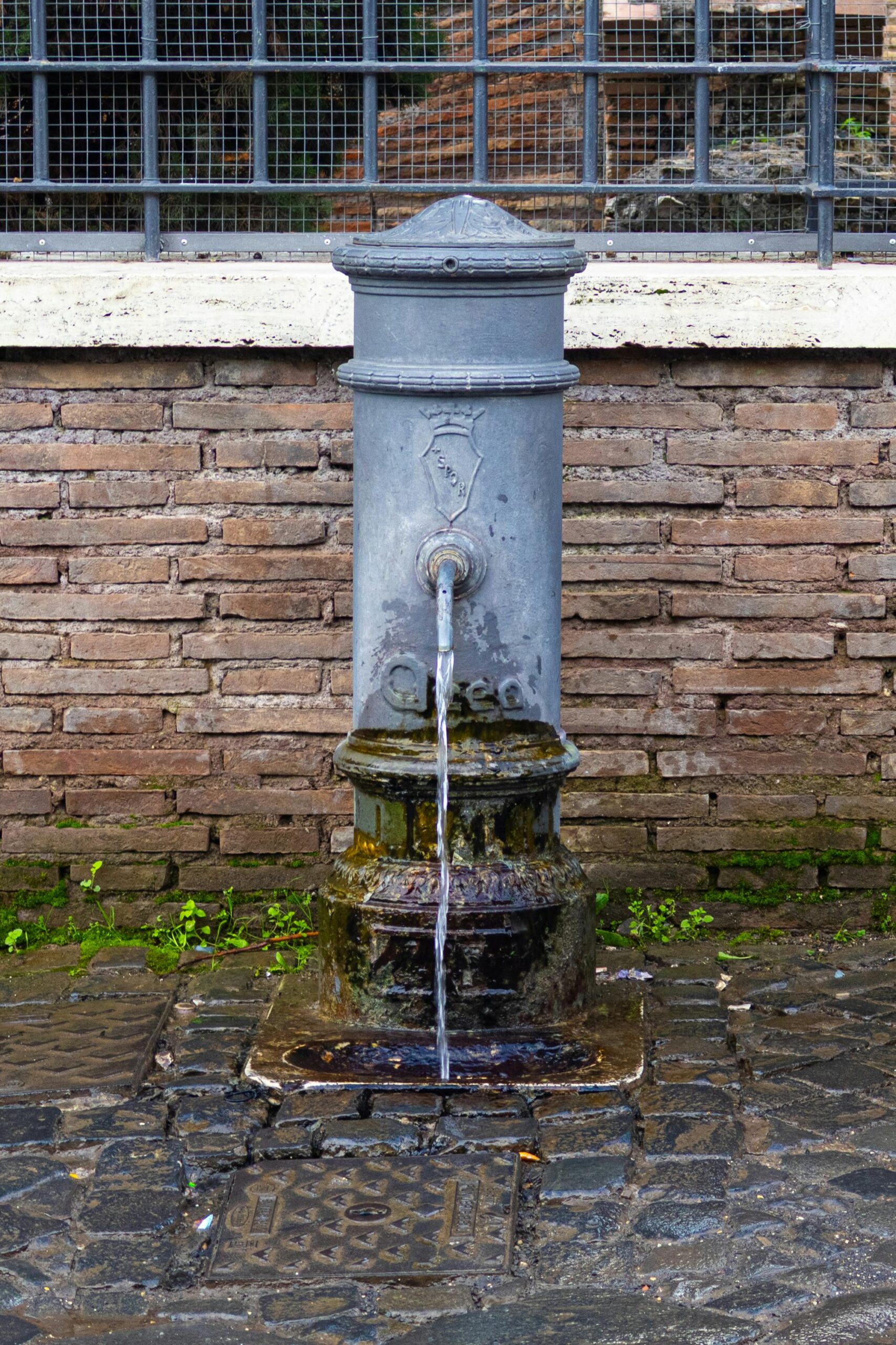
Drinking water is a different story. The small cast-iron street fountains called nasoni run with free drinking water all over the centre, so there is no need to buy a bottle each time you stop.
How Italian toilets work
Most bathrooms you meet in Rome are ordinary sit-down toilets, with a few local habits that surprise visitors.
The flush is often hard to spot. Look for a large plate or two buttons on the wall behind the toilet, a button on top of the cistern, or in older bars a pedal on the floor. The two wall buttons give a small and a full flush.
Taps can also be foot operated. If the basin has no handle and no sensor, look down for a pedal or a rubber button on the floor.
Many toilets in bars, stations and older public facilities have no seat. Seats break with heavy use and are often left off because a bare bowl is quicker to clean. Carrying a small pack of tissues solves both that and the occasional empty paper holder.
In a small bar the toilet is usually a single room at the back, sometimes locked. Ask at the counter and the barista hands over the key or presses a buzzer. Staffed facilities have an attendant at a desk near the turnstile, and you pay on the way in.
Toilets near Piazza Navona and the Pantheon: use Via Zanardelli
This is one of the easiest facilities to remember in the historic centre. From Piazza Navona, walk toward its northern end, near the Fountain of Neptune, and continue out toward Via Giuseppe Zanardelli. Look for the P.Stop rather than searching the surrounding restaurant lanes for a generic WC sign.
From the Pantheon it is a short walk north-west. If you are doing Pantheon, Piazza Navona and Campo de’ Fiori in one stretch, using the bathroom at Zanardelli before continuing south saves the usual problem of suddenly needing one among the smaller lanes around Campo de’ Fiori.
Trevi Fountain: there is no convenient toilet beside the fountain
Trevi is where many visitors get caught out. The streets immediately around the fountain are dense with shops, bars and restaurants, but there is no dependable municipal toilet sitting beside the viewing area.
If the need is not urgent, continue toward Piazza di Spagna and use the P.Stop there. Once you reach Piazza di Spagna, look for the P.Stop facility itself. Metro signs marked M or Spagna lead into the underground station and should not be confused with the public bathroom entrance.
If walking to Spagna is unrealistic, the practical backup is a bar. Order something at the counter, then ask, “Posso usare il bagno?” This means “May I use the bathroom?” Buying a coffee first is normal courtesy and gives you a much better chance of a simple yes. Access for noncustomers is not something to assume.
Colosseum and Roman Forum: use the toilet before committing to the route
The Colosseum area is easier because there are facilities both outside and inside the archaeological complex. The public facility on Piazza del Colosseo is on the side toward Via di San Giovanni in Laterano. That distinction matters if your timed entry is still some way off, because the archaeological site’s internal facilities are available only after you have entered.
Inside the Colosseum, toilets are on the first level close to the entrance turnstiles. The Parco archeologico del Colosseo also lists eight restrooms around the Forum and Palatine, mainly near entrances and exits. Accessible toilets are provided, and baby-changing facilities are available at selected locations including Via di San Gregorio and near the Via Foro Romano exit. The official archaeological park service information has the current details.
This is a good place to follow one rule: use the bathroom when you see it, even if you could probably wait. Forum and Palatine routes involve slopes, uneven paving and controlled entrances. Turning around for a toilet can become a substantial detour. Our Colosseum visitor guide covers the wider entry and route logistics.
Vatican Museums and St Peter’s: do not rely on the old Città Leonina listing
As of August 2026, the P.Stop operator marks its Piazza della Città Leonina facility near the Vatican as temporarily closed for construction. Older Rome maps and travel articles may still show it as open, so it should not be your emergency plan until the operator confirms reopening.
At the Vatican Museums
Once you have entered the Museums through the Viale Vaticano entrance, the toilet situation is much easier. Restrooms are distributed along the visitor route and are clearly signposted. The Vatican Museums also identify accessible toilets, baby-changing facilities and a nursing room on their official map. You can check the Vatican Museums restroom information before your visit.
Use one before the final stretch toward the Sistine Chapel if you need it. The museum itinerary is highly controlled, and reversing direction through crowded galleries is not always practical.
At St Peter’s Basilica
The Basilica’s official visitor information says toilets are available before the visit near the Excavations Office and again in designated areas at the end. The newer visitor welcome area also includes restrooms. Access around St Peter’s can change during papal events, security operations and major celebrations, so ask a steward for servizi igienici rather than walking out of the controlled area and hoping to find something nearby.
If you are combining the Museums and Basilica, remember that they have separate public entrances. Toilet access inside one does not solve a problem while you are queuing outside the other. Our Vatican planning guide explains how those entrances and visitor routes fit together.
Trastevere: an old reliable public toilet is currently closed
Piazza Sidney Sonnino traditionally had one of central Trastevere’s most useful P.Stop toilets. The operator currently marks it temporarily closed while work is planned on the facility.
That makes central Trastevere a place where a bar, restaurant or museum you are already visiting is often the better solution. Do not walk across the neighborhood specifically toward Piazza Sonnino because an old map shows a toilet symbol there without checking its status first.
Bathrooms at Termini and Santa Maria Maggiore
If you arrive by train with luggage, you have several possibilities. Roma Termini has staffed toilets within the station. Follow WC or servizi igienici signs rather than assuming the Metro platforms will have facilities.
Outside the station, Largo di Villa Peretti has a P.Stop approximately on the Repubblica side of the station area. For a longer opening window, the Piazza dell’Esquilino location behind Santa Maria Maggiore currently operates 08:00-20:00.
The Piazza dell’Esquilino facility is particularly useful if you are walking from Termini toward Santa Maria Maggiore, Monti and eventually the Colosseum. It lets you deal with the bathroom question before entering the older streets where your options become less obvious.
Do not plan your day around Metro station toilets
Rome’s Metro should not be treated like a network of public restrooms. ATAC lists toilets at some stations, particularly on parts of Line B and B1, but they are not a standard amenity at every stop. Several heavily used central Line A stations do not have a WC listed at all.
Use a known street-level facility before descending to the Metro, especially at the end of a long sightseeing day. This also avoids having to pass ticket gates simply to investigate whether a station has an accessible bathroom.
What the Italian toilet signs mean
The wording varies, so knowing a few terms saves time:
| Italian sign | Meaning |
|---|---|
| Bagno | Bathroom or toilet |
| Servizi igienici | Toilets or restroom facilities, common on official signs |
| WC | The quickest symbol to spot in stations and attractions |
| Uomini | Men |
| Donne | Women |
| Bagno accessibile or bagno disabili | Accessible toilet |
| Fasciatoio | Baby-changing table |
| Fuori servizio | Out of service |
| Chiuso or chiuso temporaneamente | Closed or temporarily closed |
If you are mapping several sights into one day, it helps to place one of these known bathroom stops into the route rather than waiting for an emergency. You can organize the rest of your Rome route around your booked attractions, walking sections and breaks.
Accessible toilets, children and strollers
The P.Stop locations at Via Zanardelli, Piazza di Spagna and Piazza dell’Esquilino list accessible bathrooms, family facilities and baby-changing tables. Their toilets are below street level but these locations list elevator access.
If you use a wheelchair or cannot manage stairs, check with the attendant that the lift is operating before paying at the entrance. A working toilet downstairs is not much help if the elevator is temporarily unavailable.
The Vatican Museums and Colosseum archaeological park also provide accessible facilities and selected baby-changing points, which makes them preferable to gambling on a tiny café toilet with stairs or a narrow doorway.
What to do when the toilet you planned is closed
- Check the sign before walking away. A street-level kiosk may have toilets downstairs, so the entrance is not always obvious.
- Ask staff: “Il bagno è aperto?” means “Is the bathroom open?”
- If it is fuori servizio, switch plans immediately. Do not spend another ten minutes hunting for an unmarked municipal facility.
- Use the next attraction’s toilet if you already have a ticket. This works particularly well at the Vatican Museums and Colosseum.
- Otherwise use a bar as a customer. Order at the counter, then ask for the bathroom. In the historic centre this is often faster than walking to the next dedicated facility.
Late evenings in Rome need a different strategy
Many dedicated facilities close by 18:00 or 20:00, so a sightseeing plan that works at lunchtime may fail after dinner. Piazza di Spagna and Via Zanardelli currently stay open until 20:00, while several other P.Stop locations close earlier.
After that, use the toilet at the restaurant or bar where you are already a customer rather than saving the problem for the walk home. The same applies before a late bus or long stroll across the centre. Rome becomes far less generous with dependable standalone bathrooms once the staffed daytime facilities have shut.
Frequently asked questions
Are public toilets free in Rome?
Mostly no. The staffed P.Stop toilets in the centre charge €1.50 and station toilets are also paid. Toilets inside museums and archaeological sites are included with your ticket, and bars let customers use theirs, so the price there is a coffee.
Where can I find public bathrooms in Rome?
The dependable ones are the P.Stop facilities at Via Giuseppe Zanardelli near Piazza Navona, Piazza di Spagna, Piazza dell’Esquilino behind Santa Maria Maggiore and Largo di Villa Peretti by Termini, plus the municipal toilet on Piazza del Colosseo. Inside the Colosseum, the Forum, the Vatican Museums and Termini station you will find more.
How do Roman toilets work?
At a staffed public toilet you pay at a turnstile with coins or a card, and an attendant keeps the cubicles clean. Inside, the flush is usually a plate or pair of buttons on the wall, and in older places a floor pedal. Taps are sometimes worked by a foot pedal too.
Why do some Italian bathrooms not have toilet seats?
Seats in busy bars, stations and public facilities break often, and many owners leave them off because a bare bowl is faster to clean. It is common across Italy and says little about how clean the place is. Carry tissues and you will be fine.
Can I use the toilet in a bar in Rome without buying anything?
Do not count on it. Bar toilets are for customers, so order a coffee or a bottle of water at the counter first, then ask “Posso usare il bagno?”
Do public toilets in Rome take cards?
P.Stop turnstiles are built for coins, contactless payment and the operator’s QR pass. Readers do fail now and then, so keep €1 and 50 cent coins with you.