Yes, a car-free trip in Sardinia can work, but only when you build it around a few transport-rich bases rather than trying to roam the coast. Cagliari is the easiest year-round choice; Alghero is excellent for a compact city-and-beach stay; Olbia becomes much more useful in summer; Villasimius and La Maddalena work with more timetable discipline. Sardinia without a car becomes frustrating when you expect spontaneous beach hopping, rural agriturismi, or late-night transfers between small coastal towns.
The useful planning rule is simple: choose a town where you can walk to dinner, reach at least one good beach by local transport, and make day trips without relying on a chain of two or three buses. Treat the island as several separate transport regions, not as one network that conveniently joins every famous beach.
Where a car-free stay works best
- Best all year: Cagliari and Alghero.
- Best for beaches in summer: Alghero, Villasimius, Olbia and Golfo Aranci.
- Best for an island-and-boat trip: La Maddalena, once you have reached Palau.
- Possible with compromises: Bosa, Oristano, Stintino and Cala Gonone.
- Poor choice for a flexible no-car holiday: scattered Costa Smeralda resorts, the rural interior, remote Ogliastra accommodation, and itineraries built around a different isolated beach every day.
Cagliari is the easiest all-year base
Cagliari has the strongest combination of airport access, trains, regional buses, city transport and walkability. From Cagliari Elmas Airport, regional trains reach central Cagliari in under ten minutes, with frequent departures through much of the day. The airport railway station is called Elmas Aeroporto; the city terminus is simply Cagliari. Check the live schedule on Trenitalia’s Cagliari Airport page, particularly for early and late flights.
The arrival layout also helps. Cagliari railway station opens onto Piazza Matteotti, with the regional ARST bus station in the same transport area. That means a traveler arriving with luggage can change from train to an intercity bus without crossing half the city.
Stay around Marina, Stampace or the lower part of the centre if transport convenience matters. Castello is atmospheric but sits uphill, which is less amusing when a suitcase is involved. For the beach, city buses connect Cagliari with Poetto, so you do not need to move hotels just to have swimming days.
Cagliari is also the sensible starting point for the southeast. ARST operates direct services toward Villasimius and Costa Rei. The catch is frequency: this is not metropolitan transport, and departures vary according to day type and season. The official ARST timetable for the Cagliari-Villasimius corridor should decide your day, not an old timetable screenshot saved from a travel forum.
Alghero is the strongest city-and-beach combination
Alghero is one of the rare Sardinian bases where arriving, sightseeing and getting to several beaches can all be done reasonably well on public transport. The old town is compact, much of the waterfront is walkable, and the airport has a direct ARST connection to the city. The Alghero terminus you will often see on timetables is Via Catalogna, close enough to the historic centre that another transfer is usually unnecessary. The airport also has an ARST ticket machine outside arrivals.
The local network is more useful than many visitors realise. Urban buses serve Maria Pia and Fertilia, while the Alghero-Porto Conte-Capo Caccia service reaches places including Lazzaretto, Porto Conte and Capo Caccia on applicable departures. Check the exact date on the ARST Alghero-Capo Caccia timetable, because not every bus follows the complete route.
This makes Alghero particularly good for travelers who want four or five nights in one hotel rather than a procession of one-night stops. You can walk in the evening, use buses for beach days and coastal sights, and avoid the logistical problem of hauling luggage through every transfer.
Olbia works much better in summer than its reputation suggests
Olbia is often treated purely as the place where you collect a rental car, but it can be a useful transport base if you stay near the centre or railway station. From Olbia Costa Smeralda Airport, ASPO urban lines 2 and 10 connect the airport with the city, generally around every 30 minutes. The bus stops are only about 50 metres outside arrivals, and ASPO services use airport stop number 3.
Summer is when the northeast becomes substantially easier. For the 2026 summer season, Trenitalia restored an expanded Olbia-Golfo Aranci service with stops including Olbia San Simplicio, Rudalza, Marinella, Cala Sabina and Golfo Aranci. Cala Sabina is specifically a seasonal rail stop. Check the current offer on Trenitalia’s Olbia-Golfo Aranci information.
Olbia’s urban network also reaches coastal areas such as Pittulongu, while summer service is strengthened toward several beach destinations. This makes an Olbia stay quite different from attempting to sleep at a remote Costa Smeralda resort. In town, you have a railway station, buses, shops, restaurants and airport transport within one usable network. At an isolated resort, missing the final bus can mean an expensive taxi.
If your main goal is beach time rather than nightlife, Golfo Aranci can be an even simpler summer base. You give up Olbia’s deeper transport network but gain a compact seaside town with railway access and beaches close to the centre.
Villasimius can work very well if the summer shuttle is running
Villasimius looks car-dependent because the best-known beaches are scattered around the peninsula rather than sitting directly in the town centre. The seasonal municipal beach shuttle changes the calculation. Its purpose is specifically to connect the urban area with coastal stops, and the official app provides routes, stops, times and digital ticketing. Always verify the operating period on the Villasimius Summer Bus page before booking a no-car stay.
The best setup is to sleep inside Villasimius town, preferably within an easy walk of the regional bus and shuttle stops. Then use the local shuttle for beaches and ARST for the longer Cagliari connection. Do not book an isolated villa several kilometres outside town simply because its address says Villasimius. A property can be administratively in the same municipality while being impractical without private transport.
Outside the summer transport season, Villasimius requires more compromises. The regional Cagliari connection remains useful, but the easy beach-hopping part of the plan is much weaker.
La Maddalena is easy once you reach Palau
La Maddalena is one of the places where leaving the car behind can actually improve the trip. Ferries from Palau run frequently, including late and overnight departures on the current schedule. The crossing is short, and La Maddalena town is compact enough for ordinary daily needs on foot. Check exact sailings with Delcomar, because timetables and individual departures can change.
The harder part is reaching Palau from the mainland side of Sardinia. Bus and coach links operate from the Olbia area, but service varies by operator and season. Do not book a flight into Olbia and mentally treat Palau as an airport suburb. Check the airport-to-Palau journey for your actual arrival date before committing to a same-evening ferry connection.
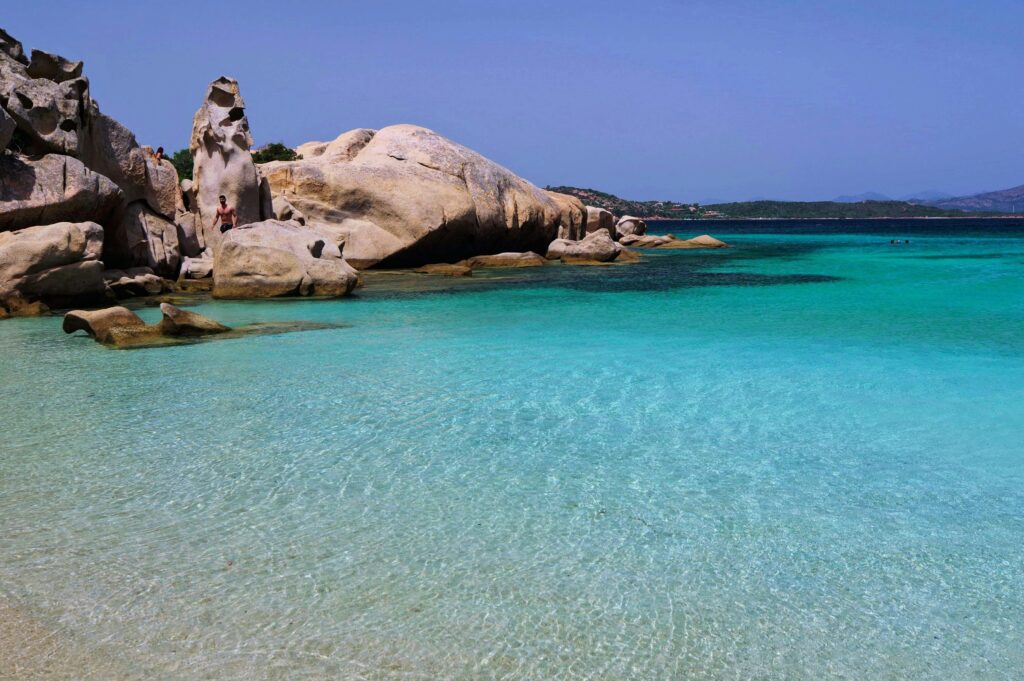
Once on La Maddalena, boat excursions are a practical way to see the archipelago without worrying about parking. Outlying beaches on La Maddalena and Caprera still require a local bus, taxi, bicycle or organised excursion, so the ferry solves the island crossing rather than every last kilometre.
Places that work only if you accept the limitations
Cala Gonone
Cala Gonone can make sense as a single-destination stay because seasonal coach services connect the Olbia area with the east coast and the harbour is a departure point for boat trips into the Gulf of Orosei. The weakness is overland exploration. Hiking starts, inland villages and beaches away from the boat network are much less flexible without a vehicle. Choose it when your plan is essentially arrive, stay several nights, take boats and walk, not when you want to tour eastern Sardinia.
Bosa
Bosa itself is compact and can be reached by bus from the Alghero direction and through other regional connections. Once there, the old town works on foot. The limitation is the surrounding coastline: staying in Bosa does not magically give you frequent transport to every cove and viewpoint. It is better as a slow two- or three-night stop than as a beach-hopping base.
Oristano
Oristano sits directly on Sardinia’s main railway corridor and is therefore easy to reach from Cagliari and the north. It works well for the city and as a transport stop, but a beach-focused holiday depends much more heavily on onward buses toward the Sinis Peninsula. Check the return journey before leaving for the coast, not when you are already standing at the beach in late afternoon.
Where a rental car still makes a major difference
The weakest public-transport trips are those built around scattered beaches rather than towns. Costa Smeralda resort-hopping is a classic example: there are useful buses and seasonal services, but accommodation, beaches, restaurants and bus stops can all be kilometres apart. A timetable may show that Porto Cervo or Baja Sardinia is served without telling you whether your hotel is anywhere near the stop.
The same caution applies to rural Barbagia, agriturismi in the interior, much of Ogliastra away from the main towns, the more isolated beaches around Chia and Teulada, and itineraries where the goal is to swim at two or three different coves in one day. Public buses are designed primarily to connect communities. They are not a hop-on beach tour.
If public transport flexibility is the main factor in choosing your Italian island, our Sicily vs Sardinia comparison explains why Sicily generally gives travelers a broader rail-based itinerary.
A better way to build a 7-day trip
Do not try to connect Cagliari, Alghero, Olbia, Cala Gonone and La Maddalena in one week simply because the island looks manageable on a map. You will spend too much of the holiday waiting for transport and protecting connections.
Three combinations make more sense:
- South: Cagliari for several nights, followed by Villasimius if the beach shuttle is operating.
- Northwest: stay in Alghero and use buses for beaches, Porto Conte and Capo Caccia rather than repeatedly changing hotels.
- Northeast: Olbia or Golfo Aranci followed by La Maddalena, with the Olbia-Palau connection checked before you reserve your ferry-day accommodation change.
Two well-connected bases usually produce a better week than four supposedly efficient one-night stops. Once you have chosen the pair that suits your flights, you can build your Italy itinerary around the actual transfer days rather than trying to fit transport around a pre-written sightseeing list.
Use the right timetable, because Sardinia has several operators
Sardinia does not have one single company running every train and bus. Trenitalia operates the main standard-gauge rail network. ARST runs a large regional bus network plus its own rail and metro services. Cities also have operators such as CTM in Cagliari and ASPO in Olbia.
The regional Around Sardinia system is particularly useful because it combines journey planning and ticket sales for participating operators including ARST, ASPO, CTM, ATP Nuoro, ATP Sassari and Sun Lines. Trenitalia journeys should still be checked through Trenitalia’s own channels.
On ARST timetables, learn these terms before you start comparing departures:
- feriale or FER: a working-day service. In Italian transport this can include Saturday, so do not automatically read it as Monday to Friday.
- festivo, FEST or similar abbreviations: Sunday or public-holiday service.
- scolastico or SCO: tied to school days.
- fermata: stop.
- capolinea: terminus.
- autostazione: bus station.
- coincidenza: connection.
- autobus sostitutivo: replacement bus, usually substituting for a train.
Always filter the timetable for your actual travel date. A departure printed in the full timetable may run only on a particular category of day.
Buy and validate bus tickets correctly
For ARST, the normal rule is to obtain your ticket before boarding using an authorised seller, ticket machine or supported mobile-ticketing service. Onboard sales are possible on many services but can involve a surcharge or special conditions, so they are a fallback rather than a planning strategy. Tickets also need to be validated at the start of the journey according to the format you are using. Digital tickets must be activated or validated using the method shown by the app.
If the onboard validator is not working, do not simply sit down with an unvalidated paper ticket. ARST’s published rules tell passengers to approach the driver so the ticket can be dealt with correctly. Keep the ticket until the journey is finished.
Luggage makes rural buses less forgiving
A rolling suitcase is easy on a train and reasonably straightforward on an intercity coach with a luggage compartment. It is much more awkward on an ordinary urban bus or a smaller regional vehicle. ARST’s conditions distinguish small hand luggage from larger or oversized bags, and larger items can depend on the available luggage space and the driver’s approval.
With a large suitcase, avoid an itinerary that requires three separate buses to reach your hotel. Choose accommodation within walking distance of a railway station, bus terminal or town-centre stop, and move hotels as few times as possible.
For a connection between different operators, about 30 minutes of slack is a sensible minimum planning margin with luggage. Give yourself more if you are transferring onto the last practical bus or ferry of the day. A theoretically faster itinerary is worthless if a ten-minute delay leaves you stranded until morning.
Late arrivals, Sundays and public holidays need a separate plan
Airport transport is not equally forgiving at all three Sardinian gateways. Cagliari has the cleanest setup because the airport is directly on the main railway. Additional late-night trains have even been added for part of summer 2026, but those special departures are date-specific and should not be treated as a permanent timetable.
Olbia Airport has frequent urban buses while they are operating, and taxis are available at the terminal, which gives you a straightforward fallback if a late flight misses public transport. Alghero has a direct airport-city bus service, but the airport itself warns that winter timetables can differ.
Sundays and Italian public holidays can mean fewer regional departures. Before booking a 07:00 flight or a Sunday-night hotel change, search the exact journey for that exact date. Do not assume the Saturday timetable carries over to Sunday.
Check 2026 rail works before crossing the island
Rail is most useful on the Cagliari-Oristano-Macomer axis and for onward links toward Sassari and Olbia, but 2026 has also brought significant engineering changes. Current Trenitalia notices show timetable alterations, cancellations and replacement arrangements affecting routes around Ozieri Chilivani, Sassari, Porto Torres and Olbia. Check Trenitalia’s current Sardinia engineering notice immediately before a long transfer.
The southwest also requires special care in 2026: Trenitalia’s Sardinia service information lists a total interruption affecting the Decimomannu-Iglesias/Carbonia corridor until December 2026. Replacement arrangements can preserve journeys, but they remove much of the simplicity that normally makes rail attractive with luggage.
For the least stressful no-car holiday, choose Alghero for a compact old-town-and-beach stay, Cagliari for the deepest year-round transport network, Villasimius for a summer beach base, or Olbia and La Maddalena for a carefully planned northeastern trip. Whichever you choose, check the final return bus before setting out each morning. In Sardinia, knowing how you are getting back is often more important than knowing how you are getting there.