Noto’s railway station sits below the Baroque centre. From the station to Porta Reale, the practical entrance to the old town, expect about 1.1 to 1.2 km and roughly 15 to 18 minutes on foot. The Cathedral is a little farther, around 18 to 20 minutes. The Noto train station to historic centre walk is straightforward but mostly uphill, which matters more than the distance if you have a suitcase, a stroller, limited mobility, or arrive in summer heat.
How far are the main sights from Noto station?
- Porta Reale: about 1.15 km, roughly 15 to 18 minutes.
- Corso Vittorio Emanuele: begins immediately after Porta Reale.
- Cattedrale di San Nicolò: about 1.25 to 1.4 km, usually 18 to 20 minutes.
- Palazzo Ducezio: opposite the Cathedral, so allow roughly the same time.
- Via Corrado Nicolaci: a few minutes beyond the Cathedral area.
Those timings assume an ordinary walking pace without a heavy suitcase. Add five to ten minutes in hot weather, with children, or if you are pulling luggage.
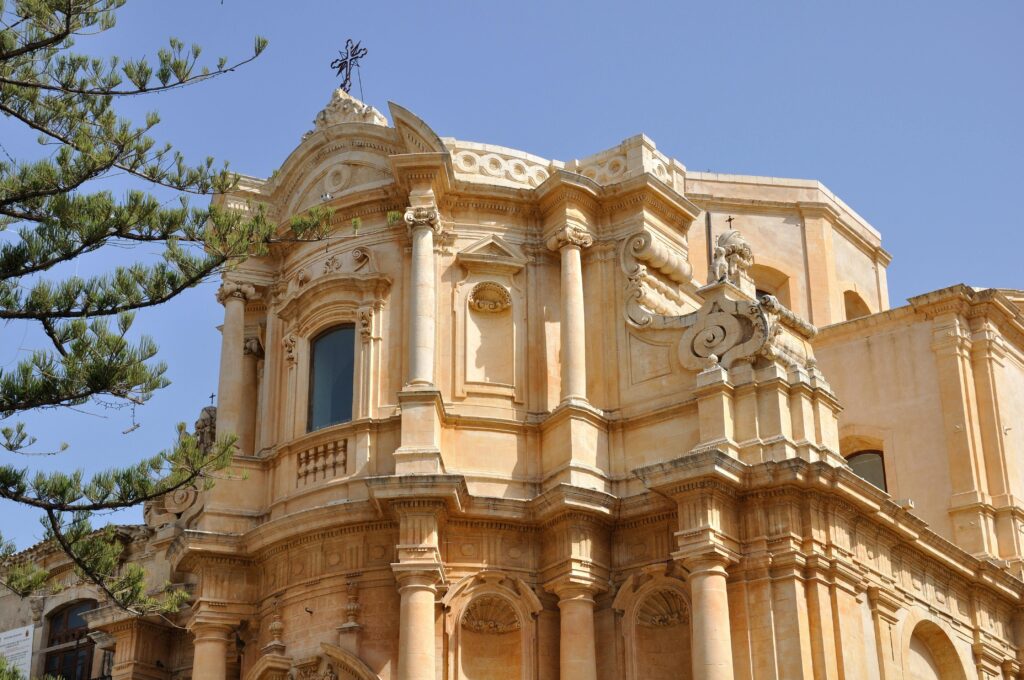
What the walk actually feels like
The station is not inconveniently remote, but it is definitely not in the historic centre. Noto was built on a slope, and the railway sits below the monumental part of town. The walk therefore feels longer on arrival than it does when returning downhill to catch a train.
The climb is not a mountain hike or a staircase marathon. It is an urban uphill walk that continues for most of the approach to the old town. With a small backpack, most reasonably mobile travelers will find it easy enough. With a large wheeled suitcase in July or August, the same kilometre becomes considerably less charming.
Once you pass Porta Reale and enter Corso Vittorio Emanuele, the hard part is essentially over. The Cathedral, Palazzo Ducezio, Santa Chiara and the other major Baroque sights are then clustered along the main historic axis.
Step by step from the station to Porta Reale
- Leave the station onto Piazza Stazione. Noto is a small station, so there is no complicated concourse or maze of exits to solve.
- Set Porta Reale as your walking destination. This is more useful than asking a map app for a vague “Noto centro” destination.
- Head uphill toward Viale Principe di Piemonte. Continue in the direction of the town rather than toward the countryside below the railway.
- Keep climbing toward Villa Comunale. The public gardens and the nearby bus stopping area are useful signs that you are getting close.
- Continue to Porta Reale. You may also see it described as Porta Reale Ferdinandea, Porta Ferdinandea or Porta Nazionale.
- Pass through the gate onto Corso Vittorio Emanuele. You are now on Noto’s main historic street. The Cathedral is only a few more minutes ahead.
Porta Reale is the best mental dividing line. Before it, you are walking from the transport area into town. After it, you are already sightseeing.
Should you walk with luggage?
With a cabin-size bag or backpack, walking is usually reasonable. A large roller suitcase changes the calculation because almost the entire approach is uphill.
Also check the location of your accommodation rather than assuming that “historic centre” means another two minutes from Porta Reale. A hotel near the lower end of Corso Vittorio Emanuele is relatively easy. Accommodation above the Cathedral, around Via Cavour, or farther into Noto’s upper streets can add distance and another climb.
For a heavy suitcase, ask your accommodation for its exact recommended arrival point. Parts of central Noto are pedestrianized or traffic-restricted, so even a taxi may not be able to stop directly outside every historic-centre door. A good hotel or apartment host should be able to tell you the nearest legal luggage drop-off point.
If you are only visiting Noto for several hours, do not assume the railway station itself will provide the left-luggage facilities you need. Private luggage-storage services operate in town, but locations and opening hours can change. Check and reserve one before arriving rather than discovering the problem with a suitcase already in your hand.
Is a taxi worth taking?
A taxi or pre-arranged pickup makes sense if you have large bags, limited mobility, small children, or you are arriving during the hottest part of the day. The drive is short, so the main advantage is avoiding the climb rather than saving a dramatic amount of time.
Do not build a tight arrival plan around finding a taxi spontaneously outside this small station. If you definitely need a ride, arrange it through your accommodation or a local taxi operator before your train arrives.
The same advice applies late in the evening. The walking distance does not change after dark, but transport options become less useful if you only start looking for a driver once you are standing outside the station.
The bus stop and train station are not the same place
This catches out travelers comparing public transport from Siracusa. Intercity buses serving Noto can stop around the Villa Comunale area, much closer to Porta Reale than the railway station. A bus arrival there can leave you only a few minutes from the start of the historic centre.
The train, by contrast, leaves you farther downhill. If your priority is minimizing the amount of suitcase hauling, compare the current rail schedule with the stops shown by Interbus before choosing purely on journey time.
If Noto is part of a longer car-free trip through Sicily, the Italy on Foot trip planner is useful for lining up the wider route rather than judging each transfer in isolation.
What if you have reduced mobility or a stroller?
RFI currently identifies Noto as a station without its passenger assistance service for people with reduced mobility. That does not mean every traveler with mobility needs is unable to use the station, but it does mean you should not assume staffed assistance will be available there. You can check the current station information and operating notes on RFI’s Noto departure board.
For wheelchair users or anyone who finds sustained uphill walking difficult, arrange road transport and confirm the accessible drop-off point with your accommodation. A stroller is much less problematic, but pushing it uphill with bags attached will make the approach noticeably slower.
Check your return train before walking away
Noto does not have the frequency of a major urban rail station. Regional trains run toward places including Siracusa, Avola, Modica and Ragusa, but operating patterns can differ by day, and individual services may carry weekday or holiday restrictions.
Check your actual travel date rather than assuming that a train you saw for Tuesday also runs at the same time on Sunday or a public holiday. Save the return journey on your phone before going sightseeing, particularly if you have an onward connection in Siracusa.
If walking back from around the Cathedral, allow about 20 minutes for the descent plus station buffer time. Thirty minutes before departure is a more sensible minimum target, and longer is better if you have luggage or children.
Remember the regional ticket rules
Trenitalia’s current Digital Regional Ticket activates automatically at the scheduled departure time of the selected train. There is no separate manual check-in step. A traditional paper regional ticket, however, must be validated before boarding. Trenitalia explains the current rules on its Digital Regional Ticket page.
That distinction matters at a small station. Do not stand on the platform trying to work out whether the paper ticket in your hand should have been stamped while the train is arriving.
Common mistakes on this transfer
- Using the Cathedral as the only distance measurement. Porta Reale is the real start of the historic centre and is several minutes closer.
- Assuming one kilometre means a flat ten-minute walk. The approach is uphill, so luggage and heat change the timing.
- Confusing the bus terminal with the railway station. Bus arrivals near Villa Comunale can be considerably closer to the monuments.
- Expecting a guaranteed taxi queue. Pre-arrange a car if walking is not an option.
- Checking only the outbound train. Return services are limited enough that missing one can seriously alter the rest of your day.
- Leaving the old town at the last possible minute. Walking downhill is easier, but you still need time to reach the correct platform and deal with your ticket.
For a traveler with light luggage, walking is usually the simplest choice: around 15 to 18 minutes to Porta Reale and about 20 minutes to the Cathedral. With a full suitcase, reduced mobility, a tired child or intense summer heat, arranging a short pickup is the more comfortable option. The station is close enough to walk, just far enough downhill that it pays to know what is waiting outside before the train doors open.